


Cairngorms National Park Guide: Wildlife, Mountains and Scenic Scotland
5th October 2026
🏔️ Cairngorms National Park Guide: Wildlife, Mountains and Scenic Scotland
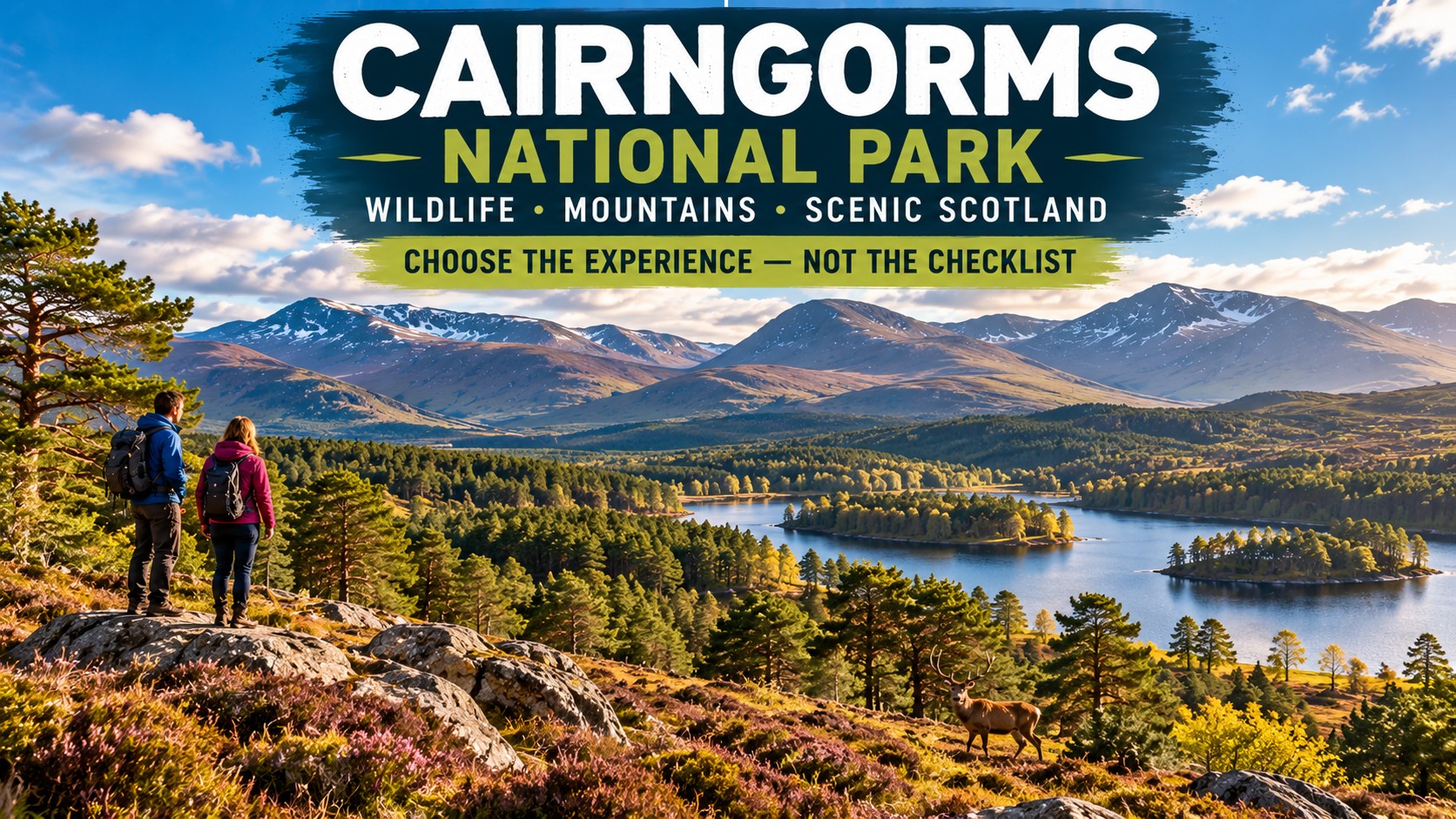
Discover the Cairngorms through mountains, forests, water and wildlife, choosing the experience that matters most rather than trying to cover the entire national park
The Cairngorms can be one of the most rewarding parts of a Scotland journey, but they do not fit neatly into a conventional sightseeing checklist. This is a landscape of mountains and high country, forests and water, wildlife habitats and Highland communities, with experiences ranging from gentle scenic exploration to serious days in the hills.
That variety is precisely what makes planning a first visit slightly more complicated. You do not need to climb a mountain to appreciate the Cairngorms, and you do not need to spend several days here to make a visit worthwhile. Equally, trying to rush across a vast national park while stopping briefly at everything that looks interesting can leave you seeing plenty without experiencing very much.
Wildlife adds another dimension. The Cairngorms are renowned for their natural environment, but wild animals do not appear to a timetable. A traveller whose priority is wildlife will usually need to approach the day differently from someone primarily interested in scenery, while walkers and outdoor enthusiasts face another set of decisions around terrain, weather and time.
The most useful question, therefore, is not “How much of the Cairngorms can I cover?” It is “What kind of Cairngorms experience do I want, and how much time should I give it?”
This guide will help you answer that question, whether you want magnificent scenery with relatively little walking, hope to spend time watching wildlife, want to explore forests and gentler trails, or see the mountains themselves as a major reason for visiting.
🗺️ Where Are the Cairngorms and What Makes the National Park Different?
Cairngorms National Park occupies a large area of the Scottish Highlands. Its scale matters because the park should not be thought of as one attraction with a single entrance, central viewpoint or obvious sequence of things to see.
Instead, the Cairngorms contain distinct landscapes and different ways of experiencing them. Mountain country may dominate the horizon, but forests, rivers, lochs, glens and settlements all contribute to the character of the park. Moving between these environments takes time, and a route that looks straightforward on a map can become a substantial day once scenic stops, walks, wildlife watching and changing conditions are added.
For first-time visitors, this leads to an important planning principle: choose what you most want from the Cairngorms before deciding how much territory to cover.
A traveller interested mainly in scenery can have an excellent visit without attempting a major walk. Someone hoping to observe wildlife may benefit from spending longer in fewer places. An active visitor may deliberately devote most of a day to one outdoor experience rather than trying to combine it with extensive sightseeing.
There is also an important difference between being in the Cairngorms, travelling through the Cairngorms and meaningfully experiencing the Cairngorms. All three can be enjoyable, but they are not the same journey.
| Cairngorms planning question | What to expect |
|---|---|
| Best for | Mountain scenery, wildlife, forests, outdoor experiences and slower landscape exploration |
| Landscape character | Large-scale Highland scenery ranging from high mountain environments to woodland, water and glens |
| Wildlife appeal | Significant, but sightings depend on habitat, season, conditions, patience and chance |
| Do you need to hike? | No. Meaningful scenic, wildlife and gentler outdoor experiences are possible without serious hiking |
| Activity range | From relaxed scenic exploration and short walks to demanding mountain days |
| Useful first-visit duration | A full day provides much more scope than a rushed stop; longer stays suit wildlife, walking and deeper exploration |
| Weather sensitivity | High, particularly where walking or mountain activity is involved |
| Core planning principle | Select the experience first, then give it realistic time |
⛰️ Why the Cairngorms Landscape Feels Different
Part of the Cairngorms’ appeal comes from contrast. The experience is not simply one continuous panorama of mountains. The character changes as high ground gives way to forests, water, glens and more sheltered landscapes, creating opportunities for visitors with very different interests and activity levels.
🏔️ Mountains and High Country
The mountains give the Cairngorms much of their visual identity. Even travellers who never intend to climb them feel their presence: broad upland horizons, steep slopes and changing weather create a sense of scale that can dominate an otherwise gentle day of exploration.
This is also where an important distinction begins. Seeing mountain country is not the same as entering a mountain environment.
A scenic visitor can appreciate the high ground from lower and more accessible locations. A walker heading farther into the hills accepts additional demands involving time, terrain, navigation, weather and preparation. Those experiences can coexist within the same national park without one being a more authentic Cairngorms visit than the other.
That adaptability is one of the park’s strengths. The mountains can be the backdrop to your day, the subject of your photography or the purpose of your journey. The right choice depends on what you want from the landscape—not on an assumption that reaching higher ground is necessary to experience it properly.🌲 Forests, Water and Changing Landscapes
Look below the mountain skyline and the Cairngorms become a much more varied destination. Woodland, rivers, lochs and glens soften the scale of the high country and create environments that can feel very different from the exposed landscapes above them.
This variety matters because it creates choice. A day in the Cairngorms can involve time among trees, beside water and within broad Highland scenery without requiring a strenuous expedition. Lower and more sheltered environments can also provide valuable alternatives when conditions make higher or more exposed ground unattractive.
Rather than treating the park as a sequence of individual sights, it is often more rewarding to notice these transitions. Moving from woodland into open country, seeing mountains reflected across water or watching the landscape change as weather moves through can be as memorable as reaching a named viewpoint.
🌦️ Weather as Part of the Landscape
Weather is inseparable from the Cairngorms experience. Sunshine can reveal enormous distances; cloud can remove entire sections of the mountain skyline; rain can deepen colours in the forest; and rapidly changing light can transform a familiar-looking landscape within minutes.
For scenic visitors, imperfect weather does not necessarily mean an unsuccessful day. Cloud, mist and showers can create atmosphere, and a flexible itinerary may allow you to shift attention from exposed scenery towards woodland, lower-level exploration or other activities.
The distinction becomes much more important once you move into demanding terrain. Atmospheric weather, unsuitable sightseeing conditions and unsafe mountain conditions are not the same thing. A day that remains enjoyable at lower level may be inappropriate for a planned mountain activity.
That is why flexibility should be treated as part of Cairngorms planning rather than as a response to something going wrong.
🦌 Wildlife in the Cairngorms: What Can Visitors Realistically Expect?
Wildlife is one of the strongest reasons to spend time in the Cairngorms, but it is also one of the easiest aspects of a visit to misunderstand.
This is not a wildlife attraction where particular animals can be expected to appear at a set time. The richness of the Cairngorms comes from the combination of habitats and the species they support. What you actually see on a particular day can depend on season, weather, location, time, patience and simple good fortune.
That uncertainty should not reduce the appeal. It should change the way you approach it.
A traveller who races between locations hoping to collect sightings may find the experience frustrating. Someone prepared to slow down, watch carefully and appreciate habitat as well as individual animals is more likely to understand why wildlife is such an important part of the Cairngorms.
🔭 Seeing Wildlife Without Turning It into a Checklist
The most useful expectation is that wildlife sightings are opportunities, not promises.
That applies even when a particular species is strongly associated with the Cairngorms. Wild animals move, feed and respond to conditions independently of visitor itineraries. Responsible wildlife watching therefore involves both patience and restraint.
Give animals space. Avoid pursuing a closer photograph at the expense of disturbance. Pay attention to the landscape around you rather than concentrating entirely on whether a particular species appears.
This approach has another benefit: it makes a wildlife day more resilient. A quiet period does not automatically become wasted time if you are also enjoying woodland, mountain scenery, changing light and the wider natural environment.
For travellers with a strong wildlife interest, knowledgeable interpretation can sometimes add considerably to the experience. Understanding habitat, behaviour and where to look can be as valuable as simply travelling to somewhere described as a wildlife location.
🐾 Wildlife-Focused Visit or General Cairngorms Visit?
How much wildlife should influence your itinerary depends on how important it is to you.
If wildlife is one of several interests, it can sit naturally alongside scenic exploration, shorter walks and time in different landscapes. You can remain observant without structuring the entire day around potential sightings.
If wildlife is a principal reason for visiting, the planning logic changes. You may need to spend longer in fewer places, accept periods when little appears to be happening and preserve flexibility rather than packing the day with fixed sightseeing stops.
That creates one of the most useful Cairngorms decisions: do you want wildlife to complement your visit, or determine it?🧭 What Kind of Cairngorms Experience Is Right for You?
There is no single ideal way to experience the national park. A better approach is to match the day to what you actually enjoy.
🚗 The Scenic Explorer
If landscapes are your priority, the Cairngorms can be highly rewarding without demanding strenuous activity. Allow time to stop, look, take shorter explorations and experience the transitions between mountain country, woodland and water.
The mistake is not choosing an easier day. It is trying to squeeze too much geography into it.
🦌 The Wildlife-Focused Visitor
Wildlife enthusiasts benefit from patience and flexibility. A slower itinerary, fewer competing priorities and realistic expectations are usually more useful than a long list of places to visit.
For this traveller, time is not simply transport between attractions. Waiting, watching and observing are part of the experience.🚶 The Gentle Walker
Walking can add considerably to a Cairngorms visit without turning the day into a mountain expedition. Moving through the landscape at walking pace reveals details that are easily missed from a vehicle: changes in vegetation, the sound of water, signs of wildlife and the gradual way woodland opens towards wider Highland scenery.
For many visitors, this middle ground is ideal. The objective is not height or distance but greater immersion.
Choose walks that suit your ability, available daylight and the conditions on the day. A relatively modest outing with time to stop and enjoy the surroundings can contribute more to a first visit than an overambitious route undertaken simply because the Cairngorms are famous for mountains.
🥾 The Active Outdoor Traveller
For more active visitors, the Cairngorms offer the opportunity to make walking or mountain activity the principal purpose of the day rather than an addition to sightseeing.
That changes the planning equation. A substantial outing can consume most or all of the available day, and conditions that have little impact on a scenic drive can become highly significant in exposed terrain. Preparation, suitable equipment, navigation ability and current information all matter more as the commitment increases.
Active travellers should therefore resist trying to combine a serious outdoor objective with an unrealistic amount of conventional sightseeing. If the mountain experience is the priority, give it the day it deserves.
| Traveller type | Main priority | Typical activity level | Useful time commitment | Flexibility required | Experience character |
|---|---|---|---|---|---|
| Scenic explorer | Landscapes and atmosphere | Low to moderate | Several hours to a full day | Moderate | Varied scenery with accessible exploration |
| Wildlife-focused visitor | Observation and natural environment | Low to moderate | Longer periods in fewer places | High | Patient, slower and less predictable |
| Gentle walker | Landscape immersion | Moderate | Half day to full day | Moderate to high | Closer connection with woodland, water and open country |
| Active outdoor traveller | Longer walks or mountain environments | Moderate to demanding | Often most or all of a day | High | Activity-led and strongly influenced by conditions |
🥾 Do You Need to Hike to Experience the Cairngorms Properly?
No. This is one of the most important misconceptions to remove when planning a first visit.
The mountains are central to the identity of the Cairngorms, but they do not impose an entrance requirement. You can have a meaningful day in the national park without attempting a major ascent, just as an experienced walker can legitimately choose to spend most of a visit concentrating on the hills.
What matters is matching the experience to your interests and capabilities.
🌿 Experiencing the Park Without Serious Hiking
A non-hiking visit can combine scenery, woodland, wildlife observation, time beside water and shorter outdoor explorations. The experience may be physically easier, but it does not have to be superficial.
The key is to allow time outside the vehicle. A scenic drive becomes more rewarding when it includes opportunities to stop appropriately, notice changes in the landscape and spend time somewhere rather than treating every location as another photograph before moving on.
This style of visit can also be more adaptable. If cloud obscures the higher mountains or conditions become uncomfortable in exposed places, lower and more sheltered environments may still provide a rewarding day.
🚶 When Walking Adds More
Walking changes your relationship with the landscape because it removes some of the speed and separation of road travel. Distances feel different, smaller features become more noticeable and the transition from one environment to another becomes part of the experience.
You do not necessarily need a long route to gain those benefits.
For first-time visitors, a carefully chosen walk that leaves enough time for the rest of the day can be more useful than selecting a route according to distance or reputation alone. Consider what you want the walk to provide: woodland, views, wildlife interest, quiet surroundings or simply more time outdoors.
⚠️ When Walking Becomes a Mountain Activity
There is a point at which an ordinary travel decision becomes a mountain-safety decision.
Substantial ascent, exposed terrain, difficult navigation, prolonged time away from easy access and severe or rapidly changing conditions require a different level of preparation. Winter can transform that distinction further.
Travellers heading into serious mountain terrain should use appropriate, current specialist information and make decisions based on the conditions, route and their own skills and equipment. A general destination guide cannot substitute for mountain-specific planning.
Turning back, changing the objective or choosing a lower-level alternative when conditions demand it is not a failed Cairngorms day. It is sound judgement.
⏳ How Long Should You Spend in the Cairngorms?
The Cairngorms reward time, but that does not mean every traveller needs a multi-day stay.
Duration should follow purpose. A scenic introduction requires less time than wildlife-focused exploration; a substantial walk may occupy an entire day; combining several different aspects of the park naturally requires longer.
The mistake is to decide how long you have and then attempt to compress every possible experience into that period.
| Time available | Experience depth | Realistic outcome | Best suited to |
|---|---|---|---|
| Short visit | Introduction | One carefully chosen landscape or experience rather than broad coverage | Travellers passing through or adding a selective Cairngorms stop to a wider journey |
| Full day | Meaningful exploration | Time for scenery plus one or two priorities such as walking, wildlife or woodland exploration | Most first-time visitors |
| Overnight | Slower and more flexible | Greater freedom to combine experiences and respond to weather or wildlife opportunities | Travellers who want the Cairngorms to be a significant part of their Scotland journey |
| Two days or longer | Deeper experience | Scope for contrasting landscapes, substantial outdoor activity or dedicated wildlife time | Walkers, wildlife enthusiasts and travellers prioritising the national park |
A short visit can still be worthwhile if expectations are realistic. Choose one aspect of the park and experience it properly rather than attempting to manufacture a miniature tour of the entire Cairngorms.
A full day creates much more freedom. It can allow scenery to be combined with a walk, wildlife interest or time in woodland without every stop becoming hurried. For many first-time visitors, this is where the Cairngorms begin to feel like a destination rather than simply impressive countryside encountered along the way.
Additional time becomes particularly valuable when your priorities involve uncertainty. Wildlife does not operate to schedule, weather can alter outdoor plans, and substantial walking cannot sensibly be compressed to preserve an overloaded itinerary.
The important question is therefore not simply “Can I stay another day?” but “What will that extra time allow me to experience?”
🛏️ Day Visit or Stay Longer?
A day visit works well when you know what you want from it. Scenic exploration, a manageable walk or a carefully focused introduction to the natural environment can all justify a dedicated day.
Problems arise when a day visit is expected to deliver everything simultaneously: extensive driving, wildlife watching, several walks, multiple scenic areas and a substantial onward journey. The result may be technically possible on a map while being unsatisfying in practice.
Staying longer changes the rhythm. It can give wildlife-focused visitors more patience, walkers more freedom to choose an appropriate period for outdoor activity and scenic travellers greater opportunity to experience contrasting parts of the landscape.
It also creates resilience. If one afternoon is affected by poor conditions, an overnight or multi-day visit may allow plans to shift rather than disappear entirely.
However, staying longer should have a purpose. If the Cairngorms are one element of a broader Scotland itinerary and your main interest is a scenic introduction, a well-planned day may be entirely appropriate. More nights are valuable when they support experiences you genuinely want—not simply because a national park seems to demand them.
🚐 Independent Exploration or Organised Experience?
The Cairngorms can suit both independent travellers and visitors who prefer an organised experience. Neither approach is inherently more authentic. They simply place responsibility for the day in different hands.
Independent travel gives you control over pace and priorities. You can spend longer somewhere that interests you, alter the day when conditions change and build the itinerary around your own balance of scenery, walking and wildlife.
That freedom also means taking responsibility for navigation, driving, timing and deciding which experiences realistically fit together. In a large rural landscape, flexibility is most useful when accompanied by restraint; having a vehicle does not mean every corner of the park needs to be included.
An organised experience reduces some of that logistical burden. Interpretation and local knowledge can also be particularly valuable when understanding landscape, wildlife or the character of an unfamiliar area matters more than simply reaching a sequence of stops.
The trade-off is usually reduced control over timing and route. Travellers who enjoy spontaneous exploration may value independence more highly, while those who prefer someone else to manage logistics or provide interpretation may find an organised format better suited to their visit.
| Decision factor | Independent exploration | Organised experience |
|---|---|---|
| Flexibility | High; plans can be changed during the day | Usually follows a planned structure |
| Planning responsibility | Traveller manages route, timing and priorities | Much of the day’s structure is managed |
| Transport | Greater freedom, with driving and navigation responsibility | Transport may form part of the experience |
| Interpretation | Requires your own research unless obtained separately | Local or specialist interpretation may add context |
| Wildlife focus | Freedom to wait, but finding opportunities requires knowledge and patience | Specialist knowledge can improve understanding and observation |
| Weather adaptation | High flexibility if alternative plans have been prepared | Depends on the format and activity |
| Best fit | Travellers who value independence and itinerary control | Travellers who value structure, interpretation or reduced logistical responsibility |
The useful decision is not which approach is “better”. It is where you want the responsibility for the day to sit.

Choose your Cairngorms experience according to what matters most—scenery, wildlife, gentle walking or a more active mountain day—then build your itinerary around that priority
🚗 Independent Exploration
Choose this when you value maximum control over pace, priorities and changing conditions. You decide where to spend longer, when to move on and how to adapt the day as circumstances change.
Choose according to how much itinerary control you want and where you want the responsibility for the journey to sit.
🌦️ When Is the Best Time to Visit the Cairngorms?
There is no single best season for every Cairngorms visitor. The better question is which season supports the experience you want.
🌱 Spring
Spring is a period of transition. Increasing daylight can create greater scope for outdoor exploration, while wildlife and changing landscapes add interest. Conditions can still be highly variable, particularly where higher ground is involved, so the calendar alone should never determine whether a particular activity is appropriate.
☀️ Summer
Long daylight gives summer visitors considerable flexibility. There is more time to combine scenery, walking and slower exploration without feeling that the day is disappearing too quickly.
That does not remove the need for planning. Popular periods can bring more visitors, and ambitious itineraries can still become rushed when driving, stopping and walking time are underestimated.
Summer’s great advantage is not that everything becomes predictable; it is that longer days provide more room to adapt.🍂 Autumn
Autumn can bring some of the Cairngorms’ most striking contrasts. Woodland colour, changing light and the transition towards colder conditions can make the landscape particularly atmospheric, while seasonal changes in wildlife add another dimension for observant visitors.
The trade-off is diminishing daylight and increasingly changeable conditions. A schedule that felt comfortable in midsummer may become unnecessarily ambitious later in the year, especially when walking, wildlife watching and scenic stops are all competing for the same hours.
Autumn therefore rewards selectivity. Rather than trying to preserve a summer-style itinerary, give fewer experiences enough time to be worthwhile.
❄️ Winter
Winter presents a very different Cairngorms. Short daylight, colder temperatures and potentially severe conditions can transform both the appearance of the landscape and the practicalities of travelling through it.
For scenic visitors, winter can produce memorable Highland atmosphere, but flexibility becomes increasingly important. Road conditions, weather and limited daylight can affect even relatively straightforward plans.
For anyone considering higher-level walking or mountain activity, winter requires a much more serious distinction. Conditions in the mountains may demand skills, judgement and equipment far beyond those needed for an ordinary sightseeing visit.
The seasons therefore should not be ranked from best to worst. Choose the season that suits your intended Cairngorms experience, then plan for the conditions that season can realistically produce.
🌱 Spring
A season of transition, increasing daylight and wildlife interest. Keep flexibility in the plan because conditions can still vary considerably, particularly around higher ground.
☀️ Summer
Long daylight creates the greatest scope for combining scenery, walking and slower exploration. Use the extra hours for flexibility rather than simply adding more stops.
🍂 Autumn
Woodland colour, changing light and seasonal atmosphere can be exceptional, but diminishing daylight makes selectivity increasingly important. Give fewer experiences enough time to matter.
❄️ Winter
Dramatic landscapes come with shorter days, colder weather and substantially greater planning demands. Mountain activity may require skills, judgement and equipment far beyond an ordinary scenic visit.
Planning Scotland beyond the Cairngorms?
Compare how spring, summer, autumn and winter affect travel across Scotland and choose the season that best suits your wider journey.
EXPLORE SCOTLAND THROUGH THE SEASONS →
🚗 Practical Cairngorms Planning: Transport, Distance and Flexibility
A good Cairngorms itinerary needs breathing room.
The national park’s scale, rural setting and range of possible experiences mean that an apparently simple day can quickly become crowded once real travelling time is added. This is particularly important for visitors planning the Cairngorms as one stage within a longer Scotland journey.
🚘 Exploring Independently
Independent exploration offers considerable freedom. You can adjust your pace, spend longer somewhere unexpectedly rewarding and change plans if weather makes the original idea less attractive.
Use that freedom selectively.
Constantly moving from one location to another can turn the advantage of independent travel into its greatest weakness. Build the day around a small number of meaningful priorities rather than treating every possible stop as something that needs to be included.
Rural driving also requires attention. Enjoy the landscape from appropriate stopping places rather than allowing dramatic scenery to compete with concentration on the road. Allow for unfamiliar roads, weather and the fact that scenic travel rarely proceeds at the relentless pace suggested by a simple distance calculation.
🚌 Visiting Without a Car
A car can provide considerable flexibility, but it should not be assumed that every Cairngorms visitor needs one.
Car-free travel is possible in parts of the area, although it requires more deliberate planning and may limit how easily some experiences can be combined. The important question is not simply whether public transport exists, but whether the available journey pattern supports the particular Cairngorms experience you want.
Because services and operating arrangements can change, check current transport information close to the time of travel rather than building an itinerary around remembered or outdated schedules.
For travellers without a car, concentrating on fewer well-connected experiences can often produce a better day than trying to reproduce an itinerary designed around unrestricted road travel.
⏱️ Don’t Confuse Map Distance with Experience Time
One of the easiest planning mistakes is to treat driving time as though it represents the whole journey.
It does not.
A scenic stop takes time. A short walk takes time. Waiting quietly for wildlife takes time. Finding somewhere appropriate to park, having lunch, responding to weather or simply staying longer because a landscape is better than expected all take time.
None of these are delays. They are the reason you came.
A successful itinerary therefore needs unused space. If every hour is committed before the day begins, the first unexpected discovery—or the first change in conditions—creates pressure elsewhere.
🌧️ Build an Adaptable Day
A useful Cairngorms plan has alternatives.
If your first choice involves exposed walking, know what lower-level experience could replace it if conditions deteriorate. If mountain views disappear into cloud, consider whether woodland, wildlife or a more sheltered exploration can become the focus instead.
This is more sophisticated than simply checking a forecast in the morning. It means designing a day that can remain worthwhile when the landscape refuses to follow your original plan.

Wildlife encounters in the Cairngorms are opportunities rather than guarantees. Slow down, watch patiently and give wild animals the space they need
Know whether scenery, wildlife, walking or another experience matters most before adding secondary stops.
Reaching somewhere is not the same as having enough time to stop, explore, observe and appreciate it.
Wildlife does not follow an itinerary. Leave enough flexibility for waiting, watching and the possibility that nothing happens immediately.
Woodland, water and gentler exploration can preserve a rewarding day when higher or more exposed ground becomes unsuitable.
Match the route to your experience, available daylight, terrain and the conditions you are likely to encounter.
Do not allocate every minute. Spare capacity gives you room to adapt, stay longer somewhere worthwhile or respond intelligently when plans change.
🧭 How the Cairngorms Fit into a Wider Scotland Journey
For some travellers, the Cairngorms will be the principal destination. For others, they will form one stage of a longer journey through Scotland. Both approaches can work, but the park’s role should be decided deliberately.
A selective scenic experience can fit naturally into a wider itinerary when expectations are modest. A full day makes sense when the Cairngorms are one of several major priorities. Wildlife-focused exploration, substantial walking or a desire to experience contrasting landscapes can justify an overnight stay or longer.
The important distinction is between geographical compatibility and itinerary compatibility.
Two places may appear to fit n
eatly together on a map, yet the combination can still be poor if travel between them consumes the time needed to experience either properly. Conversely, the Cairngorms can work extremely well within a broader Highland journey when sufficient time has been deliberately protected for them.
Think about the role the national park is playing. Is it a scenic stage, a dedicated day, a wildlife priority, an outdoor objective or one of the deeper experiences of your trip?
Once that question is answered, deciding how much time to allocate becomes considerably easier.
🌱 Experience the Cairngorms Responsibly
Responsible travel matters everywhere, but it takes on particular importance in a national park where wildlife, sensitive habitats, working landscapes and local communities all share the same environment with visitors.
The simplest principle is to behave as though your presence matters—because it does.
Wildlife should be observed without pressure or disturbance. Keep an appropriate distance, avoid pursuing animals for photographs and recognise that a closer view is not automatically a better encounter. If an animal changes its behaviour because of your presence, that is a reason to give it more space rather than move nearer.
The same consideration applies to the landscape. Use appropriate paths where they are provided, avoid unnecessary damage to fragile or waterlogged ground and take litter away with you. Respect signs, access guidance and any temporary or seasonal restrictions designed to protect wildlife, habitats or visitor safety.
Responsible parking is equally important. A beautiful stopping place does not automatically make somewhere safe or appropriate to leave a vehicle. Poor parking can damage ground, obstruct access and create problems for residents, land managers and other road users.
There is a broader sustainability benefit to good itinerary design as well. A day built around compatible experiences can reduce unnecessary backtracking while giving you more time actually enjoying the Cairngorms. Where practical, spending locally on food, accommodation and other services also allows tourism to contribute to the communities within and around the landscapes visitors have come to experience.
Above all, remember that the Cairngorms are not a scenic stage set. They are living environments. The objective is not merely to leave no obvious trace, but to experience the park in ways that respect the wildlife, landscapes and people that give it its character.
Travel with purpose. Explore with care.
❓ Cairngorms National Park FAQs
❓ Is Cairngorms National Park Worth Visiting If You Don’t Hike?
Yes. Mountains are central to the identity of the Cairngorms, but serious hiking is only one way to experience them. Scenic exploration, woodland, wildlife watching, shorter walks and time beside water can all create a worthwhile visit without committing to demanding terrain.
The important thing is to plan deliberately for that style of visit rather than treating non-hiking activities as substitutes for the “real” experience.
❓ How Many Days Do You Need in the Cairngorms?
A full day can provide an excellent first experience if you concentrate on a manageable combination of interests. An overnight stay or two days gives more flexibility for wildlife, walking, changing weather and contrasting landscapes.
You need longer only when the additional time serves something you genuinely want to experience.
❓ Can You Visit the Cairngorms Without a Car?
Yes, although the experience requires more deliberate planning and some areas or combinations of activities may be less convenient without independent transport.
Check current public transport information before travelling and build your itinerary around what can realistically be reached rather than designing a car-based itinerary and attempting to reproduce it without a vehicle.
❓ Are You Guaranteed to See Wildlife in the Cairngorms?
No. Wildlife is wild, and sightings depend on factors including habitat, season, conditions, timing, patience and chance.
Treat wildlife encounters as opportunities rather than guarantees. Appreciating the wider natural environment makes the experience rewarding even when a hoped-for species remains out of sight.
❓ Is the Cairngorms Suitable for Families?
It can be, provided the activities chosen suit the ages, abilities and interests of the people travelling.
A family scenic day or manageable outdoor exploration is very different from committing to demanding mountain terrain. Choose the experience first, consider weather and conditions, and avoid assuming that an activity is appropriate simply because it takes place within a national park.
❓ Is the Cairngorms Good in Bad Weather?
It depends on what you intended to do and what “bad weather” means in practice.
Cloud or showers may still allow an enjoyable lower-level scenic, woodland or wildlife-focused day. Conditions that are merely inconvenient for sightseeing can have much more serious implications in exposed mountain terrain.
The strongest approach is flexibility: know what you can do instead if your original plan becomes unsuitable.
❓ Is the Cairngorms Better in Summer or Winter?
Neither is universally better.
Summer offers long daylight and greater scope for combining activities. Winter can create a dramatically different landscape but brings shorter days and potentially much more demanding conditions.
Choose according to the experience you want, then plan realistically for the season rather than expecting the same Cairngorms visit throughout the year.
❓ Do You Need Special Equipment to Visit the Cairngorms?
Not for an ordinary scenic visit or straightforward exploration beyond the normal clothing and footwear appropriate for the conditions and activity you have chosen.
The requirements change substantially when you enter serious mountain terrain, particularly in difficult or winter conditions. More demanding objectives require activity-specific preparation, appropriate equipment, skills and current specialist information.
🌄 Conclusion: Choose the Cairngorms Experience You Actually Want
The Cairngorms do not ask every visitor to experience them in the same way.
You might come for mountain scenery without climbing a mountain, spend hours watching and waiting for wildlife, explore forests and gentler paths, or make a substantial outdoor adventure the central purpose of your visit. Each can be a legitimate way to experience the national park.
What matters is the match between your priority, your activity, the time available and the conditions you encounter.
Choose what interests you most. Match the activity to your abilities and expectations. Give the experience realistic time. Preserve enough flexibility for weather and wildlife. Then decide how the Cairngorms fit within the rest of your Scotland journey rather than trying to force the park into an already crowded itinerary.
The scale of the Cairngorms can tempt visitors to measure success by distance covered or places reached. A better measure is whether you gave yourself enough time to notice where you were.
In a landscape of mountains, forests, water and wildlife, seeing less can sometimes mean experiencing considerably more.