


Stonehenge Tours for Overseas Visitors: How to Choose the Right Experience from London (2027 Guide)
7th October 2026
🧭 Stonehenge Tours for Overseas Visitors: How to Choose the Right Experience from London (2027 Guide)

Where should Stonehenge fit into your Britain trip? Start with three decisions—how important Stonehenge is to you, how much itinerary time you want to give it and the way you prefer to travel—then compare the experiences that match those priorities.
For many overseas visitors, Stonehenge is one of those places they have known about for years before they ever begin planning a trip to Britain. Yet once London hotels, sightseeing days and the rest of a British itinerary start falling into place, a surprisingly difficult question appears: what is actually the right way to experience Stonehenge?
The choice is broader than simply picking one tour from a list. You may need to decide how much of your holiday Stonehenge deserves, whether to make it the focus of the day or combine it with another destination, whether standard visitor access gives you the experience you want, and how much group size or flexibility matters to you.
There is no single answer that suits every international traveller. Someone who has dreamed of seeing Stonehenge for decades may reasonably plan the day very differently from a visitor who wants to see the monument as one highlight among several during a first trip to Britain.
A better starting point is simple: choose your Stonehenge experience according to how important it is to your trip, not simply according to how many attractions an itinerary contains.
This guide uses three factors — Priority, Time and Travel Style — to help you identify the kind of Stonehenge experience that fits your Britain trip before you start comparing individual options. Once you know which type of experience suits you, you can compare actual choices within that category rather than trying to judge every Stonehenge tour against every other one.
🌍 Why Overseas Visitors Need to Think Differently About a Stonehenge Trip
Stonehenge itself does not change according to where you have travelled from, but the planning decision often does. If you are visiting Britain from overseas, your available time may already be divided between London and several other places you have waited years to see.
That makes the useful question bigger than “Which Stonehenge tour should I take?”
It becomes: what role should Stonehenge play in my overall Britain experience?
🧳 Your Stonehenge Day Is Part of a Bigger Britain Itinerary
Every day devoted to travelling beyond London is also a day that cannot be spent elsewhere. That does not make a Stonehenge excursion a poor use of time; it simply means the decision should reflect your priorities.
If Stonehenge is high on your personal list, allocating substantial time to the experience may feel entirely justified. If your principal interests lie in London and Stonehenge is somewhere you would also like to see, a more focused visit may make better sense. And if you are already planning to travel through southern England, treating Stonehenge as part of that wider journey may be more logical than viewing it solely as an excursion from London.
Thinking this way prevents a common planning mistake: choosing an itinerary first and only afterwards asking whether it matches the holiday you actually want.
🕰️ A Once-in-a-Lifetime Visit Changes the Decision
Not every overseas traveller will visit Britain only once. But if you do not expect another opportunity soon, it is reasonable to think carefully about what you would regret missing.
For one traveller, that might mean giving Stonehenge more time. For another, it could mean investigating a particular form of access. Someone else may be perfectly satisfied seeing Stonehenge as part of a broader day that also introduces another side of England.
What matters is not automatically spending more, travelling privately or choosing the longest itinerary. Importance and expense are not the same thing. A meaningful experience is the one that reflects what you personally came to see.
🗺️ Start With Your Trip, Not With the Tour List
Before comparing tour descriptions, work through three questions in order:
Priority: How important is Stonehenge within your whole Britain trip?
Time: How much of your limited itinerary are you comfortable giving it?
Travel Style: Do you value simplicity, a smaller-group environment, greater flexibility, broader sightseeing or more concentrated attention on Stonehenge?
Those answers remove much of the apparent complexity. Instead of trying to identify the universally “best” Stonehenge tour, you can identify the type of experience most likely to suit you.
That distinction is particularly useful for an overseas visitor. Once you have established whether you are looking for a focused visit, broader combination day, particular access experience, smaller-group environment or more flexible arrangement, the commercial choice becomes narrower and more meaningful: compare experiences that solve the travel decision you have already made.
🎯 Step One: How Important Is Stonehenge to Your Britain Trip?
This is the decision that should come before all the others.
⭐ Stonehenge Is One of the Main Reasons You Want to Visit Britain
If seeing Stonehenge is a major personal ambition, protect enough space in your itinerary to experience it without unnecessary competition from other priorities. You may care more about the character of the visit, the attention given to Stonehenge and the type of access available than about fitting several additional attractions into the same day.
The main risk is choosing an impressive-looking itinerary in which Stonehenge itself becomes only one element among many.
🏛️ Stonehenge Is One of Several Major British Experiences
Perhaps Stonehenge matters greatly, but so do London, historic cities, countryside or other places on your itinerary. In that case, balance becomes more important than maximum depth.
Your ideal experience may allow Stonehenge to feel substantial without asking it to dominate an entire section of your holiday. The challenge is not to see everything, but to avoid packing so much into one day that none of it receives the attention you expected.📸 Stonehenge Is Somewhere You Would Like to See While You Are Here
There is nothing second-rate about this motivation. You do not need a lifelong interest in prehistoric Britain to find Stonehenge worth experiencing.
If your main priorities lie elsewhere, efficiency may matter more than depth. A straightforward visit that lets you see and appreciate Stonehenge while preserving time for London or other destinations can be exactly the right choice.
| If Stonehenge feels like… | Your planning priority should be… | Main risk to avoid |
|---|---|---|
| A major reason for visiting Britain | Depth and quality of experience | Giving Stonehenge too little attention |
| One of several important highlights | Balance | Overloading the day |
| A worthwhile addition to your trip | Efficiency | Giving it more holiday time than your priorities justify |
Once you know which description sounds most like you, the next question becomes much easier: how much of your London itinerary should Stonehenge actually use?
⏱️ Step Two: How Much of Your London Itinerary Can Stonehenge Use?
Once you have decided how important Stonehenge is to your trip, you can make a much more sensible decision about time.
This is not simply a choice between “shorter” and “longer”. The more useful question is what you want that time to achieve. A focused experience may be exactly right for a traveller with a busy London itinerary, while another visitor may feel disappointed if Stonehenge is squeezed into a day with too many competing priorities.
🕐 When a More Focused Visit Makes Sense
A focused Stonehenge visit can work particularly well when your time in London is limited or when Stonehenge is an important addition to the trip rather than its central purpose.
The advantage is clarity. You are allocating part of your itinerary to Stonehenge without allowing the excursion to consume time you would rather spend elsewhere. For visitors trying to balance museums, historic sights, neighbourhoods, theatre, shopping or other experiences in London, that can be a sensible trade-off.
The important distinction is between efficient and rushed. They are not the same. An efficient itinerary concentrates on what you actually want to experience; a rushed one attempts to achieve more than the available time comfortably allows.
For an overseas visitor unfamiliar with the practicalities of travelling beyond London, efficiency can also include reducing unnecessary planning complexity. Having the transport and basic sequencing of the excursion organised can be valuable when what you want is a straightforward Stonehenge experience rather than another transport problem to solve during a short stay.
That convenience is not automatically a reason to choose an organised experience. It is simply one of the practical benefits worth recognising when simplicity matters to you.
☀️ When Stonehenge Deserves a Full Day
If Stonehenge is one of your principal reasons for travelling beyond London, allocating a larger part of the day can create more room for the experience rather than simply adding hours for their own sake.
A full sightseeing day may also make sense when another destination genuinely complements what you want from the trip. The test is whether the additional time produces something you value: greater depth, a less compressed day or worthwhile wider exploration.
Longer does not automatically mean better. Extra time only creates extra value when the itinerary uses it well.
🧭 When Stonehenge Should Become Part of a Longer Journey
Not every overseas visitor needs to think of Stonehenge as a journey from London and back again.
If your Britain itinerary continues through southern or south-west England, it is worth asking whether Stonehenge fits more naturally into that onward journey. Returning to London simply because many Stonehenge experiences are presented as London excursions may not suit the geography of your particular holiday.
For travellers whose plans genuinely extend into the South West, a multi-day experience can therefore become a different type of solution rather than simply a longer Stonehenge tour. BVT’s 5 Day South-West, Devon and Cornwall is one example worth investigating when Stonehenge is intended to form part of a wider journey rather than a standalone London excursion.
The important point is to recognise that choice before you commit yourself.
Ask yourself: am I fitting Stonehenge around London, giving it a full sightseeing day, or making it part of my wider journey through Britain?
🏛️ Step Three: Do You Want Stonehenge to Be the Focus or Part of a Combination Day?
For many overseas visitors, this is where two perfectly reasonable approaches diverge.
One prioritises depth. The other prioritises variety.
Neither is inherently superior.
🎯 Choose Focus When Stonehenge Matters Most
If Stonehenge is high on your personal list, an experience with fewer competing destinations may give the monument a clearer role in the day.
That does not mean every focused itinerary necessarily provides more time at Stonehenge, so the actual structure still matters. It means you are choosing the day primarily because of Stonehenge rather than because it forms one part of a collection of famous places.
This can be particularly appealing if you know you would be frustrated by leaving Stonehenge feeling that your attention had already shifted towards the next stop.
🗺️ Choose Combination When Variety Matters More
For another traveller, Stonehenge may become more appealing when it forms part of a broader introduction to England beyond London.
A combination experience can be an intelligent use of limited holiday time when the additional destination is somewhere you genuinely want to visit. It can provide contrast, variety and a broader sense of place without requiring another separate excursion from London.
There can also be a practical advantage. If the second destination already belongs on your Britain wish list and would otherwise require another substantial journey or sightseeing day, combining the two coherently may solve two genuine travel priorities within one organised excursion.
That is meaningful efficiency. It is very different from adding destinations merely to increase the number of places visited.
Combination touring should therefore be judged by coherence rather than quantity. Two places you genuinely care about can create a rewarding day. A longer list of destinations does not automatically create greater value if each stop becomes little more than something to tick off.
⚖️ Do Not Judge Value by the Number of Famous Names
Tour itineraries can be seductive on paper. Stonehenge plus another famous city, historic attraction or landscape can appear automatically better than Stonehenge alone because the list is longer.
Try a different test:
If one destination were removed from the itinerary, would you genuinely miss that destination — or mainly the feeling that you had “done more”?
If you would genuinely miss it, a combination day may fit your priorities extremely well. If that destination would otherwise require another excursion during your trip, its inclusion may also provide genuine practical value.
If not, you may value the additional breathing room more than another name on the itinerary.
The reverse is also true. Travelling to Stonehenge on a more focused experience is not automatically more authentic or meaningful. If your ambition is to encounter several different sides of Britain during a short stay, variety may be precisely what makes the day valuable.
The objective is not to maximise attractions per day. It is to make the available day reflect the experience you actually want.
🪨 Step Four: What Kind of Stonehenge Access Do You Actually Want?
Once you know how important Stonehenge is and how much of the itinerary it deserves, access becomes a more useful question.
For many visitors, standard access will provide exactly the Stonehenge experience they want. For others, the possibility of Inner Circle access may be important enough to influence when and how they plan the day.
🚶 Standard Visitor Access Can Still Be the Right Experience
It is easy to assume that a special-access experience must automatically be the superior choice. That is the wrong starting point.
Standard visitor access allows you to experience Stonehenge without needing your itinerary to revolve around obtaining a particular form of access. If your priority is to see the monument as part of a well-balanced Britain trip, that may suit you perfectly well.
The important question is not whether another access type sounds more exclusive. It is whether access itself is one of the things you care most about.
🌅 When Inner Circle Access Becomes Worth Investigating
If Stonehenge is one of the major reasons for your trip, the character of the visit may matter much more. In that situation, it can be worthwhile investigating Inner Circle access before deciding how your Stonehenge day should work.
This does not mean every keen Stonehenge visitor needs Inner Circle access, nor that standard access becomes a lesser experience. It simply introduces another decision:
Does the character of my access matter enough that I am prepared to shape part of my itinerary around it?
📅 Planning Inner Circle Access Before You Fix Your London Itinerary
If Inner Circle access matters strongly to you, consider it before fixing the rest of your Stonehenge plans rather than treating it as an upgrade to investigate afterwards.
Access opportunities are tied to particular dates and availability, so a traveller who regards this as an important part of the experience may need to establish what is possible before deciding which day of a London stay to allocate to Stonehenge. BVT’s Stonehenge Inner Circle Access Calendar (2026–2027): Dates, Availability & How to Visit provides the natural planning resource for that stage.
The order matters: first decide whether Inner Circle access genuinely matters to you; then check the relevant dates and availability; and only then build that choice into the wider itinerary.
Once you know that Inner Circle access is both important to you and feasible for your dates, the next useful step is to investigate Stonehenge Inner Circle Tours and compare the experiences capable of delivering the wider day you want. At that point, you are no longer deciding whether special access matters; you are choosing how that access should fit with your time, itinerary and other priorities.
If you are happy with standard visitor access, there is no reason to let Inner Circle planning complicate a trip that does not require it. Compare suitable experiences instead on the factors that genuinely matter to you: itinerary, available time and travel style.
👥 Step Five: What Travel Style Will Make the Day Enjoyable?
Once you have considered priority, time and access, think about the experience of the journey itself.
Group format is sometimes discussed as though there were a universal hierarchy, with private travel at the top and larger shared experiences at the bottom. In reality, the best format is the one that provides the level of simplicity, personal space and flexibility you will actually value.
🚌 Shared Touring and Simplicity
For many overseas visitors, straightforward organisation is an advantage. If you are comfortable travelling with other visitors and do not need significant control over the itinerary, a shared experience can make good sense.
For someone unfamiliar with British roads, transport connections or the practical geography beyond London, having the principal transport and sequencing organised can also reduce the amount of planning required. That convenience has genuine value when it removes complexity you would rather not manage yourself.
What matters is understanding the format you are considering rather than making assumptions from a label. If group environment matters to you, check the actual arrangements before choosing.
👥 Smaller-Group Travel and the Visitor Experience
A smaller-group format may appeal if the social environment and pace of the day are important parts of your experience. Some travellers simply prefer being part of a more limited group when exploring historic places.
That preference is legitimate, but smaller does not automatically mean better for everybody. If group size barely affects your enjoyment, it should not become the factor that overrides more important priorities such as itinerary, access or available time.
If you have established that a smaller-group environment does matter to you, BVT’s Small Group Tours provide a relevant category to investigate. The reason to consider them is not that smaller-group travel is universally superior, but that you have already identified group environment as something capable of materially improving your own day.
Private travel can become more relevant when you have specific priorities, want greater control over the structure of the day or have circumstances that make flexibility particularly valuable.
Again, the value lies in what that flexibility does for your trip. Private travel should not be assumed to produce different monument access, better weather, greater tranquillity or a more atmospheric Stonehenge simply because the format is private.
The useful question is therefore not “Which is best?”
It is:
How much control over the day do I actually need?
If the answer is “very little”, simplicity may be more valuable than flexibility you will never use. If the answer is “a great deal”, then flexibility becomes a genuine part of the decision.
This is also where price and value need to be separated. Paying more for a particular format only creates additional value when the characteristic you are paying for — greater flexibility, a preferred group environment or more control — genuinely improves the experience for you.
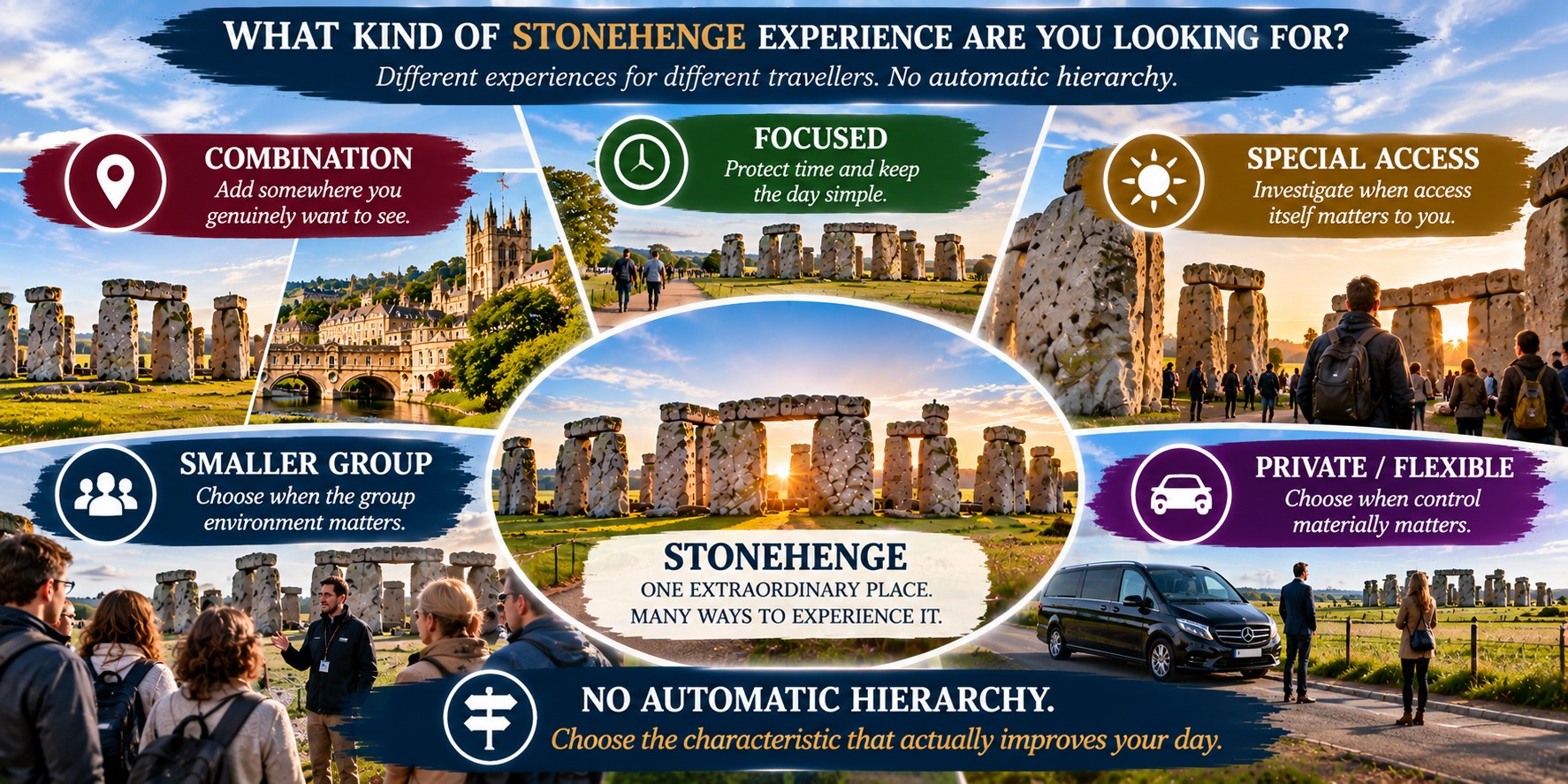
There is no automatic hierarchy of Stonehenge experiences. A focused visit, combination day, special access, smaller group or private arrangement is valuable when its particular characteristics genuinely improve the day you want to have
🧭 Step Six: Test the Experience Against the Rest of Your Britain Trip
By this stage, you may have a fairly clear idea of the Stonehenge experience you prefer. Before settling on it, put that choice back into the context of the whole holiday.
A good Stonehenge plan should strengthen your Britain itinerary rather than forcing everything else to accommodate it unnecessarily.
🏙️ If London Is Your Main Base
If most of your trip is centred on London, consider what you are giving up as well as what you are gaining.
A day beyond the capital can provide an important contrast to London, but the balance should reflect your priorities. If you have an ambitious London sightseeing plan, avoid creating unnecessary pressure by trying to fit too much immediately before or after your Stonehenge experience.
The right choice should feel like a deliberate part of your London stay, not an interruption to it.
🚗 If You Are Travelling Beyond London
If Stonehenge is only one stage of a longer journey through Britain, question the assumption that you necessarily need to return to London afterwards.
Your onward plans may make it more logical to incorporate Stonehenge into a wider journey rather than repeatedly retracing your route. This becomes particularly relevant when other places in southern or south-west England already feature in your itinerary.
If that describes your holiday, compare the value of a London-return excursion with an experience that incorporates Stonehenge into the journey you already want to make. The relevant question is not whether a multi-day option includes more places, but whether its route replaces separate journeys and connects destinations that are genuinely priorities for you.
The point is not to construct the entire route around Stonehenge. It is simply to look at the map of your holiday rather than automatically adopting the structure of a conventional London day trip.
✈️ If Your Britain Itinerary Is Very Short
A short trip makes prioritisation more important, not less.
Trying to compensate for limited time by adding more destinations can produce an itinerary that looks impressive before departure but feels relentless once you are travelling. Decide which experiences would genuinely disappoint you to miss and protect those first.
Sometimes that will mean making room for Stonehenge. Sometimes it will mean accepting that another visit to Britain would be a better time.
The right Stonehenge experience should improve your Britain itinerary, not distort it.✅ The Overseas Visitor’s Stonehenge Decision Matrix
The choices become easier when they are viewed together:
| Your situation | Experience direction worth investigating | Why |
|---|---|---|
| Stonehenge is a major trip highlight | A more focused or deeper experience | Protects time and attention for Stonehenge |
| Your London time is limited | An efficient, focused format | Reduces unnecessary itinerary pressure |
| Several major places matter equally | A combination format | Supports broader discovery |
| The character of access matters strongly | Investigate Inner Circle possibilities | Access may affect itinerary planning |
| Group environment matters to you | Investigate smaller-group formats | Travel style can affect enjoyment |
| Flexibility matters strongly | Investigate private arrangements | Greater control may have genuine value |
| Your journey continues beyond London | Consider Stonehenge within your onward travel | Returning to London may not be automatically logical |
These are directions to investigate, not universal prescriptions. Two travellers with identical amounts of time can reasonably choose very different experiences because what they want from Stonehenge is different.
The value of the matrix is not that it makes the decision for you. It helps identify which decision deserves most of your attention.
Once that direction is clear, narrow the field accordingly. If access is decisive, compare appropriate access experiences. If group environment matters, concentrate on formats that provide the environment you prefer. If Stonehenge belongs within a longer journey, compare experiences that fit that journey rather than London-return options that solve a different travel problem.
🔎 Before You Choose: Five Questions to Ask About Any Stonehenge Experience
Once you have identified the type of experience that seems right, examine the actual itinerary rather than relying on its headline description. Words such as “best”, “premium” or “ultimate” tell you very little about whether a particular day matches your priorities.
Five questions can reveal much more.
1. How Much Actual Emphasis Does the Itinerary Give Stonehenge?
Stonehenge may appear prominently in the name of an experience while sharing the day with several other destinations. That is not necessarily a problem, but it should match what you have already decided about Stonehenge’s importance.
If it is one of the principal reasons for your trip, look carefully at the overall shape of the day. If it is one highlight among several, a broader itinerary may be exactly what you want.
2. What Kind of Access Does the Experience Involve?
Do not infer the character of the Stonehenge visit from descriptive language alone. Understand what type of access is actually involved and whether it corresponds with the experience you want.
If specialised access matters to you, this is a fundamental selection criterion. If it does not, avoid allowing it to distract you from factors that matter more.
3. How Much of the Day Is Devoted to Additional Destinations?
Additional places should earn their position in your itinerary just as Stonehenge does.
Ask whether you genuinely want to visit them and whether their inclusion supports your idea of a rewarding day. A combination itinerary is most persuasive when its destinations matter to you individually, not simply because the list is longer.
If an additional destination would otherwise require another substantial excursion during your Britain trip, combining it with Stonehenge may provide genuine practical value. If you would not have chosen to visit that destination independently, however, its inclusion should not automatically make the itinerary seem better value.
4. What Group Environment and Degree of Flexibility Should I Expect?
Consider how much these factors affect your enjoyment.
If you value a particular group environment, personal flexibility or control over the day, investigate the actual format carefully. If you are comfortable with a more structured shared experience, there may be little benefit in paying or planning for flexibility you do not need.
The question is not whether one format is more exclusive than another. It is whether its practical characteristics justify their place in your decision.5. Does the Itinerary Fit the Rest of My Britain Trip?
This is the final test and one of the most important.
A Stonehenge experience can look excellent in isolation yet fit awkwardly into your holiday. Consider what comes before it, what comes afterwards and whether the day supports the overall journey you are trying to create.
The strongest choice is not necessarily the itinerary with the most impressive description. It is the one whose substance matches your priorities.
If an experience passes these tests — Stonehenge receives the emphasis you want, the access is appropriate, the additional destinations genuinely matter, the travel format suits you and the itinerary fits the wider holiday — you have reached the point where comparing specific suitable options becomes useful. You are no longer searching for the theoretical “best Stonehenge tour”; you are choosing between experiences capable of delivering what you have already decided matters.

Stonehenge can play very different roles in a Britain trip. It may be a deliberate excursion from a London base, one of the experiences protected within a short visit, or a natural stage in a wider journey beyond London. Choose the structure that fits the holiday you actually want
🧳 Practical Planning for Overseas Visitors Leaving London
Once you have chosen the broad shape of your Stonehenge experience, a few practical checks can prevent avoidable problems.
📍 Check the Departure Arrangement Carefully
Do not assume that “from London” means the experience begins close to your accommodation.
Check the actual departure or meeting arrangements for the option you are considering and work out how you will reach the starting point. London is a large city, and the practical journey to departure should form part of your planning rather than being left until the morning itself.
⏰ Protect Enough Time Around the Day
Avoid building an unnecessarily tight schedule around a substantial excursion from London.
Road conditions, transport and other circumstances can affect a day beyond the capital, so be cautious about placing an important fixed commitment immediately after your expected return. The same principle applies before departure: allow enough time to reach the correct meeting point without turning the beginning of the day into a race.
🌦️ Prepare for an Outdoor Heritage Site
Stonehenge is an outdoor experience, so dress for the conditions rather than solely for photographs.
Comfortable footwear and clothing suitable for changeable British weather can make a meaningful difference to your enjoyment. Check the forecast close to your visit and prepare accordingly rather than assuming that conditions in London will tell you exactly what the day will feel like at Stonehenge.
♿ Check Individual Accessibility Requirements Before Booking
If you or someone travelling with you has particular mobility or accessibility requirements, verify the arrangements for the specific experience you are considering.
Do not assume that all Stonehenge tours operate in the same way simply because they visit the same monument. Transport, meeting arrangements, itinerary structure and the wider day’s activities can all affect suitability.
📱 Keep Important Travel Information Accessible
Keep your booking confirmation, meeting information and relevant contact details somewhere you can reach easily while travelling.
For overseas visitors who may be relying on a mobile phone away from their usual network or routine, it can also be sensible to make essential information accessible without depending entirely on a live internet connection.
🌱 Responsible Travel: Make the Journey Count
Responsible travel is not only about how far you travel. It is also about how thoughtfully you use the journey.
When choosing a Stonehenge experience, consider whether each additional destination genuinely contributes something you value. A coherent itinerary can be more rewarding than accumulating places simply because they can be fitted into the same day, while efficient shared travel may make practical sense when it matches your needs.
At Stonehenge itself, remember that you are visiting an internationally significant historic landscape, not simply arriving at a photographic landmark. Follow visitor guidance, respect the site and its surroundings, and give the place the attention that made you want to visit in the first place.
There is no virtue in travelling slowly if the resulting itinerary does not suit you, just as there is no prize for covering the greatest possible distance. Responsible travel works best when good planning, respect for place and meaningful experience reinforce one another.
Travel with purpose. Explore with care.
❓ FAQs for Overseas Visitors Planning Stonehenge from London
❓ Can I Visit Stonehenge While Staying in London?
Yes. Stonehenge can form part of a London-based itinerary, but the right format depends on how much time you want to devote to the experience and whether you want Stonehenge to stand alone or form part of a broader day. Treat the excursion as part of your overall London planning rather than assuming every option uses your time in the same way.
❓ Is Stonehenge Worth Including If I Only Have a Few Days in London?
It can be, but this is a priorities question rather than one with a universal answer. If Stonehenge is one of the places you would most regret missing, allocating some of a short stay to it may make complete sense. If your strongest interests are in London itself, do not feel obliged to sacrifice them simply because Stonehenge is famous.
❓ Do I Need Inner Circle Access to Enjoy Stonehenge?
No. Inner Circle access offers a different way of experiencing Stonehenge, but it is not a requirement for a worthwhile visit. Consider it when the character of access is particularly important to you; otherwise, standard visitor access may fit your itinerary and priorities perfectly well.
If Inner Circle access does matter strongly, establish whether it is feasible for your dates before comparing suitable Inner Circle experiences. That keeps access as the genuine decision criterion rather than treating it as an automatic upgrade.
❓ Is It Better to Visit Stonehenge Alone or Combine It With Another Destination?
Neither approach is automatically better. A more focused experience suits travellers who want Stonehenge to command the day, while a combination experience can be ideal for visitors who genuinely value broader discovery.
A combination can also provide practical value when the additional destination is somewhere you already want to visit and would otherwise require another substantial excursion. If the extra destination has little independent importance to you, however, adding it does not automatically make the experience better value.
Decide whether depth or variety matters more to you.
❓ Should I Plan Stonehenge Before Finalising the Rest of My Britain Itinerary?
That depends on how specific your preferred Stonehenge experience is. If you are flexible about the day and comfortable with standard visitor access, Stonehenge can usually be considered alongside the rest of your itinerary.
If Inner Circle access is important to you, however, it makes sense to investigate the relevant dates and availability before fixing everything else around London. The more important a particular form of access is to your trip, the earlier it deserves attention in your planning.
❓ Is a Private Stonehenge Experience Automatically Better for an Overseas Visitor?
No. Private travel can provide valuable flexibility when you genuinely want greater control over the day, but that does not make it automatically better.
If you are comfortable with a structured shared experience, the additional flexibility may have little practical value to you. Choose private travel because its characteristics solve a real requirement or improve the trip in a way you care about — not simply because it sounds more exclusive.
🌅 Choosing the Stonehenge Experience You Will Be Glad You Chose
Planning Stonehenge from London becomes much easier once you stop searching for a universally “best” tour and start with the kind of experience you actually want.
Return to the three questions that have guided the decision:
Priority: How important is Stonehenge within your Britain trip?
Time: How much of your itinerary does it deserve?
Travel Style: How do you want to experience the journey and the day?
From there, the other choices become more manageable. You can decide whether you prefer focus or variety, whether the character of your Stonehenge access matters strongly, how important group environment or flexibility is, and whether travelling back to London fits naturally with what you are doing next.There is no automatic hierarchy in these choices. Inner Circle access does not make standard visitor access inadequate. A full-day experience is not necessarily better than a more focused visit. Private travel does not automatically beat a shared experience. A combination itinerary is not inherently better value because it contains more destinations, just as concentrating on Stonehenge does not automatically make a day more meaningful.
What matters is the match between the experience and the traveller.
Before making your choice, you should be able to answer six questions with reasonable confidence:
- How important is Stonehenge to me?
- How much of my itinerary am I happy to give it?
- Do I want greater depth or broader variety?
- Does the character of my access matter strongly?
- How much control over the day do I actually want?
- Does this experience fit the wider Britain journey I am planning?
If you can answer those, you are no longer choosing from a confusing collection of Stonehenge tours. You are evaluating a much smaller set of experiences against priorities you already understand.
The complete decision can be reduced to one useful sequence:
PRIORITY → TIME → ACCESS → EXPERIENCE TYPE → TRAVEL STYLE → ACTUAL ITINERARY → CHOICE
That order matters. Decide what Stonehenge means to your trip before deciding how long to give it. Establish whether access is important before allowing it to influence the itinerary. Decide whether you want focus or variety before comparing tours containing very different combinations of places. Establish whether group environment or flexibility genuinely matters before paying for characteristics you may not value.
Only then compare the actual experiences capable of delivering what you want.
For an overseas visitor, that distinction matters. Your time in Britain is valuable, but making good use of it does not mean squeezing the maximum possible number of famous places into every day. It means knowing which experiences deserve your time and giving them the space appropriate to their importance.
The right Stonehenge experience is not the one that promises the most. It is the one that gives the part of Stonehenge you value most enough time, attention and space within the Britain trip you actually want to have.