


Stonehenge Day Tour or Multi-Day Tour: Which Experience Is Right for You? (2027 Guide)
30th August 2026
🪨 Stonehenge Day Tour or Multi-Day Tour: Which Experience Is Right for You? (2027 Guide)

Should Stonehenge be a focused day trip, one highlight in a combination tour, or part of a wider journey through England? The right format depends on the role you want Stonehenge to play in your holiday
Stonehenge is easy to place on a list of places you want to see in Britain. The more difficult question is deciding how Stonehenge should fit into the rest of your trip.
For some travellers, the best experience is a carefully planned day tour from London or another established base. You visit Stonehenge, perhaps combine it with another destination, and return to the same accommodation that evening. For others, Stonehenge makes far more sense as one stage within a longer journey through southern England, the Cotswolds, South West England or beyond.
Neither approach is automatically better. A multi-day itinerary does not necessarily mean spending substantially more time at Stonehenge, while choosing a day tour does not mean treating the monument as an afterthought. The important difference is the role Stonehenge plays within your wider holiday.
A useful starting principle is:
Do not choose according to how many days a tour lasts. Choose according to the role you want Stonehenge to play in your journey.
This guide compares focused Stonehenge day tours, combination day tours and multi-day touring from a traveller’s perspective. It will help you consider accommodation, route geography, pace, luggage, value, additional destinations and the practical advantages of either remaining based in one place or continuing through England.
By the end, you should be able to identify not simply which tour is longer, but which travel format makes better use of your holiday.
⚖️ Stonehenge Day Tour vs Multi-Day Tour: The Quick Answer
There are really three choices rather than two.
🚌 Stonehenge Day Tour
A day tour treats Stonehenge as a defined excursion within a holiday based elsewhere. This often works particularly well for visitors staying in London who want to see Stonehenge without changing hotels or reorganising several days of their itinerary.
Stonehenge may be the sole major objective of the excursion, allowing the day to remain strongly focused on the monument.
🏛️ Stonehenge Combination Day Tour
A combination day tour keeps the convenience of returning to the same accommodation while adding another important destination or experience.
This can suit travellers who want broader sightseeing but do not need a multi-day journey. The key is whether the additional destinations are places you genuinely want to visit rather than attractions included simply to make the itinerary appear fuller.
🗺️ Multi-Day Stonehenge Journey
A multi-day tour treats Stonehenge as one stage within a larger journey. Instead of travelling to the monument and returning to your original base, the route continues towards other destinations and usually involves one or more overnight stays elsewhere.
This becomes particularly attractive when Stonehenge fits naturally into a wider exploration of England rather than existing as an isolated excursion.
All four destinations and publication records above are verified against the current protected Stonehenge master.
| Consideration Day Tour Combination Day Tour Multi-Day Tour | |||
|---|---|---|---|
| Stonehenge’s role | Main excursion | Major highlight among several | Part of a wider journey |
| Accommodation | Same base | Same base | Usually changing locations |
| Time commitment | One day | One day | Several days |
| Logistics | Simplest | Moderate | More involved |
| Sightseeing breadth | Focused | Broader | Extensive |
| Route style | Out and back | Out and back | Progressive |
| Often best for | Fixed-base travellers | Visitors wanting variety | Travellers exploring a region |
The table provides a useful starting point, but it does not decide the question for you. The next step is more important: deciding what Stonehenge actually means within your holiday.
🎯 First Decide What Stonehenge Means to Your Holiday
Before comparing prices, journey times or the number of places included, decide what role you want Stonehenge to play in your trip.
This sounds simple, but it is often the factor that makes the correct tour format obvious. Two travellers could have exactly the same number of days in Britain and still make completely different—and equally sensible—choices.
🪨 Stonehenge Is One Specific Highlight
You may have wanted to see Stonehenge for years while still planning a holiday primarily based in London. In that situation, a dedicated day tour can make excellent sense.
You can give Stonehenge a full place in your itinerary without reorganising the rest of your trip around it. You keep the same hotel, travel to the monument for the experience you came for and return to your established base afterwards.
Choosing a day tour does not mean Stonehenge matters less. In fact, a focused itinerary can sometimes give the monument greater prominence than a multi-day tour in which it is one attraction among many.
⭐ Stonehenge Is One of Several Major Highlights
Perhaps Stonehenge is important, but so is Bath, Windsor, the Cotswolds or another destination you hope to experience during the same holiday.
This creates the middle ground.
A combination day tour can allow you to experience Stonehenge alongside another major highlight without changing accommodation or committing several days to a travelling itinerary. For visitors with limited time, that can be an efficient way to broaden the experience.
There is an important qualification, however. More attractions do not automatically make a better day. Every additional stop uses travel time and divides the time available between destinations.
Ask yourself a useful question: would I still want to visit the additional destination if Stonehenge were not included?
If the answer is yes, combining the two may make genuine sense. If the answer is no, a more focused Stonehenge experience may ultimately be more rewarding.
🗺️ Stonehenge Is Part of a Wider Journey Through England
The decision changes significantly when your ambitions extend beyond individual attractions.
Perhaps you want to explore Bath, Wiltshire and the Cotswolds. Perhaps Stonehenge is near the beginning of a journey that will eventually take you through Devon and Cornwall. In these circumstances, travelling from London to Stonehenge and then all the way back to London may make less sense than continuing your journey.
The distinction can be expressed simply:
Day-tour thinking: “Stonehenge is somewhere I want to visit.”
Multi-day thinking: “Stonehenge is part of somewhere I want to explore.”
Neither mindset is superior. What matters is recognising which one better describes your holiday.
🚌 When a Stonehenge Day Tour Makes the Most Sense
A day tour is particularly attractive when you have a well-established travel base and want Stonehenge to fit cleanly into the itinerary rather than reshape it.
This is common among visitors spending a relatively short time in London. If you have four or five nights in the capital, for example, checking out of your hotel and beginning a travelling itinerary simply because you want to see Stonehenge may create more disruption than benefit.
Remaining based in one place also makes sense when your excursions head in different directions. You might visit Stonehenge on one day but have completely different plans elsewhere on subsequent days. In that situation, London can function efficiently as a central base.
Practical simplicity matters too. There is no need to repack luggage, check out, move accommodation and settle into another hotel. Families, travellers with substantial luggage and anyone who prefers a low-complexity itinerary may value that convenience more than the ability to continue touring after Stonehenge.
A day tour can also be the better option for travellers whose principal objective really is Stonehenge. There is little benefit in adding several days and multiple destinations simply because they are available.
Look at the itinerary immediately before and after your proposed Stonehenge visit. If returning to your existing accommodation fits naturally with both, a day tour is probably doing exactly what it should.
⭐ Editor’s Recommended Tour — A Focused Stonehenge Day with Special Access
For travellers who want Stonehenge to remain the clear priority while keeping London as their accommodation base, the Stonehenge Inner Circle Tour at Sunset offers a particularly strong fit.
It suits visitors who do not need a wider multi-day journey but want their Stonehenge day to feel more distinctive than a standard daytime excursion. The emphasis remains firmly on the monument, while the evening Inner Circle access provides a specialist experience without requiring you to reorganise several days of your holiday.
Stonehenge Inner Circle Tour at Sunset:
https://www.bestvaluetours.co.uk/tours/day-tours/stonehenge-tours/inner-circle-tours/stonehenge-inner-circle-sunset-tour/
🏨 When a Multi-Day Stonehenge Tour Makes More Sense
A multi-day tour begins to make stronger sense when returning to your original base interrupts a journey you already want to make.
Imagine that Stonehenge is followed on your wish list by Bath, the Cotswolds and destinations farther into South West England. Travelling from London to Stonehenge, returning to London, and then heading west again later can involve unnecessary backtracking.
A progressive itinerary can instead turn Stonehenge into one stage of the route.
This is the crucial point: Stonehenge itself does not require a multi-day tour. The wider journey may.
Multi-day touring is therefore most compelling for travellers who genuinely want to explore several connected places. It can combine transport, sightseeing and overnight stays into a continuous itinerary rather than treating every destination as a separate excursion.
It also changes the character of the holiday. Instead of repeatedly leaving and returning to one city, you experience the country as a developing journey, with landscapes, towns and regions connecting one destination to the next.
That does not make multi-day touring automatically more relaxed or more rewarding. Changing accommodation and travelling repeatedly introduces its own demands. But when the places you want to see form a logical route, those demands may be outweighed by the advantage of continuing forward rather than repeatedly returning to where you started.
🏛️ The Middle Ground: When a Combination Day Tour May Be Enough
The choice is not always between a Stonehenge-only excursion and several days on the road.
Combination day tours can work particularly well for travellers who want more variety than a focused Stonehenge visit but still prefer the convenience of returning to the same accommodation that evening.
The important issue is not how many attractions can physically be fitted into a day. It is whether the combination matches your genuine priorities.
Stonehenge and another destination you have always wanted to see can make a compelling day. Stonehenge plus several places that merely look attractive on an itinerary may produce a busier schedule without creating a better experience.
Consider how much depth matters to you. Some travellers enjoy seeing several contrasting places in one day and are comfortable with a structured timetable. Others would rather have fewer stops, more breathing room and less time watching the clock.
A combination day tour is therefore not simply a compromise between day and multi-day touring. For the right traveller, it is a distinct and highly practical third option.
⭐ Editor’s Recommended Tour — When Bath Is a Genuine Second Priority
If both Stonehenge and Bath are places you actively want to experience, the Stonehenge Inner Circle Tour with Bath & Lacock provides a strong example of when a combination day can make more sense than moving into a multi-day itinerary.
It is best suited to travellers who value Bath and the additional historic setting of Lacock in their own right, while also wanting the distinctive experience of Stonehenge Inner Circle access. If those additional destinations are not genuine priorities, a more focused Stonehenge experience may remain the better choice.
Stonehenge Inner Circle Tour with Bath & Lacock:
https://www.bestvaluetours.co.uk/tours/day-tours/stonehenge-tours/inner-circle-tours/stonehenge-inner-circle-lacock-and-bath-evening-tour/
⏱️ Does a Multi-Day Tour Mean More Time at Stonehenge?
Not necessarily.
This is one of the easiest assumptions to make when comparing tour formats. A two-, three- or five-day itinerary sounds as though it should provide a more extensive Stonehenge experience than a one-day excursion, but the headline duration describes the whole tour, not the time spent at the monument.
A multi-day itinerary may devote substantial time to Bath, the Cotswolds, Cornwall or other destinations while Stonehenge remains one scheduled visit within the journey. Conversely, a focused day tour may make Stonehenge the principal event of the day.
When comparing itineraries, look beyond the number of days. Consider how prominently Stonehenge features, what else is included and whether any special access arrangements are relevant to your priorities.
If spending more meaningful time around Stonehenge is important to you, compare the actual Stonehenge experience rather than assuming that the longest overall itinerary provides it.
🏙️ Stay Based in London or Continue Travelling?
For many visitors, this is the decision underneath the decision.
If you are starting from London, the real question may not be “day tour or multi-day tour?” at all. It may be “do I want to come back to London afterwards?”
🏨 Reasons to Keep London as Your Base
Keeping one hotel provides obvious convenience. Your luggage stays where it is, you know where you are returning each evening, and you can organise different excursions without repeatedly checking in and out.
London is particularly useful as a base when your travel plans radiate in several directions. Stonehenge may be west of the capital, while another day’s priorities take you somewhere entirely different. Returning to London then forms part of a sensible hub-and-spoke itinerary.
A fixed base can also preserve flexibility. You may want independent evenings in London, restaurant reservations, theatre plans or unstructured time between excursions. Keeping the same accommodation can make it easier to balance organised sightseeing with the parts of your holiday you prefer to arrange yourself.
Returning to London is therefore not inherently inefficient. It becomes inefficient only when it takes you away from where you actually want to go next.
🛣️ Reasons to Continue Beyond London
If your next priorities lie farther west or south-west, continuing can become much more logical.
Rather than travelling back towards London simply to leave again, a multi-day route can connect Stonehenge with subsequent destinations. The benefit is not merely saving mileage; the holiday begins to feel geographically coherent, with each stage contributing to the next.
A useful planning question is:
Where do you want to wake up the morning after Stonehenge?
If the answer is London because your plans remain centred there, a day tour is persuasive. If the answer is Bath, the Cotswolds, Devon, Cornwall or somewhere else along a developing route, it may be time to think beyond a day trip.
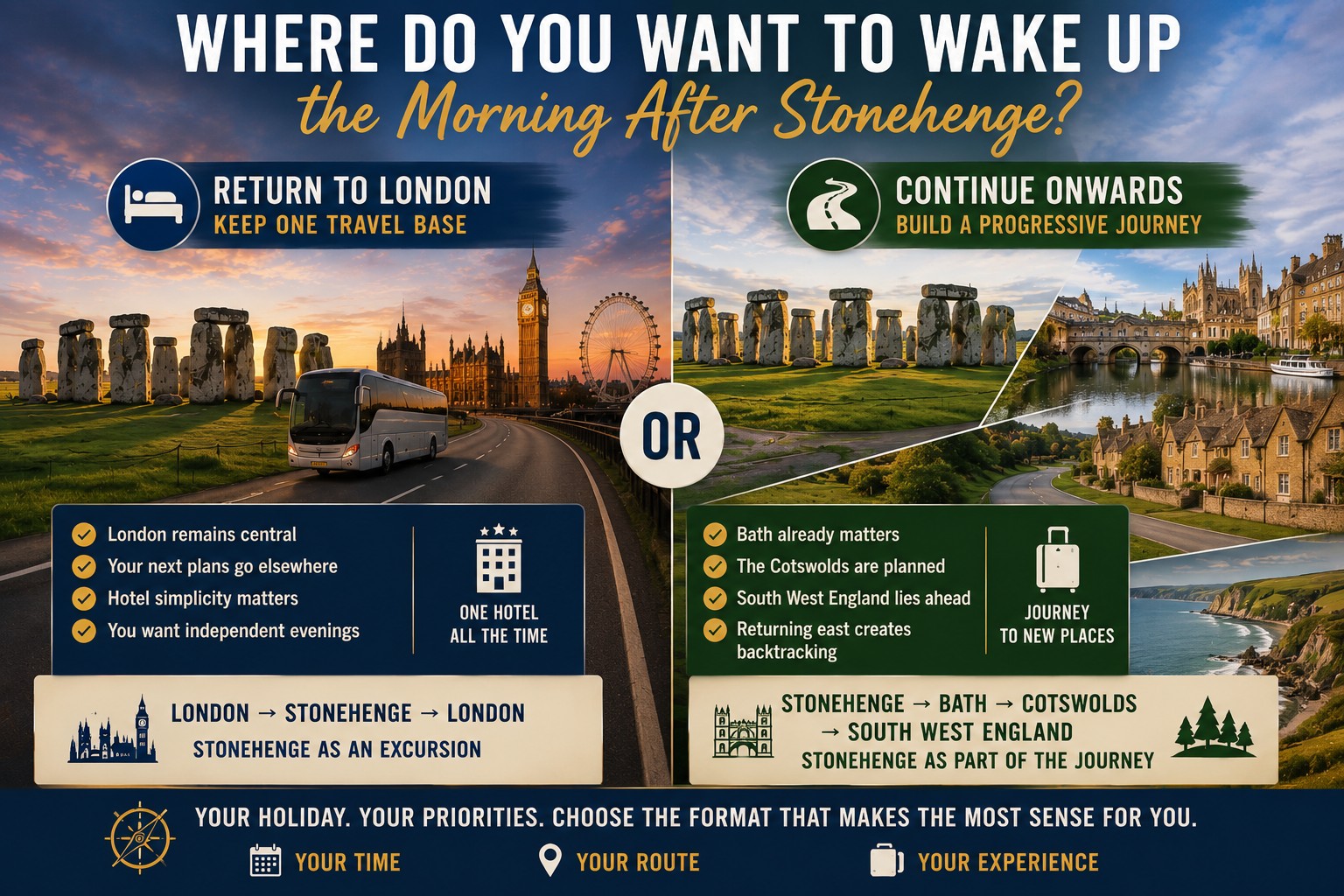
Where do you want to wake up the morning after Stonehenge? Returning to London can suit travellers who value one accommodation base, while continuing onwards can make more sense when Bath, the Cotswolds or South West England already form part of the journey
🗺️ Where Multi-Day Touring Becomes Particularly Logical
Stonehenge’s location makes it a useful component of several wider itineraries. The important thing is not to collect every nearby destination, but to identify the places that belong naturally within your journey.
🏛️ Bath and Wiltshire
Bath can form part of a broader exploration of historic southern England, while Wiltshire itself contains far more than the Stonehenge monument. If these areas already matter to you, continuing through the region can make more sense than treating Stonehenge as an isolated out-and-back excursion.
🌿 The Cotswolds
The Cotswolds introduce a very different experience of England, characterised by villages, countryside and a slower landscape-focused style of sightseeing. Travellers who genuinely want both Stonehenge and the Cotswolds may find that a longer journey gives the two experiences more room than trying to maximise a single day.
⛪ Salisbury and the Wider Stonehenge Landscape
Salisbury provides another reason to think regionally. Visitors interested in the historic city, Wiltshire and the broader archaeological landscape may want more flexibility than a straightforward London return journey provides.
🌊 South West England
Stonehenge can also function as a gateway towards South West England. Once the traveller’s ambitions extend substantially beyond Wiltshire, the logic of repeatedly returning to London weakens.
🏖️ Devon and Cornwall
For visitors ultimately heading into Devon or Cornwall, Stonehenge can become an early highlight within a much longer westward journey. At this point, the multi-day question is no longer really about Stonehenge; it is about how efficiently and enjoyably to explore a substantial part of England.
🇬🇧 Wider England and Britain Touring
The same principle applies at a larger scale. Stonehenge can sit within an itinerary extending through several English regions or form one landmark within a much broader tour of Britain.
The farther your ambitions extend beyond Stonehenge, the more important it becomes to compare routes rather than individual attractions. A well-designed multi-day journey should connect places you genuinely want to experience in an order that makes geographical and practical sense, rather than simply accumulating famous names.
For travellers reaching this point in the decision process, the most useful next step is to compare genuine multi-day itineraries rather than continuing to compare them with individual Stonehenge excursions. A route through Bath, South West England, Devon or Cornwall should earn its additional days by delivering destinations you already want to experience.
💷 Day Tour or Multi-Day Tour: Which Offers Better Value?
Price matters, but headline price alone is a poor way to compare these formats.
A day tour normally requires a smaller initial commitment. A multi-day itinerary may cost considerably more, but it can also incorporate transport over several days, guiding, accommodation and multiple destinations that would otherwise need to be arranged separately.
The question is whether you actually value those inclusions.
| Value Question Day Tour Multi-Day Tour | ||
|---|---|---|
| Lower upfront commitment | Usually stronger | Usually weaker |
| Accommodation included | Usually no | Often |
| Simplifies several travel days | Limited | Strong |
| Good when Stonehenge main priority | Strong | May be unnecessary |
| Good when several connected destinations matter | Moderate | Strong |
| Reduces independent itinerary planning | Moderate | Often strong |
If a multi-day tour includes five destinations but only two genuinely interest you, the quantity of inclusions may represent poor personal value.
On the other hand, if you already intended to visit those places and would otherwise pay separately for trains, accommodation, local transport and sightseeing, an organised journey may compare favourably.
The useful principle is:
Value is not how much is included. Value is how much of what is included matters to you.
Compare the cost of the holiday you actually want rather than simply identifying the cheapest advertised price.
🧳 Hotels, Luggage and Practical Travel Considerations
Tour-format decisions are often discussed in terms of sightseeing, but the practical details can have just as much influence on how enjoyable the journey feels.
On a day tour, your main luggage will normally remain at your accommodation. You can leave in the morning with only what you need for the day and return to the same room afterwards. That simplicity can be particularly useful for families, travellers with mobility considerations and anyone carrying substantial luggage.
Multi-day touring involves more movement. Even when an organised tour removes much of the planning, you may still be packing regularly, checking out of accommodation and settling into different locations.
That does not make the format inconvenient by definition. For many travellers, having transport and accommodation integrated into a planned route is considerably easier than arranging the same journey independently. But the physical reality of moving through several destinations should still be considered.
Check luggage arrangements before booking a specific itinerary. Do not assume that every vehicle, accommodation arrangement or tour format handles large cases in the same way.
It is also worth thinking beyond the Stonehenge visit itself. What are you doing on the morning of your visit, and where do you want to sleep that night? Those two practical questions often reveal the most natural format.
🚶 Which Travel Pace Suits You?
Pace is another area where the labels “day tour” and “multi-day tour” can be misleading.
⚡ Day Tours: Concentrated but Contained
A day tour can be intensive. There may be an early departure, significant travel and, on combination itineraries, a carefully managed schedule between several destinations.
The advantage is that the intensity is contained within one day. You return to your base afterwards and regain control of your schedule the following morning.
This can suit travellers who enjoy structured sightseeing days but want independent time between them.
🛣️ Multi-Day Tours: Broader but Cumulative
A multi-day tour spreads the journey across several days and can provide more regional context and variety. However, consecutive days of departures, sightseeing, travel and hotel changes can create a different kind of intensity.
A five-day tour is not automatically five relaxed days.
Look at the daily itinerary rather than the overall duration. Consider start times, approximate driving, the number of overnight locations and how frequently you change hotels. A route can be geographically efficient while still being more structured than you personally enjoy.

Keep Stonehenge as the focus, combine it with another genuine priority, or make it part of a wider England journey. The best format is the one that matches the holiday you actually want
👨👩👧 Which Format Suits Different Travellers?
Different travel styles often point naturally towards different formats.
| Traveller Likely Best Fit Why | ||
|---|---|---|
| Four-night London visitor | Day or combination tour | Preserves limited London time and one accommodation base |
| First UK visit with seven days | Depends on wider priorities | Either format can work |
| Ten-day England explorer | Multi-day increasingly attractive | Progressive route can connect destinations |
| Stonehenge enthusiast | Focused day or specialist experience | Keeps Stonehenge central |
| Family wanting simple logistics | Day tour often attractive | Less packing/accommodation change |
| Couple exploring South West England | Multi-day | Natural westward journey |
| Visitor planning several London excursions | Day tour | London efficient central base |
These are starting points rather than rules. Your priorities matter more than the number of days you happen to have available.
📆 BVT Stonehenge Inner Circle Access Calendar (2026–2027)
If Inner Circle access is a major priority, it can affect the day-tour-versus-multi-day decision because special access is a different proposition from an ordinary daytime visit.
Understanding realistic access opportunities before fixing the rest of your itinerary can therefore be valuable. A particularly important Stonehenge date may become the fixed point around which the surrounding journey is arranged.
The BVT Stonehenge Inner Circle Access Calendar (2026–2027) helps visitors investigate potential timing, particularly overseas travellers coordinating flights, accommodation and a wider Britain itinerary.
Calendar information and bookable availability are not necessarily the same thing. Always check the exact arrangements and availability for the experience you are considering before making non-refundable surrounding plans.
If Inner Circle access is not one of your priorities, there is no reason to complicate the day-versus-multi-day decision around it.
⭐ Editor’s Recommended Tour — Small-Group Inner Circle Access
For travellers who have decided that Stonehenge itself should remain a major focus and who also value a smaller-group format, the Stonehenge Inner Circle Tour with Small Group provides a particularly relevant specialist option.
It is best suited to visitors whose priority is not simply adding more destinations, but choosing a more focused format for experiencing Stonehenge. That makes it a different proposition from combination tours built around Bath, Windsor or other additional highlights.
Stonehenge Inner Circle Tour with Small Group:
https://www.bestvaluetours.co.uk/tours/day-tours/stonehenge-tours/inner-circle-tours/stonehenge-inner-circle-special-access-tour-from-london/
🔄 Should You Build a Wider England Journey Around Stonehenge?
Stonehenge can influence the shape of an itinerary, but that does not mean every holiday should be reorganised around it.
Building a wider journey around Stonehenge makes most sense when the monument is a major priority and the destinations you want to visit afterwards form a logical route. A fixed or special-access timing can strengthen that case further because Stonehenge then becomes a natural anchor point for the surrounding itinerary.
The opposite is equally important. There is little reason to reorganise several days of a holiday if your plans remain predominantly London-based, your other excursions head in different directions or keeping one accommodation base matters to you.
The guiding principle is:
Build around Stonehenge only when doing so improves the wider holiday, not merely the Stonehenge day.
⚠️ Common Mistakes When Choosing Between Day and Multi-Day Tours
Several mistakes can make the decision more complicated than it needs to be.
- Assuming longer automatically means better. More days only add value when you genuinely want what those additional days contain.
- Choosing by the number of attractions. A longer list of famous places is not necessarily a better match for your priorities.
- Assuming a multi-day tour means more time at Stonehenge. Always compare the actual Stonehenge experience.
- Ignoring route geography. A logically connected journey can be more important than the number of destinations included.
- Returning to London when you actually want to continue west. Backtracking may add travel without improving the holiday.
- Leaving London when a fixed base would be easier. A progressive itinerary is not automatically more efficient if your plans remain centred on the capital.
- Underestimating hotel and luggage changes. Multi-day convenience still involves physical movement between locations.
- Choosing purely on headline price. Compare what each format replaces within your wider holiday budget.
- Trying to fit too much into the holiday. More destinations can reduce the time and attention available for the places you care about most.
✅ The 7-Step Day Tour or Multi-Day Decision Process
If you are still undecided, work through the decision in this order.
1️⃣ Step 1 — Decide How Important Stonehenge Is
Is Stonehenge the principal reason for the excursion, one of several major priorities, or one stage within a wider journey?
This determines whether you should begin by looking at focused Stonehenge experiences, combination tours or broader regional itineraries.
2️⃣ Step 2 — Decide Whether You Want a Fixed Travel Base
Ask whether keeping the same accommodation is an advantage or whether you actively want to continue travelling.
A fixed base offers simplicity. A progressive route offers continuity when your next destinations lie naturally beyond Stonehenge.
3️⃣ Step 3 — Identify the Other Places You Genuinely Want to Visit
Write down your priorities before looking at tour itineraries.
This helps prevent an attractive list of inclusions from determining your holiday for you.
4️⃣ Step 4 — Check Whether Those Places Form a Logical Route
Look at where your priorities are located.
If they naturally continue in one direction beyond Stonehenge, a multi-day journey becomes more compelling. If they are scattered in different directions, returning to a central base may be more efficient.
5️⃣ Step 5 — Ask Whether a Combination Day Tour Is Enough
Before committing several days, consider whether Stonehenge plus one or two additional experiences would satisfy your priorities without requiring hotel changes or a longer travelling itinerary.
If it would, a combination day tour may provide the balance you are looking for.
6️⃣ Step 6 — Compare Pace, Accommodation and Practicalities
Consider luggage, early starts, hotel changes, travel time, family needs and how much structure you enjoy.
An itinerary that looks perfect on paper still needs to be enjoyable in practice.
7️⃣ Step 7 — Choose the Shortest Format That Still Delivers the Journey You Want
If a focused day provides the Stonehenge experience you want, there is no need to add extra days.
If Stonehenge and another important destination can be combined without compromising either, a combination day may be enough.
If several places you genuinely want to visit form a coherent onward journey, the additional time required for a multi-day tour begins to earn its place.
The final principle is simple:
Do not add days simply because more touring is available. Add days when those days improve the journey.
🌱 Touring Stonehenge and England Responsibly
Choosing between day and multi-day touring also creates an opportunity to think about how efficiently you travel.
A logically planned route can reduce unnecessary backtracking. Shared transport can provide an alternative to making repeated individual journeys, while staying longer in places that genuinely interest you can create a more meaningful experience than racing through destinations simply to increase the number visited.
At Stonehenge itself, remember that the monument forms part of an internationally important archaeological landscape. Follow visitor guidance, respect protected areas and treat the wider landscape with the same care as the stones themselves.
Responsible travel does not necessarily mean choosing the longest or slowest itinerary. It means making deliberate decisions about where you travel, how you travel and what you genuinely want to experience.
Travel with purpose. Explore with care.
❓ Frequently Asked Questions
Is One Day Enough to Visit Stonehenge?
Yes. For most visitors, one day is enough to experience Stonehenge. Choosing a multi-day tour is normally about visiting additional destinations rather than needing several days at the monument itself.
The quality of your visit depends more on the tour format, timing and schedule of the day than on the total duration of the wider itinerary.
Is a Multi-Day Stonehenge Tour Better Than a Day Tour?
Not automatically. A multi-day tour is better suited to travellers who want Stonehenge to form part of a wider journey through England. A day tour can be the stronger choice when you want to remain based in London, keep logistics simple or make Stonehenge the principal focus of the excursion.
Do Multi-Day Tours Spend More Time at Stonehenge?
Not necessarily. The duration of the overall tour does not tell you how much time is allocated specifically to Stonehenge.
A multi-day itinerary may include Stonehenge as one scheduled stop among several major destinations, while a focused day tour may make the monument the central experience. Compare the actual itinerary and the prominence given to Stonehenge rather than relying on the number of tour days.
Should I Visit Stonehenge as a Day Trip From London?
A day trip from London works particularly well when London remains your accommodation base and your subsequent plans do not naturally continue west.
If you already intend to visit Bath, the Cotswolds or South West England afterwards, compare the practical value of returning to London with the alternative of progressing onwards.
Is a Combination Day Tour Better Than a Multi-Day Tour?
It can be. If Stonehenge and another important destination are genuine priorities but you still want to keep the same accommodation base, a combination day tour may provide exactly the right balance.
A multi-day journey becomes more persuasive when several connected destinations matter to you and continuing through the region makes more sense than returning to your starting point.
What Else Can I Visit on a Multi-Day Stonehenge Journey?
Depending on the route, a wider journey may include Salisbury, Bath, the Cotswolds, South West England, Devon or Cornwall.
Do not choose according to the number of destinations available. Choose places that genuinely interest you and that form a logical route around the wider holiday you want to experience.
Are Multi-Day Stonehenge Tours Suitable for First-Time Visitors?
Yes. A multi-day tour can be an excellent choice for a first visit if you want Stonehenge to form part of a broader introduction to England.
However, being a first-time visitor does not automatically make a longer tour better. Someone planning a predominantly London-centred first trip may still find a day or combination tour much more appropriate.
Are Multi-Day Tours Better Value Than Separate Day Trips?
Sometimes. A multi-day tour can combine accommodation, transport, guiding and several destinations into one journey, while separate day trips provide greater flexibility and allow you to retain a fixed accommodation base.
Compare the places you genuinely want to visit and the costs you would otherwise incur arranging them independently.
Should I Stay Near Stonehenge Overnight?
Not normally for a standard Stonehenge visit. An overnight stay becomes more relevant if you want to explore Salisbury, Wiltshire or the wider Stonehenge landscape, have particular timing requirements, or are continuing towards southern or South West England.
Rather than asking whether Stonehenge itself requires an overnight stay, ask whether staying in the region improves what you want to do next.
Can Inner Circle Access Be Included in a Longer England Itinerary?
Potentially. Inner Circle access can become a fixed point around which the rest of your itinerary is arranged, particularly when Stonehenge is one of the most important experiences of your trip.
The important step is to confirm the exact access arrangements and availability before building inflexible travel plans around them. Once your Stonehenge timing is established, you can decide whether returning to your existing base or continuing onwards creates the better overall journey.
🎯 Final Verdict: Stonehenge Day Tour or Multi-Day Tour?
The decision becomes much easier when you stop asking which tour is longer and start asking what role Stonehenge should play within your holiday.
Choose a day tour when Stonehenge is a defined excursion within a holiday based elsewhere, you value keeping the same accommodation, and your wider plans do not naturally continue beyond the region. A focused Stonehenge day is not an inferior version of a longer tour. For the right traveller, it is the more efficient and rewarding choice.
Choose a combination day tour when Stonehenge is one of several genuine priorities, you want more sightseeing within the day, but returning to the same base still makes practical sense. This is the often-overlooked middle ground between a highly focused excursion and a travelling itinerary.
Choose a multi-day tour when Stonehenge belongs naturally within a wider journey through England, the destinations beyond it genuinely matter to you, and continuing onwards creates a better route than returning to where you started. The additional days should exist because you want the wider journey—not because Stonehenge itself requires more days.
There is no prize for choosing the longest itinerary, just as there is no advantage in forcing a complex regional journey into a single day.
The right choice is the one that allows Stonehenge to occupy exactly the place it deserves within the holiday you actually want to take.
The right choice is not the tour with the most days. It is the format that makes the best use of your holiday.