


Hop-On Hop-Off Bus Tours vs Walking Tours: Which Is Best?
6th September 2026
🚌 Hop-On Hop-Off Bus Tours vs Walking Tours: Which Is Best?
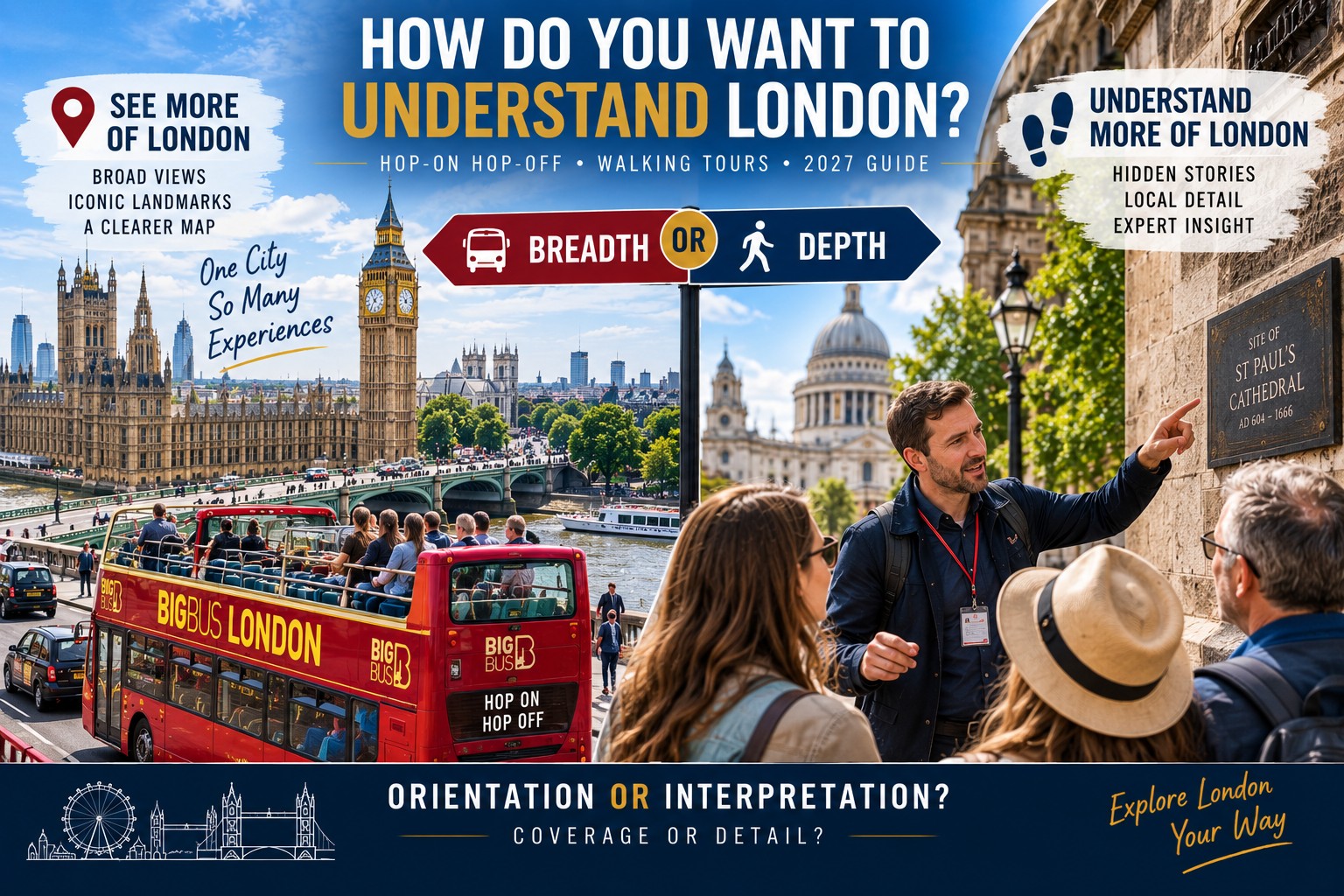
Choose breadth with a hop-on hop-off bus for London orientation and landmark coverage, or depth with a walking tour for local detail, history and expert interpretation
Choosing between hop-on hop-off bus tours and walking tours in London can look like a simple sightseeing decision, but the two formats solve very different visitor problems. One can help you see considerably more of the capital and understand how its major areas connect; the other puts you directly into the streets, neighbourhoods and stories you have come to explore.
A hop-on hop-off bus can be particularly useful when London is still unfamiliar. Seeing the city above ground can help you understand the relationship between major visitor areas and create a mental map that makes later exploration easier. A walking tour exchanges that geographical coverage for something different: closer interpretation, greater interaction and the opportunity to notice details that are easily missed when passing by in a vehicle.
Your available time, interests, mobility requirements, weather conditions and existing knowledge of London can all change which option provides better value. For some visitors, the answer may even be both—provided each experience performs a genuinely different job.
The real decision is therefore not simply bus or walking.
It is whether you currently need breadth or depth, orientation or interpretation, geographical coverage or local detail.
This guide compares both approaches so you can decide which one genuinely deserves a place in your London visit.
🧭 Hop-On Hop-Off Bus or Walking Tour: The Quick Answer
Choose a hop-on hop-off bus if your main priority is gaining a broad overview of London, seeing numerous landmarks across a relatively large area and beginning to understand how different parts of the capital connect.
Choose a walking tour if you would rather explore a smaller area in greater depth, hear detailed stories, interact more directly with a guide or investigate a particular subject that interests you.
Neither format is universally better.
A first-time visitor who cannot yet picture the relationship between Westminster, the West End, the City of London and the Tower area may gain considerably more from seeing those areas connected above ground. Someone who already understands London’s basic geography but wants to discover the history hidden within Westminster’s streets may find a specialist walk far more rewarding.
The comparison becomes clearer when you focus on the job you need the experience to perform:
| Decision factor Hop-on hop-off bus Walking tour | ||
|---|---|---|
| Broad London orientation | Excellent | Limited to the chosen area |
| Landmark coverage | Strong | Lower |
| Interpretation depth | Moderate and service-dependent | Usually strong |
| Neighbourhood detail | Limited | Excellent |
| Flexibility | Strong | Lower while the tour is operating |
| Continuous walking required | Lower | Higher |
| Specialist subjects | Limited | Excellent |
| Traffic independence | Lower | Strong |
| Guide interaction | Varies by experience | Usually stronger |
| First-day orientation | Excellent | Depends on the subject |
| Families | Often useful | Depends on age and tour |
| Limited mobility | Potentially useful; verify accessibility | Route-dependent; verify accessibility |
For some visitors, the strongest choice changes during the same trip. A bus can provide broad orientation near the beginning of a stay. Once you understand London’s shape and know which places or stories interest you most, a walking tour can provide the depth that a panoramic overview cannot.
That gives us the central principle for the entire comparison:
A hop-on hop-off bus helps you understand more of London’s shape. A walking tour helps you understand more of one part of London.
🚌 What Does a Hop-On Hop-Off London Bus Tour Do Best?
The strongest reason to choose a hop-on hop-off bus is not simply that it can take you past a long list of famous landmarks. Its greater value, particularly for visitors who are unfamiliar with London, is geographical orientation.
London can initially feel surprisingly fragmented. You might recognise Westminster, Buckingham Palace, Trafalgar Square, the West End, St Paul’s Cathedral and the Tower of London individually without having a clear sense of how those places relate to one another.
The Underground is excellent for moving around the capital, but travelling beneath the streets can make that geography harder to learn. You enter a station in one district and emerge somewhere completely different without seeing the streets, neighbourhoods and landmarks that connect the two.
A sightseeing bus provides a different perspective. Remaining above ground allows you to watch the character of London change as you travel, recognise the distance between major visitor areas and begin constructing a mental map of the city.
That is geographical compression: a large and initially complicated capital starts to become understandable within a relatively short period.
There is also value in the journey itself. On ordinary public transport, getting from one attraction to another is principally a practical task. On a sightseeing bus, the streets, architecture and landmarks between those destinations become part of what you have chosen to experience.
The hop-on hop-off format can add flexibility because you can potentially remain aboard for a broader overview and leave the route selectively when somewhere deserves closer exploration. Exact routes, frequencies, operating hours, ticket validity, accessibility and stopping arrangements vary between services, however, so current details should always be checked before booking.
One distinction is particularly important:
Treat it primarily as ordinary point-to-point transport and congestion or indirect routing may become frustrating. Treat the journey itself as part of your sightseeing and its purpose becomes much clearer.
For the right visitor, the real benefit is not simply how many landmarks the bus passes. It is how much easier London becomes to understand afterwards.
🚶 What Does a London Walking Tour Do Better?
Walking tours exchange geographical coverage for resolution.
You may see less of London during a couple of hours on foot than you would from a vehicle, but you can understand considerably more about the area immediately around you.
A knowledgeable guide can draw attention to architectural details, historic buildings, narrow streets, memorials, courtyards and connections that are difficult to appreciate while passing at road speed. Walking also creates more opportunity to stop, look carefully, ask questions and understand why a particular place matters.
That makes walking particularly effective in places such as Westminster or the City of London, and for themes where interpretation matters more than mileage—royal history, architecture, literature, food, music or neighbourhood history.
Once walking appears to be the better format, therefore, the next useful question is not simply “Which walking tour should I book?”
It is:
“What part of London—or what story about London—do I actually want to understand?”
That shift from format to interest is what allows a walking tour to become much more personal than a general sightseeing overview.
The essential difference can be expressed simply:
Bus sightseeing increases your field of view. Walking tours increase your level of detail.
Neither advantage makes one format inherently superior. It tells you what each is particularly good at delivering.
The London Gateway records and London Tours commercial destination above are verified against the current supplied master.
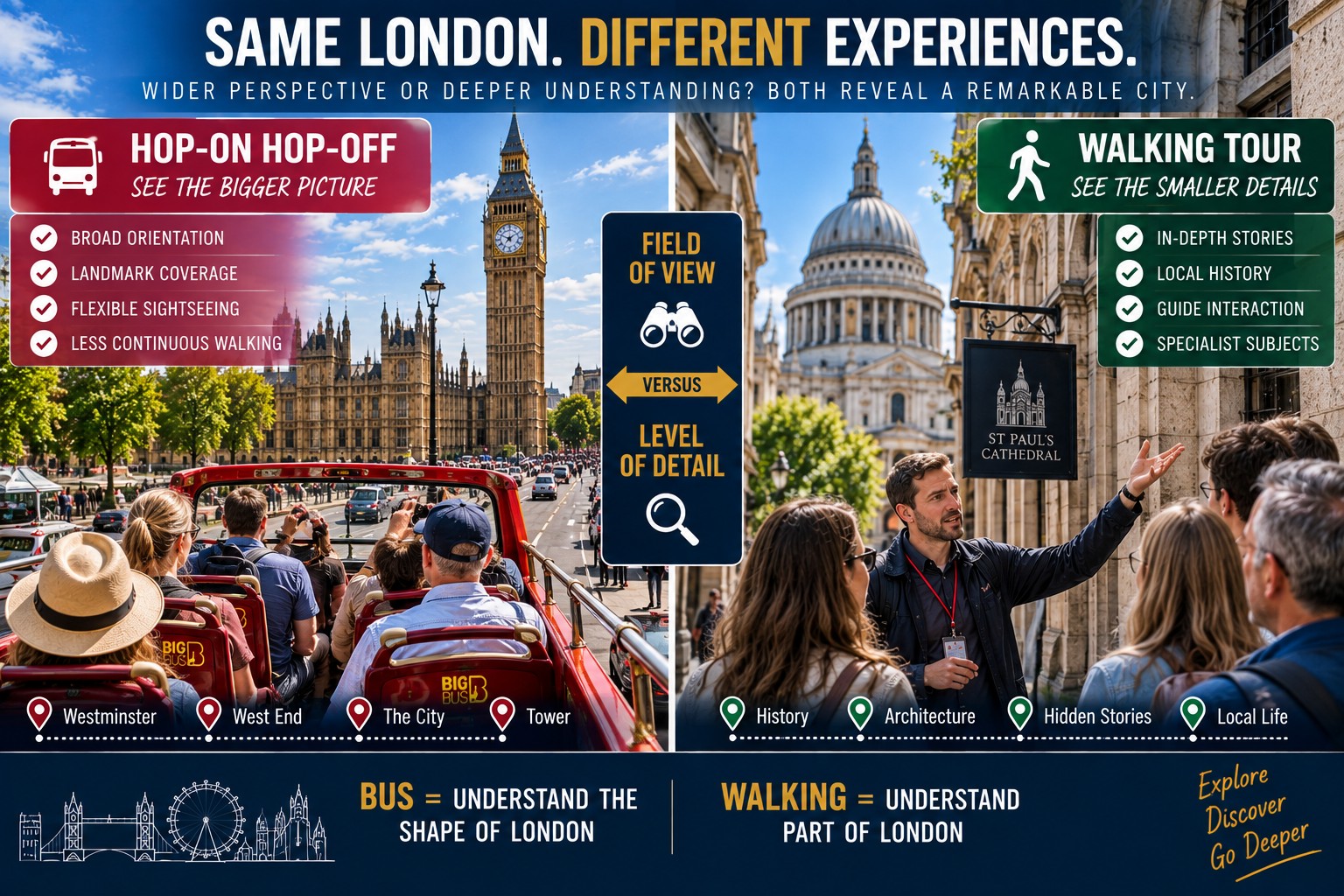
Hop-on hop-off buses provide broad London orientation and landmark coverage, while walking tours offer deeper history, local stories and greater interaction with a guide
👀 Which Is Better for First-Time Visitors to London?
For many first-time visitors, a hop-on hop-off bus has an early advantage because the first challenge is often not deciding what to see but understanding where everything is.
London’s headline sights are distributed across several visitor areas rather than concentrated around a single historic centre. Even visitors who have researched carefully before arriving can find that their mental picture of the capital bears little resemblance to its real geography. Seeing those areas connected above ground can make later independent sightseeing considerably easier.
That does not mean every first-time visitor should automatically choose a bus.
If you already have a reasonable understanding of central London, enjoy navigating independently or arrive with a strong interest in one particular subject, a walking tour may provide much greater value. Someone fascinated by political history, for example, may prefer detailed exploration around Westminster to several hours of broad landmark coverage.
The important question is what you need at that stage of your visit.
Your first organised experience does not necessarily need to be your most memorable one. Its job may simply be to make everything that follows easier.
For many visitors, that creates a natural progression:
Orientation → confidence → deeper exploration
Once London feels less intimidating, you can begin making more selective choices about the neighbourhoods, attractions and stories that deserve your time.
⏱️ Which Is Better If You Have Limited Time in London?
Limited time makes the decision more important, not less.
If you have only a short period in London and want to gain a broad impression of the capital, a hop-on hop-off experience can compress a considerable amount of geographical sightseeing into part of your stay. You can see numerous major areas without having to organise every movement independently.
A walking tour can still be the stronger choice if broad coverage is not your objective. If you already know that royal history, architecture or a particular neighbourhood matters more to you than seeing a large number of headline landmarks, concentrated depth may be a better use of those hours.
There is also a third option: neither.
A confident visitor with a tightly focused itinerary may gain more by using London’s public transport and exploring independently rather than committing limited time to an organised experience. Independent exploration is not merely a fallback when neither tour appeals; for the right visitor and itinerary, it can be the optimum choice.
The governing rule should be:
The shorter your visit, the more every organised hour needs to earn its place.
Do not respond to limited time by trying to book more. Decide which sightseeing problem matters most and use your available time to solve it well.
🚦 Does London Traffic Make Hop-On Hop-Off Tours a Bad Choice?
London traffic is a genuine consideration, but it does not automatically make sightseeing buses a poor option.
The problem usually becomes more significant when a visitor expects the service to function like fast point-to-point transport. Road congestion, diversions and changing conditions can affect journey times, so a sightseeing bus is not always the most efficient way to reach a timed attraction or appointment.
That expectation is different from using the bus for sightseeing. If watching London pass around you is part of the experience, some of the time spent on the road still has sightseeing value. You may be observing architecture, streets and neighbourhood transitions rather than simply waiting to arrive somewhere else.
Congestion can still affect your plans, particularly when you have a fixed-time attraction, restaurant reservation, theatre performance or other commitment afterwards. Allow sensible contingency rather than relying on an optimistic journey time, and check current routes, operating information and known disruptions where these could affect your day.
The key distinction is purpose:
Traffic becomes most problematic when you expect the sightseeing bus to perform a job it was never designed to perform.
If speed is your priority, London’s regular public transport network may often be the more appropriate tool. If orientation and above-ground sightseeing are the priority, the calculation is different.
The London Gateway editorial records and London Attractions commercial destination used above are verified against the protected London Gateway master.
👟 How Much Walking Is Involved—and Which Option Is Easier?
The phrase hop-on hop-off can create the impression that a sightseeing bus removes most of the physical effort from exploring London. In reality, it usually reduces continuous walking rather than eliminating walking altogether.
You may still need to walk from your accommodation or a station to the nearest stop, between a bus stop and an attraction, and through the attractions themselves. Getting on and off repeatedly can also involve more movement than expected over the course of a full sightseeing day.
A walking tour makes the physical commitment more obvious. You will normally spend a sustained period walking or standing, potentially on busy pavements and historic streets where surfaces, steps and kerbs vary. Prolonged standing can be tiring in its own right, even when the total walking distance appears relatively modest. The pace, route and number of opportunities to sit or rest will depend on the particular experience.
The better choice therefore depends on more than fitness. Consider your usual walking tolerance, ability to stand comfortably, footwear, fatigue from previous sightseeing, the amount of walking planned for the rest of the day and the requirements of everyone travelling with you.
If reducing physical effort is important, a bus may have an advantage—but verify the actual experience rather than assuming the format guarantees an easy day.
👨👩👧👦 Bus Tour or Walking Tour: Which Is Better for Families?
Families can enjoy either format, but children’s ages, interests and attention spans can matter more than the sightseeing method itself.
A hop-on hop-off bus can work particularly well when continuous walking would become tiring. Changing views can help maintain interest, and broad landmark coverage gives families the opportunity to see more of London without requiring children to walk between every major area.
Walking tours offer a different advantage: engagement.
A skilled guide telling stories, asking questions and bringing a particular subject to life can make London’s history considerably more memorable than simply passing landmarks. A themed experience matched to a child’s interests may therefore outperform a general bus tour even though it covers much less ground.
The decision can be reduced to five practical considerations:
Age + attention span + interests + walking tolerance + weather
Do not automatically choose the experience that appears to include the most. For families, the better tour is often the one everyone can still enjoy at the end.
♿ Which Is Better for Visitors With Limited Mobility?
Neither format should automatically be described as the more accessible option.
For a hop-on hop-off bus, relevant considerations can include boarding arrangements, wheelchair accommodation, seating, access at particular stops and whether every element of the experience is suitable for the traveller’s requirements.
For a walking tour, the route itself becomes critical. Distance, gradients, steps, road crossings, pavement surfaces, prolonged standing and opportunities to sit or rest may all affect suitability.
London’s historic environment also means accessibility can vary significantly between locations that appear close together on a map.
If accessibility is an important factor in your decision, verify the precise arrangements for the specific tour and route directly with the operator before booking. Do not rely solely on the assumption that a vehicle-based experience will necessarily be easier or that a relatively short walking tour will necessarily be manageable.
🌦️ What Happens When London’s Weather Changes?
Weather can change the balance between the two formats, but it should influence your decision rather than automatically make it for you.
Walking tours naturally expose you more directly to rain, cold, wind and hot weather. Light or intermittent rain may be perfectly manageable with suitable clothing, while prolonged or more severe conditions can materially affect comfort during a longer route.
A sightseeing bus may provide greater shelter depending on the vehicle and where you sit, but open-top sightseeing is itself weather-sensitive. The upper-deck experience that feels excellent on a clear day may be much less appealing in persistent rain, strong wind or uncomfortable heat.
Consider the forecast alongside the purpose of the experience.
If a particular specialist walk is one of the things you most want to do in London, imperfect weather may be worth accommodating. If your plans are flexible and conditions would materially reduce your ability to see, hear or enjoy the experience, changing the order of your sightseeing may be the better decision.
Weather should influence the sightseeing format—not automatically decide it.
The London Gateway records used above are verified against the current supplied master.
💷 Hop-On Hop-Off Bus or Walking Tour: Which Gives Better Value?
Comparing value is more useful than simply comparing ticket prices.
London tour prices can vary according to duration, operator, season, ticket validity, group size and what is included. More importantly, two experiences at very different prices may perform completely different jobs for the visitor. A lower headline price tells you little if the experience does not improve the part of your London visit that matters to you.
For a hop-on hop-off bus, much of the potential value comes from combining several benefits:
Coverage + orientation + flexibility + sightseeing while moving
If the experience helps you understand London’s geography, shows you major areas you would otherwise struggle to connect and makes the rest of your sightseeing easier to organise, its value can continue after you leave the bus.
Walking tours create value differently:
Expertise + interaction + detail + specialist interpretation
A relatively short walk through a small part of London may cover far fewer headline landmarks, yet provide greater value if the guide reveals history, architecture and stories that fundamentally change how you understand that area.
Time matters too. A cheaper experience is poor value if it occupies several hours without adding much to your visit, while a more expensive experience may justify its cost if it provides knowledge, interpretation or confidence you could not easily recreate independently.
The better question is therefore not “Which tour costs less?”
Ask:
“Which experience gives me the greatest improvement in my London visit for the time and money I am committing?”
That is a more reliable measure of value.
The cheapest experience is not necessarily the best value, and the experience with the most inclusions is not necessarily the most useful.
🔄 Should You Take Both a Bus Tour and a Walking Tour?
For some visitors, taking both can be the strongest combination—but only when the two experiences have different jobs.
Treating bus and walking tours purely as competitors can obscure one of the most useful ways to combine them. They can perform different functions at different stages of the same London visit.
A logical progression might be:
Bus orientation → understand London’s geography → identify what interests you → specialist walking tour → independent exploration
The first experience provides breadth. The second provides depth.
After seeing London more broadly, you may realise that the City interests you more than expected, that you want to understand Westminster’s political history properly, or that a particular neighbourhood deserves several hours rather than a passing glance. A walking tour can then build upon the orientation already gained instead of duplicating it.
This combination becomes easier to justify when you have sufficient time in London. It is much less convincing when two organised experiences would consume a disproportionate amount of a short visit.
Do not book both merely because they sound complementary. Ask what separate job each experience will perform. If you cannot identify two distinct benefits, one carefully chosen tour may be enough.
If your London visit is short, one well-chosen experience can be better than two partially useful ones.
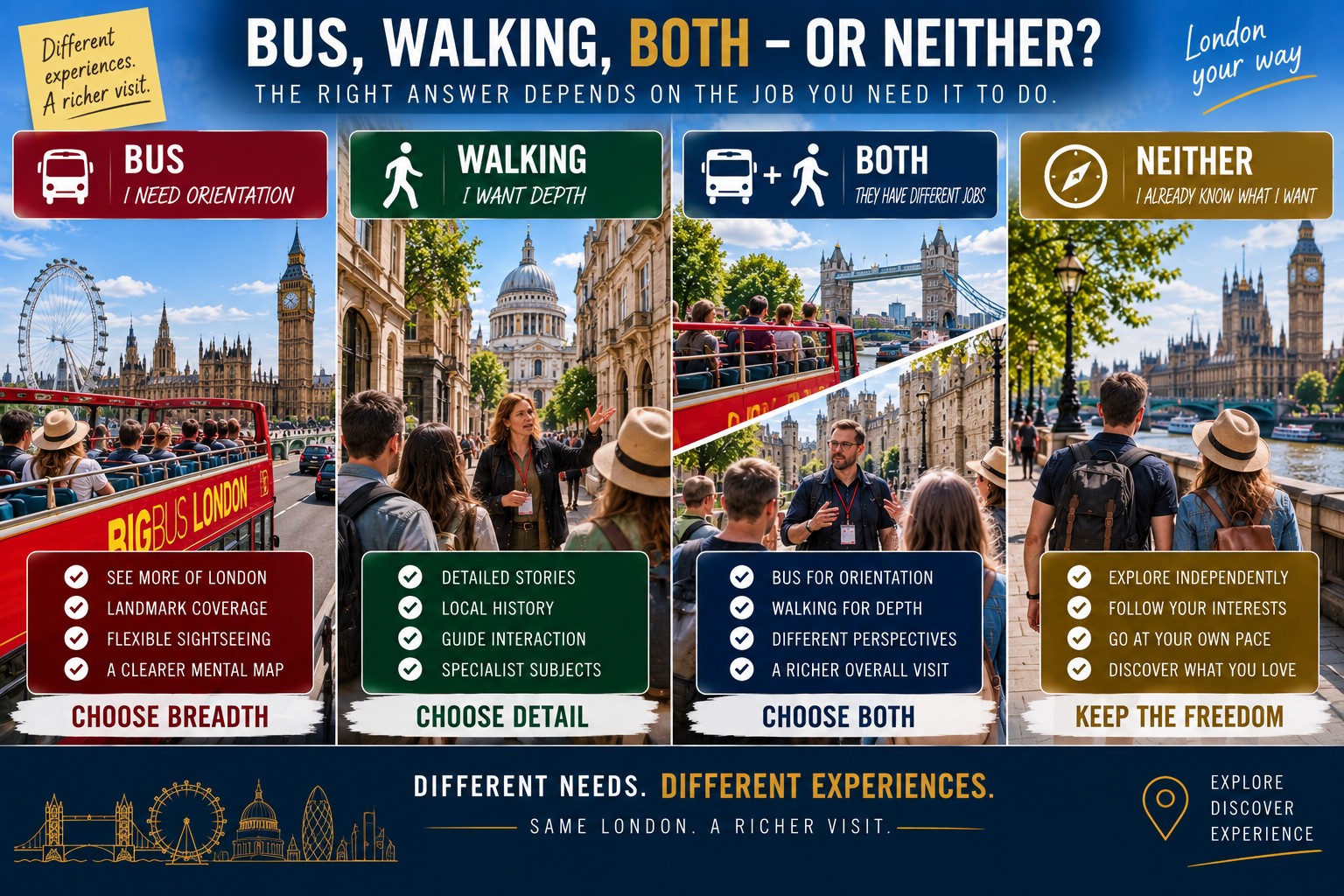
Choose a bus for breadth, a walking tour for depth, both when each performs a different job, or independent exploration when you already know what you want from London
🚤 What If Neither a Bus Tour Nor Walking Tour Is Quite Right?
Bus and walking tours are only two ways to experience London, and independent exploration should not be treated as a fallback option. For the right visitor, it can be the best choice.
If your main interest is seeing how the capital relates to the Thames, a river sightseeing experience offers a different perspective. If one major landmark or attraction matters more than broad sightseeing, spending your time on a deeper attraction-led experience may be more rewarding.
And if you already feel confident navigating London, exploring independently using its streets and public transport can give you complete control over pace, priorities and spontaneous discoveries.
The objective is not to force your plans into one of two categories.
It is to choose the sightseeing approach that genuinely improves your day.
The London Gateway editorial records and commercial destinations used in this section are verified against the supplied protected master.
🎭 Check the BVT London Events Calendar Before Choosing Your Tour
Before deciding which sightseeing format to use—or fixing a tour to a particular day—check what will actually be happening in London during your visit.
Major ceremonies, festivals, sporting occasions, concerts, exhibitions and seasonal events can influence both what you want to see and how easily you can move through particular parts of the capital. Road closures or diversions may affect sightseeing-bus routes, while large events can change crowd levels or pedestrian access around areas normally explored on walking tours.
Sometimes the event itself should become the priority.
If a ceremonial occasion, festival or other event that genuinely interests you coincides with your visit, it may make little sense to commit those same hours to general sightseeing simply because you booked it first. Equally, an event elsewhere in London may have little practical effect on your chosen route and require no change at all.
The useful approach is to check your dates before finalising the sightseeing structure:
Travel dates → London events → must-see priorities → affected areas → sightseeing format → booking decision
The BVT London Events Calendar 2026–2027 can help you identify what is happening while you are in the capital, allowing sightseeing decisions to reflect the actual circumstances of your visit rather than an itinerary planned without that context.
This can be particularly valuable before using a hop-on hop-off service because its operation depends partly on London’s road environment. Walking tours can also be affected by temporary access arrangements or unusually busy public spaces. Where an event could influence your plans, check current information and the specific operator’s arrangements before travelling.
An event does not automatically make either sightseeing format unsuitable. It simply becomes another piece of information that can help you choose more intelligently.
🌱 Which Is the More Sustainable Way to Explore London?
Walking has an obvious advantage when a journey can comfortably and practically be made on foot, but responsible London sightseeing is more nuanced than declaring every walking tour sustainable and every vehicle-based experience unsustainable.
A better starting point is geographical planning.
Visitors can create unnecessary journeys by repeatedly crossing London between attractions that could have been grouped more logically. Organising sightseeing around neighbouring areas can reduce avoidable travel while giving you more time to appreciate the streets, neighbourhoods and places between major landmarks.
Walking can then be used where practical, with London’s public transport network handling longer movements efficiently. If you choose an organised sightseeing experience, consider whether it performs a useful function within that wider plan rather than simply duplicating journeys you will make again later.
There is also a local dimension. Specialist walking tours and other locally rooted experiences can introduce visitors to neighbourhoods, independent businesses and knowledgeable guides beyond the most familiar headline sights. Choosing fewer experiences that add genuine understanding may be more rewarding than accumulating tours that repeatedly cover similar ground.
Sustainability does not require turning a holiday into an exercise in optimisation. It means making thoughtful choices where they are realistic.
A useful principle is:
The most sustainable sightseeing plan is often also the most geographically intelligent one.
Group nearby experiences, walk where practical, use public transport intelligently and avoid unnecessary duplicate journeys. The objective is not simply to move around London less, but to make the movement you do undertake contribute more effectively to the visit.
Travel with purpose. Explore with care.
❓ Hop-On Hop-Off Bus vs Walking Tour FAQs
🚌 Is a Hop-On Hop-Off Bus Worth It in London?
It can be, particularly if you are unfamiliar with London and want broad orientation alongside landmark sightseeing. Seeing different parts of the capital connected above ground can help establish a mental map that makes subsequent independent exploration easier.
The value is lower if you already understand London’s geography, intend to spend most of your time inside attractions or expect the bus to function primarily as fast transport. Judge the experience according to the sightseeing problem you need it to solve rather than simply how many landmarks or stops are included.
🚶 Are London Walking Tours Worth It?
Yes, when expert interpretation or specialist knowledge will materially improve what you experience.
A good walking tour can reveal stories, architectural details, historical connections and neighbourhood character that are difficult to appreciate independently or while passing through an area in a vehicle. They can be especially valuable when you already know which part of London or subject interests you.
If your priority is broad geographical coverage, however, walking alone may not provide the orientation you need.
🕘 Should I Do a Hop-On Hop-Off Bus on My First Day in London?
The first day can be an excellent time for a hop-on hop-off bus because the orientation gained may improve the rest of your visit. But first-day orientation value and arrival-day fatigue are two different considerations.
If you arrive after an overnight journey, significant time-zone change or particularly tiring trip, an expensive sightseeing experience may be wasted while you are exhausted. Keeping your arrival period flexible and taking the bus when you are alert enough to absorb what you are seeing can provide better value.
👟 Do You Still Have to Walk a Lot on a Hop-On Hop-Off Tour?
Potentially. Although the bus reduces continuous walking between sightseeing areas, you may still need to walk between your accommodation, bus stops, attractions and other transport connections. Visiting the attractions themselves can add considerably more walking and standing.
If minimising physical effort is important, examine your complete sightseeing day rather than assuming the bus itself removes the need to walk.
⌛ How Long Should a London Walking Tour Be?
There is no single ideal duration. Choose according to the subject, route, amount of walking and standing involved, and how much of the rest of your sightseeing day you want to protect.
A longer tour is not automatically better. The right duration is one that provides meaningful interpretation without allowing fatigue—or the opportunity cost of the experience—to outweigh what you are gaining from it.
👨👩👧👦 Is a Bus or Walking Tour Better With Children?
It depends on the children.
A sightseeing bus may suit families wanting broad coverage with less continuous walking. A well-designed walking tour can be more engaging for children who respond strongly to stories, interaction or a particular theme.
Age, interests, attention span, weather and walking tolerance should matter more than choosing the format normally considered most family-friendly.
🌧️ Is a London Walking Tour Worth Doing in the Rain?
It can be. Light rain does not necessarily spoil a walking tour if you are appropriately dressed and still comfortable exploring.
The better question is whether the conditions would materially reduce your ability to see, hear and enjoy the experience. More difficult weather can change the calculation, particularly on exposed or lengthy routes. Check the forecast and the operator’s current arrangements rather than assuming a tour will be cancelled—or that it will operate unchanged.
🔄 Can I Take a Bus Tour and Walking Tour on the Same London Trip?
Absolutely, provided each performs a different job.
A bus can help establish London’s geography early in the visit, while a later walking tour can explore a neighbourhood, period of history or specialist subject in greater depth. Used this way, the experiences complement rather than duplicate one another.
The combination is less useful when your stay is so short that two organised experiences would crowd out the independent sightseeing you also want to enjoy.
✨ Final Verdict: Choose London Coverage or London Depth
There is no universal winner between a hop-on hop-off bus and a London walking tour because the two formats are designed to solve different sightseeing problems.
Choose a hop-on hop-off bus when you need breadth. It is particularly useful when London is unfamiliar, you want to understand how major visitor areas connect, broad landmark coverage matters and reducing continuous walking would make sightseeing more comfortable.
Choose a walking tour when you want depth. If a particular neighbourhood, historical period or subject has captured your interest, exploring it on foot with knowledgeable interpretation can reveal stories, details and connections that broad panoramic sightseeing cannot provide.
Choose both when each has a clearly different purpose. A bus near the beginning of a longer visit can help establish London’s geography; a specialist walking tour later can take you much deeper into one of the places or subjects that caught your attention.
And choose neither when you already understand what you want to see and independent exploration using London’s streets and public transport will serve your plans better. That is not a lesser option. For a confident visitor with clear priorities, it may be the best sightseeing decision of all.
The simplest decision rule is therefore:
Choose breadth when you need orientation. Choose depth when you know what you want to understand.
Your circumstances still matter. Available time, mobility, family requirements, weather, events and how confidently you navigate London can all alter the balance. The right answer may consequently change not only from one traveller to another, but from the beginning of your London visit to the end.
A good London itinerary should not be judged by how many organised experiences you manage to include. Tours earn their place when they make the capital easier to understand, reveal something you would otherwise miss or allow you to use limited sightseeing time more effectively.
Ultimately, the best London sightseeing format is not the one that covers the most ground or tells the most stories. It is the one that helps you experience London in the way you need at that point in your visit.
Once that decision has been made, the next stage of planning becomes easier. You can decide which parts of London deserve deeper exploration, which experiences genuinely add something to your stay and, eventually, whether your journey should continue beyond the capital.
That is the wider value of making the sightseeing decision well:
How you explore London → what you discover → what you decide to experience next.