


Stonehenge & Avebury vs Stonehenge & Glastonbury: Which Ancient Britain Experience Should You Choose?
15th October 2026
🪨 Stonehenge & Avebury vs Stonehenge & Glastonbury: Which Ancient Britain Experience Should You Choose?

Two journeys into Britain’s remarkable past. Choose Stonehenge and Avebury to explore prehistoric monuments and archaeological landscapes more deeply, or Stonehenge and Glastonbury to discover a wider mixture of medieval history, Arthurian legends and spiritual heritage
Stonehenge is one of Britain’s most extraordinary ancient monuments, but choosing what to experience alongside it can shape the character of your entire journey. Two particularly rewarding possibilities are Avebury and Glastonbury, destinations that offer very different ways of discovering Britain’s remarkable past.
Combine Stonehenge with Avebury and you can explore two exceptional prehistoric landscapes, gaining a deeper appreciation of ancient monuments, archaeology and the communities that created them. Choose Glastonbury instead and your journey moves beyond prehistoric stone circles into medieval history, Arthurian legends, religious heritage and spiritual traditions.
Neither combination is automatically better. The right choice depends on what fascinates you most, whether you prefer archaeological depth or historical variety, and what your chosen itinerary actually includes.
This guide compares both experiences, explains their distinctive appeal and helps you decide which journey will make your visit to Stonehenge more meaningful.
🧭 Two Ways to Experience Ancient Britain
🪨 Stonehenge & Avebury: Deeper Into Prehistoric Britain
Stonehenge and Avebury form part of the same UNESCO World Heritage property, recognised for its exceptional prehistoric monuments and landscapes. Yet visiting both is not simply a matter of seeing two different stone circles.
Stonehenge presents an extraordinary concentration of monumental architecture, with its carefully arranged standing stones, lintels and distinctive setting on Salisbury Plain. Avebury offers a different sense of scale and landscape, with an enormous prehistoric stone circle surrounding part of a modern village and associated monuments extending into the surrounding countryside.
Together, they provide complementary perspectives on the achievements of Neolithic Britain. The experience is particularly rewarding for travellers who want to understand how prehistoric monuments relate to their wider landscapes rather than viewing Stonehenge as an isolated attraction.
Avebury is therefore a compelling choice for visitors whose fascination with Stonehenge begins with archaeology and extends to the wider prehistoric world.
🌄 Stonehenge & Glastonbury: History, Legend and Spiritual Heritage
Glastonbury takes the journey in another direction. Rather than concentrating primarily on prehistoric monuments, it introduces a landscape shaped by religious history, medieval traditions, legendary associations and centuries of cultural interpretation.
Glastonbury Abbey reflects the town’s importance in medieval religious history, while Glastonbury Tor has become one of Somerset’s most recognisable landmarks. The town is also closely associated with stories of King Arthur, Avalon and longstanding spiritual traditions.
These associations form an important part of Glastonbury’s identity, although legend and historical evidence must be distinguished. The cultural significance of an Arthurian tradition does not establish that the events described actually occurred.
For travellers drawn to atmosphere, storytelling, religious heritage and the changing meanings attached to historic landscapes, Glastonbury can provide a fascinating contrast to Stonehenge.
⚖️ Stonehenge & Avebury vs Stonehenge & Glastonbury: The Essential Comparison
The fundamental difference is not simply which destination has more attractions. It is the kind of historical experience each pairing creates.
| What matters to you | Stonehenge & Avebury | Stonehenge & Glastonbury |
|---|---|---|
| Main attraction | Prehistoric monuments and landscapes | History, legends and spiritual heritage |
| Archaeological emphasis | Particularly strong | Broader historical and cultural interests |
| Historical perspective | Deeper exploration of Neolithic Britain | A journey through different historical periods |
| Landscape experience | Extensive prehistoric monumental settings | Historic town, prominent hill and Somerset landscape |
| Legendary associations | Secondary to the archaeological experience | Central to much of the destination’s cultural identity |
| Relationship to Stonehenge | Expands understanding of prehistoric monuments | Introduces a contrasting historical and cultural experience |
| Particularly suited to | Archaeology enthusiasts and ancient-history travellers | Visitors interested in mythology, religious history and cultural traditions |
| Important itinerary check | Time to appreciate the monuments and their landscape | Which historic places and experiences are actually included |
Avebury offers greater continuity with Stonehenge’s prehistoric character, while Glastonbury introduces greater variety in historical periods and cultural themes.
Neither approach guarantees a better day. A traveller fascinated by Neolithic archaeology may find Avebury considerably more satisfying, while someone attracted to Arthurian stories and historic religious landscapes may remember Glastonbury more vividly.
The quality of the itinerary matters too. A destination’s appeal does not automatically mean that every tour provides enough time or access to experience its most interesting features.
Choosing your preferred destination is the first decision; choosing an experience that does it justice is the second. Once you know whether Avebury or Glastonbury interests you more, compare actual itineraries for the places visited, time available and arrangements included. A tour featuring your preferred destination is only the right choice if it delivers the aspects of that destination you most want to experience.
🪨 When Stonehenge & Avebury Offers the Better Experience
🏛️ Two Extraordinary Prehistoric Landscapes, Not Two Identical Experiences
One understandable concern about choosing Avebury is whether the day might feel repetitive. After visiting Stonehenge, would another prehistoric stone circle offer enough that is genuinely different?
The answer lies in the character of the monuments themselves.
Stonehenge is renowned for its distinctive stone architecture, including the carefully constructed trilithons and lintelled arrangements that make the monument immediately recognisable. Its setting encourages visitors to consider an extraordinary prehistoric structure within a wider ceremonial and funerary landscape.
Avebury creates a different impression. Its enormous stone circle and surrounding earthworks occupy a landscape that incorporates part of the present-day village. The scale, arrangement and relationship between monuments and surroundings give the experience a character of its own.
Rather than repeating Stonehenge, Avebury can change how visitors think about prehistoric monument building. It demonstrates that the ancient communities of Britain created monumental places in different forms, at different scales and within landscapes that continued to evolve long after their original construction.
For travellers interested in understanding prehistoric Britain, that contrast is precisely what makes the pairing worthwhile.
🔍 The Value of Understanding Stonehenge in a Wider Prehistoric Landscape
Stonehenge becomes even more fascinating when considered alongside the wider achievements of Britain’s prehistoric communities. Avebury provides an opportunity to explore that bigger picture through monuments that differ substantially in their scale, arrangement and relationship with the surrounding countryside.
The Avebury landscape includes important prehistoric features such as the West Kennet Avenue, Silbury Hill and West Kennet Long Barrow. Together, they demonstrate the richness of the area’s Neolithic heritage, although visiting Avebury does not mean that every associated monument will be included in a particular itinerary.
Their original purposes are not always fully understood. Archaeologists can investigate construction methods, dating, landscape relationships and evidence of human activity, but many questions about the beliefs and intentions of prehistoric communities remain open.
That uncertainty is part of what makes the landscape so compelling. Visiting Avebury encourages travellers to think beyond individual monuments and consider how people created, used and experienced important places over thousands of years.
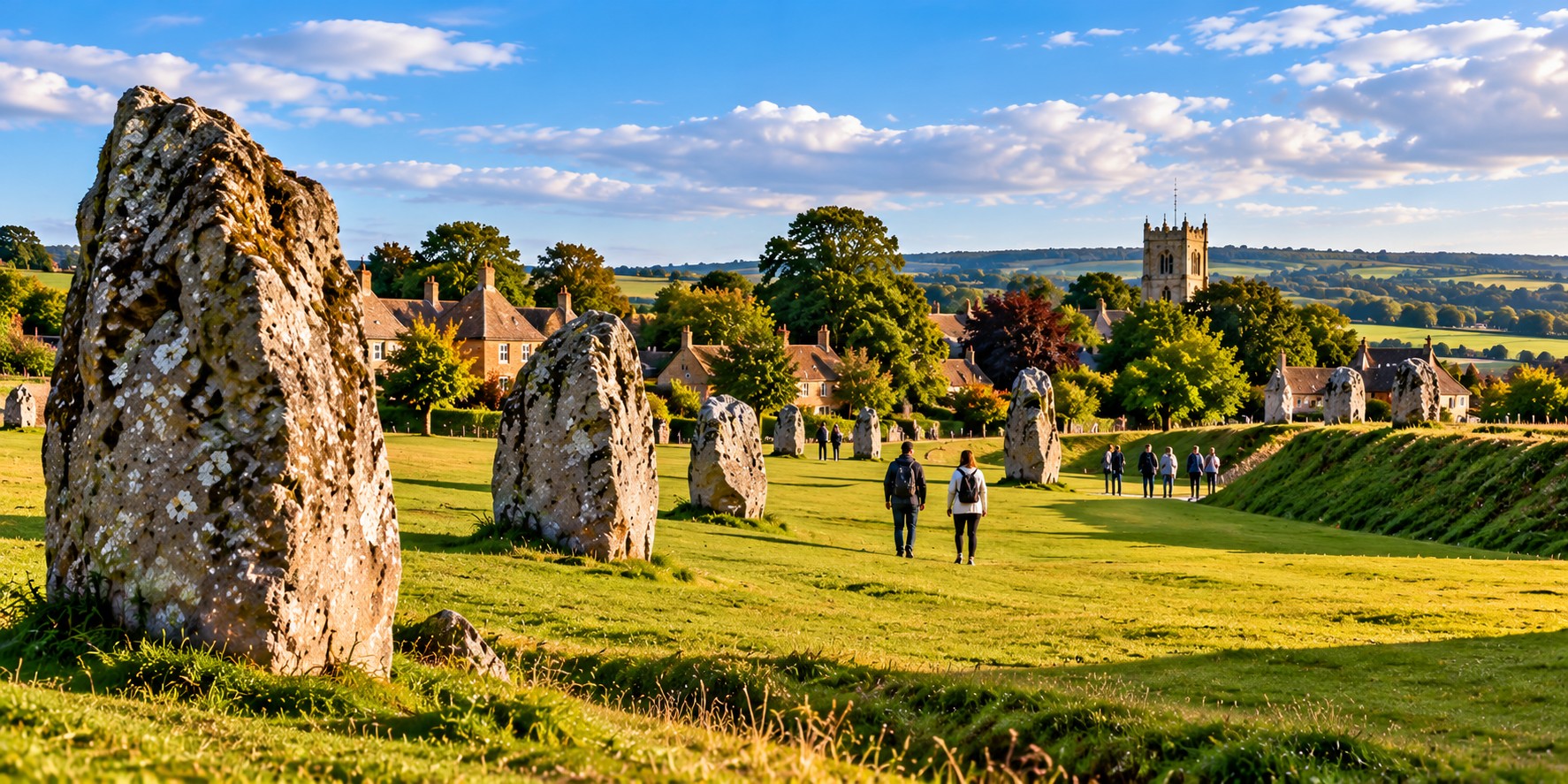
Avebury offers much more than another stone circle. Its enormous prehistoric monument, surrounding earthworks and unusual relationship with the modern village reveal a different side of Neolithic Britain, complementing rather than repeating the experience of Stonehenge
🧭 How Much of Avebury Will You Actually Explore?
An important distinction when comparing itineraries is whether the experience concentrates on Avebury’s principal stone circle and village or provides opportunities to discover more of the surrounding prehistoric landscape.
A visit centred on the stone circle can be rewarding in its own right. The scale of the monument, its earthworks and the unusual relationship between the stones and the modern village offer a distinctive experience without requiring an extensive exploration of the wider area.
For travellers with a particularly strong archaeological interest, however, the associated monuments may be an important part of Avebury’s appeal. An itinerary that includes additional prehistoric locations, or allows more time for historical interpretation, could therefore offer greater personal value.
Do not assume that a tour described as visiting Avebury includes Silbury Hill, West Kennet Long Barrow or other nearby monuments. Their inclusion, the form of any visit and the time available must be established from the actual itinerary.
This is where a seemingly small difference between tours can become decisive. A traveller hoping primarily to experience Avebury’s extraordinary stone circle may be entirely satisfied with a focused visit. Someone wanting a broader understanding of the prehistoric landscape should look more carefully at the scope of the experience.
🎯 Who Should Prioritise Avebury?
Stonehenge and Avebury is particularly appealing if you enjoy archaeology, prehistoric history and landscapes that reward careful observation.
It is also a strong choice if Stonehenge is the beginning of your curiosity rather than the full extent of it. Seeing two distinctive monumental landscapes can deepen your understanding of Britain’s ancient past in a way that a single monument cannot.
The deciding question is straightforward: would exploring Avebury’s prehistoric landscape be a highlight of your visit in its own right?
If the answer is yes, this combination deserves serious consideration. The next step is to establish whether the proposed itinerary offers the archaeological depth and time on site that would make the experience worthwhile for you.
🌄 When Stonehenge & Glastonbury Offers the Better Experience
🏰 A Different Journey Through Britain’s Past
Where Avebury extends the prehistoric story, Glastonbury introduces a much broader historical and cultural landscape.
Glastonbury’s significance developed through centuries of religious history, particularly its medieval abbey, which became one of England’s most important monastic institutions. The surviving abbey ruins offer a connection with that history, while the town’s traditions reflect the changing ways generations have understood its past.
Glastonbury Tor provides another distinctive element. Rising above the surrounding Somerset Levels, the hill is an unmistakable feature of the landscape, crowned by the surviving tower of St Michael’s Church. Its prominence has helped make it a focus of historical interest, local tradition and spiritual interpretation.
These places give Glastonbury an identity quite different from Avebury’s prehistoric monuments.
However, the experience depends heavily on the itinerary. A tour visiting Glastonbury town is not necessarily the same as one including time at the abbey or an opportunity to explore the Tor. Visitors should distinguish the destination’s wider attractions from the places they will actually experience.
🐉 Arthurian Legends, Spiritual Traditions and Historical Evidence
For many visitors, Glastonbury’s greatest attraction is its association with King Arthur and the legendary island of Avalon.
Medieval traditions connected Glastonbury with Arthurian stories, including claims concerning the burial place of Arthur and Guinevere. These associations became part of the abbey’s history and the town’s enduring cultural identity.
Yet the existence of these traditions should not be confused with proof that the legendary events occurred. The historical evidence does not establish Glastonbury as Arthur’s burial place or confirm its identification with the Avalon of medieval literature.
That distinction need not diminish the experience. Legends reveal how communities interpret landscapes, preserve stories and attach meaning to historic places. Glastonbury is fascinating partly because its documented history and legendary identity have developed alongside one another.
Its religious heritage and contemporary spiritual associations also attract visitors whose interests extend beyond conventional sightseeing. Travellers can appreciate these traditions respectfully without needing to accept every historical or spiritual claim associated with them.
🧭 Glastonbury Town, Abbey or Tor: Which Experience Matters Most?
Unlike Avebury, where the prehistoric landscape provides a relatively concentrated theme, Glastonbury offers several distinct experiences. Understanding their differences can make choosing an itinerary considerably easier.
Glastonbury town provides an opportunity to encounter the destination’s distinctive atmosphere, historic streets and contemporary cultural identity. It may appeal particularly to visitors who enjoy exploring independently, browsing local shops and experiencing the character of an unusual historic town.
Glastonbury Abbey is a more specific historical attraction. Its surviving ruins and associated traditions make it especially relevant to travellers interested in medieval religion, monastic history and the development of Arthurian associations. Visitors hoping to explore the abbey should check whether admission and sufficient visiting time are included.
Glastonbury Tor offers a different experience again. Its elevated setting, surviving church tower and surrounding landscape are central to its appeal. Reaching the summit involves an uphill walk, so available time, physical ability and weather conditions deserve consideration.
These experiences should not be treated as interchangeable.
Someone whose principal interest is medieval history may place greater value on time inside the abbey than on a general town visit. A traveller attracted by the Tor’s landscape and legendary atmosphere may be disappointed by an itinerary that offers no realistic opportunity to explore it.
Equally, a visitor interested mainly in Glastonbury’s cultural character might prefer time to wander through the town rather than a tightly scheduled programme of individual attractions.
Before choosing, identify the part of Glastonbury that interests you most and check whether the proposed experience genuinely includes it. A shorter itinerary with the right focus may provide greater satisfaction than a longer visit that misses your personal priority.
🎯 Who Should Prioritise Glastonbury?
Stonehenge and Glastonbury is particularly appealing if you enjoy historic towns, mythology, religious heritage and places with strong cultural identities.
It may also suit travellers who prefer variety. Rather than spending the day primarily exploring prehistoric monuments, they can experience Stonehenge alongside a destination associated with different historical periods and traditions.
Glastonbury is especially worth considering if Arthurian stories, the abbey’s history or the landscape around the Tor already interest you.
The important question is whether those interests are sufficiently strong to make Glastonbury a destination you genuinely want to experience, rather than somewhere you are visiting simply because its name appears alongside Stonehenge.
🤔 What If Both Avebury and Glastonbury Appeal to You?
❤️ Which Experience Would You Most Regret Missing?
When both destinations sound attractive, consider them independently of Stonehenge.
If you were planning a separate day in Britain, would you be more excited about exploring Avebury’s prehistoric monuments or discovering Glastonbury’s historical and legendary landscape?
This simple test helps distinguish genuine personal interest from the appeal of a conveniently packaged itinerary.
🔄 Do You Want Depth or Contrast?
Avebury generally offers greater prehistoric depth. Glastonbury provides greater contrast through its combination of history, legend and religious heritage.
Neither distinction is absolute. Avebury has cultural associations beyond archaeology, while Glastonbury’s landscape has a history extending beyond its medieval and legendary identity.
Nevertheless, deciding whether you prefer depth or contrast can clarify which combination better matches your expectations.
🧳 What Else Is Already in Your Britain Itinerary?
Your wider holiday matters too.
If you are already visiting several medieval towns, abbeys or legendary destinations, Avebury may introduce a different dimension to your journey. Conversely, if your plans already include extensive prehistoric sightseeing, Glastonbury could provide welcome variety.
The strongest choice is not necessarily the destination with the greatest number of attractions. It is the one that contributes something you genuinely value to your overall experience.
🚌 Compare the Actual Day, Not Just the Destination Names
Choosing between Avebury and Glastonbury is only half the decision. The other half is understanding what your chosen journey will actually deliver.
Two itineraries featuring the same destinations can offer noticeably different experiences. One might allow substantial time for exploring and interpretation, while another could concentrate on shorter sightseeing stops. Neither approach is necessarily wrong, but the difference matters when you have particular interests or expectations.
⏱️ Time, Travel and Sightseeing Balance
A longer tour does not automatically provide a better experience. What matters is how the day is divided between travelling, visiting attractions, guided interpretation and independent exploration.
For Stonehenge and Avebury, consider whether there is sufficient time to appreciate the prehistoric landscapes rather than simply viewing the principal monuments. The relationship between the stones, earthworks and surrounding countryside is an important part of Avebury’s appeal.
For Stonehenge and Glastonbury, think about which aspects of the destination interest you most. Exploring the historic town, visiting the abbey and walking towards or up Glastonbury Tor are different activities, each requiring their own time and practical arrangements.
Travellers should also consider their preferred pace. A busy itinerary may suit someone who enjoys seeing several places, while a more measured experience may be preferable for visitors who want to absorb historical interpretation, take photographs or explore independently.
🎟️ Check What You Will Actually Experience
A destination appearing in a tour description does not necessarily mean that every attraction associated with it is included.
Before choosing, distinguish between arriving at a destination, viewing a landmark from outside, entering a historic attraction, receiving guided interpretation and having time to explore independently.
These differences are particularly important at Glastonbury, where the town, abbey and Tor offer distinct experiences. At Avebury, the extent of exploration and the opportunity to appreciate the wider prehistoric landscape can also vary.
Consider four practical questions when comparing itineraries:
- Which places are genuinely visited? Distinguish confirmed sightseeing stops from attractions mentioned only as part of a destination’s wider appeal.
- What admissions and access arrangements are included? Check whether entrance to specific attractions is provided, optional or independently arranged.
- How much usable sightseeing time is available? Consider the time remaining after travel, transfers and other scheduled activities.
- How will you experience each place? Guided interpretation, independent exploration and brief photographic stops can create very different visits.
Use this practical sequence when evaluating either combination:
Destinations → Actual experiences → Access arrangements → Time balance → Sightseeing pace → Personal value
A thoughtfully balanced itinerary that includes fewer experiences may be more rewarding than an ambitious programme that leaves insufficient time to appreciate them.
The most commercially useful comparison is therefore not simply between two advertised routes. It is between the experiences those routes actually provide and the personal priorities you have already identified.
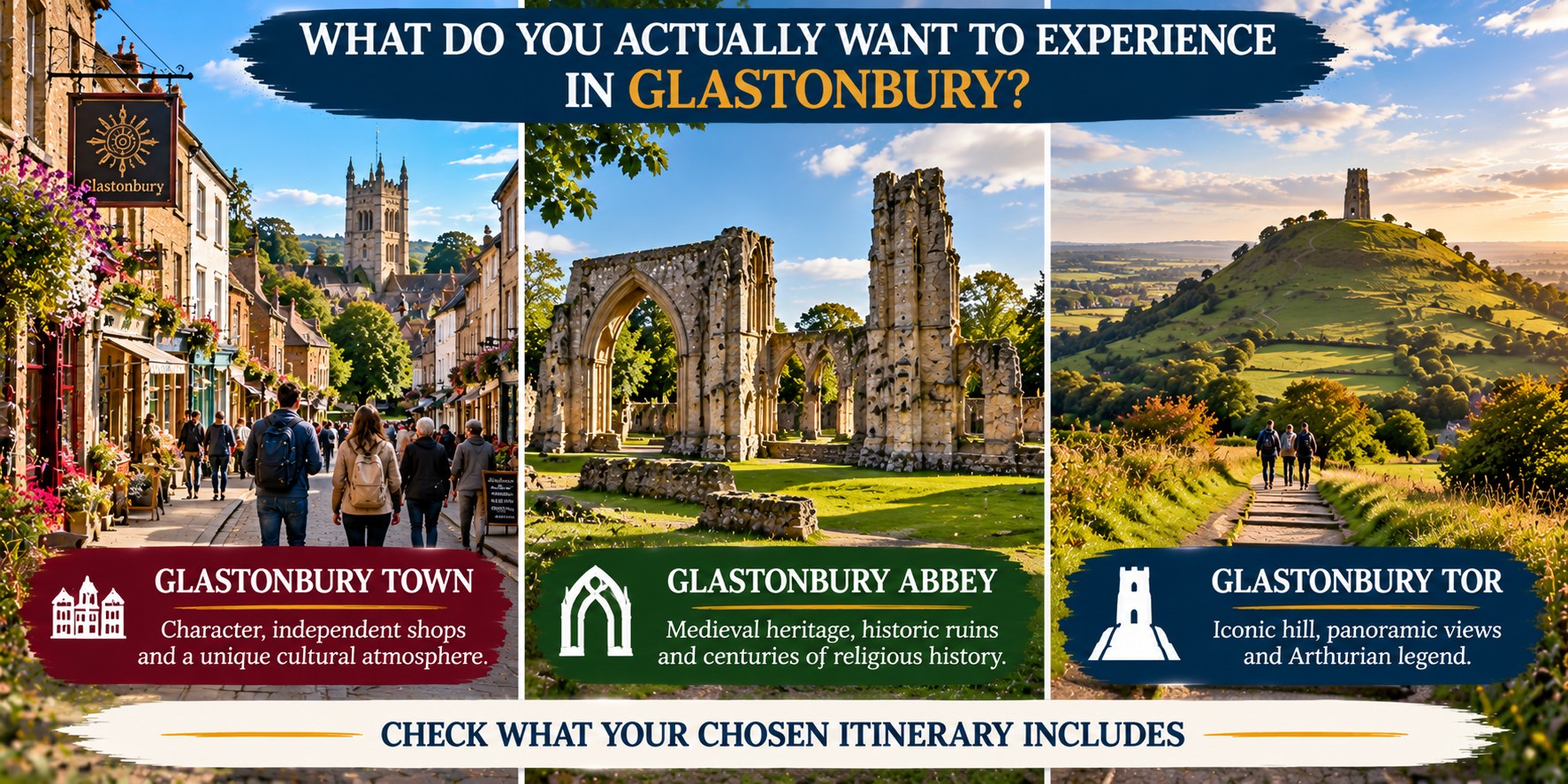
Glastonbury offers three very different experiences: the town’s distinctive cultural atmosphere, the abbey’s medieval history and the Tor’s remarkable landscape and legendary associations. Before choosing a Stonehenge and Glastonbury tour, check which attractions and experiences your itinerary actually includes
🪨 Does Stonehenge Still Receive the Attention You Want?
Remember why you began considering these journeys: you want to visit Stonehenge.
If Stonehenge is your principal priority, check that the itinerary allows the kind of visit you are hoping for. Travellers who want time to understand the monument, explore the visitor experience and appreciate its landscape may have different expectations from those content with a shorter introduction.
Neither Avebury nor Glastonbury should be judged independently of the time and attention allocated to Stonehenge itself.
When comparing tours, consider whether Stonehenge admission is included, how much time is allocated to the visit and whether the itinerary allows you to experience the aspects of the site that matter most to you.
A tour that includes an appealing second destination may still be unsuitable if the Stonehenge visit feels too restricted for your interests. Equally, a well-balanced combination can be an excellent choice when you want to experience the monument without dedicating an entire day to Stonehenge alone.
The best combination is one in which both destinations contribute meaningfully to the day without compromising the experience that matters most to you.
🌅 What If Stonehenge Inner Circle Access Is a Priority?
For some travellers, the opportunity to experience Stonehenge through a special Inner Circle visit is an important part of their plans.
If this is a priority, it makes sense to consider suitable access opportunities before settling on the rest of your itinerary. Inner Circle visits involve different arrangements from ordinary standard-access visits, and their availability should never be assumed simply because a tour includes Stonehenge.
The Stonehenge Inner Circle Access Calendar provides a useful starting point for investigating suitable dates and planning possibilities.
A sensible decision sequence is to establish whether Inner Circle access is essential to your visit, investigate suitable dates and access arrangements, and only then assess whether combining the experience with Avebury or Glastonbury is practical.
This distinction matters because a tour featuring your preferred second destination may not offer the special Stonehenge access you want. Conversely, prioritising a particular Inner Circle opportunity may influence which other destinations can reasonably be included.
Do not assume that an advertised Stonehenge combination includes Inner Circle access unless the specific itinerary confirms it.
If Inner Circle access is not a particular priority, there is no need to let it complicate your choice. Both destination combinations can be rewarding when Stonehenge is experienced through standard visitor access.
🧠 Which Ancient Britain Experience Should You Choose?
By this stage, the decision should depend less on which destination sounds impressive and more on what you genuinely want from your journey.
🪨 Choose Stonehenge & Avebury If…
Your strongest interest lies in prehistoric Britain, archaeological landscapes and the remarkable achievements of ancient communities.
Avebury is particularly rewarding when you want to place Stonehenge within a broader prehistoric context and appreciate how different monumental landscapes can illuminate one another.
🌄 Choose Stonehenge & Glastonbury If…
You are drawn to a wider mixture of history, mythology, religious heritage and cultural traditions.
Glastonbury is especially appealing when you want the second destination to introduce a different historical atmosphere rather than continue the prehistoric focus of Stonehenge.
⚖️ If the Decision Is Still Close…
Ask yourself two final questions.
Which destination would you most regret missing? And does the actual itinerary provide enough time and the right experiences to make visiting it worthwhile?
The combination that answers both questions most convincingly is likely to be the better choice for you.
🧭 Your Final Five-Point Tour Selection Check
Once you have identified your preferred destination, use five considerations to make your final choice:
- Personal interest: Does Avebury’s prehistoric landscape or Glastonbury’s historical and legendary character genuinely excite you more?
- Actual inclusions: Does the itinerary include the specific monuments, attractions or experiences you want, rather than simply mentioning the destination?
- Stonehenge experience: Is sufficient time and the appropriate form of access provided for your principal visit?
- Sightseeing pace: Does the balance between travel, guided interpretation and independent exploration suit how you enjoy travelling?
- Practical suitability: Are the departure arrangements, walking requirements, admissions and overall duration appropriate for your circumstances?
An itinerary does not need to offer the greatest number of attractions to provide the best experience. It needs to match your interests and deliver what you reasonably expect.
When those five considerations align, you can move from comparing destinations to choosing an actual tour with considerably greater confidence.
🌱 Responsible Touring: Give the Journey a Purpose
Stonehenge, Avebury and Glastonbury are places where the past remains an important part of the present. Visiting responsibly helps protect their heritage while respecting the people and communities connected with them.
At Stonehenge and Avebury, remain within permitted visitor areas, respect monument boundaries and avoid disturbing archaeological features. These landscapes contain much more than their most recognisable standing stones, and seemingly insignificant earthworks can form part of an important archaeological setting.
At Glastonbury, respect the religious, cultural and spiritual significance of historic places, particularly where visitors may be attending for reasons beyond sightseeing.
Thoughtful travel planning also matters. Consider transport arrangements, unnecessary additional journeys and whether your itinerary allows enough time to appreciate each destination. Organised group transport can sometimes reduce the number of separate vehicles making a journey, although its environmental benefits depend on the circumstances.
Above all, choose experiences for their meaning rather than simply accumulating attractions.
Travel with purpose. Explore with care.
❓ FAQs: Stonehenge & Avebury vs Stonehenge & Glastonbury
❓ Are Stonehenge and Avebury Part of the Same UNESCO World Heritage Site?
Yes. Stonehenge and Avebury form part of the UNESCO World Heritage property known as Stonehenge, Avebury and Associated Sites. The designation recognises their outstanding prehistoric monuments and landscapes. Although geographically separate, both areas contribute to understanding Neolithic and Bronze Age Britain.
❓ Is Glastonbury Primarily a Prehistoric Destination?
No. Although the wider area has a long human history, Glastonbury’s best-known visitor attractions and cultural associations are strongly connected with medieval religious heritage, Arthurian legends and spiritual traditions. It offers a different historical emphasis from Avebury’s prehistoric monumental landscape.
❓ Are Glastonbury’s King Arthur Connections Historically Proven?
No. Glastonbury has important medieval traditions associating it with King Arthur and Avalon, but these do not establish that Arthur was buried there or that the town was the Avalon described in legend. The traditions remain significant aspects of Glastonbury’s cultural history.
❓ Does One Combination Usually Include More Attractions?
Neither combination automatically includes more attractions. Individual itineraries vary in their stops, admissions, guided experiences and available sightseeing time. Compare what you will actually visit rather than judging the experience by the number of places mentioned in a description.
❓ Can I Experience Avebury or Glastonbury Without a Guided Tour?
Yes. Both destinations can be explored independently, although transport, access arrangements and the practicalities of visiting particular attractions differ. Independent travel offers flexibility, while guided experiences may provide useful historical interpretation and simplify travel between destinations.
❓ Is Either Combination Automatically Better for a First Visit to Britain?
No. First-time visitors can enjoy either experience. Avebury is particularly appealing for those interested in prehistoric archaeology, while Glastonbury may suit travellers seeking a broader mixture of history, legends and cultural heritage. Your personal interests and wider itinerary are more useful guides than whether this is your first British holiday.
🌄 Choose the Ancient Britain Experience That Means More to You
Stonehenge and Avebury offer an exceptional opportunity to explore Britain’s prehistoric achievements through two distinctive monumental landscapes. For travellers fascinated by archaeology, ancient communities and the relationship between monuments and their surroundings, this combination can provide a particularly rewarding journey.
Stonehenge and Glastonbury offer something different: a meeting of prehistoric wonder with medieval history, Arthurian traditions and a landscape rich in cultural and spiritual associations.
Neither experience is universally superior. The better choice is the one that reflects your interests and provides enough time to appreciate the places you have chosen.
Before settling on an itinerary, consider what you most want to discover, which destination you would regret missing and whether the planned experience genuinely meets those expectations.
Choose the journey that will make your Stonehenge visit more meaningful, not simply the one with the longest list of attractions.