


Stonehenge and Glastonbury Tours: Ancient Mysteries and Legendary Landscapes (2027 Guide)
11th September 2026
🗿 Stonehenge and Glastonbury Tours: Ancient Mysteries and Legendary Landscapes (2027 Guide)

Stonehenge provides the archaeological anchor before the journey expands into Glastonbury’s medieval history, distinctive landscape and Arthurian traditions—a remarkable progression through ancient and legendary Britain
🧭 Introduction: When Stonehenge Becomes the Beginning of a Legendary Journey
Stonehenge and Glastonbury are often connected in the imagination long before travellers ever place them on the same itinerary. Both evoke Britain’s distant past, extraordinary landscapes, unanswered questions and stories that have grown far beyond the physical places themselves. For visitors fascinated by archaeology, history, King Arthur, Avalon or simply the atmosphere of ancient Britain, seeing the two together can create one of southern England’s most distinctive heritage journeys.
Yet Stonehenge and Glastonbury are not two versions of the same experience. Stonehenge is first and foremost a prehistoric archaeological monument, set within a much wider ceremonial landscape on Salisbury Plain. Glastonbury is a layered historic destination shaped by its medieval abbey, prominent Tor, Christian heritage, Arthurian traditions, later spiritual associations and a modern town with a character entirely its own.
That difference is precisely what can make the combination so rewarding.
Stonehenge provides the archaeological anchor. Glastonbury expands the journey into history, landscape and legend.
For some visitors, bringing them together creates a compelling progression through several very different ways in which Britain’s past survives. For others, the additional travelling time may be better spent exploring Stonehenge more deeply, visiting another prehistoric landscape such as Avebury, or creating a simpler itinerary with fewer competing priorities.
The important question is therefore not whether Stonehenge and Glastonbury can be visited together. It is whether combining them creates the kind of journey you actually want.
A useful starting point is to decide which of three journeys you are really trying to create:
- a Stonehenge-led day with Glastonbury as a carefully chosen second experience;
- a balanced Stonehenge-and-Glastonbury journey in which both destinations matter substantially;
- or the beginning of a longer legendary-Britain journey extending into Somerset, Cornwall and other Arthurian landscapes.
Knowing which of those you want prevents many of the planning problems discussed later in this guide.
This guide will help you understand what each destination contributes, where historical evidence ends and later tradition begins, how much time Glastonbury deserves, when a one-day journey can work well and when slowing down or staying longer may produce a better experience.
🧩 Why Do Stonehenge and Glastonbury Work Together?
Stonehenge and Glastonbury work well together not because they can be placed inside one neat historical narrative, but because they encourage travellers to encounter Britain’s past in strikingly different ways.
Stonehenge presents a monumental archaeological question. Its stones, prehistoric setting and remarkable construction invite us to consider the communities that built and used this landscape thousands of years ago. Archaeology has revealed a great deal about its development and wider setting, yet important questions about the monument’s precise meanings and uses remain open.
Glastonbury offers a different kind of complexity. Here, documented history, medieval religion, dramatic landscape, Arthurian tradition and later interpretations have accumulated over centuries. Rather than revolving around one monument, the experience is spread between places such as Glastonbury Abbey, Glastonbury Tor and the town itself.
The two destinations therefore share several powerful themes: mystery, landscape, belief, interpretation and Britain’s cultural imagination. But their strongest connection for today’s visitor is thematic rather than evidence of a single ancient religious or archaeological system.
That distinction matters. It allows the journey to remain atmospheric without confusing legend with history.
In fact, the contrast is part of the attraction. Stonehenge asks what prehistoric communities built and why. Glastonbury shows how later generations can surround landscapes with history, belief and story.
Together, they can turn a sightseeing day into something more ambitious: a journey from physical archaeology into the evolving imagination of Britain.
🪨 Stonehenge: The Archaeological Anchor of the Journey
Stonehenge gives this itinerary its deepest chronological starting point. Its surviving stone monument belongs to a much wider prehistoric landscape that was created, used and altered over many generations. The scale of the construction, the movement of different types of stone and the organisation required to build and modify the monument continue to make Stonehenge one of Europe’s most remarkable archaeological sites.
For the traveller, however, its power is also unusually concentrated. You approach one globally recognised monument within a landscape containing many other traces of prehistoric activity, and much of the experience centres on looking closely at a relatively compact group of stones that has generated centuries of investigation and interpretation.
🏺 What Stonehenge Contributes
Stonehenge gives the combined journey a firm archaeological foundation.
It provides something Glastonbury cannot: a direct encounter with monumental prehistoric construction on an extraordinary scale. Archaeological research has revealed much about Stonehenge’s development and its surrounding landscape, but important questions about how prehistoric communities understood and used the monument remain open.
That combination of substantial knowledge and unresolved interpretation is part of its fascination.
Within a Stonehenge-and-Glastonbury journey, Stonehenge should therefore be treated as more than an obligatory photograph. If it is the principal reason for your trip, allow the wider itinerary to respect that priority rather than compressing the visit simply to make room for another famous destination.
This is the first major planning decision of the journey:
Decide how much of the day Stonehenge deserves before deciding how much else the day can contain.
That is especially important for first-time visitors, who can otherwise find themselves planning Glastonbury, Bath, Avebury or other destinations before deciding what kind of Stonehenge experience they actually want.
🔍 Standard Visit or Specialist Access?
You do not need specialist Stonehenge access to make a Stonehenge-and-Glastonbury journey worthwhile.
A standard visit can work particularly well within a combined itinerary because it generally provides greater flexibility when arranging the rest of the day. You can experience the monument and its landscape without making every subsequent decision depend upon a restricted specialist-access period.
Inner Circle access creates a different planning equation. For travellers who specifically value the opportunity to enter the stone circle during designated special-access periods, it can become the defining Stonehenge element of the journey. Once that experience becomes important, however, its timing may need to anchor the itinerary.
The useful planning question is therefore not simply, “Do I need Inner Circle access?”
It is:
“How important is the Stonehenge experience itself within this wider journey?”
Answer that before deciding how much Glastonbury to add.
If your priority is experiencing both destinations with maximum flexibility, a standard Stonehenge visit may actually produce the stronger overall itinerary.
If entering the Inner Circle is one of the experiences you would most regret missing, investigate access possibilities first and allow Glastonbury to fit around them rather than the reverse.
⛪ Glastonbury: Where History, Landscape and Legend Overlap
Glastonbury is harder to understand as a single attraction because it is not one.
Its appeal comes from the interaction between Glastonbury Abbey, Glastonbury Tor, the town, the surrounding Somerset landscape and the stories that have accumulated around them. This is also why travellers can underestimate how much time Glastonbury deserves: a short visit to one historic site and a fuller experience of the destination are very different things.
🏰 Glastonbury Abbey: History Before Legend
Glastonbury Abbey is central to understanding the town.
The surviving ruins belong to a monastery that became one of medieval England’s most important religious houses. That documented history gives the site considerable significance before Arthurian tradition is introduced at all.
The connection with King Arthur became particularly famous through medieval claims that the remains of Arthur and Guinevere had been discovered at Glastonbury. Those claims helped bind the Abbey to the developing traditions surrounding Arthur and Avalon, but they should not be treated as definitive proof that a historical Arthur was buried there.
The Abbey does not need the Arthurian story to be important. The legend adds another fascinating layer to an already significant historic place.
🌄 Glastonbury Tor: Landscape, History and Atmosphere
Glastonbury Tor changes the character of the visit again. Rising prominently above the Somerset Levels, the hill creates a much stronger sense of movement through landscape than an Abbey-only visit. At its summit stands the surviving tower of St Michael’s Church, while the elevated position provides extensive views across the surrounding countryside.
For many travellers, the Tor is where Glastonbury’s atmosphere becomes most tangible. Its distinctive profile, exposed position and centuries of historical and legendary associations have made it one of the most recognisable landscapes in Somerset.
None of this requires claims about supernatural forces or ancient energies. The Tor’s topography, history, views and accumulated stories already make it an evocative place.
Walking time, weather, footwear and mobility should therefore be treated as genuine planning considerations. Visiting the Tor is not the same as stepping briefly from a vehicle into an attraction, and travellers attempting Stonehenge and Glastonbury in one day should allow for the physical experience as well as the sightseeing time.
A hidden planning question is therefore worth answering early:
Would you still choose Glastonbury if the Tor walk were not practical on the day?
If the Abbey, town and Arthurian story would still make the journey worthwhile, Glastonbury remains a strong choice. If the Tor is the main reason you want to visit, protect enough time and physical capacity for it rather than treating it as an optional extra.
🏘️ Glastonbury Town: Part of the Experience, Not Just a Transfer Point
The modern town adds another layer.
Glastonbury is known for independent shops, cafés, alternative culture and a contemporary spiritual identity that gives it a character unlike either Stonehenge or many conventional heritage towns. Some visitors will find that atmosphere integral to their experience; others may be interested primarily in the Abbey or Tor.
Neither response is wrong.
What matters is recognising that someone who wants to explore the town, browse its streets and spend unhurried time there needs a very different itinerary from someone making one focused heritage stop.
Before deciding whether Glastonbury fits comfortably into your day, decide what you mean by visiting Glastonbury.
That single decision affects almost everything that follows: how long the visit needs, whether one day remains realistic, whether Stonehenge should come first or second and whether an overnight begins to make more sense.
🧠 Archaeology, History, Tradition and Legend: Know What You Are Experiencing
One of the easiest ways to misunderstand a journey through Stonehenge and Glastonbury is to treat every story associated with these landscapes as though it belongs to the same category of evidence.
It does not.
🪨 Archaeology
Archaeology examines material evidence: monuments, buildings, burials, objects, landscapes and other physical traces of past human activity.
Stonehenge is fundamentally an archaeological site, even though later generations have attached many legends and interpretations to it.
📜 History
History draws on documentary evidence alongside archaeology and other sources to investigate people, institutions and events.
Glastonbury Abbey belongs firmly within documented medieval history, even though parts of its later reputation involve stories that are much more difficult to establish.
🕯️ Tradition
Tradition includes stories, beliefs and associations developed and transmitted across generations. A tradition can become culturally and historically important even when its original factual basis is uncertain.
👑 Legend
Legend occupies the storytelling territory where possible historical memories, literary development and cultural imagination can become intertwined. King Arthur is the obvious example within a Glastonbury journey.
The purpose of making these distinctions is not to strip either destination of mystery. It is to understand the kind of mystery you are encountering.
Mystery becomes more interesting, not less, when we distinguish what is known from what has been believed or imagined.
That distinction also helps travellers choose experiences more confidently. If archaeological evidence is what excites you most, your journey may naturally remain centred on Stonehenge and Avebury. If the interaction between history, place and storytelling is equally compelling, Glastonbury begins to make a much stronger case.

Stonehenge and Glastonbury reveal different layers of Britain’s past—from physical archaeological evidence and documented medieval history to traditions and Arthurian legends developed across generations
👑 King Arthur, Avalon and Glastonbury: Why the Legend Still Matters
No serious discussion of Glastonbury can completely avoid Arthur.
For centuries, Glastonbury has been associated with Avalon, the mysterious island connected with Arthurian tradition. Medieval accounts also linked Glastonbury Abbey with the supposed discovery and later reburial of the remains of Arthur and Guinevere.
Modern historians treat these claims cautiously, and the identification of Glastonbury with Avalon is not established historical fact. The stories emerged and developed within particular medieval contexts, and their cultural importance should not be confused with archaeological proof.
Yet dismissing the legends as irrelevant would miss something important.
Arthurian tradition became part of Glastonbury’s cultural history. It influenced the way generations of writers, pilgrims, antiquarians and visitors interpreted the place. For travellers interested in legendary Britain, that accumulated history of belief and storytelling is itself worth exploring.
This is perhaps the most rewarding way to approach Glastonbury. You do not need to decide that every story is literally true to appreciate how powerfully those stories have shaped the identity of the landscape.
For some travellers, this section will also reveal that Glastonbury is not really the end of their interest. If Arthur, Avalon and legendary landscapes are becoming as important as Stonehenge itself, you may already be moving towards a broader King Arthur journey rather than planning a conventional Stonehenge day tour. Recognising that early can prevent you from trying to compress several days’ worth of curiosity into a single itinerary.
📊 Stonehenge and Glastonbury: What Does Each Add?
The strongest reason to combine Stonehenge and Glastonbury is not their similarity. It is their contrast.
| Experience Factor Stonehenge Glastonbury Combined Value | |||
|---|---|---|---|
| Core character | Prehistoric monument | Historic and legendary landscape | Several layers of Britain’s past |
| Visitor experience | Concentrated | Dispersed | Strong experiential contrast |
| Main historical focus | Prehistory | Medieval history and later traditions | Wider chronological journey |
| Legendary associations | Extensive later mythology | Strong Arthurian and Avalon traditions | Broader legendary-Britain theme |
| Landscape | Salisbury Plain and prehistoric setting | Tor, Somerset Levels, Abbey and town | Greater landscape variety |
| Walking pattern | More structured visitor route | Potentially substantial, particularly at the Tor | Pacing becomes important |
| Best suited to | Archaeology and iconic heritage | History, landscape and legend | Travellers wanting a layered journey |
| Planning flexibility | Influenced by access type | Influenced by what you choose to see | Priorities should shape the itinerary |
If you expect Glastonbury to provide “more Stonehenge”, you may be disappointed. The two places ask different questions and create different moods.
If, however, you want a journey that begins with prehistoric archaeology and expands into medieval history, landscape and Arthurian tradition, the contrast can be exactly what makes the combination memorable.
A useful decision shortcut is:
Choose the combination for contrast, not convenience.
If the contrast itself excites you, the additional travel has a clear purpose. If it does not, a geographically or archaeologically closer Stonehenge companion may provide better value from your available time.
👤 Who Will Love a Stonehenge and Glastonbury Journey Most?
Different travellers will value this pairing for different reasons. Identifying what attracts you before planning the route is one of the easiest ways to decide whether Glastonbury deserves a significant place in your itinerary.
🏺 Archaeology and History Enthusiasts
History-minded travellers may particularly enjoy the chronological and evidential contrast.
Stonehenge asks you to think about prehistoric societies whose beliefs must largely be investigated through material evidence. Glastonbury brings you into a world where documentary history, surviving medieval ruins and later traditions become much more prominent.
The value lies not in pretending the two places belong to one period, but in experiencing how differently Britain’s past can survive.
👑 King Arthur and Legendary-Britain Enthusiasts
For visitors fascinated by Arthur, Avalon, Merlin and Britain’s legendary geography, Glastonbury can change the entire character of a Stonehenge journey.
Stonehenge has accumulated its own mythology over many centuries, while Glastonbury brings Arthurian tradition much more explicitly into the experience. The result can feel less like a conventional two-attraction itinerary and more like the beginning of a themed exploration of legendary Britain.
The distinction between evidence and legend remains important, but it need not diminish the experience. For many travellers, understanding how these stories developed is part of what makes the journey compelling.
If this is your strongest interest, it is worth treating Glastonbury as a gateway rather than automatically as the final destination. BVT’s wider King Arthur Adventures of Britain journey framework becomes a natural planning direction when Arthurian landscapes themselves—not merely Stonehenge—have become the reason for travelling.
🌍 First-Time Overseas Visitors
For a first visit to Britain, Stonehenge and Glastonbury offer considerable variety, but there is also an opportunity cost to consider.
A visitor with only a few days may be choosing between Glastonbury and additional time in London, Bath, Avebury or another major destination. The fact that two places can be combined does not automatically mean they represent the best use of limited time.
The combination is strongest for first-time visitors who are genuinely attracted to archaeology, historic landscapes and legendary Britain rather than simply trying to include as many famous names as possible.
📸 Landscape and Photography Travellers
The two destinations offer strikingly different visual experiences.
Stonehenge provides monumental forms within an open archaeological landscape. Glastonbury adds Abbey ruins, the distinctive profile of the Tor and expansive views across the Somerset Levels.
Photography can enhance the experience, but weather, light and access conditions are variable. Allow enough time to experience the places themselves rather than turning the day into a succession of attempted photographs.
❤️ Couples and Experience-Led Travellers
For couples and travellers who value memorable, story-rich days, the combination can feel unusually distinctive.
Its strength comes from changing mood: prehistoric monument, ruined Abbey, Arthurian stories, open landscape and perhaps a slower period exploring Glastonbury town. The experience is most satisfying when the itinerary leaves enough space for those contrasts to register.
🔁 Repeat Stonehenge Visitors
Glastonbury can be particularly rewarding for travellers who have visited Stonehenge before.
Instead of reproducing an earlier Stonehenge day, the surrounding journey changes its context. Stonehenge becomes one chapter within a broader exploration of how archaeology, history and legend shape Britain’s cultural landscape.
⚖️ Who May Be Better Choosing Something Simpler?
Not every Stonehenge visitor should add Glastonbury.
If you have very limited time and Stonehenge is overwhelmingly your priority, spending longer there or choosing a geographically or thematically closer companion may create a better day. The same applies if Arthurian tradition, religious history and historic landscapes hold little interest for you.
Families and mixed-interest groups should also consider stamina and attention. A substantial day involving road travel, archaeological interpretation, historic ruins and a Tor walk can be excellent for one group and exhausting for another.
Most importantly, resist the temptation to judge an itinerary by the number of destinations it contains.
A meaningful two-place journey is better than an overloaded collection of famous names.
If simplifying allows you to choose the Stonehenge experience you really want, enjoy a proper meal, walk without watching the clock and finish the day with energy remaining, simplification has improved the itinerary rather than diminished it.
🚗 Can You Visit Stonehenge and Glastonbury in One Day?
Yes, potentially. But there is an important difference between fitting Stonehenge and Glastonbury into the same day and giving both enough time to feel worthwhile.
A successful combination depends less on whether the journey is technically possible and more on what you expect to experience at each destination.
✅ When One Day Works Well
A Stonehenge-and-Glastonbury day is most convincing when these are the two principal destinations rather than the foundations of an increasingly crowded itinerary.
It also helps when your starting point, transport arrangements and Stonehenge timing are straightforward. A traveller who knows exactly what they want from Glastonbury can use limited time far more effectively than someone attempting the Abbey, Tor, town and several additional stops without prioritisation.
The combination particularly suits travellers who enjoy substantial heritage-focused days and are comfortable with road travel and walking. If Stonehenge is given appropriate time and Glastonbury has a clear purpose within the itinerary, one day can provide a satisfying contrast between the two places.
🧭 One-Day Planning Checkpoint
Before committing, make sure you can answer four questions clearly:
- What kind of Stonehenge visit do I want?
- Which part or parts of Glastonbury matter most?
- Which element of the day is least flexible?
- What am I prepared to leave out if the day begins to feel rushed?
If those answers are clear, a one-day journey becomes much easier to design.
If they are not, the problem is not necessarily transport. It may be that you are trying to fit several different versions of the trip into the same day.
⭐ Editor’s Recommended Tour: Stonehenge, Glastonbury and Avebury in One Day
For travellers who have decided that a full one-day journey through archaeology, history and legend is right for them, King Arthur’s Stonehenge, Glastonbury and Avebury – Small Group Day Tour is our preferred option.
It is particularly well suited to visitors who want the contrast explored throughout this guide but would rather have the transport and route organised as part of one coherent experience. Stonehenge provides the archaeological anchor, Glastonbury introduces the Arthurian and legendary landscape, while Avebury adds another major prehistoric dimension to the day.
The small-group format is also appropriate for travellers who value a more personal touring experience while covering several substantial heritage destinations.
This is not necessarily the best choice if you want an unhurried exploration of Glastonbury Abbey, Tor and town, or if Stonehenge alone deserves most of your available time. But for visitors comfortable with a substantial sightseeing day who specifically want Stonehenge, Glastonbury and Avebury together, it closely matches the journey described here.
⚠️ When the Journey Becomes Too Rushed
Problems usually begin when the itinerary keeps expanding.
Adding Bath, Avebury, Salisbury or other significant destinations can quickly turn an interesting journey into a timetable exercise. Specialist Stonehenge access may also narrow your options if it fixes one part of the day at a particular time.
Glastonbury itself can require more time than expected if you want to explore the Abbey, climb the Tor and experience the town rather than simply passing through it. Meals, rest stops, traffic, walking and daylight also consume real time and should be included in your thinking.
If Glastonbury has become little more than a photograph between transfers, the itinerary is probably too ambitious.
🗺️ Which Should You Visit First: Stonehenge or Glastonbury?
There is no universal best order.
The most sensible sequence is usually determined by the least flexible element of your day rather than by an arbitrary rule about which destination “should” come first.
🌅 Stonehenge First
Stonehenge may make sense as the first stop when you have earlier access, when it is your principal objective or when your route naturally reaches Wiltshire before Somerset.
There is also an appealing narrative progression in beginning with prehistory and allowing the day to move gradually towards Glastonbury’s medieval and legendary layers.
🌄 Glastonbury First
Glastonbury may work better first if your Stonehenge visit is later in the day or your starting point favours Somerset.
Some travellers may also enjoy allowing the journey to build towards Stonehenge as its final iconic monument rather than treating it automatically as the opening destination.
Neither sequence is inherently superior.
Consider your starting location, Stonehenge access, daylight, walking plans, accommodation and onward route. If one element has a fixed time, allow that constraint to anchor the itinerary and arrange the more flexible parts around it.
The key principle is:
Fix the constrained experience first. Arrange the flexible experience second.
That simple approach is more reliable than choosing an itinerary order for atmosphere alone.
📅 BVT Stonehenge Inner Circle Access Calendar (2026–2027)
If Inner Circle access is important to your Stonehenge experience, investigate realistic opportunities before fixing the rest of your itinerary.
The BVT Stonehenge Inner Circle Access Calendar (2026–2027) provides a practical starting point for identifying specialist-access possibilities and considering how they might fit within a wider Stonehenge-and-Glastonbury journey.
This matters because specialist access can become the least flexible part of the day. Once a particular Stonehenge opportunity becomes important, it may influence whether Stonehenge should come first or last, how much time remains available for Glastonbury and whether an overnight journey becomes more sensible.
Before building the rest of the trip around Inner Circle access, ask:
- Does suitable access fit your actual travel dates?
- Would it work better at the beginning or end of the journey?
- Would enough meaningful time remain for Glastonbury?
- Would staying overnight produce a substantially better experience?
The calendar can therefore help with more than finding access. It can also reveal when specialist access would make an already ambitious itinerary unnecessarily complicated.
If your priority is the overall Stonehenge-and-Glastonbury journey rather than entering the stone circle itself, a standard Stonehenge visit may provide greater flexibility.
⏳ How Much Time Should You Give Glastonbury?
This is one of the most important questions in the entire itinerary.
“Visiting Glastonbury” can mean seeing one principal site, or it can mean exploring the Abbey, climbing the Tor and spending time in the town. Those are fundamentally different experiences and should not be allocated the same amount of time.
⛪ Abbey-Focused Visit
If your principal interest is medieval history or the Arthurian associations of Glastonbury Abbey, an Abbey-focused visit can give the destination a clear purpose without attempting to experience everything.
This can be particularly useful when Stonehenge remains the dominant priority of the day.
🌄 Tor-Focused Visit
If landscape, views and atmosphere are what attract you most strongly to Glastonbury, prioritising the Tor may make more sense.
Remember that this choice involves walking and is more sensitive to weather, ground conditions and individual mobility than a simple attraction visit.
🏰 Abbey + Tor
For many history and legend enthusiasts, the Abbey and Tor together create the most satisfying introduction to Glastonbury.
The Abbey provides the stronger documented historical foundation and the famous Arthurian associations, while the Tor adds landscape and physical experience. Combining them, however, turns Glastonbury into a substantial part of the day rather than a brief secondary stop.
That distinction should influence how much else you attempt.
The more of Glastonbury you decide is essential, the more carefully you should protect its time rather than assuming the destination can expand indefinitely within whatever remains after Stonehenge.
🏘️ Abbey + Tor + Town
If you want to explore the Abbey, climb the Tor and spend meaningful time in Glastonbury town, Glastonbury has become one of the principal experiences of the journey.
That may still be possible within a long day, but it should no longer be treated as a quick addition to Stonehenge. Depending on your starting point, transport and Stonehenge plans, slowing the itinerary down or staying overnight may produce a considerably better experience.
| Main Interest Glastonbury Priority Planning Implication | ||
|---|---|---|
| Arthurian tradition | Abbey | Allow time for historical context |
| Landscape | Tor | Protect walking time and consider conditions |
| History + legend | Abbey + Tor | Treat Glastonbury as a substantial visit |
| Full destination experience | Abbey + Tor + town | Consider a longer day or overnight |
| Stonehenge remains dominant | One Glastonbury priority | Keep the route disciplined |
The principle is straightforward:
The more important Glastonbury becomes to you, the less it should be treated as an itinerary add-on.
This is also the point where different types of organised journey begin to serve different travellers. A structured one-day tour can work well when you want several principal heritage experiences within one coherent route. Once you want deeper time at each destination, however, the better solution may be to change the type of trip rather than simply trying to make the day longer.
🏨 When Is an Overnight or Multi-Day Journey Better?
An overnight or multi-day journey becomes increasingly attractive when both Stonehenge and Glastonbury are genuine priorities rather than when one is simply an additional stop.
It can also make sense when specialist Stonehenge timing creates an awkward day, when you prefer slower travel, or when you want to experience the Abbey and Tor without continually watching the clock.
The case becomes stronger still when Glastonbury awakens interest in wider Somerset, Arthurian landscapes, Tintagel, Cornwall or South West England. At that point, adding time can transform the structure of the trip rather than merely making an existing day more comfortable.
The useful threshold question is:
“Would adding time make the journey fundamentally better?”
If an extra night simply creates unused time, it is unnecessary. If it allows you to experience places you genuinely care about at an appropriate pace, the longer journey may be the stronger choice.
⭐ Editor’s Recommended Tour: A Deeper Stonehenge and King Arthur Journey
For travellers who reach this point and realise that Stonehenge and the wider Arthurian theme deserve more than a single day, the 4 Day From Bristol Exploration of Mystic Stonehenge and King Arthur’s Legend provides the strongest progression among BVT’s current priority journeys.
Its value here is not simply that it lasts longer. It matches a different travel decision: moving from a concentrated sightseeing day towards a journey in which Stonehenge, legendary Britain and the King Arthur story have room to become the principal theme.
This is the more appropriate direction for travellers whose interest in Arthurian Britain has expanded beyond adding one legendary destination to Stonehenge. Rather than continuing to load additional places into a single day, a multi-day structure allows the theme itself to shape the journey.
If your priorities remain tightly focused on Stonehenge and one Glastonbury experience, you may not need this additional time. But if the legendary-Britain dimension has become one of the main reasons for travelling, a dedicated multi-day journey is likely to fit your interests more naturally.
🧭 Stonehenge + Glastonbury or Stonehenge + Avebury?
This is one of the most useful comparisons for travellers deciding how to expand a Stonehenge visit.
Both combinations can create excellent journeys, but they move in different directions.
🪨 Choose Avebury When…
Choose Avebury when prehistoric archaeology is your principal interest.
Stonehenge and Avebury allow you to remain within the world of Neolithic and Bronze Age monuments and landscapes. Rather than moving into medieval history and Arthurian tradition, the journey deepens your encounter with prehistoric Britain.
For archaeology-led travellers, that continuity can be extremely rewarding.
👑 Choose Glastonbury When…
Choose Glastonbury when you want the journey to broaden.
Glastonbury introduces medieval history, ruined religious architecture, Arthurian tradition, dramatic landscape and a modern town with a distinctive identity. It changes both the chronology and the atmosphere of the day.
The simplest distinction is:
Avebury deepens the prehistoric story. Glastonbury broadens the journey into history and legend.
If you are genuinely torn between them, ask which destination you would regret missing more. That answer is often more useful than comparing how many attractions can technically fit into the day.
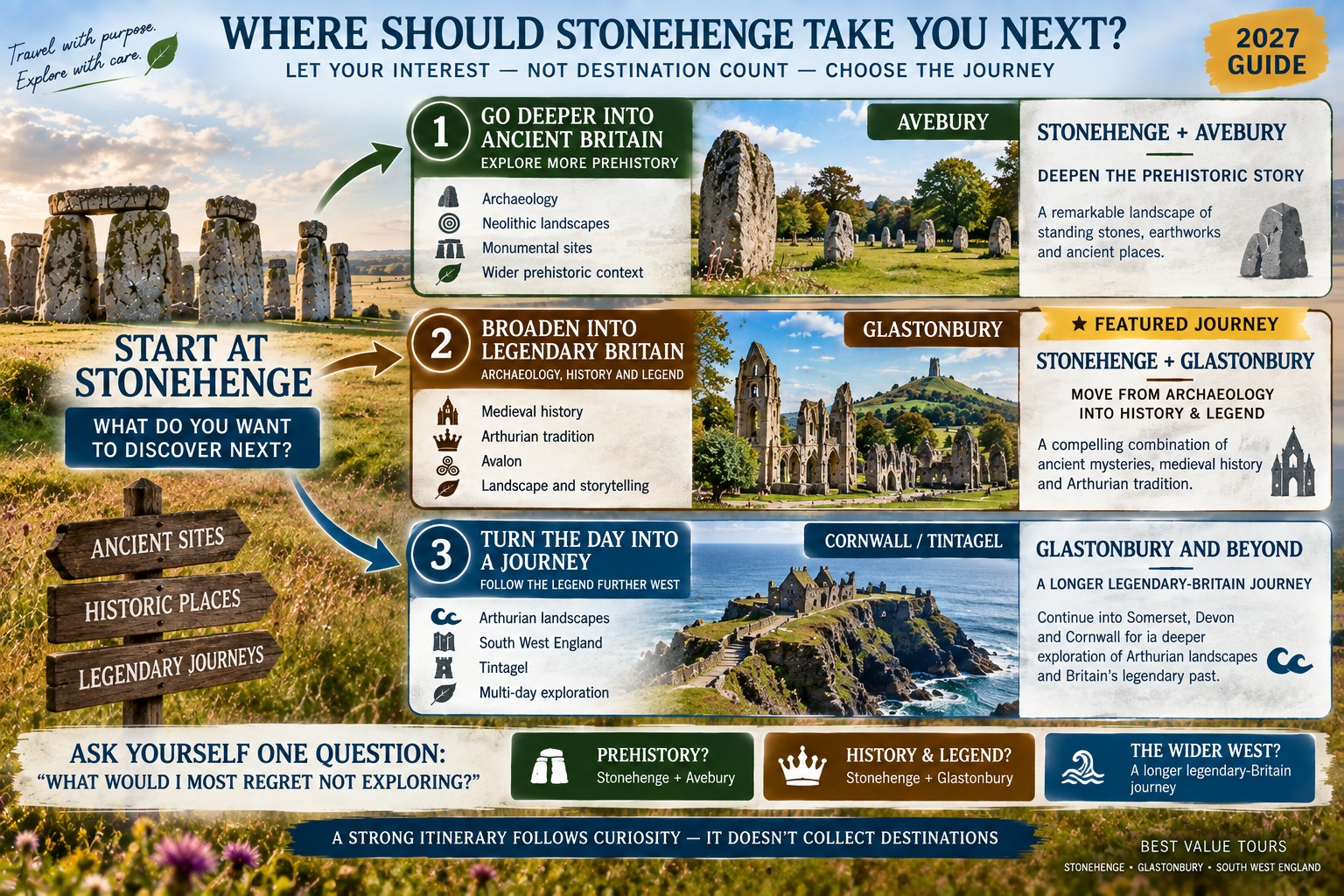
Where you travel after Stonehenge should depend on what interests you most. Choose Avebury to deepen the prehistoric story, Glastonbury to broaden the journey into history and Arthurian legend, or continue west when your curiosity has developed into a wider South West England adventure
🧭 Should You Continue Beyond Glastonbury?
For some travellers, Glastonbury will complete the journey.
For others, it will open a door.
Interest in Arthur, Avalon and legendary landscapes can naturally lead towards other places associated with the Arthurian tradition. Interest in Somerset may expand towards Devon, Cornwall, Tintagel and a wider exploration of South West England.
This is where restraint becomes particularly important.
Do not respond to every new interest by adding another stop to the same day.
Once several destinations beyond Glastonbury become genuine priorities, you are no longer planning a Stonehenge day trip—you are designing a journey.
That can be an excellent development. It simply requires a different itinerary structure.
👑 When the Journey Becomes an Arthurian-Britain Journey
If the King Arthur story has become the connecting thread between the places you most want to experience, allow that theme to shape the trip.
Stonehenge can remain an important archaeological anchor, but the wider journey may increasingly be driven by legendary landscapes, medieval traditions and places whose cultural identities have become intertwined with Arthurian Britain.
At this stage, the question is no longer how much Arthurian material can be added around Stonehenge. It is whether Stonehenge should become one chapter within a dedicated legendary-Britain journey.
🌊 When the Journey Becomes a South West England Journey
A different transition occurs when geography becomes the stronger pull.
Glastonbury may stimulate interest in exploring further west through Somerset and towards Devon and Cornwall. Tintagel, coastal landscapes and other South West destinations can then become genuine priorities rather than optional additions.
When that happens, the strongest itinerary is unlikely to be a progressively longer Stonehenge day. It is a western England journey in which Stonehenge provides a memorable beginning or major stage.
⭐ Editor’s Recommended Tour: Continue into South West England
For travellers whose interests have expanded beyond Stonehenge and Glastonbury into a broader western England journey, the 5 Day South-West, Devon and Cornwall provides the strongest progression among BVT’s current priority tours.
This recommendation serves a different traveller from the dedicated Arthurian journey. It is most appropriate when geography has become the deciding factor and you now want to continue westwards through Devon and Cornwall rather than treating every new destination as another addition to a Stonehenge-based day.
The advantage is structural: once your wish list has expanded into a genuine South West England itinerary, a multi-day journey allows those destinations to become part of the trip’s purpose rather than rushed extensions around Stonehenge.
If Glastonbury remains the furthest west you genuinely want to travel, there is no reason to expand the itinerary simply because more destinations are available. But when Devon and Cornwall have become priorities in their own right, continuing into South West England represents a natural evolution of the journey.
✅ Eight-Question Decision Framework: Is Stonehenge and Glastonbury Right for You?
If you are still undecided, work through these questions in order.
1. What Is the Main Reason You Want to Visit Stonehenge?
Is Stonehenge the defining experience of the day, or one important destination within a broader journey?
If it is overwhelmingly your priority, protect its time first.
2. What Specifically Attracts You to Glastonbury?
Is it the Abbey, the Tor, Arthurian tradition, the town, the landscape or the combination?
“Glastonbury” is too broad an answer for useful itinerary planning.
3. Are You More Interested in Archaeology or in History and Legend?
If prehistoric archaeology dominates your interest, Avebury may be the stronger companion to Stonehenge.
If you want the journey to move into medieval history, landscape and Arthurian tradition, Glastonbury offers the greater contrast.
4. Which Part of Glastonbury Would You Most Regret Missing?
Your answer reveals how much time the destination really deserves.
If the Abbey alone would satisfy your interest, a focused visit may work. If the Abbey, Tor and town all feel essential, Glastonbury has become a major component of the journey.
5. How Much Usable Sightseeing Time Do You Actually Have?
Think beyond the theoretical length of the day.
Road travel, walking, meals, rest, traffic, parking or transfer arrangements and daylight all reduce the time available for meaningful sightseeing.
6. Does Your Stonehenge Experience Create a Fixed Constraint?
Specialist access or another time-sensitive Stonehenge arrangement can determine the structure of the entire itinerary.
If so, build around that first.
7. Would Glastonbury Enrich the Journey or Merely Fill the Day?
This is perhaps the most important question.
A destination should earn its place by making the journey more meaningful, not simply by occupying available hours.
8. Is This Really Becoming a Longer South West England Journey?
If Glastonbury has led you towards Somerset, Arthurian landscapes, Tintagel, Devon or Cornwall, acknowledge that the nature of the trip has changed.
You may get far more from several days built around those interests than from continually extending a single Stonehenge itinerary.
Your answers should point towards one of three broad conclusions:
- Choose Stonehenge + Glastonbury if the transition from archaeology into history and legend genuinely appeals to you and you can give both destinations enough time.
- Choose Stonehenge alone or another combination if Glastonbury mainly adds travel without adding something you particularly value.
- Choose a longer legendary-Britain or South West England journey if Glastonbury has revealed that your real interest extends well beyond a one-day itinerary.
The strongest itinerary is usually the one that protects the experiences you would most regret rushing or missing.
That is also the point at which the most appropriate BVT journey should change with the traveller. A one-day solution, a dedicated Arthurian journey and a wider South West England itinerary answer different planning problems. The purpose is not to progress automatically towards a longer tour, but to recognise when your own priorities have naturally changed the type of journey you are planning.
🌱 Responsible Travel Through Ancient and Legendary Landscapes
Responsible travel in a Stonehenge-and-Glastonbury journey begins with designing a coherent route.
Trying to cover too many distant destinations in one day can increase unnecessary road travel while reducing the quality of the experiences themselves. A more disciplined itinerary—whether a focused day or a properly structured multi-day journey—can often make better use of both time and transport.
At Stonehenge, respect access restrictions, marked visitor routes and the protected archaeological landscape. The monument is part of a much wider prehistoric environment, and responsible visiting means treating that landscape as more than a backdrop for the stones.
At Glastonbury, use established routes when visiting the Tor, consider weather and ground conditions, and remember that the Abbey, town and surrounding landscape are historic places as well as visitor attractions. Glastonbury is also a living community, and its religious and spiritual associations continue to matter to many people.
Where practical, shared transport can reduce the number of separate vehicle journeys between destinations, although route efficiency, group size, accessibility and the actual structure of the trip should all be considered.
A multi-day itinerary is not automatically more sustainable simply because it is slower. Additional accommodation and travel should serve a genuine purpose. Equally, forcing several widely separated priorities into one rushed day is not necessarily the better answer.
The most useful principle is simple:
Build a coherent journey rather than collecting distant landmarks.
Travel slowly enough to understand why these places matter, respect the landscapes and communities through which you move, and choose experiences because they contribute meaningfully to the journey.
Travel with purpose. Explore with care.
❓ Frequently Asked Questions
Is Glastonbury Worth Visiting With Stonehenge?
Yes, if you are interested in more than prehistoric archaeology. Glastonbury adds medieval history, Arthurian tradition, landscape and a distinctive town experience. The combination is strongest for travellers who value that contrast rather than simply wanting another famous stop.
Can You Visit Stonehenge and Glastonbury in One Day?
Yes. A one-day journey can work well when Stonehenge and Glastonbury are the principal destinations and you have clear priorities at each. It becomes less convincing when additional major stops are continually added or when you want an extensive Glastonbury visit alongside a specialist Stonehenge experience.
How Are Stonehenge and Glastonbury Connected?
Their strongest connection for modern travellers is thematic rather than evidence that the two places formed part of one ancient system. Stonehenge represents prehistoric archaeology, while Glastonbury brings medieval history, Arthurian tradition, landscape and later cultural interpretation into the journey.
Was Glastonbury Really Avalon?
Glastonbury has a longstanding association with Avalon, but its identification as the Avalon of Arthurian tradition is not established historical fact. The association remains culturally important because it has shaped the way Glastonbury has been interpreted for centuries.
Is King Arthur Buried at Glastonbury Abbey?
Medieval accounts claimed that the remains of Arthur and Guinevere were discovered at Glastonbury Abbey. These claims form an important part of the Abbey’s history and Arthurian reputation, but they are not accepted as definitive evidence that a historical King Arthur was buried there.
Is Glastonbury Tor Worth Visiting?
For travellers interested in landscape, views and atmosphere, yes. The Tor adds a very different dimension to an Abbey-focused visit. However, reaching it involves walking, and weather, ground conditions and mobility should be considered when planning the day.
Which Is Better With Stonehenge: Glastonbury or Avebury?
Choose Avebury if you want to deepen the prehistoric archaeological story. Choose Glastonbury if you want to broaden the journey into medieval history, landscape and Arthurian legend.
Neither is universally better. The stronger choice depends on what you most want the Stonehenge journey to become.
Do You Need Stonehenge Inner Circle Access for This Journey?
No. A standard Stonehenge visit can work extremely well and may provide greater flexibility within a Stonehenge-and-Glastonbury itinerary.
Inner Circle access is most worthwhile when entering the stone circle is itself one of your principal travel priorities. If it is, investigate access before fixing the rest of the journey because its timing may determine the structure of the day.
Should You Visit Glastonbury Abbey or the Tor?
Choose the Abbey if medieval history and Arthurian tradition are your main interests. Choose the Tor if landscape, views and atmosphere matter more.
If both are important, allow enough time for both rather than treating Glastonbury as a brief secondary stop.
Is Stonehenge and Glastonbury Suitable for First-Time Visitors?
Yes, particularly for first-time visitors who are genuinely interested in archaeology, history and legendary Britain.
However, travellers with very limited time should compare Glastonbury with other priorities such as Bath, Avebury or additional time elsewhere in Britain. The combination works best because its different experiences appeal to you, not simply because both destinations are famous.
Is This Journey Suitable for Families?
It can be, particularly for families with older children who enjoy history, archaeology, legends and outdoor exploration.
The main consideration is pacing. Road travel, a substantial Stonehenge visit, historic ruins and a possible Tor walk can create a demanding day. Families should prioritise the experiences most likely to hold everyone’s interest rather than attempting every possible element.
Should You Stay Overnight?
Consider staying overnight when both Stonehenge and Glastonbury are major priorities, when specialist Stonehenge access creates awkward timing, or when you want to explore the Abbey, Tor and town without rushing.
An overnight can also make sense when Glastonbury is becoming the beginning of a wider Somerset, Arthurian or South West England journey.
What Else Can You Combine With Stonehenge and Glastonbury?
Avebury is a natural choice for travellers wanting additional prehistoric archaeology, while broader Arthurian interests may lead towards legendary landscapes associated with King Arthur. Travellers continuing west may also begin exploring Somerset, Devon, Cornwall and places such as Tintagel.
The important principle is not to add every appealing destination to the same day. Once several of these places become genuine priorities, consider changing from a day trip to a multi-day journey.
How Far Ahead Should You Plan for 2027?
If you want a standard Stonehenge visit and a relatively flexible Glastonbury itinerary, you may have considerable freedom in how you structure the journey.
If specialist Stonehenge access, particular accommodation, a guided experience or a fixed travel date is important, planning earlier is sensible. Identify the least flexible element first and build the rest of the itinerary around it.
🏁 Conclusion: From Ancient Monument to Legendary Landscape
Stonehenge and Glastonbury can create an exceptional journey precisely because they represent such different ways in which Britain’s past has survived.
Stonehenge confronts you with prehistoric engineering, archaeology and questions that reach back thousands of years. Glastonbury introduces medieval history, ruined religious architecture, dramatic landscape and legends that have been reshaped by generations of storytellers and visitors.
Moving between them can therefore create a remarkable progression: from material archaeology into documented history and then into the accumulated traditions through which later generations imagined Britain’s past.
But the combination works best when both destinations genuinely matter to you.
If Glastonbury is being added simply because it is famous, a simpler Stonehenge itinerary may be stronger. If the Abbey, Tor, Arthur, Avalon or historic landscapes genuinely fascinate you, give Glastonbury enough time to become a real experience rather than a hurried second stop.
And if the journey begins pulling you further west—towards Somerset, Arthurian landscapes, Tintagel, Devon or Cornwall—recognise that Stonehenge may no longer be the centre of a day trip. It may be the starting point for something larger.
That is the wider planning principle running through this guide: recommend the next journey only when the traveller has naturally reached it. A longer itinerary is valuable when it answers a real interest, not simply because more destinations can be added.
Choose Stonehenge and Glastonbury because you want to travel from archaeology into history and legend. Give each enough time to retain its own character, and the result can become a genuine journey through Britain’s ancient and legendary landscapes rather than simply two famous stops in one day.