


The Real Geography of King Arthur and Merlin: Following Britain’s Legendary Landscape (2026 Guide)
2nd August 2026
🏛️ The Real Geography of King Arthur and Merlin: Following Britain’s Legendary Landscape (2026 Guide)
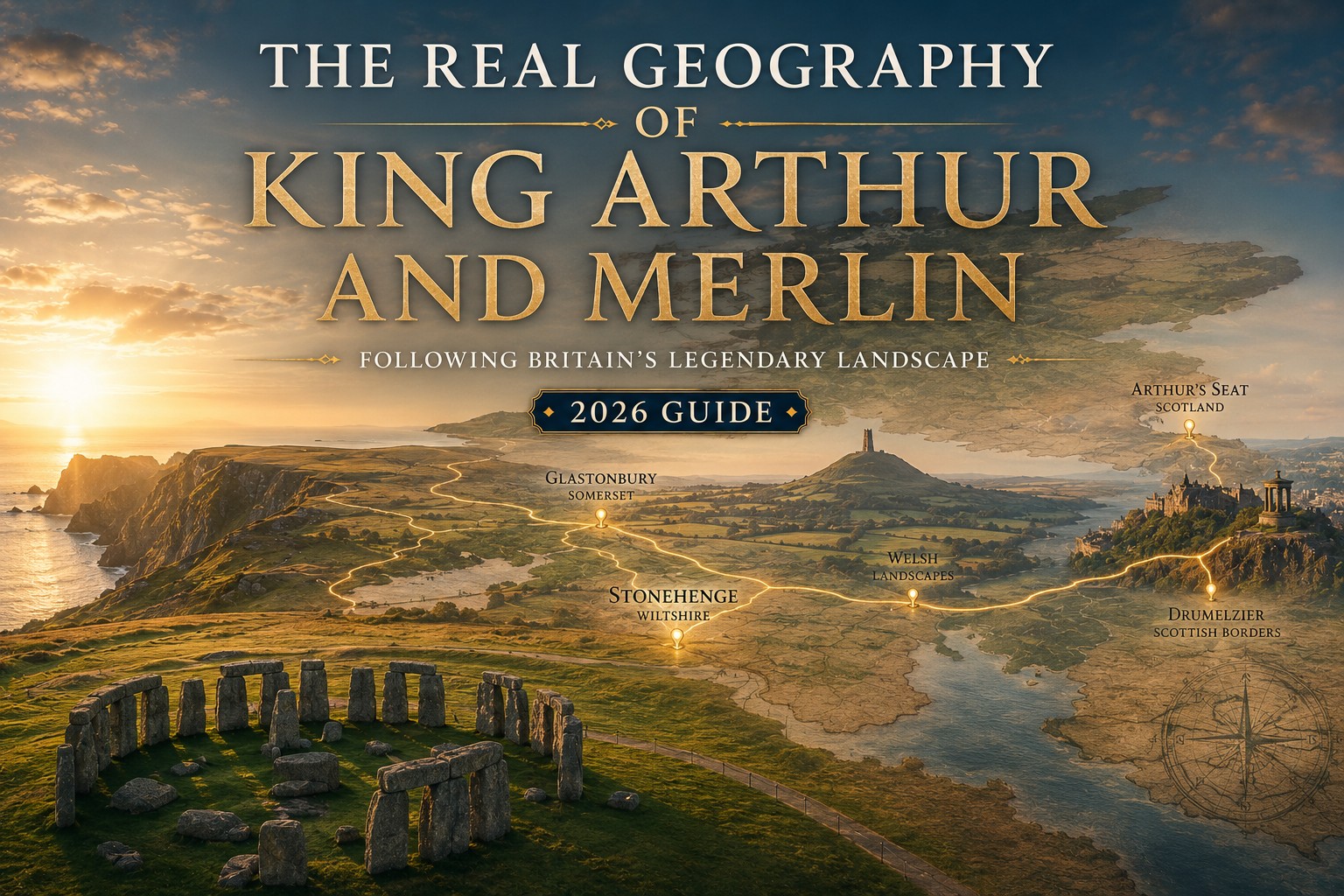
Britain’s legendary landscape is not one fixed map but several overlapping geographies. This illustration traces the connections between Stonehenge, Arthurian England, Wales and Scotland, showing how archaeology, literature and local tradition together shaped Britain’s greatest legends
Britain’s Arthurian and Merlin traditions are often presented as though they belong to one seamless world. Stonehenge, Camelot, Avalon, Tintagel, Welsh prophecy and Merlin’s Scotland can appear to form a single ancient map, waiting to be followed from one legendary place to the next.
The reality is more complex—and more rewarding.
These locations were never part of one documented journey undertaken by King Arthur or Merlin. Instead, they belong to several overlapping geographies created across different periods. Archaeology anchors some places in material history. Medieval writers attached powerful stories to others. Regional folklore preserved additional traditions, while modern travellers now connect them into routes that can be explored across England, Wales and Scotland.
When those places are marked on a map, a striking pattern emerges. Stonehenge provides the prehistoric starting point on Salisbury Plain. Arthurian traditions spread across Cornwall, Somerset and southern England. Welsh literature preserves some of the deepest roots behind the figure who became Merlin, while the Scottish Borders and later Scottish folklore carry his legendary afterlife northwards.
This guide follows that selected route, not as a claim that every legend describes real events, but as an exploration of how stories became attached to real landscapes. It will distinguish archaeological evidence from medieval literature, direct local traditions from later associations, and historical geography from the map experienced by travellers today.
Britain does not possess one definitive Arthurian map. It possesses several maps layered over one another.
To understand the real geography of King Arthur and Merlin, it helps to begin with the place where prehistory and later storytelling meet with exceptional force.
🗺️ Britain’s Legendary Geography at a Glance
Britain’s legendary landscape is not one fixed map but a series of overlapping geographies shaped by archaeology, medieval literature, regional tradition and modern travel. This guide follows how these different layers connect some of Britain’s most iconic destinations into one remarkable journey.
| Region | Principal Location | Legendary Importance |
|---|---|---|
| 🪨 Wiltshire | Stonehenge | The prehistoric starting point where archaeology and Merlin’s later literary tradition meet. |
| 👑 Southern England | Tintagel, Glastonbury & Winchester | The heart of Britain’s Arthurian traditions, developed through medieval literature and local legend. |
| 🐉 Wales | The Literary Landscape of Myrddin | The earliest literary traditions that inspired the legendary figure later known as Merlin. |
| 🧙 Scottish Borders | Drumelzier | Home to one of Britain’s strongest long-standing regional traditions surrounding Merlin. |
| 🏔️ Scotland | Arthur’s Seat & the Highlands | Landscapes where Arthurian traditions, Gaelic mythology and Scotland’s own legendary heritage intertwine. |
🧭 Understanding Britain’s Legendary Landscape
Rather than following one historical route, this guide explores four interconnected perspectives: archaeology, medieval literature, regional folklore and modern travel. Together, they reveal how real landscapes gradually became woven into Britain’s greatest legends.
🪨 Stonehenge — Where Britain’s Legendary Geography Begins
Stonehenge stands on Salisbury Plain in Wiltshire, far from many of the places most strongly associated with King Arthur. Yet it remains the ideal starting point because it demonstrates how an ancient landscape can acquire new meanings long after its original builders have disappeared from living memory.
Construction began around 3000 BC, with the principal stone settings developing later during the Neolithic period. The monument therefore predates the historical eras associated with Druids, Arthur or Merlin by thousands of years. Its builders left no written explanation of what the site meant to them, creating an interpretive space that later generations repeatedly filled.
Geoffrey of Monmouth transformed that space in the twelfth century by connecting Merlin with the transport of the Giants’ Dance to Salisbury Plain. Archaeology does not support the story as an account of Stonehenge’s construction, but Geoffrey’s narrative permanently changed the monument’s literary geography.
From that point onward, Stonehenge existed on more than one map: as a prehistoric monument, a medieval legendary setting and a modern destination where visitors encounter both histories together.
📍 Stonehenge on Three Different Maps
Stonehenge occupies more than one place in Britain’s story. Its physical location has never changed, but its meaning has evolved as archaeology, medieval literature and modern travel each added a new layer to its identity.
| Perspective | What Stonehenge Represents | Key Takeaway |
|---|---|---|
| 🏛️ Historical Geography | A Neolithic ceremonial monument standing within the wider prehistoric landscape of Salisbury Plain. | Explains when Stonehenge was built and the archaeological evidence that survives today. |
| 📖 Literary Geography | The setting for Geoffrey of Monmouth’s story of Merlin transporting the Giants’ Dance to Salisbury Plain. | Shows how medieval writers transformed an ancient monument into part of Britain’s legendary history. |
| 🧭 Travel Geography | The natural gateway for exploring Stonehenge, Arthurian England, Wales and Merlin’s Scotland. | Demonstrates why Stonehenge remains the ideal starting point for Britain’s legendary landscape today. |
💡 One Monument. Three Different Maps.
Stonehenge’s physical location has remained unchanged for more than 4,500 years, but its place in Britain’s story has continually evolved. Archaeology explains its origins, medieval literature gave it legendary meaning, and modern travel brings both perspectives together—allowing visitors to experience one monument through three complementary lenses.
🧭 Stonehenge on Three Different Maps
Stonehenge’s physical location is straightforward. It stands in Wiltshire within one of Europe’s most important prehistoric landscapes, surrounded by burial mounds, ancient avenues and other archaeological features that help explain how the monument developed over time.
Its literary location is more complicated.
Geoffrey of Monmouth’s account places Stonehenge within a much wider legendary geography involving Ireland, kingship, conflict and Merlin. In his version, the monument’s stones belonged to the Giants’ Dance on Mount Killaraus before being transported to Salisbury Plain. This is not archaeological evidence, but it demonstrates how medieval literature expanded Stonehenge beyond Wiltshire and connected it with a national story.
Its modern travel geography adds a third layer. Visitors now experience Stonehenge as both a prehistoric monument and a cultural gateway into the wider landscapes associated with Arthur and Merlin. It is often the first place travellers encounter before continuing towards Glastonbury, Tintagel, Wales or Scotland.
📊 Stonehenge’s Place in Britain’s Legendary Geography
| Perspective | Stonehenge’s Role |
|---|---|
| Historical Geography | A Neolithic monument within the wider Stonehenge landscape of Salisbury Plain |
| Literary Geography | The setting for Geoffrey of Monmouth’s Merlin and Giants’ Dance narrative |
| Travel Geography | A practical and symbolic starting point for exploring Arthurian and Merlin locations across Britain |
These three perspectives do not carry equal evidential weight. Archaeology explains the monument’s material history, while literature records how later generations interpreted it. Modern travel brings both together, allowing visitors to experience a place that is historically ancient and culturally layered.
The same pattern appears repeatedly across Britain. Tintagel is both an archaeological site and Arthur’s legendary birthplace. Glastonbury is both a medieval religious centre and the traditional Avalon. Drumelzier is both a real Borders village and the setting of a long-standing Merlin tradition.
Understanding those overlapping maps is the key to following Britain’s legendary landscape responsibly.
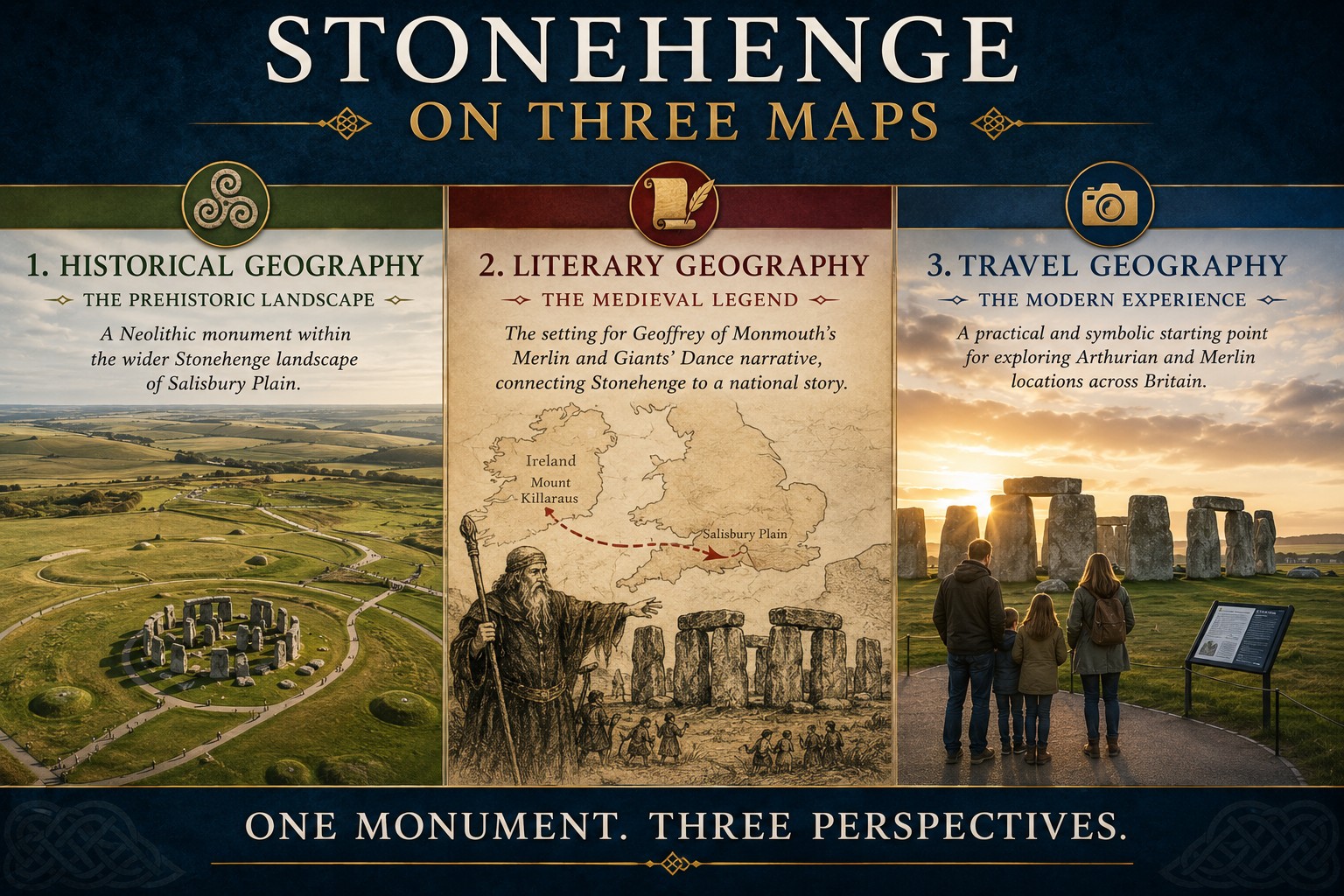
Stonehenge can be understood in three different ways: as a prehistoric archaeological monument, as the legendary Stonehenge of Geoffrey of Monmouth’s Merlin, and as the starting point for exploring Britain’s wider Arthurian and Merlin landscapes
👑 Arthurian England — The Geography of a Legendary King
From Salisbury Plain, the route moves west into the landscapes most strongly associated with King Arthur.
Arthurian geography is not organised around one proven capital, birthplace or kingdom. Instead, it developed through early Welsh tradition, medieval literature, regional storytelling and later historical interpretation. This explains why multiple places claim connections with Camelot, Avalon, Arthur’s birth or his final resting place.
The result is not one definitive Arthurian map, but a network of locations that each preserve a different part of the legend.
👑 Explore the Heart of Arthurian England
Arthur’s legend is woven into some of England’s most remarkable landscapes. Continue your journey beyond Stonehenge to discover the castles, abbeys and historic places that have shaped Britain’s greatest legendary king for nearly a thousand years.
⚔️ Stonehenge & King Arthur Sites Tour
Follow one of Britain’s most fascinating legendary journeys as you explore Stonehenge alongside the landscapes traditionally associated with King Arthur, including Glastonbury, Tintagel and other iconic destinations where history and legend meet.
🏰 Tintagel Castle & King Arthur
Discover Cornwall’s spectacular clifftop castle, traditionally regarded as King Arthur’s birthplace, and explore the archaeological discoveries and medieval traditions that continue to inspire visitors today.
🧭 Continue the Legendary Journey
Stonehenge introduces Britain’s legendary landscape, but Arthur’s story stretches much further. Travelling west through Glastonbury and Tintagel reveals how medieval writers, local traditions and remarkable historic landscapes combined to create one of the world’s greatest enduring legends.
👑 Arthurian England — The Geography of a Legendary King
King Arthur’s legend became attached to some of England’s most remarkable landscapes, but not because historians proved that every event occurred exactly where later tradition claimed.
Instead, the geography evolved over centuries.
Medieval chroniclers, local traditions and later writers each contributed to a growing map that linked Arthur with castles, abbeys, hills and ancient settlements. Rather than competing with one another, these places together illustrate how Britain’s greatest legendary king gradually became woven into the country’s physical landscape.
🔍 Tintagel — Arthur’s Traditional Birthplace
No Arthurian destination is more famous than Tintagel on Cornwall’s dramatic Atlantic coastline.
Geoffrey of Monmouth identified Tintagel as Arthur’s birthplace, and the location quickly became central to medieval Arthurian tradition. Archaeology, however, tells a more measured story. Excavations have revealed that Tintagel was an important high-status settlement during the post-Roman period, demonstrating that it was a place of genuine political and cultural importance during the centuries when an historical Arthur, if one existed, may have lived.
That evidence does not confirm Arthur’s birth at Tintagel.
Instead, it explains why medieval writers found the location such a convincing setting for Britain’s greatest legendary king.
🔍 Glastonbury — Avalon and the Medieval Imagination
Travelling east into Somerset brings visitors to Glastonbury, another place where history and legend became closely intertwined.
For centuries, Glastonbury has been associated with the mythical island of Avalon, where Arthur was said to have been taken after the Battle of Camlann. During the twelfth century, the monks of Glastonbury Abbey announced that they had discovered the graves of Arthur and Queen Guinevere. Most historians now regard this as a medieval claim rather than historical proof, yet it permanently strengthened Glastonbury’s position within Arthurian geography and attracted pilgrims from across medieval Europe.
Today, visitors experience both traditions together. The abbey’s genuine medieval importance combines with centuries of Arthurian storytelling to create one of Britain’s most evocative historic landscapes.
🔍 Winchester and the Search for Camelot
No single location has ever been universally accepted as Camelot.
Winchester remains one of the strongest later candidates because of its royal history and the famous medieval Round Table displayed within the Great Hall. Other places, including Cadbury Castle in Somerset, have also been proposed by historians and enthusiasts over the years.
Rather than searching for one definitive Camelot, it is more helpful to recognise that the legend expanded geographically as different communities and writers embraced Arthur’s story.
📊 Arthurian England at a Glance
| Destination | Traditional Association | Historical Context | Visitor Experience |
|---|---|---|---|
| Tintagel | Arthur’s traditional birthplace | Important post-Roman settlement | Spectacular coastal scenery and medieval castle ruins |
| Glastonbury | Avalon and Arthur’s legendary burial | Medieval abbey and pilgrimage centre | Historic ruins, Glastonbury Tor and centuries of folklore |
| Winchester | Later Camelot tradition | Historic royal city with the medieval Round Table | Cathedral, Great Hall and royal heritage |
| Cadbury Castle | Alternative Camelot candidate | Iron Age hillfort with long-standing Arthurian associations | Earthworks, countryside walks and legendary connections |
Arthur’s geography dominates southern England, but the legendary figure who became his adviser has deeper literary roots elsewhere.
To understand Merlin properly, the journey must next cross into Wales.
🐉 Wales — The Literary Roots of Merlin
To understand the real geography of Merlin, it is necessary to step away from Arthurian England and look west towards Wales, where many of the earliest literary traditions connected with the character first emerged.
Before Merlin became the familiar court adviser, magician and prophet of medieval romance, Welsh tradition preserved stories of a figure known as Myrddin. Rather than living in royal courts or directing kings, Myrddin was portrayed as a prophetic and troubled figure whose life became closely associated with battle, exile and the wilderness. Although these traditions survive through medieval manuscripts rather than contemporary records, they represent some of the deepest literary roots from which the later Merlin developed.
Understanding this distinction is important because it reminds us that Merlin’s geography did not begin at Stonehenge.
It began within a very different literary landscape.
🔍 From Myrddin to Merlin
During the twelfth century, Geoffrey of Monmouth drew upon earlier Welsh traditions while reshaping them into a new literary character who could serve within his wider history of Britain’s kings.
He did far more than simply rename Myrddin.
Instead, he combined earlier prophetic traditions with new political and historical themes, creating the Merlin who became inseparably linked with King Arthur, Stonehenge and Britain’s medieval legendary history. From that point onwards, Merlin’s geographical world expanded dramatically beyond Wales.
This explains why modern travellers encounter Merlin across several different regions.
His earliest literary roots lie in Wales.
His most famous medieval association belongs to Stonehenge.
His best-known royal connections appear within Arthurian England.
His later regional traditions continue into Scotland.
Rather than contradicting one another, these locations represent different stages in the development of one of Britain’s most influential legendary figures.
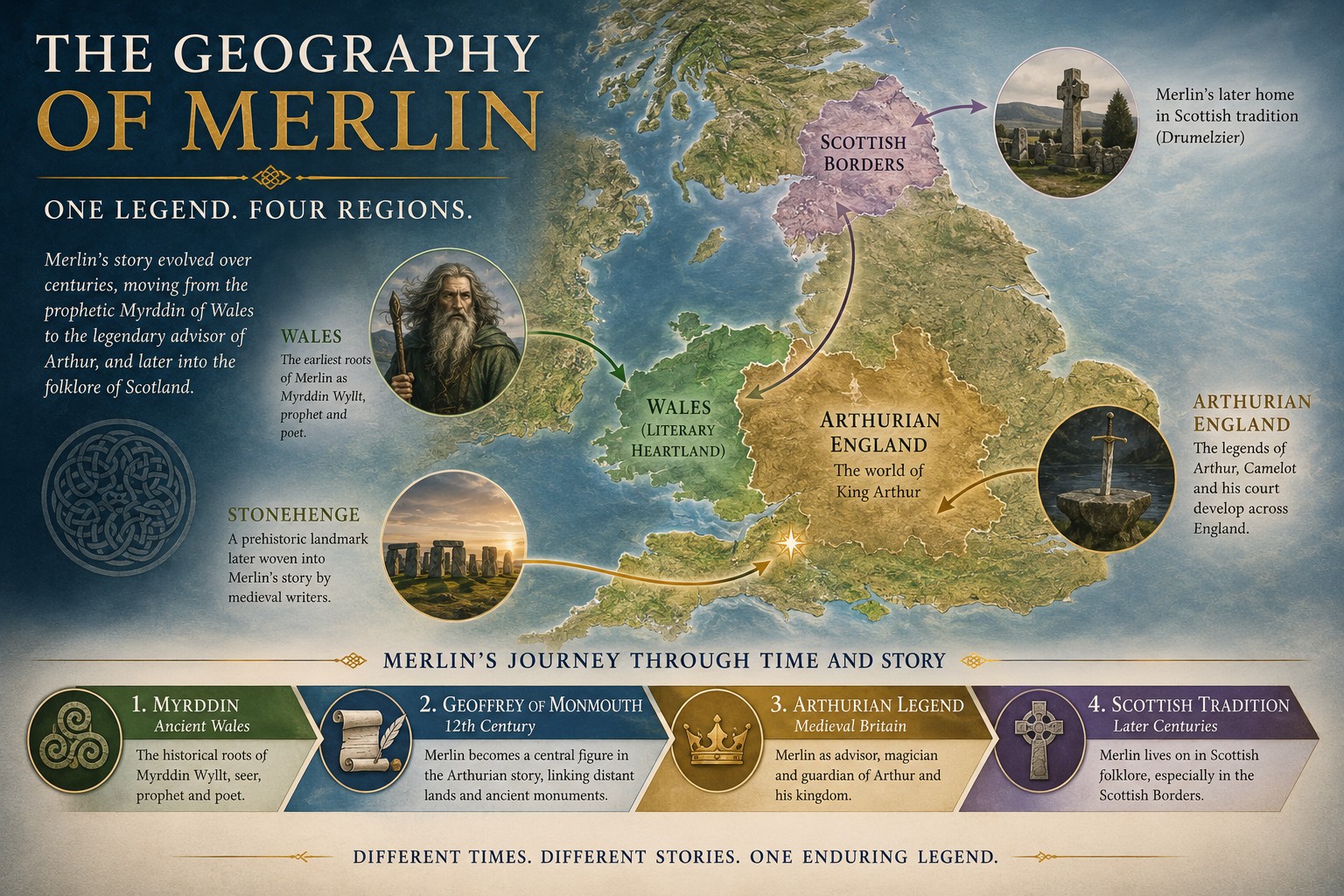
Merlin’s story did not belong to one place. It evolved over centuries, beginning with the Welsh traditions of Myrddin before expanding through medieval literature to Stonehenge, Arthurian England and Scotland’s enduring regional folklore
🧙 Merlin’s Geographical Evolution
The Merlin familiar to modern readers did not appear in one place or at one moment in history. His story evolved over centuries as different regions, writers and traditions shaped one of Britain’s most enduring legendary figures.
① Early Welsh Tradition
🐉 Myrddin
The earliest literary roots lie within Welsh tradition, where Myrddin appears as a prophetic figure closely associated with battle, exile and the wilderness.
② Twelfth Century
📖 Geoffrey of Monmouth
Geoffrey reshaped earlier Welsh traditions into the Merlin recognised today, linking him with Britain’s kings and introducing the famous Stonehenge narrative.
③ Arthurian England
👑 Merlin the Royal Adviser
Through medieval romance, Merlin became inseparably connected with King Arthur, Camelot, prophecy and the wider legendary geography of southern England.
④ Scotland
🏔️ Merlin’s Northern Legacy
Later regional traditions carried Merlin’s story into the Scottish Borders and beyond, where places such as Drumelzier became closely associated with his final years.
💡 Merlin’s Story Travelled Across Britain
Merlin’s geography did not move because one historical figure journeyed across Britain. Instead, his legend expanded as successive writers and communities attached new stories to different landscapes. Understanding that evolution helps explain why Wales, Stonehenge, Arthurian England and Scotland all preserve authentic—but different—parts of Merlin’s remarkable legacy.
📊 The Geographical Evolution of Merlin
| Region | Merlin’s Association | Geographical Importance |
|---|---|---|
| Wales | Early literary traditions surrounding Myrddin | Foundation of Merlin’s legendary character |
| Wiltshire | Geoffrey of Monmouth’s Stonehenge narrative | Merlin enters Britain’s national legendary history |
| Arthurian England | Adviser, prophet and counsellor to King Arthur | Expansion through medieval literature |
| Scottish Borders | Long-standing local Merlin traditions | Regional continuation of Merlin’s legendary legacy |
This progression illustrates one of the article’s central themes.
Britain’s legendary geography was never fixed.
It evolved as stories travelled between regions, writers adapted earlier traditions and local communities embraced characters that had already become part of Britain’s shared cultural imagination.
The final major stage of that journey lies north of the border, where Merlin’s story found a lasting home within some of Scotland’s most atmospheric landscapes.
🧙 Merlin’s Scotland — The Legend’s Northern Geography
By the time Merlin’s story reached Scotland, it had already evolved far beyond its earliest Welsh roots.
Instead of remaining solely the prophetic Myrddin of early tradition or the royal adviser of Arthurian romance, Merlin became connected with new landscapes that reflected Scotland’s own history, folklore and cultural identity. These associations developed gradually through regional tradition rather than archaeology, creating a northern geography that complements rather than replaces the earlier English and Welsh traditions.
The strongest of these connections is found in the Scottish Borders.
🔍 Drumelzier — Scotland’s Strongest Merlin Tradition
Among all the places associated with Merlin in Scotland, Drumelzier has the longest-established local tradition.
Situated near the meeting of the River Tweed and Powsail Burn, the village has for centuries been identified by local folklore as the place where Merlin—often linked with the prophetic Myrddin—met his end. No archaeological evidence confirms this tradition, yet it remains one of Britain’s most enduring regional Merlin associations and continues to attract visitors interested in the legendary geography of the British Isles.
Part of its appeal lies in the landscape itself.
The wooded valleys, gently flowing rivers and peaceful countryside create an atmosphere entirely different from the windswept cliffs of Tintagel or the open chalk landscape surrounding Stonehenge. Rather than dramatic spectacle, Drumelzier offers quiet reflection, making it an appropriate setting for one of Britain’s most contemplative legendary traditions.
🔍 Arthur’s Seat — A Landmark Within Scotland’s Legendary Landscape
Travelling north to Edinburgh introduces another important landmark.
Arthur’s Seat is connected primarily with Arthurian tradition rather than with Merlin directly. Rising above Scotland’s capital, the extinct volcano has long been associated with Britain’s legendary king, although no historical evidence links it to Arthur’s lifetime. Its importance lies in demonstrating how Arthurian geography expanded beyond England and became woven into Scotland’s own cultural landscape.
The summit also offers one of Britain’s finest panoramic viewpoints, allowing visitors to appreciate how landscape itself often inspired legendary storytelling.
🔍 Beyond Merlin — Scotland’s Wider Mythical Landscapes
Further north, the Scottish Highlands and the Isle of Skye belong to a broader world of Scottish mythology rather than direct Merlin tradition.
Ancient glens, remote lochs, dramatic mountains and Gaelic folklore have inspired stories of warriors, fairies, prophets and supernatural beings for centuries. These landscapes should not be viewed as primary Merlin sites, yet they help explain why Scotland became such fertile ground for later legendary development.
📊 Scotland’s Legendary Geography
| Destination | Connection Type | Strength of Merlin Association | Visitor Experience |
|---|---|---|---|
| Drumelzier | Long-standing local tradition | Strong | Traditional site associated with Merlin’s final resting place |
| Arthur’s Seat | Arthurian landscape | Indirect | Outstanding views and legendary associations |
| Scottish Highlands | Regional folklore | Indirect | Ancient scenery, clan history and enduring mythology |
| Isle of Skye | Gaelic mythology | Indirect | Fairy traditions, dramatic landscapes and island folklore |
Taken together, these locations demonstrate that Britain’s legendary geography is not a single continuous narrative but a series of interconnected traditions rooted in different regions.
Each landscape preserves its own voice while contributing to the wider story.
🗺️ Britain’s Legendary Route
This selected route follows the geographical development of Britain’s Arthurian and Merlin traditions from prehistoric Stonehenge through southern England and Wales to the Scottish Borders and Edinburgh.
① Stonehenge, Wiltshire
🪨 The Prehistoric Starting Point
Begin where archaeology and later storytelling meet. Stonehenge introduces the distinction between physical history, medieval literature and modern legendary geography.
② Glastonbury, Somerset
👑 Avalon and Arthurian Tradition
Continue west to the medieval abbey, Glastonbury Tor and the long-established traditions connecting this evocative landscape with Avalon and Arthur’s legendary burial.
③ Tintagel, Cornwall
🏰 Arthur’s Traditional Birthplace
Explore the dramatic Atlantic stronghold where genuine post-Roman archaeology and Geoffrey of Monmouth’s influential Arthurian narrative come together.
④ Winchester, Hampshire
⚔️ The Later Geography of Camelot
Discover the historic royal city and its medieval Round Table while considering how different places became associated with Camelot through later tradition.
⑤ Wales
🐉 The Literary Roots of Myrddin
Cross into the landscape of the early Welsh traditions that helped shape Myrddin, the prophetic figure later transformed into the Merlin of medieval literature.
⑥ Drumelzier, Scottish Borders
🧙 Scotland’s Strongest Merlin Tradition
Follow Merlin’s legendary geography north to the peaceful Borders landscape traditionally associated with his final years and resting place.
⑦ Arthur’s Seat, Edinburgh
⛰️ A Northern Arthurian Landscape
Conclude the principal route above Scotland’s capital, where geology, panoramic scenery and Arthurian tradition illustrate how Britain’s legendary geography continued to expand.
🧭 A Connected Travel Route, Not a Historical Journey
This route does not claim that Arthur or Merlin travelled between these destinations. It connects the real landscapes where archaeology, medieval literature and regional tradition preserved different chapters of their evolving legends. For a rewarding experience, explore it in stages rather than treating the destinations as a hurried checklist.
🗺️ Three Ways to Read Britain’s Legendary Geography
One of the reasons debates about King Arthur and Merlin continue today is that people are often looking at different versions of the same landscape.
An archaeologist, a literary historian and a traveller may all visit Stonehenge, Tintagel or Drumelzier and leave with very different conclusions. None of these perspectives answers every question because each is asking something different. Archaeology investigates physical evidence. Literature explores how stories developed. Travel geography considers how modern visitors experience these places today.
Recognising these overlapping perspectives is one of the best ways to understand Britain’s legendary landscape. Rather than forcing history and legend to compete, it allows each to contribute its own layer to the story.
🔍 Historical Geography
Historical geography begins with evidence that can be examined, dated and interpreted.
It explains Stonehenge as one of Europe’s most important prehistoric ceremonial landscapes. It identifies Tintagel as a significant post-Roman settlement, Glastonbury as an influential medieval religious centre and the Scottish Borders as a region with a rich documented history beyond its legendary associations.
Historical geography cannot confirm the existence of Arthur or Merlin as the legendary figures later literature describes. Instead, it provides the physical framework within which those traditions later developed.
🔍 Literary Geography
Literary geography asks a different question.
Instead of asking where events definitely happened, it explores where writers placed them and why those choices proved so influential.
Geoffrey of Monmouth permanently connected Merlin with Stonehenge, while later authors expanded Arthurian traditions around places such as Tintagel, Avalon and Camelot. These literary landscapes became so influential that they continue to shape visitor expectations today, even when archaeology tells a different story.
Rather than dismissing these traditions, it is more useful to recognise them as an important part of Britain’s cultural heritage.
🔍 Travel Geography
Travel geography brings both previous perspectives together.
Today’s visitors can experience Stonehenge, explore Tintagel’s dramatic coastline, walk through the ruins of Glastonbury Abbey, discover the peaceful valley around Drumelzier or climb Arthur’s Seat while appreciating archaeology, literature and local tradition at the same time. Those fortunate enough to join an authorised Stonehenge Inner Circle Access visit can also experience the monument from within the stone circle, adding another memorable dimension to Britain’s legendary landscape.
⚖️ History vs Legend: How to Read Britain’s Legendary Geography
Britain’s legendary places are best understood by separating what the evidence can demonstrate from what literature and tradition later added. Both perspectives matter, but they answer different questions.
| 🏛️ History & Archaeology | 📖 Legend & Literature |
|---|---|
| Begins with physical remains, excavated evidence, scientific dating and surviving historical records. | Begins with medieval writing, oral tradition, regional folklore and later cultural interpretation. |
| Asks what can be demonstrated about a place, its date, use and historical development. | Asks how later generations understood a place and why particular stories became attached to it. |
| Explains Stonehenge as a prehistoric monument, Tintagel as a post-Roman settlement and Glastonbury as a major medieval religious centre. | Connects Stonehenge with Merlin, Tintagel with Arthur’s birth and Glastonbury with Avalon. |
| Recognises uncertainty where the surviving evidence is incomplete. | Preserves cultural memory even where a story cannot be treated as historical fact. |
🧭 Travel Geography Brings Both Together
Modern visitors do not have to choose between history and legend. The richest journeys combine archaeological evidence with literary tradition, allowing each destination to be appreciated both for what can be proved and for the stories that have shaped its cultural identity.
🚗 Following Britain’s Legendary Landscape Today
One of the pleasures of following Britain’s legendary geography is discovering that each region naturally leads to the next.
Stonehenge introduces Britain’s prehistoric past and the mystery that inspired later writers. Cornwall and Somerset reveal how Arthurian traditions spread through medieval literature. Wales provides the literary roots of Merlin, while Scotland preserves some of his strongest regional traditions alongside landscapes that have inspired folklore for centuries.
Although these destinations appear close together on a map, they deserve unhurried exploration. Southern England, Cornwall, Wales and Scotland each reward visitors who allow time to appreciate not only the famous landmarks but also the surrounding countryside, historic towns and quieter places that helped shape Britain’s legendary traditions.
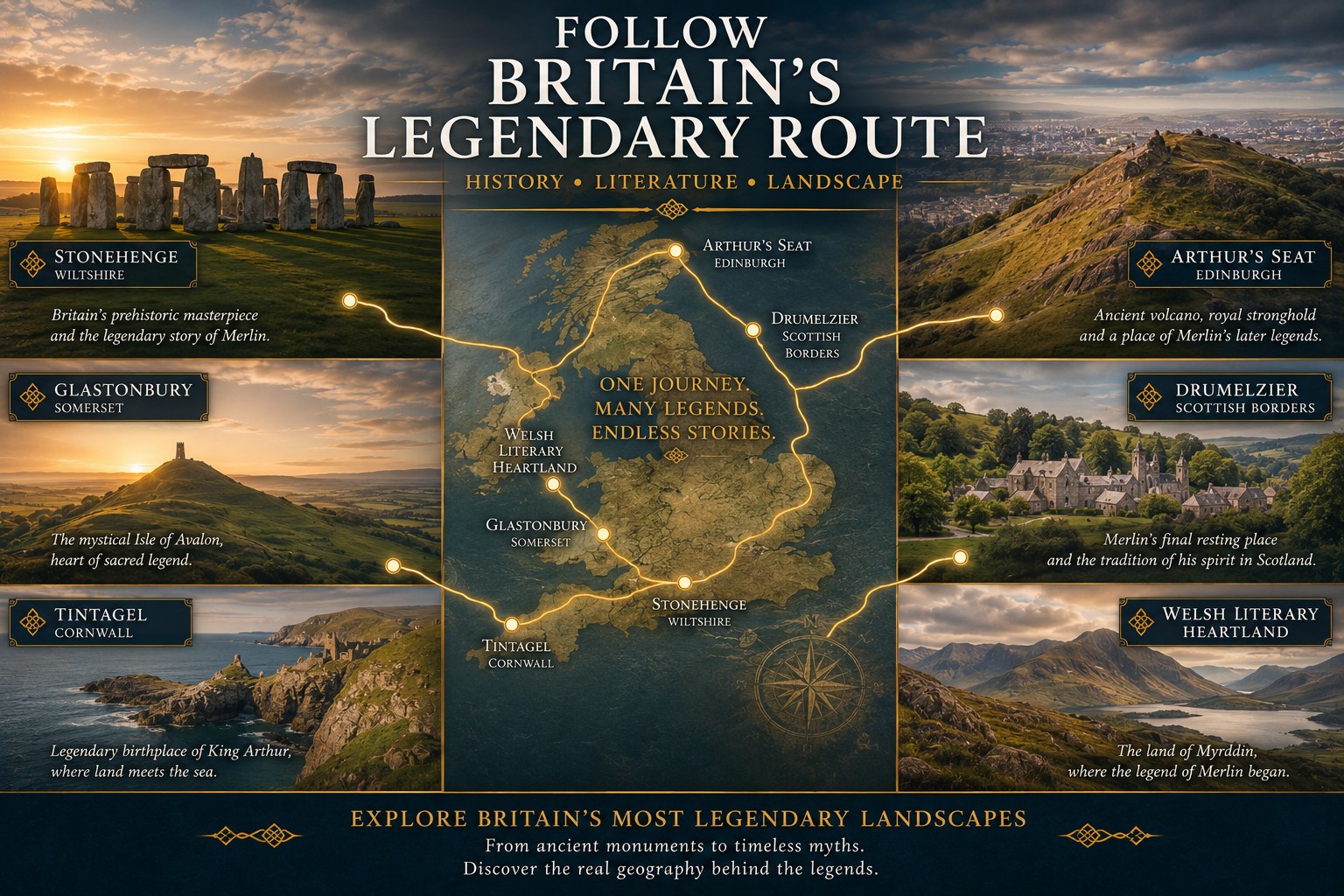
From Stonehenge and Glastonbury to Tintagel, Wales and Scotland, Britain’s legendary route brings together archaeology, medieval literature and regional folklore into one unforgettable journey across the British Isles
📊 Suggested Legendary Britain Itineraries
| Time Available | Suggested Route | Best For |
|---|---|---|
| 1 Day | Stonehenge | An introduction to Britain’s legendary landscape and prehistoric heritage |
| 3–4 Days | Stonehenge, Glastonbury and Tintagel | A rewarding journey through the heart of Arthurian England |
| 5–7 Days | Stonehenge, Glastonbury, Tintagel, Winchester and selected Welsh locations | Exploring the evolution of Arthur and Merlin across southern Britain |
| 10–14 Days | Stonehenge, Arthurian England, Welsh Merlin traditions, Drumelzier, Edinburgh and carefully selected Highland destinations | A comprehensive exploration of Britain’s legendary geography |
These suggested routes are not intended to follow a historical journey made by Arthur or Merlin. Instead, they connect the principal landscapes where archaeology, medieval literature and regional tradition have shaped Britain’s legendary heritage. Travelling at a relaxed pace allows each destination to reveal its own distinct character rather than becoming part of a hurried checklist.
🔍 Why Stonehenge Makes the Ideal Starting Point
Every traveller approaches Britain’s legendary landscape from a different direction, but Stonehenge remains the most natural place to begin.
The monument stands at the meeting point of archaeology and legend. It introduces visitors to Britain’s prehistoric past while also demonstrating how later generations transformed an ancient monument into one of the country’s most enduring literary landmarks. Understanding Stonehenge first makes the later Arthurian and Merlin traditions easier to appreciate because readers can already recognise the distinction between physical evidence, medieval storytelling and local folklore.
Its location also fits naturally within a wider journey. From Salisbury Plain, visitors can continue west towards Glastonbury and Tintagel, cross into Wales to explore the literary roots of Myrddin, or head north to discover the Scottish landscapes where Merlin’s story continued to evolve.
💡 Expert Traveller Tip
Use Stonehenge as the anchor point for your wider itinerary rather than treating it as one stop among many. Check your preferred Stonehenge date first, then build the rest of the journey around it through Glastonbury, Tintagel, Wales or Scotland.
This approach is especially useful when Inner Circle Access is part of your plans because availability is limited to selected dates. Fixing the least flexible experience first makes it much easier to arrange accommodation, transport and the longer regional stages of the journey with confidence.
🧭 BVT Planning Advice
Avoid trying to cover every legendary destination in one rushed route. Choose one or two regions, allow time for the surrounding landscapes and local history, and treat each stop as a distinct chapter rather than a checklist item.
📅 Begin Your Legendary Journey with the BVT Stonehenge Inner Circle Access Calendar
If Britain’s legendary geography has a natural starting point, it is Stonehenge.
Experiencing the monument during an authorised Stonehenge Inner Circle Access visit offers a perspective that relatively few visitors enjoy. Entering the stone circle outside normal opening hours allows you to appreciate the monument’s scale, craftsmanship and atmosphere in a way that complements its remarkable archaeological and literary history.
Because Inner Circle Access is available only on selected dates, planning ahead is highly recommended. The BVT Stonehenge Inner Circle Access Calendar provides a simple way to compare available sunrise and sunset access throughout the year, making it easier to build a wider itinerary around your chosen visit.
Whether you are planning a dedicated Stonehenge experience or using the monument as the first stop on a broader journey through Britain’s legendary landscapes, careful preparation helps you make the most of your visit.
📅 Begin Your Legendary Journey at Stonehenge
Every legendary journey needs a starting point, and for thousands of visitors each year that begins at Stonehenge. If you’re planning to explore Britain’s Arthurian landscapes, Merlin traditions and historic sites, experiencing Stonehenge first provides the perfect foundation.
The Stonehenge Inner Circle Access Calendar makes it easy to compare exclusive sunrise and sunset access dates throughout the year, helping you choose the ideal time to begin your wider Legendary Britain itinerary.
📅 View the Stonehenge Inner Circle Access Calendar
💡 Why Start with Stonehenge?
Stonehenge is the natural gateway to Britain’s legendary geography. Planning your visit here first makes it easier to build an unforgettable journey through Arthurian England, the literary landscapes of Wales and the enduring Merlin traditions of Scotland.
📚 Continue Exploring Legendary Britain
Britain’s legendary landscape is made up of interconnected stories rather than isolated destinations. Continue your journey with these carefully selected guides to deepen your understanding of Stonehenge, King Arthur and Merlin.
🗺️ Britain’s Most Legendary Places
Discover the complete journey linking Stonehenge, Arthurian England and Merlin’s Scotland into one unforgettable itinerary through Britain’s greatest legendary landscapes.
📍 You Are Here
The Real Geography of King Arthur and Merlin: Following Britain’s Legendary Landscape
This guide explains how archaeology, medieval literature and regional tradition combine to create Britain’s unique legendary geography, providing the perfect bridge between the Stonehenge and Merlin mini-clusters.
🧙 Merlin, Druids and Stonehenge
Separate historical evidence from enduring legend as you explore how Merlin, the Druids and Stonehenge became connected through centuries of storytelling.
✨ Every Guide Reveals Another Piece of the Puzzle
Together, these articles build a connected picture of Britain’s legendary landscape—from the prehistoric origins of Stonehenge to the medieval traditions of King Arthur and the enduring legacy of Merlin. Exploring them as a series provides a richer understanding than reading any one guide in isolation.
🌍 Protecting Britain’s Legendary Landscapes
Britain’s legendary places have survived because countless generations recognised their importance and chose to protect them. From prehistoric monuments and medieval abbeys to rugged coastlines, ancient hillforts and peaceful river valleys, these remarkable landscapes deserve the same respect from today’s visitors.
Responsible travel begins with understanding that every destination tells two stories.
One is written in stone, earth and archaeology.
The other has been preserved through literature, folklore and local tradition.
Both deserve careful stewardship.
At Stonehenge, respecting designated pathways and following English Heritage guidance helps protect not only the famous stone circle but also the wider UNESCO World Heritage landscape, where burial mounds, ceremonial avenues and other prehistoric features continue to deepen our understanding of Neolithic Britain.
Elsewhere, responsible travel takes different forms. At Tintagel, remaining on marked paths helps protect fragile coastal cliffs and archaeological remains. Around Glastonbury, respecting historic buildings, places of worship and archaeological sites preserves both their heritage and their atmosphere. In the Scottish Borders, Arthur’s Seat and the Highlands, thoughtful walking, careful parking and consideration for local communities help ensure these landscapes remain welcoming for future visitors.
Choosing local accommodation, supporting independent businesses, reducing unnecessary car journeys where practical and allowing enough time to explore each destination also contributes to more sustainable tourism. Travelling more slowly not only benefits local communities but often provides a richer understanding of the landscapes that inspired Britain’s greatest stories.
Britain’s legendary geography has evolved over thousands of years.
Protecting it today ensures future generations can continue discovering where archaeology, history and legend meet.
Travel with purpose. Explore with care.
🌿 Travel with Purpose. Explore with Care.
Britain’s legendary places have survived for centuries because generations have valued and protected them. Whether you’re standing among the ancient stones of Stonehenge, exploring the dramatic cliffs of Tintagel, walking the peaceful landscapes of the Welsh Marches or discovering Merlin’s traditions in Scotland, every visit helps shape the future of these remarkable places.
Responsible travel means respecting both the historic sites and the landscapes that surround them. Staying on marked paths, supporting local communities, following site guidance and leaving each destination exactly as you found it helps preserve Britain’s unique heritage for future generations.
🌍 Every Legendary Place Deserves Protection
The stories of Stonehenge, King Arthur and Merlin have endured for hundreds—sometimes thousands—of years. By travelling thoughtfully today, you help ensure these extraordinary landscapes continue to inspire visitors, historians and storytellers for many years to come.
❓ Frequently Asked Questions
❓ Where did King Arthur supposedly live?
There is no single historically verified home of King Arthur. Medieval tradition associates him with several places, including Tintagel, Glastonbury and later Camelot traditions connected with Winchester and other locations. Together, these places form a wider Arthurian geography rather than identifying one confirmed historical kingdom.
❓ Where did Merlin originate?
The literary roots of Merlin lie in Welsh traditions surrounding the prophetic figure Myrddin. During the twelfth century, Geoffrey of Monmouth drew upon and reshaped these earlier traditions to create the Merlin who became closely associated with King Arthur and Stonehenge.
❓ Is Stonehenge really connected with Merlin?
Yes, through medieval literature. Geoffrey of Monmouth famously linked Merlin with the transport of the Giants’ Dance to Salisbury Plain. Archaeological evidence, however, shows that Stonehenge was constructed thousands of years before the historical periods associated with Merlin or the Druids.
❓ Why are Arthurian locations spread across Britain?
Arthurian traditions developed over many centuries through medieval literature, regional folklore and local storytelling. As the legend evolved, different landscapes became associated with different parts of Arthur’s story, creating a geographical network rather than a single historical location.
❓ Where is Camelot believed to have been?
Several places have been proposed, including Winchester and Cadbury Castle in Somerset. No location has been conclusively identified, and Camelot remains primarily a literary setting whose location has varied between traditions.
❓ Where is Avalon traditionally located?
The strongest medieval tradition identifies Glastonbury with Avalon. Most historians regard this as a medieval literary and religious tradition rather than established historical evidence.
❓ Why is Drumelzier associated with Merlin?
Long-standing local tradition in the Scottish Borders identifies Drumelzier as the place where Merlin met his end. Although archaeology cannot verify the story, it remains one of Britain’s strongest regional Merlin traditions.
❓ Can you explore Britain’s legendary geography in one trip?
Yes. A carefully planned itinerary can connect Stonehenge, Arthurian England, Welsh Merlin traditions and Scotland’s legendary landscapes. Allowing ten to fourteen days provides a comfortable pace for appreciating both the famous sites and the surrounding countryside.
❓ Why should Stonehenge be the first stop?
Stonehenge provides the ideal introduction because it demonstrates how archaeology, medieval literature and later folklore combine to create Britain’s legendary geography. Understanding Stonehenge first provides valuable context for the Arthurian and Merlin traditions that follow.
❓ Which part of Britain has the strongest Merlin tradition?
Different regions preserve different aspects of Merlin’s story. Wales contains the earliest literary traditions surrounding Myrddin, Stonehenge preserves Merlin’s best-known medieval association, while the Scottish Borders contain one of the strongest long-standing regional traditions centred on Drumelzier.
🏁 Final Thoughts — Following the Real Geography Behind Britain’s Greatest Legends
King Arthur and Merlin have never belonged to a single place.
Their stories have travelled across Britain for centuries, becoming woven into prehistoric monuments, medieval abbeys, royal cities, remote valleys and dramatic coastlines. Each landscape preserves a different chapter, allowing visitors to experience not one legendary map, but several overlapping geographies shaped by archaeology, literature and local tradition.
Stonehenge remains the natural place to begin. It anchors Britain’s prehistoric landscape while introducing the literary traditions that later connected Merlin with one of the world’s most remarkable ancient monuments. From there, the journey continues through Arthurian England, the literary roots of Myrddin in Wales and the enduring Merlin traditions of Scotland.
Following this route is not about proving that every legend happened exactly as later writers described.
It is about understanding how Britain’s landscapes inspired stories powerful enough to endure for centuries.
Some places preserve evidence.
Some preserve memory.
Britain’s legendary landscapes preserve both.
🧭 Continue Planning Your Legendary Britain Journey
You’ve followed the real geography behind Britain’s greatest legends—from prehistoric Stonehenge and Arthurian England to the literary traditions of Wales and the enduring Merlin landscapes of Scotland. If you’re ready to experience these remarkable places for yourself, these expert resources provide the perfect next step.
✨ Where Every Legendary Journey Begins
Stonehenge is more than Britain’s best-known prehistoric monument—it’s the natural gateway to a wider journey through Arthurian England, the literary landscapes of Wales and Merlin’s Scotland. Begin by planning your Stonehenge visit, then let Britain’s extraordinary history, mythology and landscapes guide the rest of your adventure.