


Planning the Perfect Stonehenge Inner Circle Visit: Everything You Need to Know (2027 Guide)
16th September 2026
🪨 Planning the Perfect Stonehenge Inner Circle Visit: Everything You Need to Know (2027 Guide)
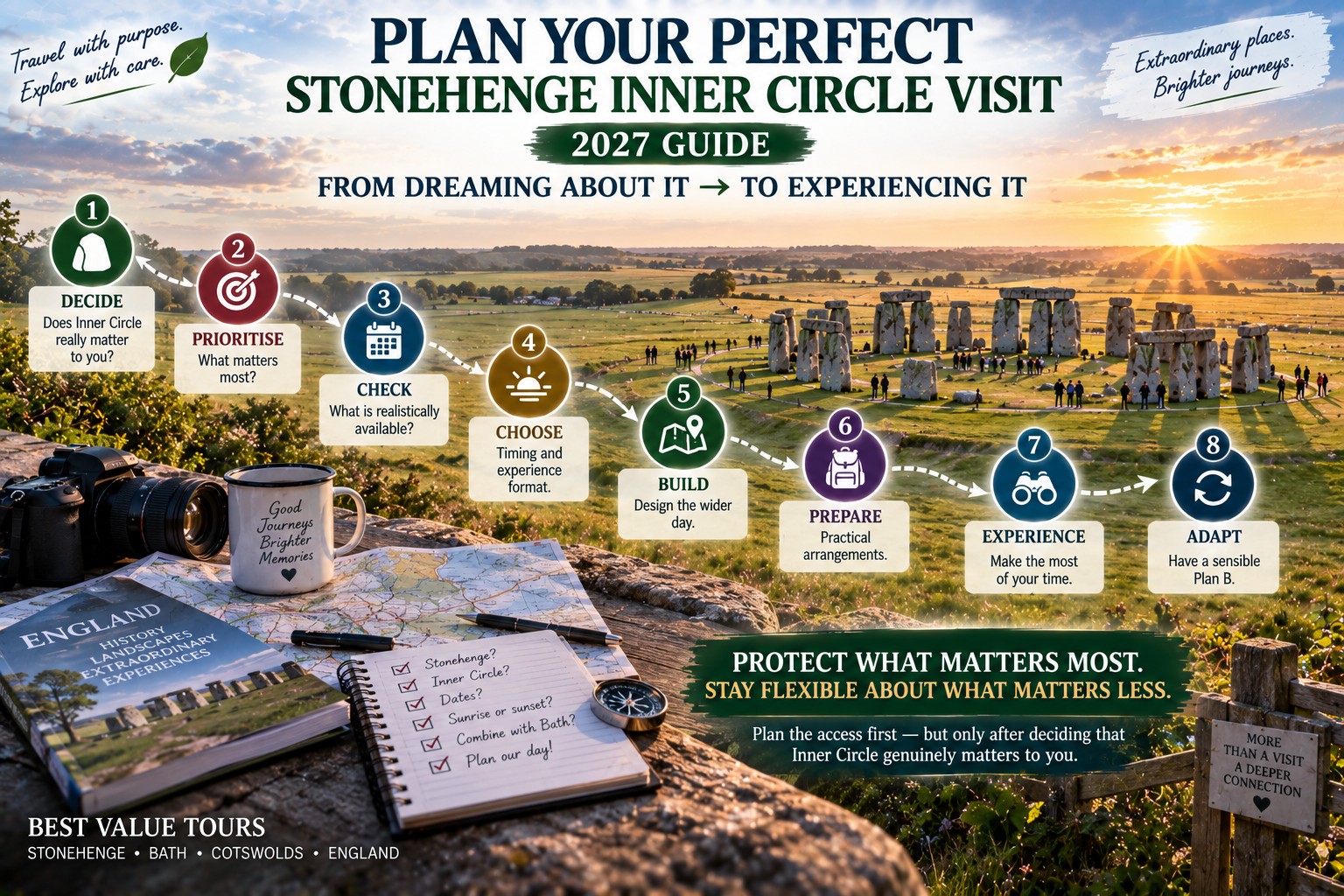
A successful Stonehenge Inner Circle visit starts with deciding what matters most. Prioritise the experience, check what is realistically available, build the wider itinerary around it and stay flexible about the details that matter less
👋 From Dreaming About Inner Circle to Planning It Properly
For many visitors, seeing Stonehenge is already one of the highlights of a trip to Britain. But if you are considering a Stonehenge Inner Circle experience in 2027, your planning becomes slightly different. You are no longer simply deciding when to visit one of the world’s most famous prehistoric monuments; you are considering a more unusual form of access that may influence the timing, structure and priorities of your entire Stonehenge day.
That does not mean an Inner Circle visit needs to be complicated. The key is to make the important decisions in the right order. Before searching for the perfect date or deciding between sunrise and sunset, first establish what you actually want from the experience and how important specialist access is within your wider trip.
There is no single perfect Inner Circle visit for everybody. One traveller may value historical interpretation above everything else, another may prioritise photography, while somebody celebrating a special occasion may care more about a smaller group or a more personalised day. A visitor with fixed holiday dates faces a different planning challenge from somebody who can adjust their itinerary around realistic access opportunities.
The most useful starting principle is therefore simple: plan the access first—but only after deciding that Inner Circle genuinely matters to you.
🧭 The Eight-Stage Stonehenge Inner Circle Planning Roadmap
Rather than treating dates, timing, tour format and itinerary as separate questions, think of them as stages in one planning process.
| Stage The question to answer | |
|---|---|
| 1. Decide | Is Inner Circle genuinely important to my Stonehenge experience? |
| 2. Prioritise | What matters most to me: proximity, history, atmosphere, photography, privacy, timing or itinerary? |
| 3. Check | What access opportunities are realistically available? |
| 4. Choose | Which timing and experience format suit my priorities? |
| 5. Build | What should I do before and after Stonehenge? |
| 6. Prepare | What practical arrangements do I need to make? |
| 7. Experience | How can I make the most of my time at Stonehenge? |
| 8. Adapt | What will I do if my preferred arrangement is unavailable? |
Following this sequence prevents a common planning problem: deciding exactly what your ideal visit should look like before establishing whether all those elements can realistically fit together.
It also gives you a useful way to judge compromises. If Inner Circle access is essential but sunset is merely desirable, changing the timing may be an easy decision. If your travel date cannot move, however, the date takes priority and the type of Stonehenge experience may need to remain flexible.
The aim is not to make every element perfect. It is to identify the elements that matter most, protect those where possible and make sensible decisions around them.
🪨 What Is a Stonehenge Inner Circle Experience?
During a standard visit to Stonehenge, visitors experience the monument from the normal visitor route around the stone circle. Inner Circle access is different because authorised special-access arrangements allow visitors much closer to the stones than during normal public visiting.
That change in physical perspective can be significant. From closer range, the scale and texture of individual stones become more apparent, as do some of the relationships between the surviving uprights, lintels and different parts of the monument. For travellers with a strong interest in Stonehenge, this different viewpoint can be the principal reason for choosing specialist access.
It is important, however, to separate the access itself from everything that may surround it. The quality of the guide, group size, transport arrangements, wider itinerary and level of personalisation are separate features. Two experiences offering Inner Circle access can therefore feel quite different as complete days out.
🚫 What Inner Circle Access Does Not Automatically Mean
Special access should not be confused with private access. Other authorised visitors may be present, and you should never plan on having Stonehenge entirely to yourself.
Nor should Inner Circle automatically be interpreted as unrestricted movement, a specialist archaeological tour or a small-group experience. The precise arrangements depend on the particular visit, and visitors should always check what is actually included and what instructions apply.
The same caution applies to sunrise and sunset. An early or late visit may offer very different light and atmosphere from daytime visiting, but weather and cloud cannot be booked alongside your access. Dramatic skies, glowing stones and ideal photographic conditions are possibilities, not promises.
Most importantly, Inner Circle is not automatically the best way for every traveller to see Stonehenge. It is a different experience, and its value depends upon what you want from your visit.
🤔 First Decision: Is Inner Circle Actually Right for You?
Before rearranging travel dates or building a day around specialist access, ask yourself a more fundamental question: how much would closer access actually change the value of Stonehenge for me?
🪨 Inner Circle May Matter More If…
Inner Circle can be particularly appealing if Stonehenge is one of the principal reasons for your trip and experiencing the monument from closer range has long been an ambition. It can also appeal strongly to visitors interested in archaeology, ancient landscapes, photography or simply gaining a different physical perspective on a monument they already know well from photographs.
You may also be a good candidate if you are prepared to give Stonehenge some influence over the rest of your itinerary. If specialist access matters enough that you would consider changing the order of sightseeing days or accepting a less convenient start or finish, it is reasonable to make it one of your planning priorities.
🌿 Standard Access May Suit You Better If…
A standard visit may be the stronger choice when flexibility and simplicity matter more than specialist access. Perhaps Stonehenge is one attraction within a tightly planned British holiday, your available day cannot move, or your main priority is understanding the monument rather than getting closer to the stones.
This distinction matters because a traveller should not reorganise a substantial holiday around Inner Circle merely because it sounds more exclusive. First establish what the access would add for you. Then decide how much planning priority it deserves.
🎯 Define Your Perfect Visit Before Looking for It
One of the easiest ways to make Inner Circle planning unnecessarily difficult is to treat every preference as essential.
Perhaps you want Inner Circle access, sunset timing, a small group, a particular weekday, a visit to Bath and a departure from London—all within one very specific travel window. Each additional requirement narrows the possibilities.
A better approach is to decide what is genuinely non-negotiable and what is simply desirable.
🔒 Separate Your Non-Negotiables From Your Preferences
Imagine that experiencing the Inner Circle is one of the main reasons you are visiting southern England. In that case, Inner Circle access itself might be non-negotiable, while sunset is merely your preferred timing. If sunset is unavailable but another suitable access opportunity exists, the sensible compromise may be obvious.
Another traveller may have only one free day in their London itinerary. For them, the date is non-negotiable. Inner Circle access may then become the preference rather than the fixed requirement.
Making this distinction early gives you room to make intelligent compromises later rather than feeling that anything short of the original ideal represents a failed plan.
🧠 Ask What You Actually Want to Remember
Think beyond labels such as “sunrise tour” or “small-group tour”. Ask what you want to remember about the day.
Is it standing closer to the stones? Understanding more about prehistoric Britain? Having time to ask questions? Photographing Stonehenge from an unusual perspective? Sharing the experience with somebody important to you? Exploring Avebury as part of a wider ancient-landscape journey?
These are the experiences that should determine your choices.
📝 Build Your Personal Priority Order
A useful exercise is to identify your three most important priorities before comparing dates or tour formats.
For example:
- Inner Circle access.
- Strong historical interpretation.
- A relaxed itinerary.
Another traveller might choose:
- Fixed Saturday travel date.
- Small-group experience.
- Opportunity to visit Bath.
Neither list is better. What matters is that each gives the traveller a rational basis for evaluating the choices that follow.
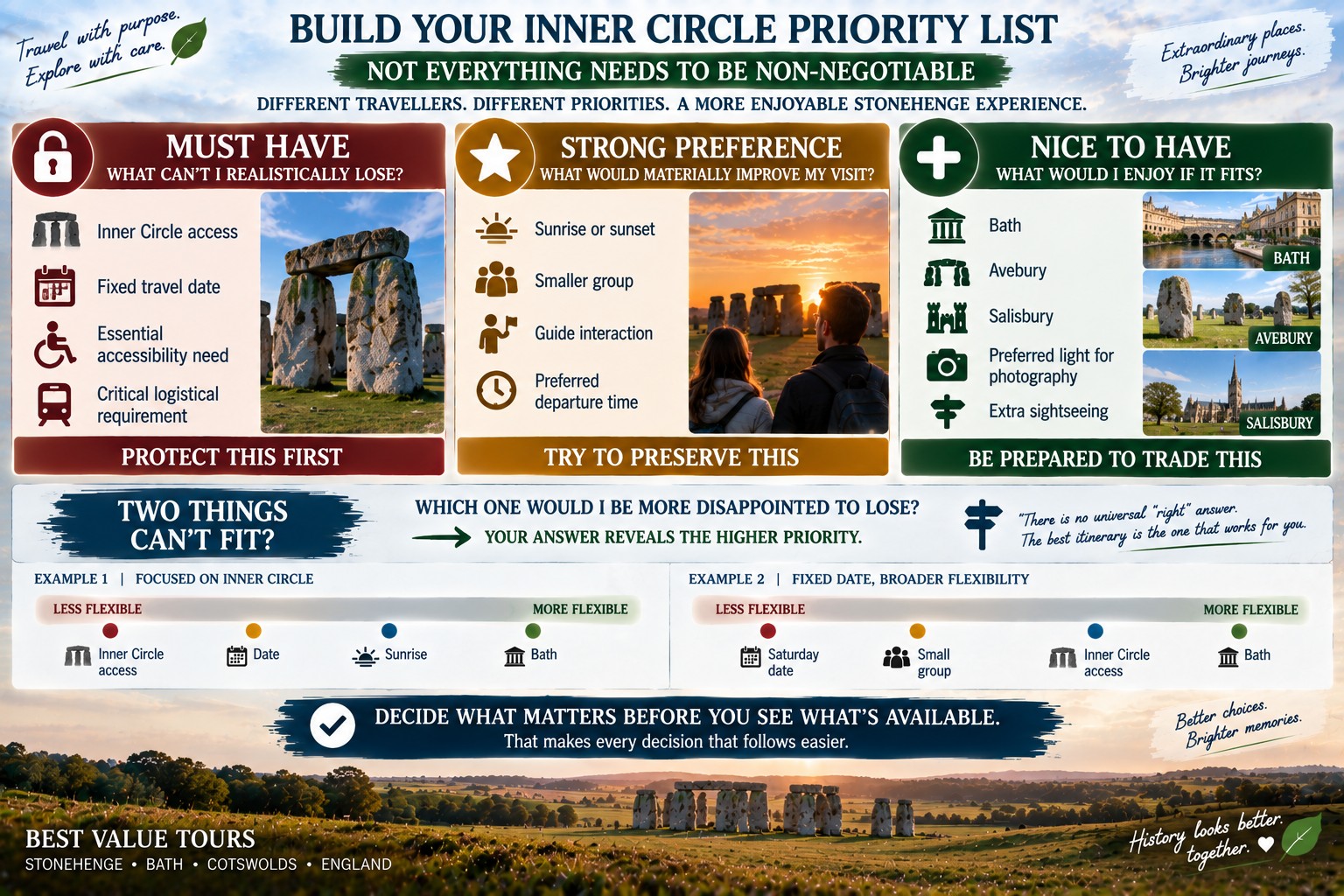
Successful Inner Circle planning becomes easier when every preference is not treated as essential. Protect your genuine must-haves first, try to preserve the features that would materially improve the visit, and remain flexible about the extras you would simply enjoy
📅 Check Access Before Building the Rest of Your Trip
Once you know how important Inner Circle is to you, availability becomes a practical planning consideration.
If specialist access is one of your non-negotiables, avoid constructing an inflexible itinerary around an assumed Stonehenge date and investigating access only afterwards. Establish realistic possibilities early enough that they can influence the rest of the trip.
This does not mean treating every Inner Circle opportunity as an emergency or assuming that every date will disappear immediately. It means recognising that specialist access has constraints that ordinary sightseeing may not have.
The narrower your requirements, the more important this becomes. A traveller who can choose between several days and different timings has considerably more planning flexibility than somebody requiring one particular date, one particular time of day and one particular experience format.
📆 BVT Stonehenge Inner Circle Access Calendar (2026–2027)
The BVT Stonehenge Inner Circle Access Calendar (2026–2027) is designed to help visitors move from the idea of an Inner Circle visit towards realistic planning. Within BVT’s wider Stonehenge planning ecosystem, the Calendar provides a practical reference point for investigating access possibilities before constructing the rest of the itinerary.
🔍 What the Calendar Helps You Establish
The first purpose of checking the Calendar is not to identify some universally “best” date. It is to establish which opportunities may fit your travel period and whether your preferred plans need flexibility.
If several possibilities align with your trip, you can then compare them according to the priorities you identified earlier. If your original plan does not align well with realistic access possibilities, you can decide whether Inner Circle matters enough to adjust something else.
That is a much more useful planning process than choosing an idealised date first and trying to force the rest of the journey around it.
🧭 How to Use the Calendar in the Right Order
A sensible sequence is:
Identify workable access opportunities → compare timings → consider the experience formats available to you → build the wider itinerary.
This order matters because it separates what is realistically possible from what is personally preferable. It also prevents you spending time designing an elaborate itinerary around an access arrangement that may not suit your travel dates.
⚠️ What a Calendar Cannot Decide for You
A calendar cannot tell you whether Inner Circle is worth changing your holiday for. Nor can it decide whether sunrise or sunset suits your body clock, whether a small group matters to you, or whether Bath, Avebury or Salisbury belongs in the rest of your day.
Those are traveller decisions.
Use the Calendar to establish possibilities. Use your priorities to decide between them.
🗓️ How Should You Choose Your Inner Circle Date?
Once you have identified realistic possibilities, compare dates against your actual trip rather than searching for an abstract “best day”.
Start with the factors you cannot easily change. These may include flights, accommodation, family commitments or the overall structure of your holiday. Then consider the variables where you have more flexibility: Stonehenge timing, surrounding attractions or the order in which you visit different places.
Season also matters, but not because one month guarantees a better experience than another. Daylight changes through the year, weather remains variable, and the practical shape of an early or late visit changes with the season.
For many travellers, therefore, the best date is not the theoretically perfect one. It is the best realistic opportunity that fits the trip they actually want to take.
Once you have established which dates could work, compare the Inner Circle experiences available around them rather than choosing by date alone. The wider range of Stonehenge Inner Circle Tours can help you distinguish between different timings, group formats and accompanying destinations before deciding which combination best matches the priorities you have already identified.
🌅 Sunrise or Sunset: Think About the Whole Day
Sunrise versus sunset can easily become an emotional decision. Photographs encourage us to imagine Stonehenge glowing beneath a spectacular sky, and both early and late access can sound inherently atmospheric.
A better question is: which timing creates the better complete day for you?
🌄 When an Earlier Experience May Fit Better
An early experience can make Stonehenge the opening event of the day. For travellers comfortable with early starts, that can leave substantial time afterwards for another destination or a slower continuation through the surrounding region.
But the start itself matters. Consider when you need to leave your accommodation, how you will reach the relevant meeting point, how well you cope with very early mornings and what you realistically want to do afterwards.
An early start that leaves everyone exhausted by lunchtime is not automatically superior simply because the word “sunrise” appears in the description.
🌇 When a Later Experience May Fit Better
A later experience can allow sightseeing before Stonehenge and can make the monument the culmination of the day. That can work particularly well when the preceding itinerary is coherent and the return arrangements remain comfortable.
Again, consider the complete journey. Seasonal daylight, meal arrangements, accommodation and the journey after Stonehenge may all matter more than the imagined colour of the sky.
Neither sunrise nor sunset is universally better. Choose the timing that creates the stronger whole day, not the stronger imagined photograph.
⭐ Editor’s Recommended Tour: Stonehenge Inner Circle Tour at Sunset
If you have concluded that later access works best with your wider day—and experiencing Stonehenge towards sunset is itself an important part of what you want—the Stonehenge Inner Circle Tour at Sunset is a particularly natural option to consider.
It is best suited to travellers who have already weighed the practical implications of a later visit and prefer Stonehenge to become the culmination of their day rather than simply choosing “sunset” for the promise of perfect light.
The recommendation is therefore about the shape of the complete experience, not a guarantee of particular weather or photographic conditions.
👥 Which Inner Circle Tour Format Fits You?
Once timing is becoming clearer, consider the experience surrounding the access.
Do not choose purely according to labels such as “small group”, “private” or “premium”. Instead, ask what practical benefit you want that format to provide. Group size, personalisation, guide interaction, itinerary structure and logistics can all affect the character of the day, but none should be treated as automatically superior.
| Format Interaction Privacy Flexibility Logistics Particularly useful when Main trade-off | ||||||
|---|---|---|---|---|---|---|
| Shared experience | Varies | Low | Usually more structured | Often straightforward | Convenience and value matter | Less personal control |
| Small group | Potentially easier | Shared | Depends on itinerary | Organised | Group environment and interaction matter | Still a shared experience |
| Private | Potentially highly personal | High within your touring party | Often greater | Can be tailored | Pace and personalisation matter | Usually higher cost |
These are general decision criteria rather than guarantees. The actual arrangements of the experience you are considering should always take precedence.
🚌 Shared Experiences
A larger shared experience can suit travellers who want organised transport, a clear itinerary and straightforward logistics. It can also provide strong value where personalisation is not a major priority.
The important question is whether the schedule and complete experience suit you—not whether the group is larger than another option.
👥 Small-Group Experiences
A smaller group can make interaction easier and may create a more manageable shared environment. Travellers who enjoy asking questions or prefer not to move as part of a large party may value this considerably.
But small group does not automatically mean better guiding, greater access or a more flexible itinerary. Examine the complete experience rather than relying on the group-size label alone.
⭐ Editor’s Recommended Tour: Stonehenge Inner Circle Tour with Small Group
If a smaller touring environment has emerged as one of your genuine priorities, the Stonehenge Inner Circle Tour with Small Group is a particularly relevant option to consider.
It is best suited to travellers who value the combination of specialist Stonehenge access with a more manageable shared-group experience, rather than those seeking complete privacy or maximum itinerary control.
The reason to choose it should therefore be the practical benefit that the smaller-group format adds to your visit—not an assumption that smaller automatically means better.
🔐 Private Experiences
Private touring can become particularly valuable where personal pace, itinerary control or direct guide interaction matters. It may also appeal for special occasions or where a travelling party has particular logistical requirements.
Again, distinguish privacy from expertise. A private experience is not automatically an archaeological specialist experience, and the exact degree of flexibility depends on the itinerary and arrangements concerned.
The useful question across all three formats is:
What benefit am I actually trying to gain from travelling this way?
🧑🏫 How Important Is the Guide?
For some visitors, getting closer to Stonehenge is the central attraction. For others, access becomes much more meaningful when accompanied by strong interpretation.
If you are particularly interested in archaeology or prehistoric Britain, consider how much opportunity you want to ask questions and understand what you are seeing. Stonehenge becomes more interesting when its surviving stones are considered alongside what archaeology can tell us about construction, chronology, landscape and the people who created and used this extraordinary place.
Be careful, however, not to use group size as a proxy for expertise. A smaller group may make conversation easier, but it does not by itself establish the knowledge or specialism of the person leading the experience.
For history-focused travellers, who helps you understand Stonehenge may matter almost as much as how close you get to it.
🗺️ Make Inner Circle the Anchor—Not Necessarily the Whole Day
Once you have established a realistic access opportunity, suitable timing and appropriate experience format, you can build the rest of the journey around that fixed point.
The key question is no longer “How many famous places can I fit in?” It is:
What would genuinely improve this particular Stonehenge day?
🪨 A Stonehenge-Focused Day
There is nothing incomplete about allowing Stonehenge to dominate the day. Travellers with a strong interest in archaeology, photography or the surrounding landscape may prefer depth over destination count.
A less crowded itinerary can also provide breathing room around an early or late specialist-access experience. Instead of making every hour dependent on the previous stop running perfectly, you preserve time to absorb Stonehenge and the landscape around it.
🌿 Stonehenge and Avebury
Avebury can make particular sense for visitors wanting to explore prehistoric Britain beyond a single monument. The combination offers continuity of subject rather than simply adding another famous attraction.
For somebody whose main interest is ancient landscapes, that thematic connection may be more valuable than trying to include a completely different headline destination. The important consideration is whether the additional visit deepens the story you want the day to tell.
⭐ Editor’s Recommended Tour: Stonehenge Inner Circle Tour with Avebury & West Avebury
For travellers who have identified prehistoric Britain and ancient landscapes as central priorities, the Stonehenge Inner Circle Tour with Avebury & West Avebury is a particularly strong fit.
Rather than combining Stonehenge with an unrelated attraction simply to increase the number of places visited, this type of itinerary allows the wider day to remain focused on the prehistoric landscape. It is therefore especially appropriate for visitors who want their Inner Circle experience to form part of a deeper ancient-Britain journey.
If your principal aim is variety rather than archaeological continuity, however, another combination may suit you better.
⛪ Stonehenge and Salisbury
Salisbury offers a different but geographically coherent historical dimension to a Stonehenge journey. It can work well for visitors interested in extending their day without turning it into a race across southern England.
The attraction here is contrast combined with sensible journey design. Rather than simply counting destinations, consider whether Salisbury adds something you genuinely want from the day.
🛁 Stonehenge and Bath
Bath creates a much stronger historical and architectural contrast. For travellers wanting two major English experiences within the same journey, that contrast can be exactly the appeal.
But a combination should be chosen because both destinations matter to you, not because fitting more famous names into the itinerary automatically makes the day better. If Inner Circle is your principal objective, make sure the second destination supports rather than overwhelms it.
⭐ Editor’s Recommended Tour: Stonehenge Inner Circle Tour with Bath & Lacock
If your priorities point towards variety rather than a purely prehistoric day, the Stonehenge Inner Circle Tour with Bath & Lacock offers a particularly coherent alternative.
It is best suited to travellers who genuinely want the contrast between Stonehenge and historic England, with Bath and Lacock adding different architectural and cultural dimensions to the journey. That makes it a stronger choice for somebody seeking a broader English sightseeing experience than for a traveller whose overriding interest is archaeology.
The important test remains the same: choose this combination because the additional destinations are part of the experience you want—not simply because they can be fitted into the itinerary.
🏰 What If Windsor Matters More to You?
Some visitors want their Stonehenge day to connect specialist prehistoric access with another major landmark rather than concentrate on ancient landscapes or Bath.
For that traveller, the Stonehenge Inner Circle Tour with Windsor provides a different type of combination. It is particularly relevant where Windsor is already high on your Britain wish list and combining the two experiences creates a more practical overall itinerary.
As with every combination, the value comes from solving a genuine planning need. If Windsor is not important to you, its inclusion should not outweigh an itinerary that better reflects your priorities.
🗺️ A Longer Southern England Journey
Sometimes the most useful planning decision is to stop trying to fit everything into one day.
If your wish list includes Stonehenge, Avebury, Bath, the Cotswolds or further destinations across southern and South West England, a longer journey may provide considerably more meaningful time in each place.
That is not simply a question of adding nights. It is a different style of travel: Stonehenge becomes one important part of a regional journey rather than the fixed centre of a high-speed day trip.
⏱️ Do Not Overload Your Inner Circle Day
An Inner Circle visit can already place unusual timing constraints on the day. Adding too many destinations can turn what should be the highlight into another item that has to happen on schedule.
Remember that travel time is not experience time. Every additional stop introduces movement, meeting points, parking or transfers, and the possibility that delays elsewhere affect the part of the day you care about most.
Fatigue matters too. A theoretically impressive itinerary can feel very different after an exceptionally early start or a long day on the road.
Use a simple test:
If adding another destination makes the experience you travelled for worse, it has not improved the itinerary.
Sometimes the perfect addition to an Inner Circle day is another remarkable destination. Sometimes it is simply more time.
🎒 What Should You Prepare Before Your Inner Circle Experience?
Once the major decisions are settled, preparation becomes straightforward—but it still matters. Stonehenge is an outdoor heritage landscape, so comfort, weather and the precise arrangements of your chosen experience deserve attention.
The objective is not to prepare for every possible eventuality. It is to remove the practical distractions that could prevent you from concentrating on Stonehenge once you arrive.
👟 Clothing and Footwear
Dress for the conditions rather than the photograph you hope to take. Comfortable footwear and practical layers are generally more useful than planning around a single weather assumption.
If your visit involves an early start or later finish, remember that conditions can feel very different from the middle of the day. Check the forecast close to departure and adapt accordingly rather than relying on seasonal expectations alone.
🌦️ Weather and Changing Conditions
British weather can alter the character of Stonehenge quickly. Sunshine can be beautiful, but cloud, wind or changing light can create their own experience of the landscape.
Good planning therefore means preparing for variability rather than allowing the success of the visit to depend on a perfect forecast. If the weather differs from what you imagined, that does not mean the experience has somehow failed.
📷 Photography
If photography matters to you, prepare your equipment in advance so you do not spend valuable access time organising it. Think about what you actually want to capture, but leave room to experience the monument without constantly looking through a screen.
Any specific photography or equipment rules should be checked against the current instructions applying to your particular visit rather than assumed from somebody else’s previous experience.
♿ Comfort, Mobility and Accessibility
Travellers with mobility, accessibility or other practical requirements should investigate the arrangements for the specific experience they are considering rather than assuming every Inner Circle visit operates identically.
This is particularly important where transport, walking, meeting arrangements, timings or the surrounding itinerary affect the suitability of the overall day. Confirming these details before committing to a particular experience can prevent an otherwise avoidable problem later.
📄 Confirm the Details of Your Particular Experience
Before travelling, make sure you understand:
- where and when you meet or depart;
- the type of access included;
- the scheduled timing;
- the group arrangement;
- what is and is not included;
- what happens before and after Stonehenge;
- expected return arrangements;
- any current instructions or restrictions relevant to your visit.
The closer you get to travel, the less useful assumptions become.
✅ The Final 48-Hour Planning Check
A day or two before your experience, stop planning the theoretical trip and check the practical one you are actually taking.
Confirm your latest joining instructions, meeting point and departure time. Check the weather forecast and prepare suitable clothing and essential items. Make sure everyone travelling understands the schedule, especially where an unusually early departure or later return is involved.
Also review what happens after Stonehenge. If you have onward reservations, transport or evening plans, make sure they still make sense alongside the confirmed itinerary.
This final check is not about redesigning the trip. It is about removing avoidable uncertainty so that, when the experience begins, you can concentrate on Stonehenge.
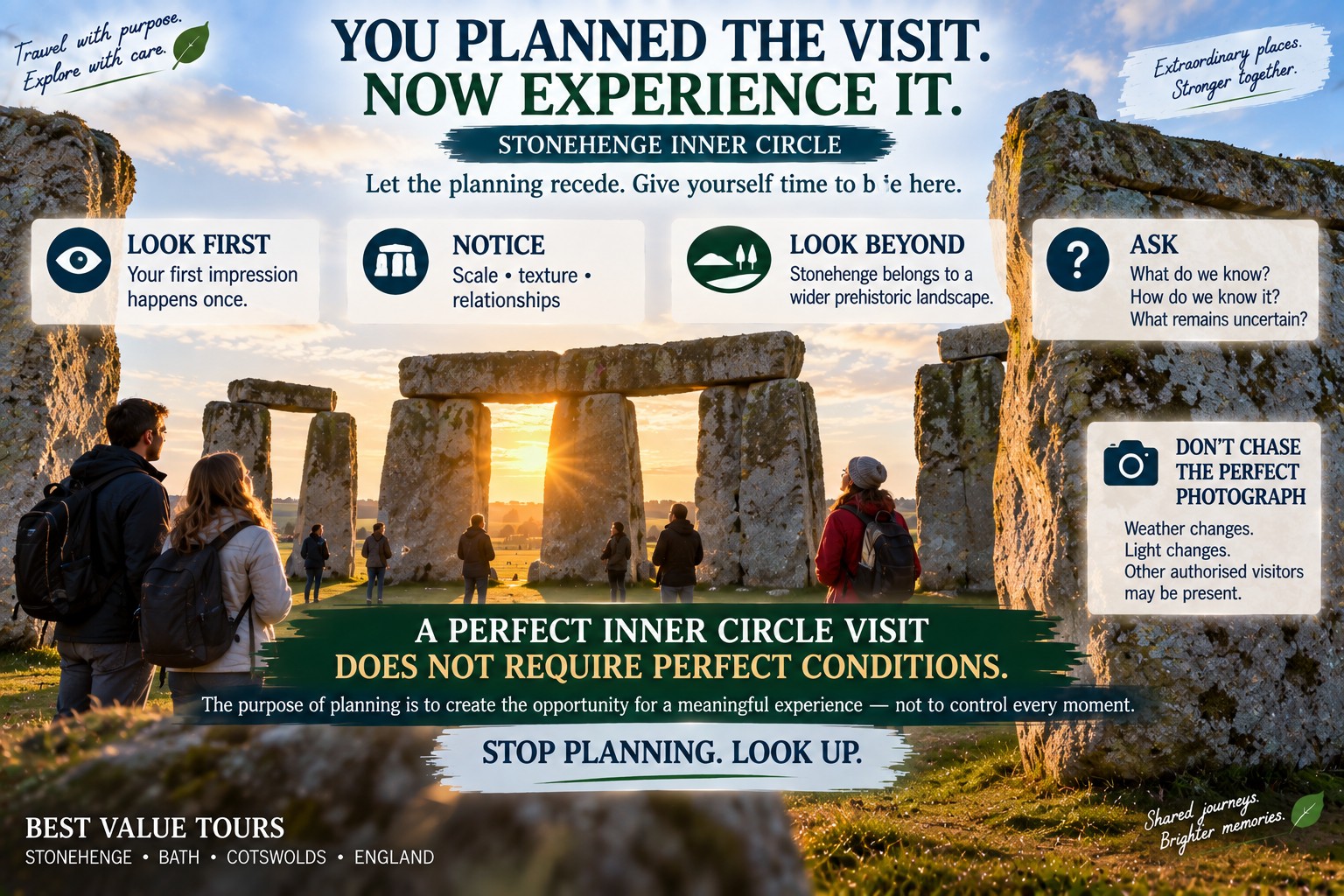
Once the planning is complete, give yourself time to experience Stonehenge. Look carefully at the stones, notice their scale and texture, consider the wider prehistoric landscape and remember that a meaningful Inner Circle visit does not require perfect weather, light or solitude
🌄 How to Make the Most of Your Time Inside the Stonehenge Landscape
Planning can get you to Stonehenge at the right time and in the right way. It cannot experience the monument for you.
Once you are there, allow the pace of the visit to change. You have already dealt with dates, timings, transport and practical arrangements; this is the point at which those decisions should recede into the background.
👀 Look Before You Photograph Everything
Stonehenge is one of the most photographed monuments in Britain, and taking photographs is understandably part of the experience for many visitors. But consider spending your first moments simply looking.
Photographs can be taken throughout the visit. Your first impression happens once.
Allow yourself time to adjust to the different perspective before concentrating on particular photographs or viewpoints. An Inner Circle experience can reveal aspects of Stonehenge that are less obvious from familiar distant images, and noticing them requires attention rather than speed.
🪨 Notice Scale, Texture and Relationships Between the Stones
Closer perspective can reveal details that are much harder to appreciate from familiar photographs. Notice differences in scale, surfaces and shapes, and look at how surviving uprights and lintels relate to one another.
Rather than trying to find one iconic viewpoint immediately, move your attention around the monument and notice how its appearance changes with perspective. Individual stones that seem almost uniform from farther away can become much more distinctive when viewed more closely.
You do not need specialist archaeological knowledge to benefit from looking carefully. Curiosity is enough.
🧭 Remember the Wider Landscape
Stonehenge is not an isolated prehistoric object placed in an empty field. It belongs to a much wider archaeological landscape shaped by monuments, earthworks and generations of human activity.
Even when your attention is naturally drawn towards the stones, remembering that broader setting can deepen your understanding of why Stonehenge continues to fascinate archaeologists and visitors alike. The monument makes more sense when considered as part of a landscape rather than simply as a famous circle viewed in isolation.
💬 Ask Questions
If your experience includes guiding, use it. Ask about the features you notice, what archaeological evidence can tell us and where interpretation remains uncertain.
One mark of good historical understanding is recognising the difference between what is known, what evidence suggests and what remains debated. Stonehenge does not become less fascinating because every question has not been answered; in many respects, those uncertainties are part of what makes the monument so compelling.
⏳ Do Not Spend the Experience Chasing the “Perfect” Moment
The weather may not behave as expected. The sky may not resemble the photograph that originally inspired your trip. Other authorised visitors may be present.
None of those things automatically diminishes the experience.
A perfect Inner Circle visit does not require perfect conditions. The purpose of all the planning is to create the best opportunity to experience Stonehenge meaningfully—not to control everything that happens once you arrive.
🔄 What If Your Preferred Inner Circle Plan Is Not Available?
One of the most useful things you can do before checking availability is decide what you are prepared to change.
That gives you three levels of planning rather than one fragile ideal. It also prevents disappointment from turning into poor travel decisions simply because the exact combination you first imagined is not available.
🅰️ Plan A — Your Preferred Experience
Plan A is the arrangement that best matches your priorities: perhaps a particular travel period, preferred timing and desired experience format.
If it is realistically available and fits comfortably within the rest of your journey, excellent. There is no reason to complicate a plan that already works.
🅱️ Plan B — Protect Inner Circle, Change Something Else
If Inner Circle itself is the non-negotiable, consider which preference can move.
Could you change the date? Accept another time of day? Choose a different group format? Rearrange what happens before or afterwards?
Returning to the priority list you created earlier makes these decisions much easier. Instead of asking whether an alternative is identical to your original plan, ask whether it still protects the parts of the experience that matter most.
If you have several workable alternatives, comparing the wider range of Stonehenge Inner Circle Tours can be more useful than continuing to search for one exact arrangement. A different timing, group format or accompanying destination may preserve the specialist access that matters most while requiring only a relatively minor compromise elsewhere.
🅲 Plan C — Protect the Quality of Your Stonehenge Visit
Sometimes the sensible answer is not to keep compromising the wider holiday in pursuit of specialist access.
An excellent standard Stonehenge visit may be preferable to an Inner Circle arrangement that requires an impractical date change, an exhausting itinerary or sacrifices elsewhere that matter more to you.
That is not a failed Plan A. It is successful travel planning: protect the experience rather than the label.
⚠️ Common Inner Circle Planning Mistakes
Several mistakes recur because travellers naturally focus on the most exciting part of the experience rather than the complete journey.
Avoid assuming Inner Circle is automatically superior to standard access, or that specialist access means privacy. Do not choose sunrise or sunset without considering what that timing does to the rest of the day, and avoid fixing numerous surrounding arrangements before establishing realistic access possibilities.
Likewise, do not assume a small group automatically means better guiding, or that private automatically means specialist expertise. Check what the particular experience actually provides rather than relying on category labels.
Be careful about treating every preference as essential. Requiring one precise date, one timing, one group format and several additional destinations can eliminate otherwise excellent possibilities without necessarily improving the experience.
Perhaps most importantly, avoid overloading the itinerary and expecting weather, dramatic light or solitude to validate the day. Those are variables you cannot fully control.
The strongest planning concentrates on what you can control: priorities, flexibility, experience choice, preparation and expectations.
That distinction is useful far beyond Stonehenge. Good travel planning is rarely about engineering perfect conditions; it is about making informed choices that leave enough flexibility to enjoy what actually happens.
🌱 Planning a More Responsible Stonehenge Journey
Responsible travel at Stonehenge begins with recognising that you are visiting far more than a famous photographic landmark. Stonehenge sits within an internationally important archaeological landscape, and visitors should respect all access instructions, permitted routes and protections associated with the site.
That responsibility becomes particularly important when experiencing Stonehenge through specialist access. Being closer to an ancient monument does not make the surrounding landscape less sensitive. Follow the instructions applying to your visit, avoid assuming that apparently empty ground is archaeologically insignificant, and treat the privilege of closer access with appropriate care.
Good itinerary design can also improve both the visitor experience and the efficiency of the wider journey. Combining places because they fit coherently can reduce unnecessary backtracking, while giving destinations sufficient time can prevent travel becoming a race between attractions.
Avoid simplistic assumptions about transport formats. A small-group or private vehicle is not automatically the greener choice; occupancy, distance travelled, route efficiency and available alternatives all matter. A thoughtfully planned shared journey can sometimes make better use of transport than an itinerary involving repeated individual journeys between the same areas.
The same principle that creates a better Inner Circle day often creates a more responsible one: travel deliberately, avoid unnecessary movement and give important places the time they deserve.
Travel with purpose. Explore with care.
📋 Your Stonehenge Inner Circle Planning Checklist
Before considering your plan complete, work through the entire decision sequence:
- Decide whether Inner Circle genuinely matters to your Stonehenge experience.
- Identify your non-negotiables.
- Rank your most important preferences.
- Establish realistic access opportunities.
- Choose a timing that works with the complete day.
- Select the experience format that matches your needs.
- Build a coherent wider itinerary.
- Verify the specific practical arrangements.
- Prepare for weather and outdoor conditions.
- Create a realistic fallback plan.
- Arrive with realistic expectations.
- Give yourself enough mental space to actually experience Stonehenge.
If those twelve points are resolved, most of the difficult planning has already been done. More importantly, you will have built the visit around your own priorities rather than somebody else’s definition of the perfect Stonehenge experience.
❓ Frequently Asked Questions
❓ What Is Stonehenge Inner Circle Access?
Inner Circle access is a specialist form of authorised access that allows visitors closer to the stones than during normal public visiting. The precise arrangements can vary, so always check the details applying to the particular experience you are considering.
❓ How Is Inner Circle Different From a Normal Stonehenge Visit?
The principal difference is physical access and perspective. A standard visit still provides the mainstream Stonehenge visitor experience, while Inner Circle access allows a different relationship with the monument from closer range. Neither should automatically be considered the right choice for every traveller.
❓ Is Stonehenge Inner Circle Worth Planning Around?
It can be if closer access is genuinely important to you. If Stonehenge is a major reason for your trip, you may reasonably allow access opportunities to influence your itinerary. If convenience, fixed dates or wider sightseeing matter more, reorganising a holiday around Inner Circle may provide less value.
❓ Is Inner Circle Access Private?
Not necessarily. Specialist access and private access are different things. Other authorised visitors may be present, so you should not assume that an Inner Circle experience means having Stonehenge to yourself.
❓ Can You Walk Anywhere You Want During Inner Circle Access?
You should not assume unrestricted movement. Stonehenge is a protected archaeological site, and visitors must follow the instructions and access arrangements applying to their particular experience.
❓ Is Sunrise or Sunset Better for Stonehenge Inner Circle?
Neither is universally better. Consider the complete day rather than choosing solely according to the prospect of dramatic light. Your preferred start time, wider itinerary, season, transport arrangements and tolerance for early or late travel should all influence the decision.
❓ Does Sunrise or Sunset Access Guarantee Better Photographs?
No. Light and weather conditions remain unpredictable. Early or late timing may create interesting photographic possibilities, but dramatic skies, sunshine and particular atmospheric conditions cannot be guaranteed.
❓ How Far Ahead Should I Plan a 2027 Inner Circle Visit?
If Inner Circle is important to your trip, investigate realistic access possibilities before making the rest of your itinerary unnecessarily rigid. The appropriate planning horizon depends on your travel dates, flexibility and the arrangements available, so avoid relying on a universal lead-time rule.
❓ What Should I Do If My Preferred Date Is Unavailable?
Return to your priorities. If Inner Circle is non-negotiable, consider changing the date, timing or experience format. If your travel date is fixed, investigate other suitable Stonehenge options rather than compromising the wider holiday simply to preserve the Inner Circle label.
❓ Is a Small-Group Inner Circle Experience Better?
Not automatically. A smaller group may make interaction easier and suit travellers who prefer a less crowded touring environment, but group size alone does not determine guide quality, access arrangements or the overall standard of the experience.
❓ Is a Private Inner Circle Experience Worth It?
Private touring can offer greater personalisation and may be particularly valuable when pace, direct interaction or itinerary flexibility matters. Whether that additional value justifies the cost depends on your priorities and the specific arrangements offered.
❓ Can I Combine Stonehenge Inner Circle With Avebury?
Potentially, and the combination can be particularly appealing to travellers interested in prehistoric landscapes. Whether it creates the right day depends on the timing and structure of the particular itinerary you are considering.
❓ Can I Combine Stonehenge Inner Circle With Bath or Salisbury?
Potentially. Both can create worthwhile combinations for different reasons, but the important question is whether the additional destination improves your day without making the itinerary rushed. Inner Circle timing should remain the anchor if it is your principal objective.
❓ What Should I Wear for an Inner Circle Visit?
Prepare for an outdoor heritage landscape and check the weather close to travel. Comfortable footwear and practical layers are generally sensible, while any specific requirements should be confirmed against the current instructions for your experience.
❓ What Should I Bring to Stonehenge Inner Circle?
Bring what you genuinely need for the conditions and your particular experience. That may include suitable outerwear, essential personal items and photography equipment if relevant. Avoid carrying unnecessary equipment simply because the visit feels special, and check any current instructions that could affect what you may bring.
❓ Is Inner Circle Suitable for a First Visit to Stonehenge?
It can be. You do not need to have visited Stonehenge previously to appreciate closer access. For a first-time visitor, the more important question is whether specialist access matches your priorities and whether the complete experience gives you the understanding, timing and itinerary you want.
🪨 Final Thoughts: The Perfect Inner Circle Visit Is the One Built Around You
Planning the perfect Stonehenge Inner Circle visit in 2027 does not begin with sunrise, sunset, group size or even a particular date.
It begins by deciding why you want Inner Circle access in the first place.
Once you understand that, the rest of the planning becomes much clearer. Identify what matters most. Separate genuine requirements from preferences. Establish realistic access possibilities. Choose the timing and experience format that best support your priorities. Then build the wider day around those decisions rather than forcing specialist access into an itinerary that was designed without it.
That approach also makes compromise easier. If your preferred timing is unavailable, you know whether timing or access matters more. If a second destination makes the day rushed, you can judge whether it genuinely adds value. If Inner Circle no longer fits the trip comfortably, you can choose an excellent standard Stonehenge visit without treating it as a lesser experience.
Most importantly, remember what all this planning is supposed to achieve.
You are not trying to manufacture perfect weather, an empty Stonehenge or a flawless photograph. You are creating the conditions for a meaningful encounter with one of the world’s great prehistoric monuments.
Make the important decisions carefully. Leave flexibility where you can. Prepare properly. Then, when you finally reach Stonehenge, stop planning and experience it.