


Stonehenge, Devon and Cornwall Tours: How to Build the Perfect South West Journey (2027 Guide)
17th September 2026
🗺️ Stonehenge, Devon and Cornwall Tours: How to Build the Perfect South West Journey (2027 Guide)

Stonehenge can be the beginning of a much wider journey through South West England. Build the route around the places that genuinely matter, allow enough time to experience them properly, and resist turning the itinerary into a checklist.
👋 From Stonehenge to England’s Far South West
A journey from Stonehenge through Devon and into Cornwall can reveal remarkably different sides of southern England. You can begin among one of the world’s most famous prehistoric landscapes, travel west through historic towns and changing countryside, and eventually reach Cornwall’s rugged coastline, distinctive communities and Atlantic horizons.
The challenge is not finding enough places to visit. It is deciding which places deserve your limited time.
Stonehenge, Bath, Glastonbury, Devon, Tintagel, the Eden Project and Cornwall’s coast can all sound tempting when you are planning from home. Put too many of them into one itinerary, however, and a potentially memorable journey can become a succession of arrivals, photographs and departures.
This guide takes a different approach. Rather than giving you the longest possible list of attractions, it will help you decide how much time you need, what matters most to you, how to build a logical route and whether independent or organised travel better suits your plans.
The most useful principle to remember is simple:
The perfect South West journey is not the one containing the most places. It is the one that gives the places you choose enough time to matter.
🧭 Why Stonehenge Works as a Gateway to Devon and Cornwall
Stonehenge does not need to be treated as an isolated excursion from London. If your wider holiday is taking you towards Devon and Cornwall, it can also become a memorable opening chapter to a journey west.
The connection is primarily geographical and experiential rather than historical. Stonehenge, Devon and Cornwall do not represent one continuous historical period or culture. What makes the journey compelling is the way the landscapes, destinations and character of the trip evolve as you travel.
🪨 From Prehistoric Britain to the South West
Stonehenge provides an extraordinary starting point. The monument sits within a much wider prehistoric landscape, giving travellers an immediate encounter with Britain’s deep past before the journey continues into places shaped by very different periods, communities and traditions.
You do not need to devote the entire first day to Stonehenge for it to play this role. What matters is allowing enough time to experience the monument and its setting properly rather than treating it as a hurried photograph before a long journey west.
For history-focused visitors, Stonehenge can also establish a useful theme. The wider trip becomes an exploration of different layers of Britain’s story rather than simply a route between famous attractions.
🌊 A Journey That Changes as You Travel West
As the journey develops, its character can change substantially. Historic cities and inland landscapes can give way to Devon’s countryside and coast before Cornwall introduces its own communities, heritage, legends and increasingly Atlantic character.
That changing character is part of the experience.
Instead of thinking only in terms of London → Stonehenge → Cornwall, consider the places between those points and decide whether any deserve to become meaningful parts of the holiday rather than convenient stops on the way somewhere else.
That decision begins with the resource every itinerary has to respect: time.
⏱️ First Decision: How Many Days Do You Really Need?
Before deciding whether to include Bath, Glastonbury, Tintagel or another Cornish destination, establish how many days you can genuinely devote to the journey.
The difference between three days and seven days is not simply four additional nights. It changes the type of South West experience you can reasonably construct, how far west you can travel comfortably and how much meaningful time you can spend once you arrive.
📅 South West Journey Duration Planner
| Time available Realistic approach Main compromise | ||
|---|---|---|
| 2–3 days | Highly selective journey built around a few priorities | Very limited regional depth |
| 4–5 days | Meaningful Stonehenge–Devon–Cornwall journey with careful prioritisation | Several desirable stops may need to be omitted |
| 6–7 days | More time for Devon and Cornwall, with greater destination choice | Requires a larger share of your holiday |
| 8+ days | Slower regional exploration with considerably more flexibility | More accommodation and overall trip planning |
These are planning frameworks, not rigid rules. A traveller who enjoys fast-paced touring may be comfortable covering more ground than somebody who wants long coastal walks, leisurely lunches and time to explore smaller places.
The important distinction is between what is technically possible and what is worth doing.
🚫 Why Trying to “Do Cornwall” Too Quickly Usually Fails
A map can make an itinerary look deceptively straightforward. The route line does not show the time spent checking out of accommodation, stopping for meals, parking, reaching attractions, exploring them, dealing with ordinary traffic conditions or simply taking a break.
Nor does it show fatigue.
A day containing several hours of movement and four headline attractions may look impressive on paper while providing surprisingly little meaningful time anywhere.
Travel time is not experience time.
If you have only two or three days, that does not mean you cannot create an excellent journey. It means you need to be highly selective. With four or five days, a more substantial westward progression becomes possible. With a week or more, you gain much greater freedom to let Devon and Cornwall become destinations in their own right rather than scenery viewed between scheduled stops.
For travellers who want the South West journey itself to become a substantial part of their holiday, this duration decision also provides an early indication of whether an organised multi-day itinerary may be worth comparing with independent travel. A four- or five-day journey and a week-long exploration solve quite different planning problems, so it is more useful to choose the amount of regional depth you want before comparing particular routes.
Before adding another place to the itinerary, ask a more useful question than “Can we fit it in?”
Ask:
If we include it, will we still have enough time to enjoy the places that matter more?
Once you know how much time you genuinely have, the next decision becomes more personal: what do you actually want those days to contain?
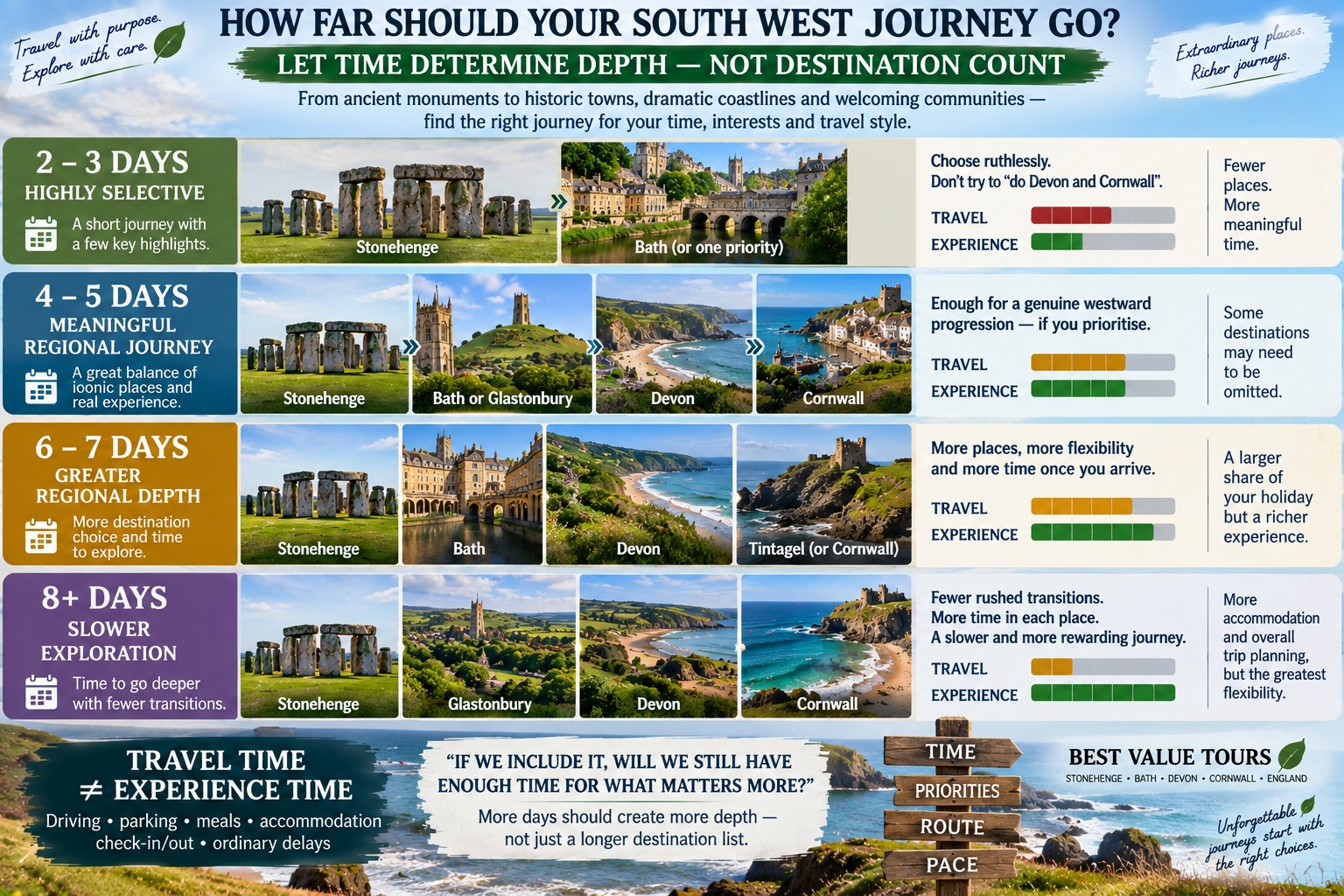
How much South West England can your available time realistically support? A shorter trip requires careful selection, while additional days can provide more meaningful time in Devon and Cornwall. The key is to use extra time for greater depth rather than simply adding more destinations
🎯 Decide What Kind of South West Journey You Actually Want
There is no universally correct Stonehenge, Devon and Cornwall itinerary because travellers are looking for different things.
Before choosing individual stops, identify the two or three experiences that matter most to you. Doing this early makes later compromises much easier and helps prevent famous place names from taking over an itinerary that was supposed to reflect your interests.
🏛️ History and Heritage
If history is your principal interest, Stonehenge provides a natural beginning, but your journey can subsequently move through very different periods and stories.
Historic cities, settlements, archaeological landscapes and heritage attractions may deserve more of your time than beaches or scenic detours. The important thing is not to assume that every historic place needs to be included simply because history is your theme.
Choose those that add something genuinely different.
🌊 Coast and Landscape
For many travellers, Devon and Cornwall mean countryside, cliffs, beaches, harbours and the feeling of travelling towards Britain’s Atlantic edge.
If landscape is your priority, protect time for actually experiencing it. A coastal destination loses much of its value if your itinerary allows only enough time to leave the vehicle, take a photograph and continue elsewhere.
This may mean sacrificing a famous inland attraction to create a better coastal day.
🏰 Legends and Arthurian Britain
Travellers interested in King Arthur can create a particularly atmospheric westward journey involving places associated with later Arthurian tradition, including Glastonbury and Tintagel.
However, historical perspective matters. Stonehenge is a prehistoric monument thousands of years older than the period in which a historical figure behind later Arthurian traditions might have lived. Connections between Stonehenge, Merlin and Arthur belong largely to later literary and legendary traditions rather than demonstrating that these places formed one historical Arthurian landscape.
Understanding that distinction does not diminish the journey. It allows you to appreciate archaeology, history and legend on their own terms.
For travellers who discover that this combination of prehistoric places and Arthurian tradition is the real purpose of their trip, it can be useful to compare a themed journey with a general South West itinerary rather than trying to force every coastal and historic attraction into the same route.
🌿 Countryside and Slower Travel
Perhaps your ideal South West trip involves fewer headline attractions and more time in landscapes, villages or smaller communities.
If so, resist building an itinerary designed for somebody else’s definition of sightseeing. An afternoon with space to explore can be more valuable to you than another major attraction added simply because it appears on a list of places you are supposed to see.
🎭 Variety
First-time visitors to Britain may want contrast rather than a single theme.
Stonehenge, a historic city, Devon countryside and Cornwall’s coast can provide very different experiences within the same journey. Variety can work extremely well—but it still requires prioritisation.
A useful exercise is to write down your three most important experiences before adding destinations. Those priorities become the test against which the rest of the itinerary is judged.
🗺️ Build the Route Before Choosing Every Stop
Once you know how much time you have and what matters most, you can begin constructing the route.
A common planning mistake is to start with a long list of attractions and then attempt to connect them. A better approach is to build the journey in stages:
Anchor → Prioritise → Sequence → Pace → Choose Format → Refine
Anchor — Identify the experience or destination you would most regret missing.
Prioritise — Decide which themes and experiences matter most.
Sequence — Arrange your chosen destinations in a geographically sensible order.
Pace — Check how much meaningful time remains after travel and everyday logistics.
Choose Format — Decide whether independent travel or an organised itinerary best supports the journey you have designed.
Refine — Remove anything that weakens a higher-priority experience.
This approach changes itinerary planning from a destination-collecting exercise into a series of decisions.
🔄 Avoid Unnecessary Backtracking
A journey from Stonehenge towards Devon and Cornwall naturally lends itself to westward progression. That does not mean there is only one correct route, but unnecessary backtracking can consume time without adding anything to the experience.
Look at your proposed itinerary as a whole.
If one optional attraction requires a substantial diversion or forces you to reverse direction, ask whether it contributes enough to justify the additional movement.
Sometimes it will. A place that is central to your interests may be worth a detour.
The important point is that the detour should be a conscious choice rather than an accidental consequence of planning each day separately.
A geographically coherent route can also reduce unnecessary mileage and make the journey feel less fragmented—an advantage for both visitor experience and more responsible travel.
🧳 Think in Overnight Bases, Not Just Attractions
Accommodation decisions shape the journey almost as much as attraction choices.
Changing accommodation every night can increase geographical coverage, but it also creates repeated packing, check-in and check-out time. Staying longer in fewer bases can reduce that friction and provide more opportunity to experience the surrounding area.
Neither approach is automatically better.
If your priority is a progressive road trip, several overnight locations may make sense. If you want slower exploration, fewer bases may produce a much better experience.
This becomes particularly important in Devon and Cornwall, where deciding where you sleep can determine which landscapes and attractions are realistically enjoyable the following day.
Before finalising the route, ask:
Does my overnight plan support the experiences I care about, or am I moving simply because the itinerary says I should?
With the journey framework established, you can now evaluate individual destinations much more effectively. Instead of asking whether somewhere is famous enough to include, you can ask whether it genuinely strengthens your particular route.
🏞️ What Should You Include Between Stonehenge and Cornwall?
Once the overall route is clear, individual destinations become easier to assess.
Rather than asking whether each place is “worth visiting,” ask:
What does this place add to my particular journey?
A destination that is essential for one traveller may add unnecessary pressure to another itinerary.
🪨 Stonehenge: The Ancient Starting Point
Stonehenge can provide the prehistoric anchor for the journey and a powerful opening contrast with the landscapes and destinations farther west.
Allow enough space to experience it properly.
For most travellers, a standard visit can fit relatively easily into a wider South West itinerary. If specialist Inner Circle access is important to you, however, timing and availability may influence the structure of the opening stage of your journey.
The distinction matters because Stonehenge should be treated as a genuine priority only to the extent that you want it to be one.
🛁 Bath: For Architecture, Roman Heritage and City Contrast
Bath can work particularly well for travellers who want a historic city experience alongside Stonehenge and the rural or coastal landscapes that follow.
Its Roman heritage and distinctive architecture provide a strong contrast with both prehistoric Stonehenge and the increasingly rural journey west.
That does not make Bath compulsory.
If your priorities are Cornwall’s coast, Devon countryside or Arthurian landscapes, spending substantial time in Bath may reduce the time available for experiences you value more.
For travellers with limited time who primarily want a compact Stonehenge-led experience rather than a full Devon and Cornwall journey, combining Stonehenge with Bath and nearby historic places can also be a coherent alternative to travelling farther west.
⭐ Editor’s Recommended Tour: Stonehenge, Bath, Avebury and Lacock
For travellers attracted by the combination of Stonehenge and Bath but who do not have enough time—or do not want—to build a multi-day South West itinerary, the Small Group Tour – Stonehenge, Bath, Avebury, Lacock provides a more concentrated way to explore several contrasting historic places within one organised experience.
It is particularly appropriate for visitors whose priority is variety and heritage rather than reaching Devon or Cornwall. The small-group format may also appeal to travellers who prefer organised transport and a predetermined route without moving accommodation.
🔮 Glastonbury: For History, Spirituality and Arthurian Tradition
Glastonbury adds a very different character.
Its historical and religious associations sit alongside later traditions involving Avalon and King Arthur, making it particularly relevant for travellers interested in the relationship between documented history, spirituality and legend.
If that theme is central to your journey, Glastonbury can form a meaningful bridge between Stonehenge and the Arthurian traditions encountered farther west.
If it is not, including it simply because it lies broadly on your route may create another stop without strengthening the trip.
As elsewhere in this journey, distinguish between historical evidence and later tradition. Doing so makes Glastonbury more interesting, not less.
⭐ Editor’s Recommended Tour: Stonehenge, Glastonbury and Avebury
If your interest in Glastonbury is part of a wider fascination with prehistoric landscapes, Arthurian tradition and the stories attached to ancient places, you do not necessarily need to build a full Devon and Cornwall itinerary around that theme.
The King Arthur’s Stonehenge, Glastonbury and Avebury – Small Group Day Tour is particularly relevant for travellers who want Stonehenge and Glastonbury to form the heart of their experience, with Avebury adding another important prehistoric landscape, but who do not need the additional time and distance involved in travelling farther into the South West.
It is therefore best viewed as an alternative for a specific type of traveller rather than a shortened Cornwall journey: one whose priority is the relationship between archaeology, history and legend.
🌿 Devon: More Than Somewhere You Pass Through
Devon creates one of the most important decisions in the whole itinerary.
Ask yourself:
Are you travelling through Devon, or travelling to Devon?
There is a significant difference.
If Cornwall is your overwhelming priority and time is limited, Devon may principally form part of your westward progression. Trying to add several Devon attractions simply because you are passing through can reduce the time available once you reach Cornwall.
If Devon’s countryside, coast, towns or landscapes are among the reasons you are making the journey, however, it deserves protected time of its own.
Do not treat Devon and Cornwall as interchangeable parts of one destination. They are neighbouring counties with distinct landscapes, communities and visitor experiences.
The question is not whether Devon deserves to be explored. It is whether this particular journey gives you enough time to explore it properly.
🏰 Tintagel: For Dramatic Landscape and Arthurian Tradition
Tintagel can be one of the most atmospheric additions to an Arthurian-themed journey.
Its appeal comes from several layers at once: dramatic coastal landscape, archaeology, documented medieval history and the powerful later traditions connecting Tintagel with King Arthur.
Those layers should not be collapsed into a single story. The site’s genuine archaeological and historical significance is interesting in its own right, while the Arthurian association belongs to a broader tradition that developed over centuries.
For travellers whose priorities include both landscape and legend, Tintagel can therefore justify the time required to reach and experience it.
For travellers whose main goal is simply to see Cornwall, it is not automatically essential. Its location and the time required to visit should be weighed against whichever Cornish experiences matter most to you.
If Stonehenge, Glastonbury and Tintagel have emerged as major priorities during your planning, that is also a useful signal that you are no longer designing a general sightseeing itinerary. You are beginning to construct a themed journey through ancient places and Arthurian Britain, and your route should reflect that choice.
⭐ Editor’s Recommended Tour: A Four-Day Arthurian Journey
For travellers whose priorities have clearly become Stonehenge, ancient landscapes and the traditions surrounding King Arthur, the 4 Day From Bristol Exploration of Mystic Stonehenge and King Arthur’s Legend offers a more focused alternative to a general Devon and Cornwall itinerary.
This is most appropriate for visitors who want their multi-day journey organised around the Arthurian and legendary dimension of the South West, rather than travellers whose main priorities are Cornwall’s coast or a broad exploration of Devon.
The distinction matters. Once a particular theme becomes the reason for travelling, choosing an itinerary designed around that theme can make more sense than adding individually famous places to a general route.
🌊 Cornwall: Decide How Deep You Want to Go
Reaching Cornwall is not the same as experiencing Cornwall.
The county contains enough variety to occupy an entire holiday, so the most useful question is not simply whether Cornwall should be included. It is how much of Cornwall you realistically want to explore.
North Cornwall may work particularly well for travellers interested in dramatic coastline and places such as Tintagel. Travelling farther west opens different possibilities again, but every additional mile needs to be considered against the experience time available once you arrive.
This is where itinerary ambition can become counterproductive.
If reaching the far South West consumes most of the available time, you may technically have visited Cornwall while experiencing very little of what made you want to go there.
Protect meaningful time once you arrive.
A shorter geographical reach with time to explore can produce a much richer journey than a more ambitious route dominated by driving or scheduled transfers.
🌱 Eden Project: For Something Completely Different
The Eden Project can provide a striking change of subject within a journey otherwise dominated by ancient monuments, historic places, countryside and coast.
Its biomes, plants and environmental themes may be particularly appealing to families, garden enthusiasts and travellers interested in sustainability or contemporary approaches to humanity’s relationship with the natural world.
That contrast can be valuable.
However, as with every other major attraction in this guide, inclusion should be purposeful. If the Eden Project genuinely interests you, allow it sufficient time. If it appears on the itinerary only because it is famous and geographically convenient, consider whether another experience would better serve your priorities.
By this stage of the planning process, a pattern should be emerging.
Some places will have become clear priorities. Others may remain attractive but optional. That distinction is exactly what you need before making one of the most important decisions in the entire South West journey:
Do you want greater coverage, or greater depth?
⚖️ Depth or Coverage: The Decision That Makes or Breaks the Journey
Once your priorities are clear, decide how you want the journey to feel.
Two travellers can visit the same region for the same number of days and have completely different experiences because one prioritises coverage while the other prioritises depth.
Neither approach is inherently wrong. Problems arise when you expect the benefits of both without allowing enough time.
📸 The Highlights Journey
A highlights-focused journey can work well for travellers who enjoy variety, are comfortable with regular movement and want an introduction to several different places.
Stonehenge might form the prehistoric opening, followed by a historic or legendary destination, progression through Devon and selected experiences in Cornwall.
The advantage is range.
The compromise is that every additional stop reduces the time available elsewhere. You need to accept that some destinations will function as introductions rather than deep explorations.
If that matches the way you enjoy travelling, there is nothing wrong with it.
🌿 The Slower Journey
A slower itinerary deliberately includes fewer places.
Instead of trying to incorporate every famous destination between Stonehenge and Cornwall, you might give Stonehenge proper attention, choose one meaningful intermediate experience and then protect several days for Devon or Cornwall.
The advantage is depth, flexibility and less pressure to keep moving.
The compromise is obvious: you will miss places that another traveller might consider essential.
But missing somewhere is not necessarily a planning failure. It may be the decision that allows somewhere else to become memorable.
🧠 The BVT “Would I Miss It?” Test
When your itinerary becomes crowded, apply four questions to each optional destination:
- Is this place one of the reasons I am making the journey?
- Does it add something genuinely different from the places already included?
- Would I personally regret missing it?
- Does including it reduce the quality of an experience that matters more?
The fourth question is often the most revealing.
Bath, Glastonbury, Devon, Tintagel and the Eden Project can all be excellent additions. They do not all need to appear in the same itinerary.
Every inclusion has an opportunity cost.
If adding another attraction means shortening your Stonehenge visit, losing meaningful time on the coast or turning a relaxed Cornwall day into several hours of movement, the real decision is not whether that attraction is worthwhile.
It is whether it is more worthwhile than the experience you are giving up.
Once you begin thinking this way, itinerary planning becomes considerably easier.
You are no longer trying to build the biggest possible South West journey.
You are building the journey that gives your highest-priority places enough time to matter.

Stonehenge can be the opening chapter to several very different South West journeys. Follow your priorities west—whether they lead towards contrasting heritage, Arthurian landscapes, Devon and Cornwall, or a slower exploration of southern England
🗓️ What Can a Five-Day Stonehenge, Devon and Cornwall Journey Look Like?
Five days can provide enough time for a meaningful journey from Stonehenge into the South West, but only if you prioritise carefully.
The following is not a prescribed itinerary. It is a planning framework showing how a five-day journey might progress without turning every day into a competition between destinations.
| Day Journey focus Planning objective | ||
|---|---|---|
| Day 1 | Stonehenge and westward transition | Begin strongly without overloading the day |
| Day 2 | Devon or another priority destination | Give the intermediate region genuine value |
| Day 3 | Progress deeper into the South West | Prioritise rather than accumulate stops |
| Day 4 | Cornwall | Protect meaningful experience time |
| Day 5 | Final South West experience and onward journey | Avoid making the final day purely about transport |
The exact destinations should reflect your priorities.
An Arthurian-focused journey might give greater importance to Glastonbury and Tintagel.
A coast-and-landscape journey might remove an inland attraction to protect more time in Devon or Cornwall.
A first-time overseas visitor may prefer Stonehenge, one historic destination and a selection of contrasting South West landscapes.
The framework matters more than the precise places.
If your wish list cannot comfortably fit within five days, you have three legitimate choices:
- Remove destinations.
- Extend the journey.
- Consciously accept a faster travel style.
What matters is recognising the compromise rather than discovering it after the journey has begun.
⭐ Editor’s Recommended Tour: Five-Day South West, Devon and Cornwall
For travellers who have reached this stage and concluded that five days, Stonehenge and a genuine progression into Devon and Cornwall match the journey they want, the 5 Day South-West, Devon and Cornwall tour is particularly relevant.
It closely matches the planning problem explored throughout this guide: how to combine major South West experiences within a defined period without having to construct every transport, accommodation and routing decision independently.
It is therefore most appropriate for visitors who want a multi-day organised journey rather than a self-drive itinerary, and whose priorities extend beyond Stonehenge to experiencing the South West as a substantial part of their holiday.
Travellers who value complete route flexibility, spontaneous changes or significantly more time in individual locations may still prefer independent travel. The important comparison is not simply how many destinations are included, but whether the itinerary provides the balance of coverage, depth and logistical support that suits you.
If five days feels too compressed after applying the planning tests above, that is useful information rather than a problem. It may indicate that you should remove destinations—or consider whether a longer South West journey better matches the experience you actually want.
⭐ Editor’s Recommended Tour: Seven-Day South Coast and Cornwall Journey
If the five-day framework feels too compressed because you want more time and a broader southern England experience, the 7 Day Stunning South Coast, Cornwall and Isle of Wight offers a different proposition.
This is more appropriate for travellers who are willing to devote a full week to the journey and whose interests extend beyond Stonehenge and Cornwall to a wider exploration of England’s southern landscapes and coast.
It should not automatically be considered “better” simply because it is longer. A five-day journey may be more suitable if your priorities are tightly focused on Stonehenge, Devon and Cornwall. The seven-day option becomes more relevant when the journey through southern England is itself a major part of the holiday and you are comfortable allocating additional time to it.
That distinction illustrates an important principle: choose the itinerary that matches your priorities rather than assuming that the route containing the most places provides the greatest value.
🚗 Independent Road Trip or Organised Multi-Day Tour?
Once you know what you want to see and how much time you have, the next major decision is how you want to travel.
Independent road trips and organised multi-day tours can both work extremely well in the South West. They simply solve different problems.
| Consideration Independent road trip Organised multi-day tour | ||
|---|---|---|
| Route flexibility | Usually high | Usually predetermined |
| Driving and navigation | Your responsibility | Usually coordinated for you |
| Accommodation logistics | You arrange them | Often incorporated into the itinerary |
| Spontaneous changes | Easier | More limited |
| Interpretation | Depends on your own research or local guides | May be built into the experience |
| Planning workload | Higher | Usually lower |
| Group environment | Private to your travelling party | Shared with other travellers unless private |
🚙 Independent Travel May Suit You If…
Independent travel is particularly attractive if flexibility is one of your highest priorities.
You can decide when to leave, where to stop, how long to remain and whether to change the plan because of weather, energy levels or something interesting discovered along the way.
That freedom is valuable.
It also means accepting responsibility for driving, navigation, parking, accommodation, daily timing and the practical consequences of changing the route.
For some travellers, that is part of the pleasure. For others, it becomes work they would rather remove from the holiday.
The right question is therefore not whether self-driving provides more freedom—it usually does.
It is whether you want the responsibilities that make that freedom possible.
🚌 Organised Touring May Suit You If…
An organised multi-day tour can be particularly useful if you want the route, transport and much of the daily logistical planning coordinated for you.
That can appeal to overseas visitors who would prefer not to drive in Britain, travellers who do not enjoy constructing accommodation and transport arrangements, or anyone comfortable following a predetermined route in exchange for reducing their planning workload.
Organised touring can also make it easier to connect several geographically separated places without having to solve every individual transport stage yourself.
The compromise is reduced spontaneity.
Departure times, overnight locations and the amount of time available at individual destinations will normally be determined by the itinerary rather than by you.
That makes the itinerary itself important.
Do not compare organised tours simply by counting how many attractions they include. A tour containing more named stops is not automatically a better journey.
Look instead at where it goes, how the route progresses, how much time is likely to remain for meaningful experiences and whether its priorities resemble your own.
🧠 Choose Based on the Journey You Want, Not the Label
Before choosing between independent and organised travel, ask:
- How important is flexibility to me?
- Do I enjoy planning transport and accommodation?
- Am I comfortable driving and navigating in the South West?
- How valuable is interpretation or guided context to me?
- Am I comfortable following a predetermined route?
- Do I want maximum control, or would I rather reduce the planning workload?
There is no universally superior answer.
A well-designed independent road trip can be excellent. So can a thoughtfully chosen organised itinerary.
The objective is to select the format that supports the experience you have already decided you want.
🪨 Where Does Stonehenge Inner Circle Fit?
Stonehenge Inner Circle access creates a slightly different planning question because it may be available only through particular access arrangements and timings.
If a standard Stonehenge visit meets your priorities, you generally have more freedom when constructing the wider journey west.
If entering the stone circle during specialist access is one of the experiences you most want from the holiday, however, it can influence where you stay, when you visit Stonehenge and how the first stage of the South West journey is organised.
The important thing is to establish that priority early.
Do not design an entire Devon and Cornwall itinerary and then assume specialist Stonehenge access will fit conveniently into it.
Equally, do not reorganise an otherwise excellent South West holiday around Inner Circle access unless that experience genuinely matters enough to you.
Stonehenge should anchor the journey only to the extent that you want it to.
📆 BVT Stonehenge Inner Circle Access Calendar (2026–2027)
If Inner Circle access matters to your journey, investigate realistic possibilities before making the rest of the itinerary rigid.
The BVT Stonehenge Inner Circle Access Calendar (2026–2027) provides a practical starting point for identifying available Inner Circle opportunities and understanding how specialist access could fit around a wider South West journey.
If several suitable possibilities correspond with your travel dates, you may retain considerable flexibility.
If opportunities are more constrained, you then have a clearer decision to make: is Inner Circle access important enough to adjust the surrounding itinerary?
That is a much better question to answer early than after accommodation and the rest of your South West route have already been fixed.
If Inner Circle matters to your journey, establish realistic access possibilities before making the surrounding itinerary unnecessarily rigid.
The Calendar should inform your planning rather than dictate it. Always verify the current arrangements for the particular experience you are considering before making dependent travel plans.
⭐ Editor’s Recommended Tour: Stonehenge Inner Circle Tours
For travellers who have decided that specialist access is one of the experiences they would most regret missing, Stonehenge Inner Circle Tours are the logical next option to investigate.
They are most relevant when Stonehenge is a genuine anchor for the wider holiday and the opportunity to experience the monument from within the stone circle is important enough to influence timing.
They are less important for travellers whose principal objective is Devon or Cornwall and who are satisfied with a standard Stonehenge visit. In that case, retaining greater flexibility for the westward journey may be more valuable than restructuring the itinerary around specialist access.
🚫 Common South West Itinerary Mistakes
Even a route containing excellent destinations can become a poor journey if the planning decisions behind it are wrong.
Several mistakes appear repeatedly.
🗺️ Treating Devon and Cornwall as One Quick Destination
Devon and Cornwall are neighbouring counties, not one attraction.
Trying to “see Devon and Cornwall” in a very short period can produce an itinerary dominated by movement rather than experience.
Decide what you actually want from each county and allocate time accordingly.
➕ Adding Famous Attractions Automatically
Stonehenge, Bath, Glastonbury, Tintagel and the Eden Project can all justify inclusion.
That does not mean they all belong in your itinerary.
Each additional destination should answer two questions:
What does it contribute?
And:
What does including it cost somewhere else?
If the second answer is more significant than the first, remove it.
⏳ Underestimating Cumulative Movement
Individual journey stages can look manageable when considered separately.
The problem appears when several of them accumulate across consecutive days.
Driving, parking, checking in and out, finding meals and reaching attractions all consume time and energy. Build the itinerary around the complete daily experience rather than the theoretical driving time between map points.
🌿 Treating Devon as Transit When It Is Actually a Priority
If Devon’s countryside, coast or communities are among the reasons you want to make this journey, do not allocate it only the time left between Stonehenge and Cornwall.
Protect meaningful time for it.
The opposite is equally important. If Cornwall is your overwhelming priority, do not force additional Devon sightseeing into the itinerary simply because you are travelling through the county.
Your priorities—not geographical obligation—should determine the balance.
🚙 Assuming Self-Driving Will Automatically Feel Relaxed
Independent travel provides flexibility, but flexibility and relaxation are not the same thing.
A self-drive itinerary involving frequent accommodation changes, long distances and several attractions each day can be demanding.
If you choose independent travel because you want freedom, construct an itinerary that actually gives you enough space to use that freedom.
🚌 Assuming an Organised Tour Is Better Because It Includes More Stops
Destination count is a poor measure of itinerary quality.
A longer list of attractions may represent excellent value for a traveller who enjoys fast-paced sightseeing. For somebody seeking deeper experiences, the same itinerary may feel rushed.
Compare the route and pace with your priorities rather than treating the number of included places as a quality score.
🏰 Treating Arthurian Legend as Historical Evidence
Arthurian traditions add atmosphere and cultural depth to places such as Glastonbury and Tintagel, but legend, literature, archaeology and documented history are not interchangeable.
Approach them as different layers of the story.
Doing so protects historical accuracy while allowing the legendary landscape to remain compelling.
📸 Building a Holiday for Photographs Rather Than Memories
It is easy to design an impressive-looking itinerary.
Stonehenge. Bath. Glastonbury. Devon. Tintagel. Cornwall. Eden Project.
The list may look excellent on paper.
The real question is what you will remember about each place afterwards.
If the answer is likely to be little more than arriving, photographing it and leaving, reduce the itinerary.
The itinerary should serve the traveller—not the destination checklist.
🌱 Building a More Responsible South West Journey
Responsible travel does not require turning the holiday into an environmental calculation.
Many of the same decisions that improve the visitor experience can also reduce unnecessary movement.
A logical westward route can limit avoidable backtracking. Fewer accommodation changes can reduce repeated transfers. Spending meaningful time in fewer places can support a slower relationship with destinations rather than treating them as items to collect.
Where practical, shared transport or public transport may reduce the need for individual vehicle journeys. However, avoid simplistic assumptions that one form of travel is automatically “greener” in every circumstance. Environmental impact can depend on distance, vehicle occupancy, routing and the realistic alternatives available.
Responsible travel also extends beyond transport. Follow local guidance, respect paths and protected environments, minimise waste and consider supporting local communities and businesses during the journey.
There is considerable overlap between a well-designed itinerary and a more thoughtful one:
less unnecessary movement and more meaningful experience.
Travel with purpose. Explore with care.
✅ Build Your South West Journey: Final Planning Checklist
By this stage, you should have enough information to move from collecting ideas to constructing the actual journey.
Work through the following sequence:
- Confirm how many days you genuinely have.
- Identify your dominant interests—history, coast, Arthurian tradition, countryside, variety or another priority.
- Decide whether Stonehenge is an anchor or simply one part of the journey.
- Decide whether Inner Circle access matters enough to influence your dates or route.
- Choose the destinations you would genuinely regret missing.
- Decide whether Devon is a destination in its own right or primarily part of your westward progression.
- Decide how deeply you want to explore Cornwall.
- Arrange your priorities into a geographically sensible sequence.
- Choose between independent travel and an organised itinerary.
- Select overnight bases that support the route rather than complicate it.
- Remove any stop that significantly damages a higher-priority experience.
- Verify current opening arrangements, access requirements, transport details and any advance booking requirements before committing to dependent plans.
If the itinerary still feels crowded, repeat step eleven.
Removing one destination can sometimes improve several days at once.
There is also one final practical test worth applying before booking.
Look at each day and estimate how much of it will be spent experiencing places compared with reaching them, parking, checking in, checking out and preparing to move again.
If most days are dominated by reaching the next destination, reconsider the route.
A successful South West journey should feel like a holiday through a changing region—not a logistical exercise connecting map points.
❓ Frequently Asked Questions
Can You Visit Stonehenge, Devon and Cornwall on the Same Trip?
Yes. Stonehenge can work very naturally as the beginning of a westward journey through southern England towards Devon and Cornwall.
The important issue is not whether the destinations can be combined geographically, but whether you have enough time to experience the places you choose properly.
How Many Days Do You Need for Stonehenge, Devon and Cornwall?
Around four to five days can support a meaningful journey if you prioritise carefully. Six or seven days provides considerably more freedom to explore Devon and Cornwall rather than principally travelling through them.
With only two or three days, you will normally need to be much more selective.
Is Five Days Enough for Stonehenge, Devon and Cornwall?
It can be.
Five days works best when you accept that you cannot explore every desirable destination in depth. Choose the places that matter most, build a logical route and protect meaningful time once you reach Devon and Cornwall.
If your wish list remains extensive after prioritising, extending the journey or reducing the number of stops will usually produce a better experience.
Should You Visit Devon and Cornwall or Concentrate on Cornwall?
That depends on what you want from the journey.
If Devon’s countryside, coast or communities are genuine priorities, give the county meaningful time rather than treating it as somewhere to pass through.
If Cornwall is overwhelmingly the reason for travelling west and your time is limited, concentrating more of the itinerary there may produce a better experience than trying to divide limited days between both counties.
Is Stonehenge a Good Stop on the Way to Cornwall?
Yes, particularly if you are travelling west from London or another part of southern England and Stonehenge is already one of your priorities.
It can provide a memorable prehistoric beginning to the journey before the character of the trip changes as you travel farther west.
Allow enough time for the visit rather than treating Stonehenge purely as a quick roadside stop.
Should You Include Bath?
Include Bath if its Roman heritage, architecture and city experience add something important to your journey.
It can provide excellent contrast with Stonehenge and the countryside and coast farther west. However, if your priorities are Devon, Cornwall or Arthurian landscapes and your time is limited, Bath is not compulsory.
Can You Combine Stonehenge, Glastonbury and Cornwall?
Yes.
This combination can work particularly well for travellers interested in ancient landscapes, history, spirituality and Arthurian traditions.
The key is allowing sufficient time. Glastonbury should strengthen the journey rather than becoming another hurried stop between Stonehenge and Cornwall.
Is Tintagel Worth Including?
Tintagel can be particularly rewarding if you are interested in dramatic coastal scenery, archaeology, medieval history or Arthurian tradition.
It is not automatically essential to every Cornwall itinerary. Consider its location and the time required to visit against your other priorities in the county.
Do You Need a Car for a Stonehenge, Devon and Cornwall Journey?
Not necessarily.
Independent driving offers considerable flexibility, but organised multi-day touring can remove much of the transport and accommodation planning. Some journeys can also incorporate public transport, although the practicality depends heavily on the exact destinations and route.
Choose the travel format after deciding what you want to experience rather than designing the entire holiday around a particular mode of transport.
Is an Organised Multi-Day Tour Easier Than Driving?
It can be, particularly if you would prefer not to manage navigation, parking, accommodation and daily routing yourself.
The trade-off is reduced flexibility. Compare organised itineraries according to their route, pace and fit with your priorities rather than simply the number of included destinations.
Can You Include Stonehenge Inner Circle Access in a Devon and Cornwall Journey?
Yes, but if Inner Circle access is important to you, investigate realistic access possibilities before fixing the rest of the itinerary.
Specialist access may influence your Stonehenge timing, overnight arrangements or the first stage of your westward journey.
If Inner Circle access is not a major priority, a standard Stonehenge visit may provide greater flexibility when constructing the wider South West route.
What Is the Biggest Mistake When Planning a Stonehenge, Devon and Cornwall Trip?
Trying to include too much.
The South West contains far more worthwhile places than most visitors can comfortably experience in a single journey.
Prioritise the destinations and experiences that matter most to you, arrange them logically and give them enough time to become meaningful.
A shorter itinerary experienced properly will often be more rewarding than a longer list of places experienced mainly through a vehicle window.
🌅 Final Thoughts: Build a Journey, Not a Checklist
There is no single perfect route from Stonehenge through Devon and Cornwall.
A history enthusiast may build the journey around Stonehenge and heritage destinations. Someone fascinated by Arthurian tradition may give greater importance to Glastonbury and Tintagel. A landscape-focused traveller may remove several inland attractions to protect time for Devon and Cornwall’s countryside and coast.
All can be excellent journeys.
The strongest itineraries begin with time, then establish priorities, create a logical route, protect a comfortable pace and finally choose the travel format that best supports those decisions.
Stonehenge can provide an extraordinary beginning.
Devon can become a meaningful destination rather than simply somewhere crossed on the way west.
Cornwall can reward the effort required to reach it—but only if you leave enough time to experience it once you arrive.
You do not need to visit every famous place.
You do not need to travel farther simply because you can.
And you do not need to follow somebody else’s idea of the perfect itinerary.
Choose what matters. Give it enough time. Let the journey itself become part of the experience.