


How Merlin Connects Stonehenge, King Arthur and Scotland (2026 Guide)
3rd August 2026
🏛️ How Merlin Connects Stonehenge, King Arthur and Scotland (2026 Guide)
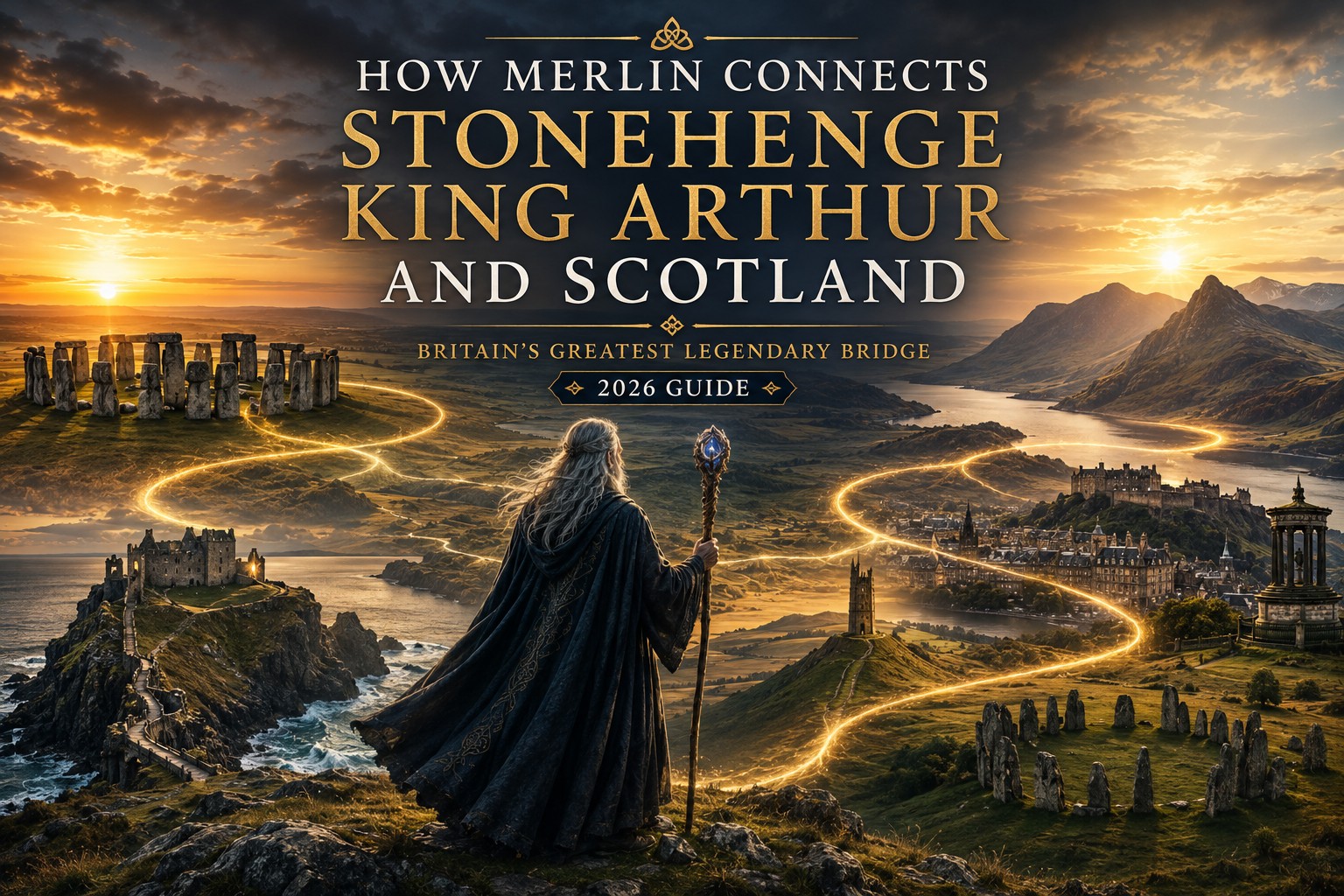
Merlin is the thread that links Britain’s greatest legendary landscapes. From Stonehenge and Arthurian England to Wales and Scotland, his evolving story connects archaeology, medieval literature and centuries of regional tradition into one remarkable cultural journey
Merlin occupies a unique place within Britain’s legendary heritage.
Unlike many famous figures who are closely associated with one location, Merlin’s story stretches across the country, connecting prehistoric monuments, medieval kings, Welsh literary traditions and Scottish folklore. Stonehenge, King Arthur and Scotland may appear to belong to separate stories, yet Merlin provides the thread that gradually brought them together.
These connections did not appear all at once.
They developed over many centuries as writers, storytellers and local communities adapted Merlin for new audiences. His earliest literary roots lie in Wales, where traditions surrounding the prophetic figure Myrddin were preserved in medieval manuscripts. During the twelfth century, Geoffrey of Monmouth transformed those earlier traditions into the Merlin recognised today, permanently linking him with Stonehenge and King Arthur. Later generations carried the legend even further north, where Scotland embraced Merlin within its own rich landscape of folklore and regional tradition.
This gradual evolution explains why Merlin appears in so many different parts of Britain.
He is not simply a magician from Arthurian legend or a mysterious figure connected with Stonehenge. He became Britain’s greatest legendary bridge, linking places that were never part of one documented historical journey but which together reveal the remarkable evolution of Britain’s cultural imagination.
Understanding how Merlin connects Stonehenge, King Arthur and Scotland therefore means looking beyond individual legends.
It means following the literary, historical and cultural threads that transformed one prophetic figure into the character who united some of Britain’s most celebrated landscapes.
By tracing those connections, we also discover how Britain’s legendary heritage evolved from regional traditions into a shared national story that continues to fascinate visitors today.
🌍 Merlin’s Britain at a Glance
Merlin’s story was not created in one place. Over many centuries, his legend evolved across Britain, connecting prehistoric monuments, medieval kingdoms, Welsh literary traditions and Scotland’s rich folklore into one remarkable cultural journey.
| Region | Merlin’s Connection | Why It Matters |
|---|---|---|
| 🪨 Stonehenge | Geoffrey of Monmouth linked Merlin with the monument’s legendary origin. | Created one of Britain’s most enduring literary associations. |
| 👑 Arthurian England | Merlin became King Arthur’s trusted adviser, prophet and mentor. | Established Britain’s greatest legendary partnership. |
| 🐉 Wales | Earlier traditions preserved the prophetic figure Myrddin. | Provides the earliest literary foundations of Merlin. |
| 🏴 Scottish Borders | Long-standing regional traditions associate Merlin with Drumelzier. | Shows how Merlin’s story continued to evolve across Britain. |
| 🏔️ Scotland | Merlin’s legend became part of Scotland’s wider mythical landscape. | Completes Britain’s interconnected legendary heritage. |
🧭 One Legend. Four Regions. One Remarkable Journey.
Merlin’s importance lies not in belonging to a single place, but in connecting many of Britain’s most famous landscapes. From prehistoric Stonehenge and Arthurian England to the literary traditions of Wales and the enduring folklore of Scotland, his story provides a unique thread that unites Britain’s archaeology, literature and cultural heritage.
🪨 Stonehenge — The Monument That Made Merlin Famous
For many visitors, Merlin and Stonehenge seem inseparable.
It is easy to assume that this connection reaches back into prehistory, but the truth is very different. Stonehenge was already an ancient monument when medieval writers first associated Merlin with it. By the twelfth century, the enormous stones standing alone on Salisbury Plain had inspired centuries of curiosity. Their builders had left no written explanation, encouraging generations to search for answers that archaeology could not yet provide.
The most influential explanation came from Geoffrey of Monmouth in his Historia Regum Britanniae. Geoffrey did not simply tell another story about Stonehenge. He transformed the monument’s place within Britain’s cultural imagination by making Merlin the central figure in its legendary origin.
That single literary decision changed both forever.
🪨 Why Stonehenge Needed an Explanation
By Geoffrey of Monmouth’s lifetime, Stonehenge had already stood on Salisbury Plain for thousands of years.
Its immense sarsen stones, carefully arranged bluestones and commanding position within one of Europe’s richest prehistoric landscapes inspired admiration, curiosity and speculation. Medieval people could appreciate the monument’s scale and craftsmanship, but they possessed no surviving written records explaining who built it or why. Faced with one of Britain’s greatest ancient mysteries, writers naturally sought explanations that reflected the knowledge and beliefs of their own age.
Geoffrey’s answer proved extraordinary.
Rather than presenting Stonehenge as the work of unknown prehistoric communities, he placed Merlin at the heart of its story. According to Historia Regum Britanniae, Merlin arranged for the legendary Giants’ Dance to be brought from Ireland to Salisbury Plain, creating a monument worthy of commemorating fallen British nobles. The story was imaginative rather than historical, yet it offered medieval readers a compelling explanation for one of Britain’s most remarkable monuments.
Modern archaeology paints a very different picture.
Scientific investigation has shown that Stonehenge was constructed in several phases during the Neolithic and Early Bronze Age, beginning around 3000 BC and continuing for many centuries. The monument therefore predates the traditional eras associated with Merlin, King Arthur and the Druids by thousands of years. Archaeology explains how Stonehenge was built; Geoffrey explained why medieval audiences believed it mattered.
That distinction is crucial.
Stonehenge did not create Merlin.
Merlin transformed the way generations of people understood Stonehenge.
From the twelfth century onwards, Britain’s most famous prehistoric monument also became one of its greatest literary landscapes, ensuring Merlin’s name would forever accompany discussions about Stonehenge.
📊 Merlin and Stonehenge
| Question | Historical Understanding |
|---|---|
| Why is Merlin connected with Stonehenge? | Geoffrey of Monmouth’s Historia Regum Britanniae created the enduring literary association. |
| Did Merlin build Stonehenge? | No. Archaeological evidence shows the monument was constructed during the Neolithic and Early Bronze Age, thousands of years earlier. |
| Why did Geoffrey’s story become so influential? | It provided medieval Britain with a memorable explanation for an ancient monument whose true origins were unknown. |
| Why does the connection still matter today? | It permanently united one of Britain’s greatest legends with one of its greatest prehistoric monuments, shaping literature, culture and visitor expectations ever since. |
⚖️ Merlin & Stonehenge — Myth vs History
Stonehenge’s connection with Merlin is one of Britain’s most enduring legends. Understanding the difference between archaeological evidence and medieval storytelling allows visitors to appreciate both the monument’s true prehistoric origins and the remarkable literary tradition that later transformed its cultural meaning.
| 🏛️ History & Archaeology | 📖 Myth & Medieval Literature |
|---|---|
| Stonehenge was built during the Neolithic and Early Bronze Age, beginning around 3000 BC and developing over many centuries. | Geoffrey of Monmouth’s Historia Regum Britanniae tells how Merlin transported the Giants’ Dance from Ireland to create Stonehenge. |
| Its construction predates the traditional eras associated with Merlin, King Arthur and the Druids by thousands of years. | The story provided medieval Britain with a memorable explanation for one of its greatest ancient mysteries. |
| Modern archaeology explains how Stonehenge was built through excavation, scientific dating and ongoing research. | The legend explains why Stonehenge became permanently linked with Merlin in Britain’s cultural imagination. |
| Stonehenge remains one of Europe’s most important prehistoric monuments. | Merlin transformed it into one of Britain’s greatest literary landscapes, inspiring generations of writers, artists and visitors. |
💡 Two Stories. One Extraordinary Monument.
History and legend do not compete—they complement one another. Archaeology reveals Stonehenge’s true prehistoric origins, while medieval literature explains how Merlin became forever connected with Britain’s most famous ancient monument. Appreciating both perspectives offers the richest understanding of Stonehenge’s remarkable place in Britain’s heritage.
👑 King Arthur — The Partnership That Spread Merlin Across Britain
Merlin’s association with Stonehenge established his place within Britain’s legendary landscape.
His partnership with King Arthur ensured that his reputation would spread far beyond Salisbury Plain.
Before Geoffrey of Monmouth, Merlin’s literary roots were already taking shape through earlier Welsh traditions surrounding Myrddin. Geoffrey built upon those foundations, transforming Merlin into the trusted adviser whose wisdom, foresight and guidance became indispensable to Britain’s greatest legendary king.
Arthur represented leadership.
Merlin represented wisdom.
Together, they created the most enduring partnership in Britain’s legendary history.
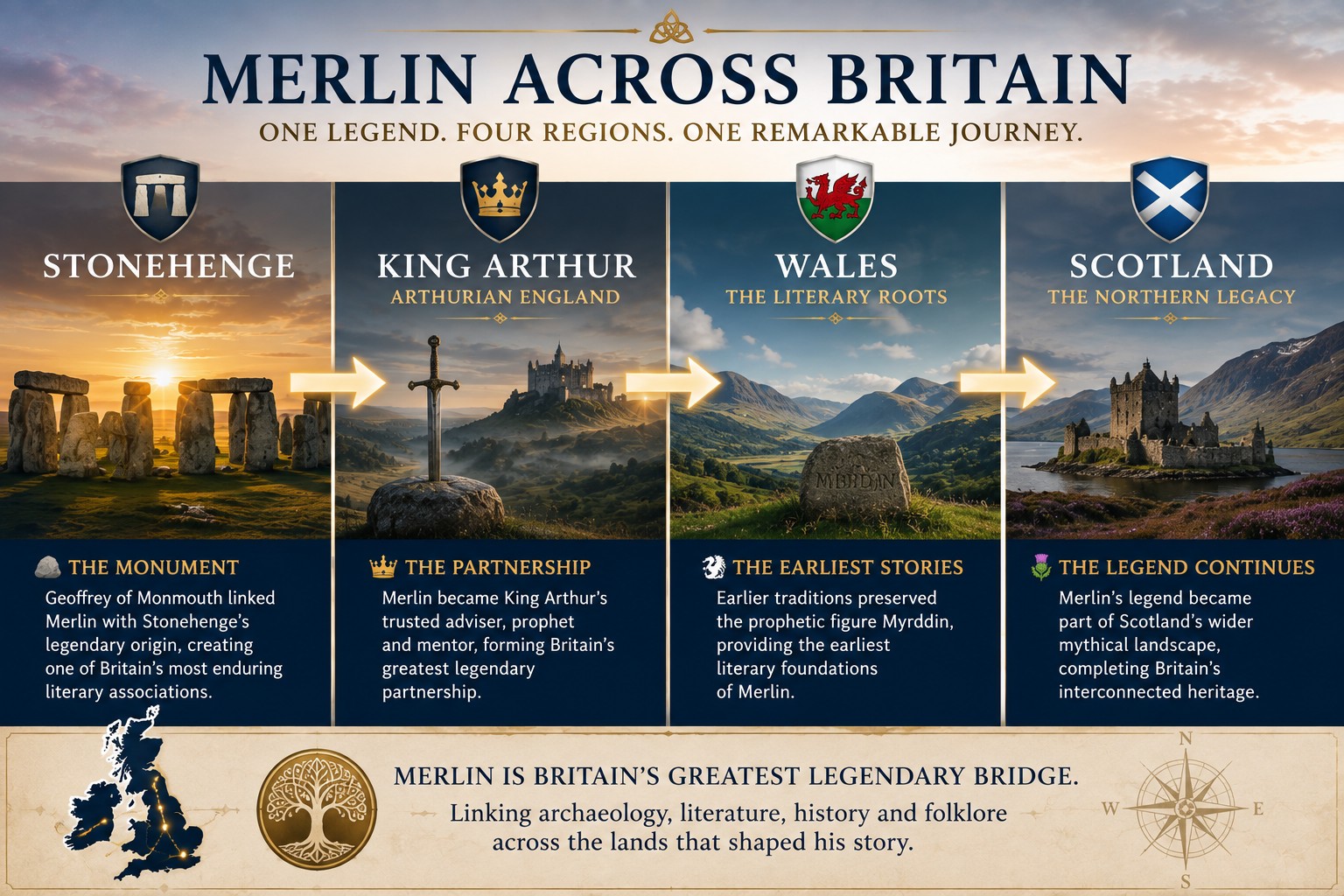
Merlin’s story evolved across four distinct regions of Britain, connecting Stonehenge, Arthurian England, the Welsh traditions of Myrddin and Scotland’s enduring regional folklore into one remarkable legendary journey
👑 Why Merlin Became Arthur’s Greatest Adviser
Merlin’s importance within Arthurian tradition extends far beyond magic.
Modern books and films often portray him primarily as a powerful wizard, but medieval writers gave him a much broader purpose. Merlin became the figure who connected prophecy with leadership, wisdom with kingship and Britain’s ancient past with its legendary future. His influence shaped the Arthurian story long before the Round Table reached its greatest fame.
Geoffrey of Monmouth introduced Merlin as a counsellor whose vision extended beyond immediate events, while later medieval romances developed his character into adviser, teacher, strategist and moral guide. Rather than solving every problem himself, Merlin frequently helped others make wiser decisions, allowing Arthur’s kingdom to grow through judgement rather than miracles alone.
This relationship transformed both characters.
Arthur embodied courage, leadership and the ideal of just kingship.
Merlin embodied knowledge, foresight and experience.
Together, they created Britain’s most enduring legendary partnership, one that has remained central to Arthurian storytelling for almost nine centuries.
🔍 More Than a Magician
One reason Merlin continues to resonate with modern audiences is that his greatest strengths are not supernatural.
He represents thoughtful leadership, long-term vision and the understanding that wisdom often proves more valuable than force. Medieval audiences admired these qualities just as much as the magical abilities later associated with him, helping Merlin become one of the most respected figures within Britain’s literary heritage.
Arthur’s growing popularity also carried Merlin far beyond Britain. As Arthurian romances spread across medieval Europe, Merlin travelled with them, becoming recognised throughout the continent. Yet despite this wider fame, his strongest literary and cultural associations always remained rooted in Britain’s landscapes.
📊 Merlin’s Role in Arthurian Tradition
| Role | Why It Matters |
|---|---|
| Prophet | Foretells events that shape Britain’s legendary future. |
| Adviser | Guides Arthur and earlier rulers with wisdom and foresight. |
| Teacher | Encourages leadership built upon judgement rather than power alone. |
| Strategist | Helps unite political vision with moral responsibility. |
| Legendary Bridge | Connects Stonehenge, Arthurian Britain, Wales and Scotland into one evolving tradition. |
Merlin’s partnership with Arthur also marked the beginning of another transformation.
He was no longer simply the prophetic figure preserved within early Welsh literature.
He had become Britain’s most influential legendary adviser.
To understand how that remarkable evolution occurred, however, we must step back before Arthur’s reign and return to the older traditions from which Merlin first emerged.
👑 Merlin & Arthur — A Legendary Partnership
Merlin and King Arthur became Britain’s greatest legendary partnership because each represented different strengths. Together, they combined wisdom, leadership and vision to create one of the most enduring stories in British literature.
| 🧙 Merlin | 👑 King Arthur |
|---|---|
| Visionary Adviser Guided events through wisdom, prophecy and long-term planning. |
Inspirational Leader United kingdoms through courage, justice and leadership. |
| Keeper of Ancient Knowledge Represented learning, tradition and the mysterious past. |
Protector of the Realm Represented order, stability and the hope of a better Britain. |
| Connected Britain’s Legendary Places His stories linked Stonehenge, Wales, Arthurian England and Scotland into one legendary landscape. |
United Britain’s Legendary Kingdom His adventures brought together castles, battlefields, abbeys and royal courts across Britain. |
| Represents Wisdom | Represents Leadership |
✨ Two Legends. One Enduring Story.
Merlin and Arthur are remembered not because either figure stands alone, but because their partnership combines knowledge with leadership, vision with action and legend with landscape. Together, they transformed Britain’s ancient places into one of the world’s richest legendary traditions—a story that continues to inspire visitors today.
🐉 Before Arthur — Merlin’s Welsh Origins
Long before Merlin advised King Arthur or became associated with Stonehenge, Welsh literary tradition preserved stories of a remarkable prophetic figure known as Myrddin.
Although these traditions survive through medieval manuscripts rather than contemporary records, they preserve some of the earliest foundations of the character later readers would recognise as Merlin. Myrddin is portrayed not as a courtly adviser but as a solitary prophet shaped by conflict, exile and the natural world. His wisdom comes from reflection and vision rather than political influence, creating a character very different from the Merlin who would later stand beside Britain’s legendary king.
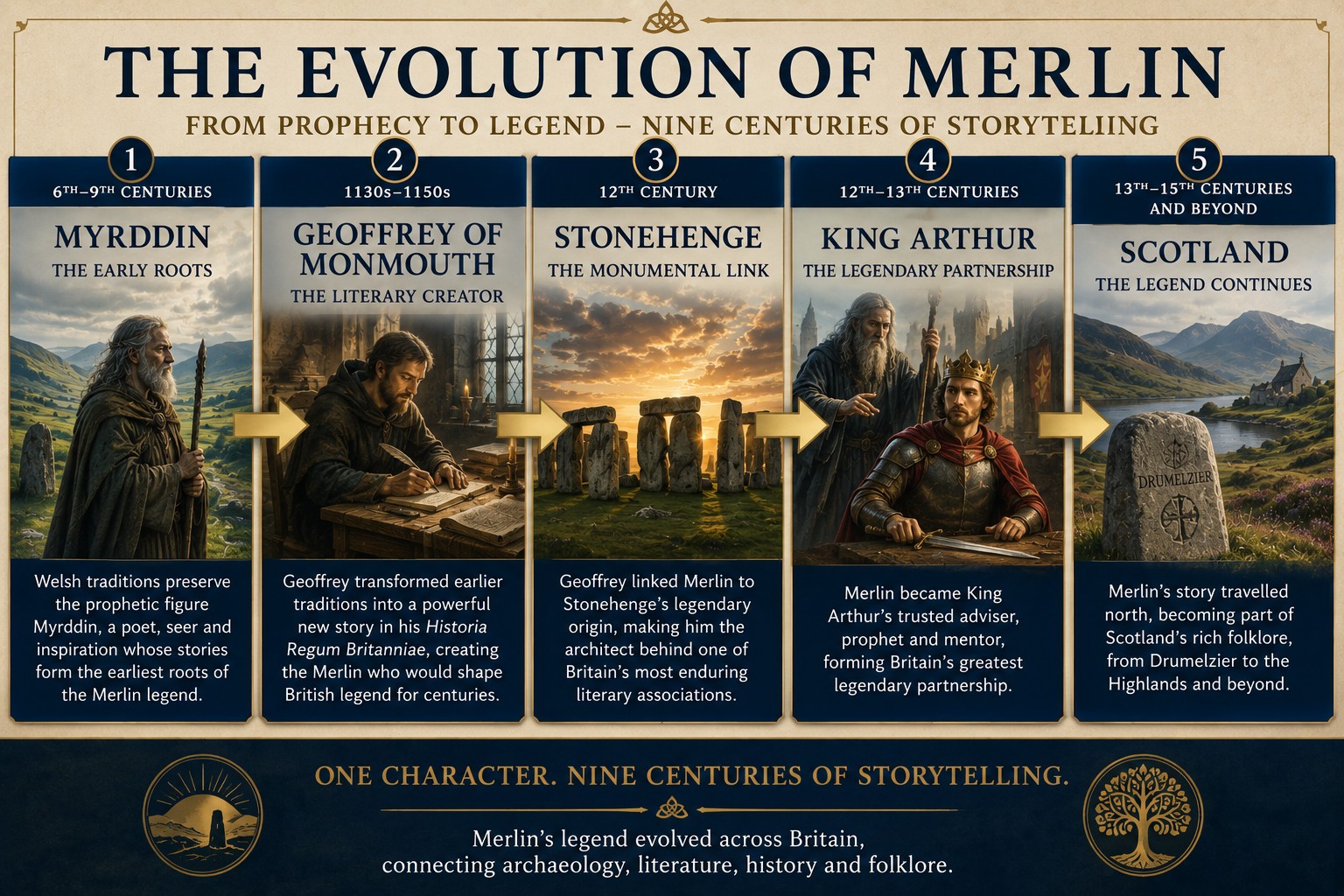
Merlin did not emerge fully formed. His story evolved over centuries, growing from the Welsh traditions of Myrddin into the legendary figure who connected Stonehenge, King Arthur and Scotland
🐉 From Myrddin to Merlin — The Evolution of a Legend
The transformation from Myrddin to Merlin was not the work of one writer or one generation.
It developed gradually as stories passed between poets, chroniclers and medieval historians, each adding new layers to an already fascinating character. Welsh literary tradition preserved Myrddin as a prophetic figure closely associated with battle, exile and the wilderness. Geoffrey of Monmouth inherited these traditions, Latinised the name into Merlinus and expanded the character into someone capable of supporting his ambitious history of Britain’s kings.
In doing so, Geoffrey achieved something remarkable.
He did not simply adapt an existing legend.
He created a literary figure who could unite Britain’s past, present and future within a single narrative. Merlin became the adviser of kings, interpreter of prophecy and symbolic link between ancient Britain and the emerging Arthurian tradition. Later medieval writers continued to develop this foundation, adding new adventures, deeper relationships and richer symbolism until Merlin became one of Europe’s most recognisable legendary characters.
This literary evolution explains why Merlin appears to belong to several different places at once.
Each region preserves a different stage of his development.
Wales contains his earliest literary foundations.
Stonehenge became his most famous legendary association.
Arthurian England established him as Britain’s greatest adviser.
Scotland preserved some of his most enduring regional traditions.
Rather than contradicting one another, these locations illustrate how legends naturally evolve as they pass through different cultures, landscapes and generations.
📊 The Evolution of Merlin
| Stage | Merlin’s Development | Lasting Importance |
|---|---|---|
| Welsh Literary Tradition | Myrddin appears as a prophetic figure associated with wilderness and battle. | Provides the earliest literary foundations of the legend. |
| Geoffrey of Monmouth | Earlier traditions are expanded into the Merlin of Britain’s royal history and linked with Stonehenge. | Creates the enduring medieval Merlin recognised today. |
| Arthurian Romance | Merlin develops into Arthur’s trusted adviser, prophet and mentor. | Spreads Merlin’s influence throughout medieval Europe. |
| Regional Folklore | Local traditions across Britain, particularly in Scotland, continue to adapt Merlin’s story. | Establishes Merlin as a lasting figure within Britain’s legendary landscape. |
The important point is that Merlin did not emerge fully formed.
His story evolved over centuries, growing from regional literary traditions into a national legend capable of connecting some of Britain’s greatest historic landscapes.
That remarkable journey did not end with Arthur.
It continued north into Scotland, where Merlin’s story found one of its most enduring regional homes.
🧙 From Myrddin to Merlin — The Evolution of a Legend
Merlin did not emerge fully formed as King Arthur’s famous adviser. His character developed over centuries as Welsh literary traditions, medieval chroniclers, Arthurian romance and regional folklore each added new layers to his story.
① Early Welsh Literary Tradition
🐉 Myrddin the Prophet
Welsh tradition preserves Myrddin as a prophetic and solitary figure associated with battle, exile, wilderness and visionary insight. These stories provide the earliest literary foundations of the later Merlin legend.
② Twelfth Century
📖 Geoffrey of Monmouth Reshapes the Legend
Geoffrey drew upon earlier Welsh traditions, Latinised the name as Merlinus and transformed the character into a prophet and adviser within his wider history of Britain’s kings.
③ Stonehenge Enters Merlin’s Story
🪨 Britain’s Greatest Literary Association
Geoffrey linked Merlin with the transport of the Giants’ Dance to Salisbury Plain, permanently connecting him with Stonehenge despite the monument’s far older prehistoric origins.
④ Arthurian Romance
👑 Arthur’s Adviser, Teacher and Strategist
Later medieval writers developed Merlin into King Arthur’s trusted counsellor, prophet and mentor, spreading his fame throughout Britain and medieval Europe.
⑤ Regional Folklore
🏴 Merlin’s Story Travels Across Britain
Local traditions continued adapting Merlin’s character, particularly in Scotland, where Drumelzier became associated with his final years and legendary resting place.
⑥ Modern Britain
🔗 Britain’s Legendary Bridge
Merlin is now the connecting figure between Stonehenge, King Arthur, Welsh literary tradition and Scotland’s regional folklore, uniting several of Britain’s greatest legendary landscapes.
💡 A Legend Built Across Centuries
Merlin’s evolution was not one simple transformation. Each generation inherited an existing character and added new roles, places and meanings. The result is a figure whose story connects regional Welsh literature, medieval national history, Arthurian romance and living folklore across Britain.
🏴 Scotland — Merlin’s Northern Legacy
By the time Merlin became part of Scotland’s legendary landscape, he was already one of Britain’s best-known literary figures.
Scotland did not create Merlin.
Instead, it inherited and adapted an existing legend, weaving it into landscapes that already possessed rich traditions of folklore, heroic storytelling and cultural memory. Rather than replacing the earlier Welsh or Arthurian traditions, Scotland added another important chapter to Merlin’s continuing evolution, demonstrating how powerful stories naturally become rooted in new places over time.
Among all Scottish locations connected with Merlin, one stands above the rest.
🏴 Drumelzier — Scotland’s Strongest Merlin Tradition
Among all the places associated with Merlin across Britain, Drumelzier in the Scottish Borders preserves one of the oldest and most enduring regional traditions.
For centuries, local folklore has identified this peaceful village, close to the meeting of the River Tweed and Powsail Burn, as the place where Merlin—often associated with the earlier Welsh figure Myrddin—met his end. Archaeology cannot confirm the tradition, yet its historical significance lies in something equally valuable: generation after generation has continued to preserve the story, allowing Merlin’s legacy to become firmly rooted within the Borders’ cultural identity.
That continuity is what makes Drumelzier so important.
Rather than existing only within medieval manuscripts, Merlin became connected with a real landscape that visitors can still experience today. The quiet valleys, wooded hillsides and gently flowing rivers create an atmosphere very different from the open chalk landscape surrounding Stonehenge or the dramatic coastline of Tintagel. It is a place of reflection rather than spectacle, making it an entirely fitting setting for Britain’s most enigmatic prophetic figure.
🔍 Arthur’s Seat and Scotland’s Wider Legendary Landscape
Further north, Arthur’s Seat demonstrates how Arthurian tradition also became woven into Scotland’s cultural landscape.
The extinct volcano overlooking Edinburgh is associated primarily with King Arthur rather than Merlin directly. No historical evidence links either figure with the site, yet its commanding position above Scotland’s capital illustrates how dramatic natural landmarks repeatedly attracted legendary stories. Arthur’s Seat therefore complements Merlin’s Scottish legacy without forming one of its primary locations.
Beyond Edinburgh, the Scottish Highlands and the Isle of Skye belong to Scotland’s wider mythical landscape rather than to Merlin’s core tradition.
These remarkable regions are celebrated for Gaelic mythology, clan history, fairy folklore and ancient storytelling. While they should not be regarded as principal Merlin locations, they help explain why later generations found Scotland such fertile ground for expanding Britain’s legendary imagination. Their mountains, glens, lochs and islands provided landscapes in which stories naturally flourished and continued to evolve.
📊 Merlin’s Legacy in Scotland
| Place | Type of Association | Why It Matters Today |
|---|---|---|
| Drumelzier | Long-standing regional Merlin tradition | Traditionally associated with Merlin’s final resting place and one of Scotland’s strongest Merlin legends. |
| Arthur’s Seat | Arthurian association | Demonstrates the spread of Arthurian tradition into Scotland’s landscape. |
| Scottish Highlands | Wider mythical landscape | Rich folklore and ancient scenery that helped sustain legendary storytelling. |
| Isle of Skye | Gaelic mythology | Celebrated for fairy traditions, folklore and dramatic natural beauty rather than direct Merlin associations. |
Together, these places complete the northern chapter of Merlin’s story.
They demonstrate how one literary figure gradually became woven into the identity of another nation, enriching Scotland’s own legendary heritage while strengthening Merlin’s role as Britain’s great cultural connector.
🔗 Merlin — Britain’s Legendary Bridge
By now, a clear pattern begins to emerge.
Merlin’s greatest significance does not lie in one monument, one kingdom or one region.
It lies in the remarkable way he connects them all.
🔗 Merlin — Britain’s Legendary Bridge
Merlin’s greatest legacy is not that he belongs to one famous place.
It is that he connects places which, at first glance, appear to have little in common.
Without Merlin, Stonehenge remains one of Europe’s greatest prehistoric monuments. King Arthur remains Britain’s legendary king. Welsh literature preserves the traditions of Myrddin, while Scotland maintains its own rich folklore and regional legends.
With Merlin, these separate stories become part of a much larger cultural narrative.
Over many centuries, he evolved into the figure who links prehistoric archaeology with medieval literature, regional folklore with national identity and ancient landscapes with modern visitor experiences. Few legendary characters have shaped Britain’s cultural imagination across so many regions or so many generations.
That is why Merlin occupies such a unique position within Britain’s legendary heritage.
🔍 Five Ways Merlin Connects Britain
Merlin’s influence can be understood through five distinct connections, each representing a different layer of Britain’s cultural landscape.
History
Although Merlin belongs primarily to literature rather than documented history, his story became attached to genuine historic places. Stonehenge, Tintagel, Glastonbury and Drumelzier all possess their own archaeological or historical significance, even where Merlin’s role belongs to later tradition.
Literature
Geoffrey of Monmouth created the defining bridge by bringing together earlier Welsh traditions and expanding Merlin into one of medieval Britain’s most influential literary figures. Later writers continued that process, ensuring Merlin’s story reached readers across Europe while remaining firmly rooted in Britain.
Landscape
Merlin’s journey unfolds across some of Britain’s most remarkable scenery. Salisbury Plain, Cornwall’s dramatic coastline, the valleys of Wales and the hills of Scotland each preserve a different chapter in his evolving story, demonstrating how landscapes themselves helped shape legendary traditions.
Folklore
Communities across Britain adapted Merlin’s story to their own regions, allowing local traditions to flourish while preserving recognisable elements of the wider legend. This explains why Merlin appears in different forms without ever losing his essential identity.
Modern Travel
Today, Merlin has become the narrative thread connecting several of Britain’s finest visitor experiences. Travellers who begin at Stonehenge often continue towards Tintagel, Glastonbury, Wales or Scotland, discovering that they are following the same literary journey that gradually developed over centuries. Even exploring one stage of Merlin’s story provides valuable insight into Britain’s legendary heritage; completing the entire route simply reveals the full richness of those interconnected traditions.
📊 Merlin’s Five Great Connections
| Connection | Merlin’s Role | Modern Significance |
|---|---|---|
| Stonehenge | Literary interpreter of Britain’s greatest prehistoric monument | Introduces visitors to Merlin’s legendary world |
| King Arthur | Adviser, prophet and counsellor | Central figure within Arthurian tradition |
| Wales | Earliest literary foundations through Myrddin | Explains Merlin’s origins and evolution |
| Scotland | Enduring regional traditions | Demonstrates Merlin’s continuing cultural influence |
| Modern Britain | Connecting figure across multiple landscapes | Creates one of Britain’s richest heritage travel experiences |
Seen together, these five connections explain why Merlin remains unlike any other figure in British legend.
He does not simply appear within Britain’s greatest stories.
He is the character who binds them together.
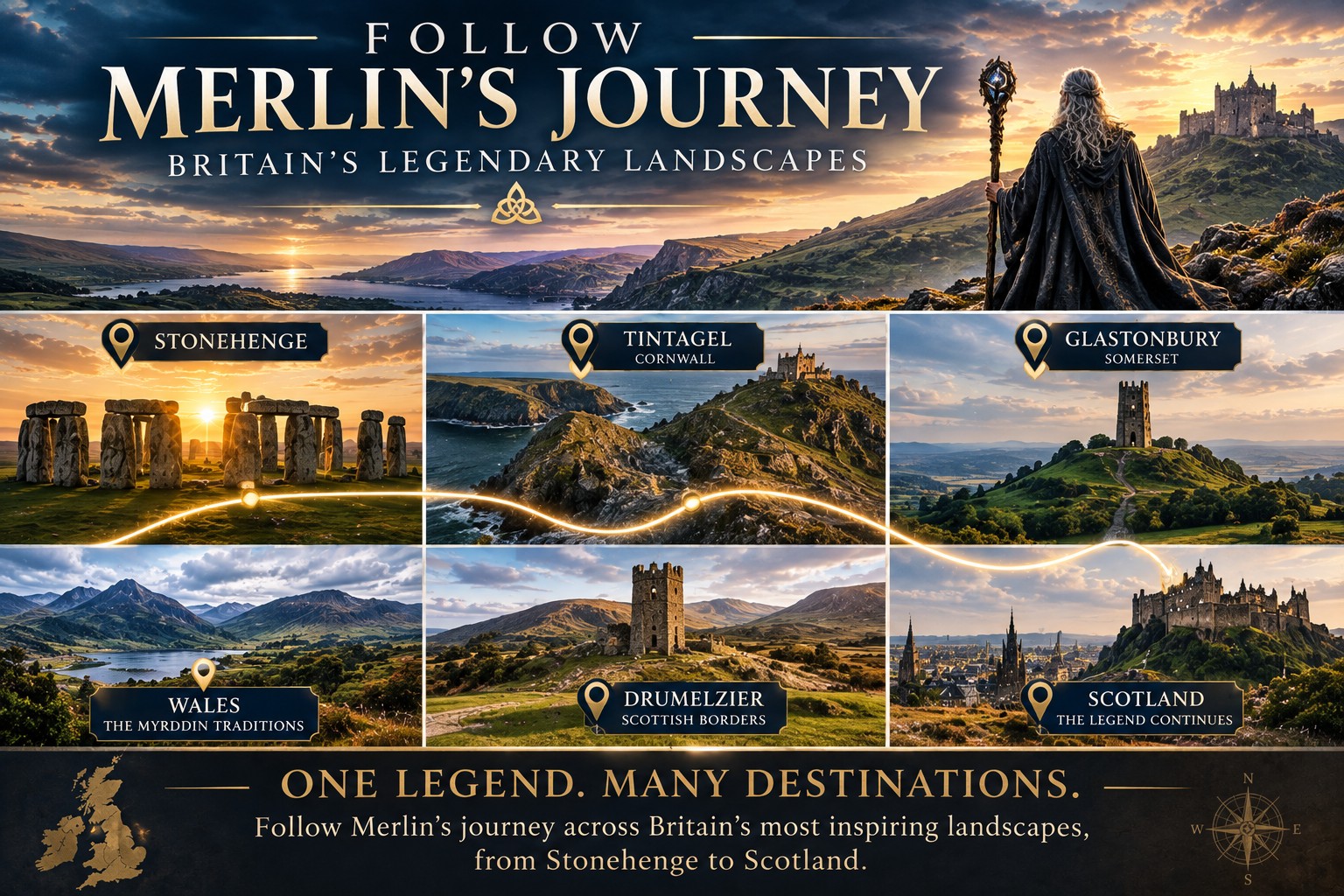
Follow Merlin’s story across Britain’s legendary landscapes, from Stonehenge and Arthurian England to Wales and Scotland, discovering how one enduring legend connects some of the country’s most remarkable historic places
🗺️ Merlin’s Journey Across Britain
Merlin’s legend is woven across Britain rather than tied to a single location. This journey links the key landscapes where archaeology, medieval literature and regional tradition combined to create one of Britain’s greatest enduring legends.
① Stonehenge, Wiltshire
🪨 The Legendary Beginning
Britain’s most famous prehistoric monument became permanently associated with Merlin through Geoffrey of Monmouth’s story of the Giants’ Dance, making Stonehenge the natural gateway to Britain’s legendary landscape.
② Southern England
👑 Arthur’s Kingdom
Glastonbury, Tintagel and Winchester became central to Arthurian tradition, where Merlin emerged as King Arthur’s trusted adviser, strategist and prophet.
③ Wales
🐉 The Origins of Myrddin
Earlier Welsh poetry and tradition preserve Myrddin as a prophetic figure whose stories provided the literary foundations from which the later Merlin evolved.
④ Drumelzier, Scottish Borders
🏴 Merlin’s Final Chapter
Regional tradition identifies Drumelzier as the place of Merlin’s final days, illustrating how his legend continued to spread beyond its earlier literary roots.
⑤ Scotland’s Legendary Landscapes
🏔️ Merlin’s Lasting Legacy
From the Borders to Arthur’s Seat and the Highlands, Scotland preserves some of the richest later traditions that completed Merlin’s journey across Britain’s legendary landscape.
🧭 Follow the Legend, Not the Timeline
Merlin’s journey is not a record of one historical person’s travels. It is the story of how different places, cultures and generations adopted and reshaped the legend over hundreds of years. Exploring these landscapes reveals how archaeology, medieval literature and regional folklore combined to create one of Britain’s most enduring cultural traditions.
🚗 Following Merlin’s Journey Across Britain Today
One of the most rewarding aspects of Merlin’s story is that it can still be followed through real places across Britain.
Unlike purely fictional characters whose adventures exist only within books, Merlin gradually became associated with genuine landscapes that visitors can explore today. Each destination represents a different stage in the legend’s evolution, allowing travellers to experience how archaeology, medieval literature, regional folklore and modern tourism have become closely intertwined over many centuries.
The journey naturally begins at Stonehenge.
Here, Geoffrey of Monmouth permanently linked Merlin with Britain’s most famous prehistoric monument, creating the literary association that still shapes public imagination today. From Salisbury Plain, travellers can continue west towards Tintagel, where Arthurian tradition places the legendary king’s birth, before exploring Glastonbury, long connected with Avalon and Arthur’s final journey.
Crossing into Wales introduces the literary traditions surrounding Myrddin, revealing that Merlin’s story began long before the Arthurian romances made him famous. Continuing north into the Scottish Borders brings visitors to Drumelzier, where one of Britain’s strongest regional Merlin traditions has endured for centuries. Beyond this, Edinburgh, the Highlands and the Isle of Skye demonstrate how Scotland’s spectacular landscapes naturally became home to some of Britain’s richest folklore.
Rather than attempting to prove every legend historically true, this journey achieves something equally valuable.
It reveals how Britain’s shared cultural imagination developed across different regions and different centuries, gradually weaving separate traditions into one remarkable legendary heritage.
🔗 Merlin’s Five Great Connections
Merlin became Britain’s greatest legendary bridge because his story connects five distinct parts of the country’s cultural heritage. Each connection represents a different stage in the evolution of his legend.
🪨 1. Stonehenge
Geoffrey of Monmouth connected Merlin with the legendary movement of the Giants’ Dance to Salisbury Plain, permanently linking Britain’s best-known legendary figure with its greatest prehistoric monument.
👑 2. King Arthur
Merlin became Arthur’s adviser, prophet and teacher, creating a partnership that united wisdom with leadership and carried both figures into the centre of Britain’s medieval legendary tradition.
🐉 3. Wales
The Welsh traditions surrounding Myrddin preserve the earliest literary foundations of the character later reshaped as Merlin, revealing that his story began long before his association with Arthur or Stonehenge.
🏴 4. Scotland
Long-standing regional traditions, particularly around Drumelzier, extended Merlin’s story northwards and established him within Scotland’s own landscape of folklore and cultural memory.
🧭 5. Modern Britain
Today, Merlin provides the narrative thread connecting Stonehenge, Arthurian England, Wales and Scotland into one rewarding journey through archaeology, literature, folklore and living heritage.
✨ Why Merlin Is Britain’s Legendary Bridge
Most legendary figures are remembered through one place or one story. Merlin is different. His evolving role connects prehistoric monuments, medieval kingship, Welsh literary origins, Scottish folklore and modern heritage travel—making him the figure who binds Britain’s greatest legendary landscapes together.
📊 Suggested Merlin Journey Itineraries
| Time Available | Suggested Journey | Ideal For |
|---|---|---|
| 1 Day | Stonehenge | Discover Merlin’s most famous literary association with Britain’s greatest prehistoric monument. |
| 3–4 Days | Stonehenge, Glastonbury and Tintagel | Explore the heart of Arthurian England and Merlin’s medieval legacy. |
| 5–7 Days | Stonehenge, Arthurian England and Wales | Follow Merlin’s literary evolution from Myrddin to Arthurian adviser. |
| 10–14 Days | Stonehenge, Arthurian England, Wales, Drumelzier, Edinburgh and selected Highland destinations | Experience Merlin’s complete legendary journey across Britain at a relaxed pace. |
Whether you explore one destination or complete the entire route, each location offers another perspective on Merlin’s remarkable legacy. Together, they demonstrate how one legendary figure came to connect some of Britain’s most important historic and cultural landscapes.
🔍 Why Every Merlin Journey Should Begin at Stonehenge
Every traveller will approach Britain’s legendary landscape with different interests.
Some are fascinated by archaeology. Others come for King Arthur, Merlin or medieval history. Stonehenge brings all of these themes together more effectively than any other destination because it introduces the relationship between physical evidence and literary tradition that runs throughout Merlin’s story.
Beginning here provides the historical and cultural context that makes every later destination more meaningful.
💡 Expert Traveller Tip
If you’re planning to explore Britain’s legendary landscapes, begin your journey at Stonehenge. It is the one destination that naturally introduces the archaeology, medieval literature and folklore that shaped the stories of Merlin and King Arthur, providing the perfect foundation before continuing to Arthurian England, Wales or Scotland.
Stonehenge also works exceptionally well as the first stop from a practical travel perspective. It is one of Britain’s most accessible historic sites, making it easy to build a wider itinerary that includes places such as Glastonbury, Tintagel, the Welsh Borders and the Scottish landscapes associated with Merlin’s later traditions.
🧭 BVT Planning Advice
Plan your Stonehenge visit first, then use it as the anchor for the rest of your itinerary. Building your journey around one confirmed date creates a more relaxed, enjoyable trip and allows you to experience Britain’s legendary places as a connected story rather than a rushed checklist of destinations.
📅 Plan Your Merlin Journey with the BVT Stonehenge Inner Circle Access Calendar
If you are planning to follow Merlin’s legendary connections across Britain, there is no better place to begin than Stonehenge itself.
Experiencing the monument during an authorised Stonehenge Inner Circle Access visit offers a rare opportunity to enter the stone circle outside normal public opening hours. Standing among the ancient stones at sunrise or sunset provides a memorable perspective on the monument that inspired one of Britain’s greatest medieval legends.
Because Inner Circle Access is available only on selected dates throughout the year, planning ahead is essential. The BVT Stonehenge Inner Circle Access Calendar makes it easy to compare available sunrise and sunset access dates, helping you build a wider itinerary around one of Britain’s most remarkable heritage experiences.
📅 Plan Your Merlin Journey at Stonehenge
Merlin’s story spans Britain, but one place provides the perfect starting point for exploring his legendary world—Stonehenge. Whether you’re following Arthurian England, the literary traditions of Wales or Merlin’s enduring legacy in Scotland, beginning your journey here brings the whole story into focus.
The Stonehenge Inner Circle Access Calendar helps you compare exclusive sunrise and sunset access dates throughout the year, making it easy to choose the ideal time to begin your own Legendary Britain adventure.
📅 View the Stonehenge Inner Circle Access Calendar
💡 Why Begin with Stonehenge?
Stonehenge is where Britain’s prehistoric heritage and Merlin’s medieval legend come together. Planning your visit here first creates the perfect foundation for continuing your journey through Arthurian England, the Welsh traditions of Myrddin and the legendary landscapes of Scotland.
📚 Continue Exploring Merlin’s Britain
Merlin’s story stretches far beyond a single monument or legend. Continue exploring how archaeology, medieval literature and regional folklore combine to create one of Britain’s richest legendary journeys.
🪨 Did Merlin Ever Visit Stonehenge?
Discover how one of Britain’s most famous questions blends prehistoric archaeology with medieval storytelling, and why Merlin became permanently linked with Stonehenge.
🧙 Merlin, Druids and Stonehenge
Separate historical evidence from enduring legend as you explore how Merlin, the Druids and Stonehenge became connected through centuries of myth, literature and popular imagination.
🌍 Britain’s Most Legendary Places
Follow the complete Legendary Britain journey linking Stonehenge, King Arthur, Merlin and Scotland’s remarkable landscapes into one unforgettable travel experience.
✨ One Story. Many Destinations.
Together, these guides reveal how Merlin became the legendary thread connecting prehistoric Stonehenge, King Arthur’s England, the literary traditions of Wales and the folklore of Scotland. Reading them as a series provides a deeper understanding of Britain’s unique legendary landscape.
🌍 Protecting Britain’s Legendary Landscapes
Britain’s legendary landscapes have endured because generations before us recognised their importance and chose to protect them. From the prehistoric monument of Stonehenge and the windswept cliffs of Tintagel to the historic ruins of Glastonbury Abbey, the peaceful valleys of the Scottish Borders and the dramatic scenery of the Highlands, every destination tells a story that deserves to be preserved with care.
Responsible travel begins by recognising that these places carry more than one form of heritage.
One story is written in archaeology, geology and documented history.
The other has been preserved through literature, folklore and centuries of local tradition.
Both contribute to Britain’s remarkable cultural identity, and both deserve equal respect from modern visitors.
At Stonehenge, following English Heritage guidance and remaining on designated pathways helps protect not only the famous stone circle but also the wider UNESCO World Heritage landscape. Ancient burial mounds, ceremonial avenues and lesser-known archaeological features continue to provide valuable evidence about Britain’s Neolithic past, making the surrounding landscape every bit as important as the stones themselves.
Elsewhere, responsible travel takes different forms. At Tintagel, respecting cliff-top paths helps preserve fragile coastal archaeology and protects sensitive wildlife habitats. Around Glastonbury, thoughtful behaviour safeguards historic buildings, places of worship and one of England’s most significant medieval landscapes. In Wales, visitors can enjoy landscapes associated with Myrddin while supporting local communities and respecting their cultural heritage. Across the Scottish Borders, Arthur’s Seat and the Highlands, careful walking, responsible parking and support for independent businesses help ensure these remarkable places remain welcoming for generations to come.
Travelling more slowly also has lasting benefits. Choosing local accommodation, reducing unnecessary car journeys where practical and allowing time to explore each destination beyond its most famous viewpoint creates a richer experience while supporting the communities that care for Britain’s heritage every day.
Britain’s legendary landscape has evolved over thousands of years.
Its future now depends upon the choices we make today.
Travel with purpose. Explore with care.
🌿 Travel with Purpose. Explore with Care.
Britain’s legendary landscapes have inspired travellers, historians and storytellers for generations. From the ancient stones of Stonehenge to the castles of Arthurian England, the literary landscapes of Wales and the traditions preserved in Scotland, each destination represents an important part of our shared cultural heritage.
Responsible travel helps ensure these remarkable places remain protected for future generations. Respecting historic monuments, following site guidance, supporting local communities and caring for the surrounding countryside all help preserve the landscapes that continue to inspire Britain’s greatest legends.
🌍 Every Visit Helps Protect Britain’s Legendary Heritage
Small actions make a lasting difference. By travelling thoughtfully and respecting both historic sites and natural landscapes, you help ensure that Stonehenge, Arthurian England, Wales and Scotland continue to inspire future generations with their unique stories and remarkable places.
❓ Frequently Asked Questions
❓ How does Merlin connect Stonehenge, King Arthur and Scotland?
Merlin acts as the literary thread linking several of Britain’s greatest legendary traditions. Geoffrey of Monmouth connected him with Stonehenge before establishing him as King Arthur’s trusted adviser, while later regional traditions, particularly in the Scottish Borders, extended Merlin’s story into Scotland.
❓ Was Merlin originally a Welsh figure?
The earliest literary foundations of Merlin lie in Welsh traditions surrounding the prophetic figure Myrddin. Geoffrey of Monmouth later Latinised and expanded these earlier traditions into the Merlin recognised throughout medieval Arthurian literature.
❓ Did Merlin really build Stonehenge?
No. Archaeological evidence shows that Stonehenge was constructed during the Neolithic and Early Bronze Age, thousands of years before the traditional period associated with Merlin. The connection comes from Geoffrey of Monmouth’s twelfth-century literary account.
❓ Why is Geoffrey of Monmouth so important?
Geoffrey brought together earlier traditions and created the medieval Merlin most people recognise today. His writings permanently linked Merlin with Stonehenge and established his central role within the Arthurian legend.
❓ Why is Merlin associated with Scotland?
Long-standing regional traditions, especially around Drumelzier in the Scottish Borders, connected Merlin with Scotland long after the character became established within medieval literature. These traditions form an important part of Scotland’s legendary heritage.
❓ Where is Merlin traditionally buried?
According to long-standing local tradition, Merlin’s final resting place is near Drumelzier in the Scottish Borders. This remains part of regional folklore rather than verified archaeological history.
❓ Can you follow Merlin’s story across Britain?
Yes. Visitors can explore Stonehenge, Arthurian England, Welsh landscapes associated with Myrddin and Scotland’s Merlin traditions as part of one rewarding journey through Britain’s literary, historical and cultural heritage.
❓ Why should Stonehenge be the first stop?
Stonehenge introduces the relationship between archaeology and medieval storytelling that defines Merlin’s later legend. Beginning there provides valuable context for understanding every destination that follows.
❓ Is Merlin history or legend?
Merlin belongs primarily to literature and folklore rather than documented history. His enduring significance comes from the way successive generations connected his story with real places across Britain.
❓ What makes Merlin different from other legendary figures?
Unlike most legendary characters, Merlin became the figure who connected prehistoric Stonehenge, King Arthur, Welsh literary tradition and Scotland’s regional folklore into one evolving British narrative.
🏁 Final Thoughts — One Legend That Connected Britain
Merlin’s greatest achievement was never the performance of magic or the advising of kings.
His true legacy lies in the remarkable way his story brought together landscapes that might otherwise have remained entirely separate.
From the prehistoric mystery of Stonehenge and the royal traditions surrounding King Arthur to the literary foundations of Myrddin in Wales and the enduring folklore of Scotland, Merlin became the character who united Britain’s archaeology, literature and regional traditions into one continuous cultural journey.
That is why Merlin remains so relevant today.
Following his story is not simply an exploration of myth. It is an opportunity to understand how Britain’s greatest legends developed, how different communities shaped those traditions and how remarkable landscapes inspired storytellers for almost a thousand years.
Some places preserve archaeology.
Some preserve literature.
Some preserve folklore.
Merlin connects them all.
🧭 Continue Planning Your Merlin Journey Across Britain
Merlin’s legend connects some of Britain’s most remarkable places—from the ancient mystery of Stonehenge and the kingdoms of Arthurian England to the literary traditions of Wales and the legendary landscapes of Scotland. If you’re ready to turn these stories into a real adventure, these expert resources provide the perfect place to begin.
✨ Begin Where Britain’s Greatest Legends Meet
Merlin’s story stretches across Britain, but it is at Stonehenge that prehistoric history and medieval legend first come together. Begin your journey here, then continue through Arthurian England, the literary landscapes of Wales and the enduring folklore of Scotland to experience Britain’s legendary heritage as one connected adventure.