


Merlin & the Scottish Highlands: Mythical Landscapes and Hidden Places
1st August 2026
🏔️ Merlin & the Scottish Highlands: Mythical Landscapes and Hidden Places (2026 Guide)
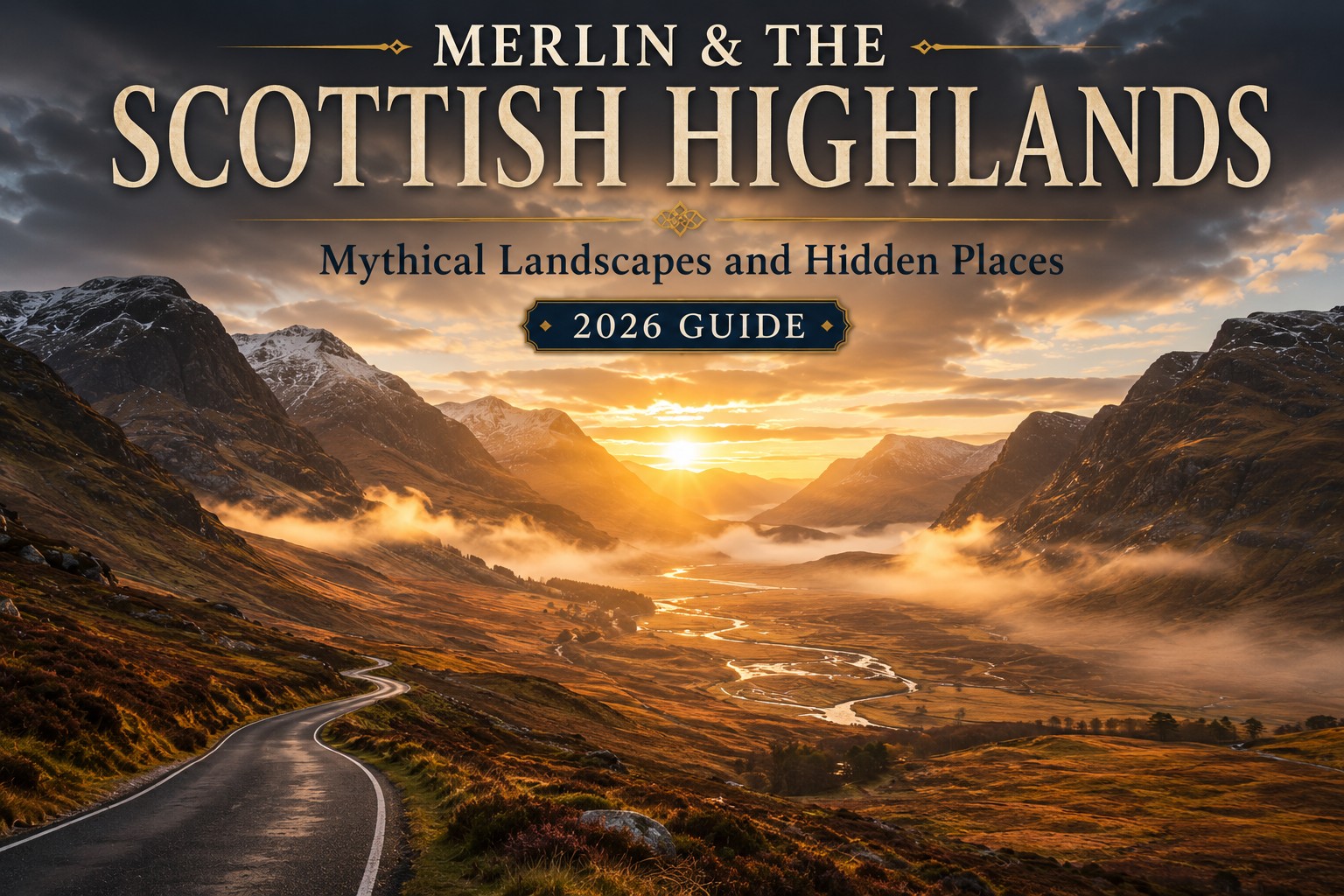
The dramatic landscapes of Glen Coe capture the spirit of the Scottish Highlands, where towering mountains, remote glens and changing weather have inspired centuries of folklore, literature and the enduring legend of Merlin
A road disappears into Glen Coe beneath steep volcanic mountains. Cloud drifts across Rannoch Moor. Ancient pinewoods darken the lower slopes of the Cairngorms, while the black waters of Loch Ness stretch through the Great Glen beneath changing Highland skies.
These are not empty wildernesses untouched by history. They are lived-in landscapes shaped by geology, Gaelic communities, clan territories, crofting, clearance, forestry, transport, tourism and conservation. Yet they still retain a scale and atmosphere capable of making modern life feel briefly distant.
That is why the connection between Merlin and the Scottish Highlands feels so natural.
There is no historical evidence that Merlin travelled through every glen, crossed every moor or stood beside each loch explored in this guide. His relationship with the Highlands belongs primarily to literature, folklore and cultural imagination. Even so, the region’s mountains, forests and secluded valleys reflect the qualities that later traditions repeatedly associated with him: solitude, prophecy, hidden knowledge and an unusually close relationship with the natural world.
Merlin did not begin solely as the court magician familiar from modern films. Early Welsh traditions include Myrddin, a prophetic figure driven into wilderness after the trauma of battle. Geoffrey of Monmouth later reshaped those traditions, helping transform Merlin into Arthur’s adviser and one of Britain’s most enduring legendary characters. Other literary strands continued to place him beyond ordinary society, within forests and remote places where insight seemed to emerge through withdrawal and observation.
The Highlands do not prove Merlin’s presence.
They reproduce the literary conditions in which his wilderness identity makes sense.
Having followed Merlin through the Scottish Borders, Edinburgh, Skye and Scotland’s prehistoric stone landscapes, the journey now widens into the Highlands themselves. This article explores why places such as Glen Coe, Ben Nevis, the Cairngorms, Loch Ness, Rannoch Moor, Torridon and Assynt feel so deeply connected with myth.
It also separates recorded history from later storytelling, explains how wild landscapes acquire legendary identities and offers practical guidance for experiencing these places responsibly.
The Highlands become more than scenery within this final inspirational chapter of the Merlin mini-cluster.
They become the landscape that explains the legend.
🏔️ Understanding the Scottish Highlands
The Scottish Highlands are far more than dramatic scenery. They are a remarkable landscape shaped over millions of years by powerful geological forces and enriched by thousands of years of human history, Gaelic culture and enduring traditions. Together, these influences have created one of Europe’s most distinctive and inspiring regions.
The Highlands at a Glance
- Ancient geology shaped by volcanoes, glaciers and deep geological time.
- Gaelic heritage reflected in language, place names and centuries of Highland culture.
- Historic communities influenced by clans, crofting, trade and changing ways of life.
- Rich wildlife including native pinewoods, mountain habitats and internationally important peatlands.
- Living landscapes where conservation, tourism and local communities continue to shape the region today.
Understanding the real Highlands—their geology, history and people—makes the legends inspired by these landscapes even more fascinating.
🌄 Why the Scottish Highlands Inspire Merlin Legends
The Scottish Highlands possess something that has become increasingly uncommon across much of Europe: a powerful sense of space.
Although modern roads, villages and visitor facilities make the region more accessible than ever before, large areas still retain an extraordinary feeling of openness. Mountains dominate the skyline, glens stretch far into the distance and weather continually reshapes the landscape. Morning sunshine can quickly give way to drifting mist, while cloud and rain transform familiar scenery into something altogether different within minutes.
For generations, such places have inspired stories.
This is not simply because earlier communities lacked scientific explanations for the world around them. Folklore served many purposes. It preserved local memory, reinforced shared values, warned of danger, explained unusual places and helped people build a lasting relationship with the landscapes they called home.
The Highlands proved especially fertile ground for these traditions.
Fairy hills, prophetic visions, mysterious waters, supernatural encounters and stories of the Cailleach, the ancient divine figure associated with winter and the shaping of mountains, all became woven into Highland folklore. Over time, these traditions created a cultural landscape where myth and place became inseparable.
Merlin naturally found a home within that wider tradition.
🧙 Merlin Beyond Camelot
Many people first encounter Merlin as the wise magician advising King Arthur from the royal court of Camelot.
The older literary tradition is considerably richer.
Early Welsh sources describe Myrddin as a prophet whose experiences lead him away from society and into the wilderness. Later writers adapted and expanded these traditions, producing several different interpretations of Merlin across the medieval period. Some portray him as counsellor to kings, while others emphasise his role as a wanderer, philosopher and guardian of forgotten knowledge living beyond ordinary civilisation.
That evolution is important.
It explains why later generations increasingly imagined Merlin in forests, mountains and remote valleys rather than exclusively within castles and royal halls. His wisdom comes not from political power but from observation, contemplation and an intimate understanding of the natural world.
Few landscapes reflect those qualities more convincingly than the Scottish Highlands.
Here, immense geological history, changing weather, secluded glens and quiet woodland create exactly the kind of environment that later storytellers associated with Merlin’s character. The Highlands do not demonstrate that Merlin lived here, but they illustrate why his wilderness identity has remained so enduring within Britain’s legendary imagination.
Understanding that distinction allows readers to appreciate both the literary tradition and the remarkable landscapes that continue to inspire it today.
🧙 How Merlin Evolved Through Legend
Merlin was not created as one fixed character. His identity developed across centuries of Welsh tradition, medieval literature and later storytelling, gradually changing from prophetic wanderer into royal adviser, magician and guardian of Britain’s wildest landscapes.
🌿 Myrddin
Early Welsh traditions describe Myrddin as a prophetic figure driven into the wilderness after the trauma of battle. Solitude, grief and insight form the foundation of this older literary identity.
📜 Geoffrey of Monmouth
In the 12th century, Geoffrey reshaped earlier traditions and helped establish Merlin as one of Britain’s most influential legendary figures, blending prophecy, political storytelling and supernatural knowledge.
👑 Arthurian Merlin
Later Arthurian literature increasingly presented Merlin as the adviser to kings, guide to Arthur and keeper of ancient knowledge, creating the court magician familiar to many modern audiences.
🌲 Wilderness Prophet
Other literary strands retained Merlin as a solitary wanderer, philosopher and observer living beyond ordinary society. Forests, mountains and secluded valleys became natural settings for his wisdom.
🏔️ Scottish Literary Tradition
Scotland’s forests, glens, mountains and lochs reflect the landscapes later storytellers associated with prophecy, hidden knowledge and withdrawal from ordinary life, allowing Merlin’s wilderness identity to feel naturally at home here.
Merlin’s Highland connection comes from the evolution of his literary character—not evidence that he historically travelled through every Scottish glen.

Plan a logical journey through Scotland’s legendary landscapes with a route that flows naturally from Edinburgh into the Highlands, adding Skye or Drumelzier only where time allows without unnecessary backtracking
🏞️ Highland Landscapes That Feel Truly Mythical
There is no single mountain, glen or loch that can legitimately claim to be Merlin’s Highland home.
Instead, the region contains a remarkable collection of landscapes that embody the qualities later writers repeatedly associated with him—solitude, wisdom, mystery and a profound connection with the natural world. Each destination tells a different story, yet together they explain why the Highlands have become one of Britain’s most evocative legendary settings.
Rather than searching for historical proof of Merlin’s presence, it is more rewarding to explore why these places continue to inspire the imagination.
Planning your journey around the right season can make an even bigger difference, so it’s worth checking our Scotland Events Calendar for Highland Games, seasonal festivals and other events taking place during your visit.
Choosing the right touring style can be just as important as choosing the right route, so our guide to the best Scotland tours from London and across Britain compares rail holidays, escorted tours, small-group journeys and self-drive options.
🌫️ Glen Coe — A Valley Forged by Fire and Ice
Few Highland landscapes create such an immediate emotional impact as Glen Coe.
The valley occupies the remains of an ancient super volcano that later glaciers sculpted into the dramatic landscape visitors experience today. Towering mountains rise steeply above the glen, while rapidly changing weather continually alters its appearance. Sunlight, rain and drifting cloud can transform the same viewpoint within minutes, ensuring that no two visits ever feel identical.
This remarkable setting has inspired generations of artists, writers and travellers.
Although Glen Coe is best known historically for the tragic events of 1692, its immense geological scale also creates an atmosphere that feels timeless. The landscape encourages reflection rather than certainty, making it easy to understand why storytellers have long associated such places with prophecy and ancient wisdom.
🏔️ Ben Nevis — Britain’s Highest Mountain
Rising to 1,345 metres (4,413 feet), Ben Nevis is the highest mountain in the United Kingdom.
Visible across much of the surrounding Highlands, it dominates the landscape and reminds visitors of the immense natural forces that shaped Scotland over millions of years. Whether viewed from Glen Nevis below or admired from more distant viewpoints, the mountain commands attention through scale alone.
For later literary traditions, elevated places often symbolised perspective and insight.
That symbolism complements Merlin’s character remarkably well. Rather than representing conquest or power, Britain’s highest mountain encourages visitors to pause, observe and appreciate the wider landscape stretching far beyond the immediate horizon.
Those intending to reach the summit should remember that Ben Nevis is a serious mountain environment. Weather can change rapidly, and proper preparation is essential. Fortunately, visitors do not need to climb the mountain to appreciate its grandeur or its place within the legendary atmosphere of the Highlands.
🏞️ Cairngorms National Park — Ancient Forests and Hidden Glens
If Glen Coe represents dramatic mountain scenery, the Cairngorms National Park offers a different kind of wonder.
Here, remnants of Scotland’s ancient Caledonian pine forests survive alongside rivers, heather moorland, broad valleys and quiet woodland trails. These nationally important habitats support a remarkable variety of wildlife, while hidden glens and peaceful landscapes reward visitors who are prepared to slow their pace and explore thoughtfully.
It is a landscape that reveals itself gradually.
That quiet sense of discovery perfectly complements the enduring literary image of Merlin as a seeker of wisdom rather than spectacle.
🏞️ Scotland’s Legendary Highland Landscapes Compared
Every Highland landscape tells a different story. Some inspire through dramatic mountain scenery, others through mystery, solitude or ancient woodland. Together they help explain why Scotland’s Highlands have become such a natural setting for Merlin’s enduring literary tradition.
| Landscape | Atmosphere | Legendary Connection | Accessibility | Best For |
|---|---|---|---|---|
| 🌫️ Glen Coe | Powerful & dramatic | Prophecy & ancient atmosphere | Excellent roadside access | Photography & scenery |
| 🏔️ Ben Nevis | Epic & inspiring | Perspective & wilderness | Viewpoints for all visitors | Mountain scenery |
| 🌲 Cairngorms | Peaceful & secluded | Wisdom & quiet discovery | Very good road network | Walking & wildlife |
| 🌊 Loch Ness | Mysterious & atmospheric | Folklore & enduring mystery | Excellent year-round access | Families & sightseeing |
| 🌄 Rannoch Moor | Wild & expansive | Isolation & changing weather | Roadside viewpoints | Open wilderness |
| ⛰️ Torridon | Ancient & majestic | Timeless mountain landscapes | Remote roads | Scenic touring |
| 🪨 Assynt | Quiet & otherworldly | Ancient landscapes & solitude | More remote | Exploration & photography |
Together these remarkable landscapes explain why the Scottish Highlands have become one of Britain’s most enduring settings for mythology, folklore and the literary evolution of Merlin.
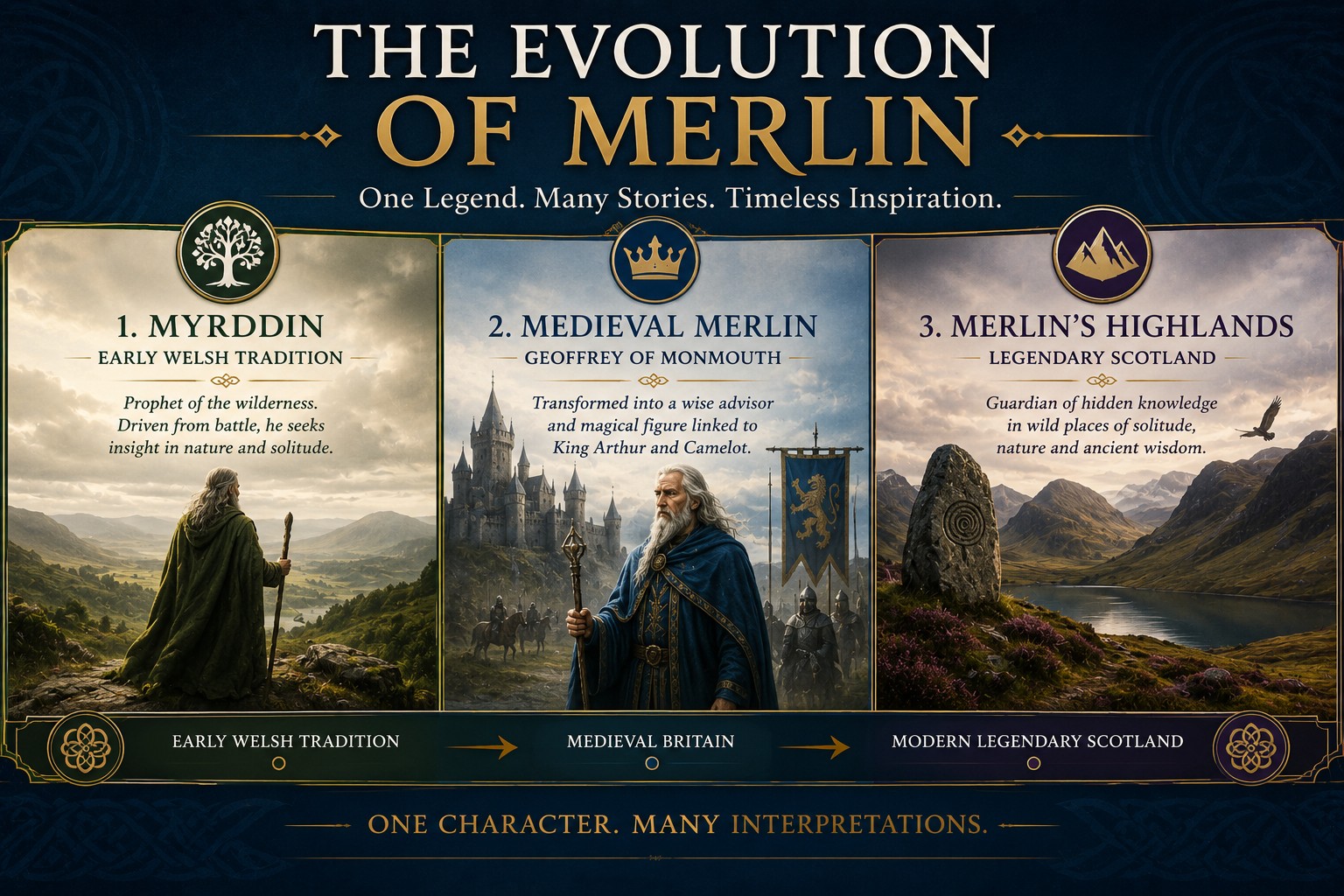
Merlin did not emerge fully formed in medieval legend. This infographic traces his development from the early Welsh traditions of Myrddin to Geoffrey of Monmouth’s influential writings and the later literary association with Scotland’s wild Highland landscapes
🌊 Loch Ness, Rannoch Moor and the North-West Highlands
While Glen Coe, Ben Nevis and the Cairngorms each reveal a different side of the Highlands, several other landscapes complete the picture of why this region has become so closely associated with mystery and enduring legend.
🌊 Loch Ness — More Than a Monster Legend
Loch Ness is one of Scotland’s best-known destinations, yet its appeal extends far beyond the famous monster story.
Stretching for approximately 23 miles (37 kilometres) through the Great Glen, its deep, dark waters, steep wooded slopes and constantly changing light create an atmosphere that naturally encourages curiosity. Long before Nessie became an international phenomenon, local folklore and Highland storytelling had already attached mystery to this remarkable landscape.
For readers following the Merlin mini-cluster, Loch Ness also provides an important bridge to our earlier exploration of The Wizard of the Highlands: Merlin and Loch Ness. Rather than repeating that story here, it is enough to recognise that the loch’s dramatic setting reflects the same qualities repeatedly associated with Merlin throughout medieval literature—wisdom, mystery and the enduring attraction of places that resist easy explanation.
🌄 Rannoch Moor — A Landscape Defined by Space
Few places express the scale of the Highlands quite like Rannoch Moor.
This internationally important landscape of peatland, lochans, rocky outcrops and open moor stretches across an immense area, creating one of Britain’s most impressive expanses of wild country. Although roads and railways cross parts of the moor, the overwhelming impression remains one of openness, changing weather and remarkable tranquillity.
Its beauty is also fragile.
Peatlands play a vital role in storing carbon and supporting specialised habitats, making responsible access especially important. Staying on established routes and respecting this sensitive environment helps ensure that future generations can continue to enjoy one of Scotland’s most distinctive landscapes.
🪨 Torridon and Assynt — Mountains Older Than Legend
The mountain regions of Torridon and Assynt reveal another dimension of the Highlands.
In Torridon, immense sandstone mountains rise dramatically above sea lochs and ancient glens, creating some of Scotland’s most spectacular scenery. Assynt offers something different again, where isolated peaks emerge unexpectedly from loch-filled landscapes, giving the region an almost otherworldly appearance.
These mountains are vastly older than any story ever told about them.
Long before Merlin entered medieval literature, before kingdoms rose and fell and before written history reached much of Britain, geological processes had already shaped these extraordinary landscapes. Against that immense timescale, human legends become another fascinating layer in the Highlands’ continuing story.
📊 Comparing Scotland’s Legendary Highland Landscapes
| Landscape | Defining Character | Legendary Quality | Planning Consideration |
|---|---|---|---|
| Glen Coe | Volcanic valley shaped by glaciers | Dramatic scenery and powerful atmosphere | Easily reached but often busy |
| Ben Nevis | Britain’s highest mountain | Symbol of perspective and wilderness | Summit requires careful preparation |
| Cairngorms | Ancient forests and broad glens | Quiet discovery and natural beauty | Best explored over several days |
| Loch Ness | Deep Highland loch | Enduring folklore and mystery | Accessible year-round |
| Rannoch Moor | Vast peatland wilderness | Solitude and changing weather | Stay on established routes |
| Torridon & Assynt | Ancient north-west mountains | Timeless landscapes | Allow extra travel time between locations |
🌄 How Great Landscapes Become Great Legends
Legends rarely appear overnight. They often emerge gradually as remarkable landscapes inspire generations of people to observe, interpret, remember and retell the stories connected with them. The Scottish Highlands provide one of Britain’s finest examples of this enduring relationship between place and imagination.
🏔️ Landscape
Mountains, glens, forests, rivers and lochs create places that naturally capture attention.
🌫️ Isolation
Remote locations encourage reflection, mystery and a deeper connection with the natural world.
✨ Wonder
Powerful scenery inspires curiosity, imagination and questions that cannot always be answered immediately.
📖 Storytelling
Communities share stories that explain remarkable places, preserve memories and pass on knowledge.
🪶 Folklore
Over generations, stories become part of local tradition and begin to shape the identity of the landscape itself.
🧙 Legend
Literary figures such as Merlin become naturally associated with places that reflect the qualities of their stories.
🏴 Cultural Identity
History, landscape and legend become woven together, creating places that continue to inspire visitors for generations.
The Highlands do not prove Merlin’s story—they help explain why stories like Merlin’s continue to flourish within landscapes of such extraordinary character.
🌌 Why Wilderness Creates Legend
Why do certain landscapes inspire myths while others simply become places on a map?
The answer lies not only in geography but also in the relationship between people and place.
Throughout history, remote landscapes have encouraged storytelling because they invite curiosity without providing complete certainty. Mountains disappear into cloud, narrow glens conceal what lies beyond the next ridge and quiet forests soften the boundary between the familiar and the unknown. These settings encourage reflection rather than immediate explanation, allowing imagination and observation to exist side by side.
In the Highlands, that process unfolded over many centuries.
Folklore did more than explain the unknown. It preserved community memory, reinforced shared values, reflected respect for powerful natural places and passed local knowledge from one generation to the next. Stories attached themselves to rivers, mountain passes, waterfalls and lonely lochs because they helped people understand both the landscape and their place within it.
Highland tradition includes tales of fairy hills, water spirits, prophetic dreams, mysterious disappearances and the **Cailleach **, the powerful figure associated with winter, mountains and the shaping of the land itself. These stories differ in detail from one region to another, yet together they create a cultural landscape where myth feels as natural as the scenery.
Merlin became part of this wider tradition because his literary character evolved in the same direction.
As later medieval traditions developed, Merlin increasingly appeared as a figure who sought wisdom away from political power. Forests replaced royal halls. Mountains replaced castles. Solitude became a source of insight rather than isolation. His understanding of nature became inseparable from his understanding of people.
The Scottish Highlands embody those same qualities.
Not because they prove Merlin ever travelled here, but because they reflect the environment later writers instinctively associated with him. The landscape itself reinforces the literary tradition.
Understanding this distinction allows archaeology, history and folklore to complement rather than contradict one another. Each explains a different aspect of Scotland’s remarkable past, and together they create a richer appreciation of the Highlands than any single perspective could offer.
The Highlands do not merely provide scenery for legend.
They help explain why legend takes the form it does.
🌄 Why Landscapes Create Legends
Extraordinary places often inspire extraordinary stories. Across generations, remarkable landscapes encourage people to ask questions, imagine possibilities and pass those stories from one generation to the next until they become part of a nation’s identity.
Scotland’s Highlands illustrate this process perfectly. Their dramatic landscapes inspire stories, those stories become folklore, and over time they become part of the country’s cultural identity.
🏰 Myth, History and the Scottish Highlands
One of the Highlands’ greatest strengths is that visitors never have to choose between history and legend.
Both enrich the journey, provided we understand the role each one plays.
🏰 Myth, History and the Scottish Highlands
History and folklore are often presented as opposites, but in the Highlands they work best when viewed as complementary ways of understanding the same landscape.
History relies on evidence. Archaeology examines monuments, settlements and artefacts. Geology explains how mountains, glens and lochs were formed over immense timescales, while historical research reveals how Gaelic communities, clan territories, military roads, crofting, the Highland Clearances and modern conservation have all shaped the region we see today.
Folklore tells a different story.
Rather than proving historical events, it preserves cultural memory. Traditional stories help explain how communities interpreted remarkable places, passed on local knowledge, expressed values and maintained connections with the landscape through generations of oral storytelling. In this sense, folklore becomes part of the Highlands’ cultural heritage every bit as much as castles, churches or archaeological sites.
Merlin belongs firmly within that literary tradition.
There is no archaeological evidence placing him across the Highlands, yet his evolving character fits these landscapes remarkably well. The mountains, forests and hidden glens mirror the qualities later writers associated with him—reflection, wisdom, mystery and a life lived close to nature.
Visitors do not need to choose between believing the legends and appreciating the History.
The greatest enjoyment often comes from understanding both.

From the dramatic valley of Glen Coe to the rugged peaks of Torridon, Scotland’s Highlands combine remarkable geology, breathtaking scenery and centuries of folklore into one of Britain’s most inspiring landscapes
🚗 Experiencing Merlin’s Highlands Today
Travelling through the Highlands is less about ticking famous landmarks from a list and more about allowing the landscape to unfold naturally.
Distances can be deceptive. A journey that appears short on a map may involve winding roads, changing weather and frequent opportunities to stop at viewpoints, historic villages or peaceful loch shores. Building flexibility into your plans almost always leads to a more rewarding experience.
Visitors interested primarily in scenery can comfortably enjoy Glen Coe, Loch Ness, the Cairngorms and many other highlights from established roads, viewpoints and walking paths without attempting demanding mountain hikes. Those wishing to climb peaks such as Ben Nevis should plan separately, monitor weather conditions carefully and ensure they have suitable equipment and experience.
The Highlands also reward slower travel.
Spend time in local cafés, visit small museums, explore independent visitor centres and pause in villages that many travellers simply drive through. These quieter experiences often provide the strongest sense of place and a deeper appreciation of Highland culture than rushing between famous viewpoints.
Whether your interest lies in mythology, photography, wildlife, history or simply spectacular scenery, the Highlands offer remarkable diversity within one region.
The practical route planning comes next.
Our final Merlin mini-cluster article brings these landscapes together in a carefully planned Merlin-Inspired Scotland Itinerary (3–5 Days), helping readers transform inspiration into a realistic and memorable journey.
First-time visitors can also use our Scotland travel guide to compare the Highlands with Scotland’s islands, cities and other iconic regions before deciding where to spend their time.
🧭 Planning Your Highland Journey
The Scottish Highlands reward every type of traveller. Whether you have a single day or several days to explore, choosing the right style of journey allows you to experience more of the landscapes that inspired Merlin’s enduring legend.
| Time Available | Ideal Experience | Perfect For |
|---|---|---|
| 🚍 1 Day | Scenic Highland drive with one or two iconic locations. | First-time visitors and day trippers. |
| 🌄 Weekend | Combine mountain scenery, lochs and one legendary destination. | Short breaks. |
| 🏔️ 3–5 Days | Explore Glen Coe, Ben Nevis, Loch Ness, Cairngorms and surrounding landscapes. | The classic Highland experience. |
| 🗺️ 5+ Days | Add Skye, Torridon, Assynt and remote Highland regions. | Photography, walking and in-depth exploration. |
The more time you allow, the more opportunities you’ll have to experience the remarkable landscapes that have inspired Scotland’s mythology, history and literary traditions.
📅 Plan Your Journey with the BVT Scotland Events Calendar
One of the greatest advantages of exploring the Scottish Highlands is that every season offers a completely different experience.
Spring brings fresh greenery to the glens, flowing waterfalls and quieter roads after the winter months. Summer provides exceptionally long daylight hours, allowing visitors to enjoy scenic viewpoints well into the evening. Autumn transforms woodland into rich shades of gold and copper, while crisp air and dramatic skies make it a favourite season for photographers. Winter introduces another side of the Highlands altogether, with snow-dusted mountains, peaceful landscapes and an atmosphere unlike any other time of year.
Planning your visit around seasonal events can make a Highland journey even more rewarding.
The Best Value Tours Scotland Events Calendar is an excellent planning resource for discovering festivals, cultural celebrations and seasonal inspiration that may complement your itinerary. Whether you are combining the Highlands with Edinburgh, the Isle of Skye, Loch Ness or other parts of Scotland, checking the calendar before you travel can help you make the most of your visit.
📅 Plan Your Highland Adventure Around Scotland’s Biggest Events
Every season reveals a different side of Scotland. Highland Games, cultural festivals, wildlife seasons, autumn colours and winter celebrations can all add something special to your journey through the Highlands.
Before finalising your itinerary, explore the Best Value Tours Scotland Events Calendar to discover what is happening during your visit and make the most of your time in Scotland.
Great journeys aren’t just about where you go—they’re also about choosing the perfect time to experience Scotland.
🌱 Exploring the Highlands Responsibly
The landscapes that inspire Scotland’s greatest legends are also among its most valuable natural environments.
Many mountain paths, peatlands, forests and wildlife habitats are surprisingly sensitive. Staying on established paths where appropriate, avoiding disturbance to wildlife, respecting seasonal guidance, parking considerately and taking all litter home are simple actions that help protect these remarkable places.
Supporting local communities is equally important.
Choosing independent accommodation, cafés, museums, guides and local businesses helps sustain the people who care for these landscapes throughout the year. Travelling at a relaxed pace also reduces pressure on popular destinations while encouraging visitors to discover quieter corners of the Highlands.
The Highlands have inspired storytellers for centuries.
With thoughtful and responsible travel, they will continue to inspire generations yet to come.
Travel with purpose. Explore with care.
❓ Frequently Asked Questions
❓ Is Merlin historically connected with the Scottish Highlands?
No historical or archaeological evidence confirms that Merlin travelled throughout the Highlands. His connection is primarily literary and folkloric, reflecting the wilderness landscapes associated with his character in later traditions.
❓ Which Highland locations best capture the atmosphere of Merlin’s legends?
Glen Coe, Loch Ness, the Cairngorms, Rannoch Moor, Torridon and Assynt each offer distinctive scenery that complements the literary image of Merlin as a prophet and wanderer.
❓ Do I need a car to explore these landscapes?
A car provides the greatest flexibility for visiting remote Highland locations, although organised tours also offer excellent access to many of the region’s highlights.
❓ When is the best time to visit?
Spring and autumn often provide an ideal balance of beautiful scenery, comfortable conditions and fewer visitors, while summer offers the longest daylight hours for sightseeing.
❓ Is Ben Nevis suitable for all visitors?
The mountain can be admired from numerous viewpoints without climbing it. Anyone planning a summit walk should prepare carefully, check weather conditions and ensure they have appropriate experience and equipment.
❓ Can I combine these places into one journey?
Yes. A well-planned itinerary allows several of these legendary landscapes to be experienced together, depending on the length of your visit.
🧭 Final Thoughts
The Scottish Highlands possess a remarkable ability to make ancient stories feel timeless.
Their mountains, forests, rivers and hidden glens do not prove that Merlin lived here, but they explain why generations of writers and storytellers found these landscapes such a natural home for his legendary character. The region’s extraordinary scenery, rich folklore and deep cultural history combine to create an experience that is both intellectually rewarding and emotionally memorable.
Merlin does not make the Highlands mythical.
The Highlands help explain why generations continued to reinvent Merlin as a figure of wilderness, prophecy and hidden knowledge.
That is what makes this region so special.
Having explored the legendary landscapes that shaped Scotland’s Merlin traditions, the next step is to experience them for yourself. Our concluding article, Merlin-Inspired Scotland Itinerary (3–5 Days), brings together many of the places featured throughout this mini-cluster into one practical and unforgettable Highland journey.
🚌 Explore Scotland with Best Value Tours
Turn Highland inspiration into a real Scotland journey. Choose from flexible day tours, immersive multi-day adventures or wider journeys across Britain and Ireland.
Whether you have one day or a longer holiday, explore the travel option that best suits your plans.
From a single day of discovery to a longer Highland adventure, start planning your Scotland experience.
🧙 Explore Merlin’s Scotland
Journey through Scotland’s legendary landscapes with Merlin, ancient standing stones, Edinburgh traditions, Highland mythology and a complete itinerary inspired by the places where history and legend meet.
📖 Begin with the Complete Merlin Guide
Start with the central guide to Merlin’s Scottish traditions, historical associations and the places visitors can explore today.
🏰 Discover Scotland’s Legendary Places
Explore the landscapes, monuments and historic locations connected with Merlin, Arthurian tradition and Scotland’s ancient stories.
🏔️ Continue into the Scottish Highlands
Discover how wilderness, mountains, hidden places and Highland storytelling helped shape Merlin’s Scottish identity.
🗺️ Follow the Complete Merlin-Inspired Route
Bring the legends together with a carefully planned 3–5 day itinerary linking Edinburgh, the Highlands and Scotland’s most atmospheric Merlin locations without unnecessary backtracking.
🇬🇧 Turn the Legends into Your Own Scotland Journey
Explore guided day tours, longer Highland journeys and Scotland’s year-round events as you move from inspiration into practical travel planning.
Discover the legend → explore the places → enter the Highlands → follow the itinerary → plan your Scotland journey