


Christmas in Britain & Europe: The Complete Festive Travel Guide
29th November 2024
🎄 Christmas in Britain & Europe: The Complete Festive Travel Guide

From festive London and ancient Stonehenge to Scotland, historic towns and continental Christmas markets, build a Christmas journey around the dates, destinations and experiences that matter most to you
Christmas can be one of the most memorable times of year to explore Britain and Europe. London glows beneath elaborate illuminations, historic towns decorate centuries-old streets, Christmas markets bring seasonal atmosphere to city squares, and palaces, cathedrals and heritage destinations take on a different character during winter. Continue into continental Europe and the possibilities expand again, from Paris and Belgium to the great Christmas-market traditions found across the continent.
But Christmas in Britain and Europe is not simply ordinary sightseeing with festive decorations added.
Winter daylight is shorter. Weather can affect the rhythm of a day. Seasonal events operate on specific dates, popular experiences can have limited capacity, and transport and attraction opening arrangements may change significantly around the principal public holidays.
Most importantly, the festive season is not one continuous travel period. A December sightseeing break, Christmas Eve, Christmas Day, Boxing Day, New Year’s Eve and New Year’s Day can each require a different approach.
That makes good planning particularly valuable.
Rather than beginning with a long list of attractions, start with three questions: When are you travelling? Where would you like to spend your time? What kind of Christmas experience do you actually want?
Answer those well and it becomes much easier to build a festive journey that suits you rather than trying to fit your holiday around somebody else’s idea of the perfect Christmas trip.
🧭 How to Plan a Christmas Trip to Britain & Europe
There is no single perfect Christmas itinerary. A family visiting London for five days has very different requirements from a couple travelling between European Christmas markets, while someone hoping to combine London, Stonehenge and Scotland during a longer winter holiday faces different decisions again.
A useful way to simplify those choices is:
WHEN → WHERE → WHAT
Use those three decisions as the foundation of your festive journey.
📅 Start With Your Dates
At Christmas, your exact dates can influence the trip as much as your destination.
During an ordinary December day, much of the normal visitor infrastructure may operate alongside Christmas markets, illuminations and seasonal attractions. Move closer to the major public holidays and the situation can change. Opening hours may alter, transport can become more restricted and some experiences may operate only on particular dates.
Christmas Day requires especially careful planning because visitors should never assume that ordinary sightseeing arrangements apply. Boxing Day creates different possibilities again, while New Year’s Eve and New Year’s Day bring their own events, crowds, transport considerations and limited-capacity experiences.
Establish which festive dates your trip actually includes before building the itinerary around them.
🏙️ Choose Your Base or Journey
Once your dates are clear, decide whether your trip is centred on one base or built around a wider journey.
For many international visitors, London is the natural starting point. It combines major attractions, festive atmosphere, transport connections and access to day trips across southern England. It can also work as the beginning of a longer journey into Scotland or continental Europe.
Other travellers may prefer to spend more time outside the capital, combining historic cities, countryside, heritage sites or several regions. A longer Christmas holiday might include London followed by Scotland, or Britain followed by Paris, Belgium or a wider European journey.
The important question is not simply, “Where should we go?”
Ask instead:
“What role should each destination play in the journey?”
London might be your gateway. Scotland might provide the dramatic winter landscapes and New Year atmosphere. A European city might add a contrasting Christmas-market tradition. A countryside stay might deliberately slow the pace between major sightseeing days.
Thinking in this way helps prevent the itinerary becoming a collection of disconnected places.
🎁 Choose the Experience You Actually Want
Christmas travel can mean very different things to different people.
You may want:
- traditional Christmas markets;
- festive lights and decorations;
- historic cities;
- winter countryside;
- palaces and heritage;
- family attractions;
- Christmas Day sightseeing;
- New Year’s Eve celebrations;
- scenic rail travel;
- a multi-day festive tour;
- or a journey combining several of these.
The strongest itinerary is usually built around the experiences that matter most to you rather than around the number of destinations you can fit into the trip.
This becomes particularly important when travelling with children, older relatives or a mixed group. Trying to include every possible festive experience can quickly turn an enjoyable winter holiday into an exhausting one.
Choose your priorities first. Add variety second.
🗓️ Christmas Eve, Christmas Day, Boxing Day & New Year
The dates around Christmas and New Year deserve separate consideration because they do not operate like ordinary sightseeing days.
🎄 Christmas Eve
Christmas Eve can still provide substantial sightseeing opportunities, but visitors should expect the day to become progressively quieter as evening approaches.
It can be an excellent time for organised sightseeing, particularly when the itinerary has been designed specifically around festive operating conditions.
For independent travellers, the key is to check transport and attraction arrangements carefully and avoid assuming that evening services will operate normally.
🎅 Christmas Day
Christmas Day is one of the most distinctive sightseeing days of the festive period—and one of the easiest to misunderstand.
Public transport can be extremely limited or unavailable, many attractions close, and normal independent sightseeing patterns may not be practical.
That does not mean visitors must spend the day in their hotel.
Specialist Christmas Day tours can provide access to carefully planned sightseeing itineraries when ordinary transport options are restricted.
For travellers who want to explore rather than remain in one place, organised touring can therefore become substantially more valuable on Christmas Day than it might be during an ordinary sightseeing day.
🎁 Boxing Day
Boxing Day often marks the gradual return of sightseeing activity, but visitors should still check individual transport services, attraction opening times and tour arrangements.
For travellers based in London, Boxing Day can also create an opportunity to explore beyond the capital as festive touring resumes.
🎆 New Year’s Eve
New Year’s Eve can be one of the most exciting nights of the festive season, particularly in major cities.
London attracts large numbers of visitors for celebrations, dining, entertainment and fireworks, while Edinburgh’s Hogmanay traditions create a very different but equally distinctive New Year experience.
The key consideration is capacity. Popular New Year’s Eve experiences can be limited, and the most sought-after options may need to be planned well before the final days of December.
🌅 New Year’s Day
New Year’s Day is not simply the morning after the celebrations.
For travellers who still want to explore, it can form a valuable sightseeing day in its own right. As with Christmas Day and Boxing Day, however, visitors should check transport and attraction arrangements rather than assuming normal schedules.
Organised New Year’s Day tours can simplify the logistics and turn what might otherwise be an awkward travel day into part of the holiday itself.
| Festive date | What to expect | Planning priority |
|---|---|---|
| Christmas Eve | Sightseeing possible, quieter evening | Check reduced services and closing times |
| Christmas Day | Major transport and attraction restrictions | Plan specialist sightseeing or meals early |
| Boxing Day | Activity begins returning | Check individual services and tour availability |
| New Year’s Eve | Major celebrations and high demand | Reserve limited-capacity experiences early |
| New Year’s Day | Sightseeing possible with altered schedules | Confirm transport and attraction arrangements |
The lesson is simple: the closer your travel dates are to the principal festive holidays, the more valuable advance planning becomes.

The festive season is not one continuous travel period. Christmas Eve, Christmas Day, Boxing Day and New Year can each bring different sightseeing, transport, opening and planning considerations
🇬🇧 Where to Spend Christmas in Britain
Britain offers several very different kinds of festive journey.
You can base yourself in London and use the capital as a gateway. You can explore historic cities and countryside. You can include Stonehenge and other major heritage sites. You can travel north into Scotland for Edinburgh, the Highlands and Hogmanay.
The right choice depends on how much time you have and what kind of atmosphere you want.
🎡 Christmas in London: The Natural Festive Gateway
For many overseas visitors, London is the simplest place to begin.
The capital combines famous landmarks with Christmas lights, decorated shopping streets, seasonal entertainment, winter attractions and access to day trips. It also provides major rail and air connections for travellers continuing elsewhere in Britain or Europe.
If London is your principal base, the Christmas in London guide provides the stronger next step into detailed festive planning for the capital.
London also works particularly well for travellers who want variety without changing hotels repeatedly. A single stay can combine city sightseeing, festive evenings and carefully chosen excursions beyond the capital.
🏰 Historic Cities & England Beyond London
London may be the principal gateway, but it is only one version of Christmas in Britain.
Historic cities such as Bath, Oxford, Canterbury, Salisbury and Winchester can add architecture, cathedrals, traditional streets and a more intimate seasonal atmosphere. Some work particularly well as day trips from London; others justify a longer stay.
The important distinction is between collecting destinations and building a coherent journey. If several historic cities interest you, consider whether they fit naturally into the same route rather than repeatedly returning to London between each one.
🌲 English Countryside
Winter countryside travel provides a different experience again.
The Cotswolds, for example, can offer historic villages, rural landscapes and a slower rhythm than major cities. This can be especially valuable in a longer festive itinerary where several intensive sightseeing days would otherwise sit back-to-back.
Travellers specifically attracted by this style of festive journey can explore Christmas in the Cotswolds in greater depth.
🪨 Stonehenge During the Festive Period
Stonehenge can fit naturally into a Christmas journey through southern England, particularly for visitors already based in London or travelling through Wiltshire toward Bath and the West Country.
The attraction is not Christmas decoration. It is contrast.
After illuminated streets, markets and busy city centres, Stonehenge provides an encounter with a much older landscape. Winter conditions, shorter daylight and seasonal access arrangements can also make planning more important than at other times of year.
For travellers specifically considering the monument during this period, Stonehenge at Christmas provides the specialist festive guidance rather than requiring this wider Hub to duplicate it.
🏴 Christmas & New Year in Scotland
Scotland can become either a dedicated festive destination or the second major stage of a longer British journey.
Edinburgh provides historic streets, seasonal atmosphere and one of Europe’s best-known New Year celebrations. Beyond the capital, the Highlands and islands offer winter landscapes and a very different experience from southern Britain.
The dedicated Christmas in Scotland guide is the natural next step for travellers whose festive journey is moving north.
Visitors travelling specifically for New Year should also distinguish general Scottish Christmas travel from Edinburgh’s Hogmanay celebrations.
✨ Christmas Markets, Lights & Festive Experiences
For many visitors, the festive atmosphere matters as much as the sightseeing.
That atmosphere can come from several different sources: Christmas markets, illuminated streets and gardens, decorated palaces, cathedral services, seasonal entertainment and family attractions.
The strongest trip rarely needs all of them.
Choose the experiences that create the kind of Christmas you actually want.
🎪 Christmas Markets
Christmas markets can range from large destination events to smaller seasonal additions within an existing city break.
If markets are one of the main reasons for travelling, use them to shape the route rather than simply adding whichever market happens to be nearby. The dedicated Christmas Markets in Britain & Europe guide provides the deeper comparison and journey-planning layer.
A market-focused journey might combine several cities. A broader sightseeing journey may work better with one or two markets as part of a more varied itinerary.
Also remember that Christmas-market operating dates do not always extend through Christmas itself. Some finish before 25 December, while others continue later. Check the dates of the individual market rather than assuming that “Christmas market season” means the entire festive period.
💡 Lights & Illuminations
Festive illuminations are particularly useful for travellers who want to extend the sightseeing day after winter daylight has faded.
London provides extensive street displays, while gardens, estates and other attractions may operate dedicated evening illumination events.
These experiences can work especially well when paired with daytime sightseeing rather than treated as competing attractions.
For visitors who want to make illuminations a more deliberate part of the journey, Christmas Lights & Illuminations provides the specialist festive layer.
👑 Palaces, Cathedrals & Heritage
Britain’s historic buildings can be especially atmospheric during the festive period.
Palaces may introduce seasonal decorations and events. Cathedrals retain their religious significance while also attracting visitors interested in architecture, music and history. Historic houses and estates can provide a quieter alternative to the busiest city-centre attractions.
The important point is to distinguish between ordinary visitor opening, special festive programming and religious services. They are not interchangeable, and access arrangements may differ.
Where a particular heritage experience matters to you, verify the exact seasonal programme before building the day around it.
👨👩👧👦 Family & Themed Experiences
Families often need a different balance from adult-only travellers.
Children may enjoy lights, seasonal attractions and themed experiences more than a sequence of museums and historic monuments. At the same time, parents may still want the journey to feel connected to the destination rather than becoming a succession of generic Christmas activities.
The strongest family itinerary usually alternates different types of experience.
A major attraction in the morning, a relaxed afternoon and an evening illumination can work better than three intensive sightseeing visits in succession.
The dedicated Christmas Family Experiences guide provides the deeper festive planning layer for families.
👥 Choose Christmas Travel Around the People Travelling
A festive itinerary should not only reflect the destination.
It should reflect the travellers.
The same five-day Christmas journey can work brilliantly for one group and poorly for another simply because the pace, transport or type of sightseeing does not suit the people taking it.
👨👩👧 Families
For families, variety usually matters more than volume.
Mix major sights with experiences that give children something immediate to engage with. Avoid creating long sequences of similar heritage visits unless the children genuinely enjoy them.
Allow additional time for meals, winter clothing, transport and unexpected pauses. A schedule that appears relaxed for two adults may feel considerably more demanding with younger children.
❤️ Couples
Couples may have greater flexibility to combine daytime sightseeing with evening experiences, longer meals or more atmospheric winter journeys.
A city break can work particularly well when major attractions are balanced with markets, lights, neighbourhood exploration and time that is deliberately left unscheduled.
For some couples, a multi-city rail journey or short European extension may provide more value than adding additional sightseeing days in the same destination.
👨👩👧👦 Multi-Generational Groups
Multi-generational travel requires particularly careful pacing.
A journey involving children, parents and grandparents may need to accommodate different walking speeds, interests and energy levels. This does not mean reducing the quality of the itinerary. It means being more selective.
Choose experiences with broad appeal, avoid unnecessary transfers and allow enough time for the group to enjoy each destination without continually watching the clock.
Organised travel can sometimes simplify this considerably by reducing the number of individual transport and admission decisions the group needs to make.
🌍 International Visitors
For international visitors, the biggest challenge is often deciding how much of Britain and Europe to include in one journey.
It is easy to underestimate travel time when looking at a map.
London, Scotland, Paris and Belgium may all appear relatively close compared with journeys across larger countries, but repeatedly changing hotels, stations and transport systems consumes time and energy.
If this is your first visit, think in terms of journey stages rather than the maximum number of destinations.
London can provide the gateway. A second British region can add contrast. Continental Europe can then become the next stage rather than another hurried excursion.
| Traveller type | Useful priority | Common mistake |
|---|---|---|
| Families | Variety and manageable pace | Too many intensive sightseeing days |
| Couples | Atmosphere and flexibility | Over-scheduling every hour |
| Multi-generational groups | Accessibility and broad appeal | Too many transfers |
| First-time international visitors | Logical journey structure | Trying to see too many countries |
🇪🇺 Christmas in Europe
A festive journey does not need to end when you leave Britain.
For travellers with enough time, London can form the beginning of a wider European journey rather than the entire holiday. Rail and air connections make it possible to combine Britain with cities across continental Europe, but the strongest combinations are those that add a genuinely different experience.
If you are deciding how Britain should connect with the next stage of a continental trip, Touring Europe from Britain provides the broader journey-planning framework.
🇫🇷 Paris
Paris is one of the most obvious European extensions from London.
The experience is different enough to justify the journey: major landmarks, decorated streets, seasonal dining and a distinct French festive atmosphere can turn a Britain-focused holiday into a two-country trip without requiring an extensive European itinerary.
Travellers considering the city specifically during the festive period can continue to Paris at Christmas for the more focused seasonal guidance.
Whether Paris works best as a day trip, short break or longer stay depends on the overall journey. If it is one of the principal destinations, giving it sufficient time will usually produce a more rewarding experience than treating it as another item to collect.
🇧🇪 Bruges & Brussels
Belgium offers another natural extension, particularly for travellers interested in historic centres and Christmas-market atmosphere.
Bruges provides a compact medieval setting that can feel especially suited to a winter visit, while Brussels offers a larger city experience with major sights, dining and seasonal events.
For a market-focused journey, Bruges Christmas Markets provides the more specialist destination layer.
Travellers considering the Belgian capital can similarly continue into Brussels at Christmas.
🎪 European Christmas Markets
Christmas markets can become the organising principle of a European festive journey rather than simply an attraction visited along the way.
The strongest market-focused itineraries usually combine destinations that offer meaningful contrast. One city might provide a large traditional market, another a compact historic centre, while another contributes architecture, food or cultural experiences beyond the market itself.
Avoid choosing destinations purely because they all have Christmas markets. The journey should still be worthwhile once you step away from the stalls.
Travellers primarily motivated by this style of trip should use the dedicated Christmas Markets in Britain & Europe guide to compare the wider possibilities.
🚆 Britain and Europe in the Same Journey
Combining Britain and continental Europe can work extremely well when the journey is treated as a sequence rather than a collection of separate city breaks.
For example:
London → British day trips → Paris
or:
London → Belgium → onward European Christmas markets
or:
Scotland → London → continental Europe
The specific route matters less than the principle behind it.
Each stage should either deepen the experience or provide worthwhile contrast.
This is where thinking of London as a gateway becomes particularly useful. You do not necessarily need to choose between a British holiday and a European holiday. With sufficient time, the two can form one connected journey.
🚌 Day Trip, Short Break or Festive Multi-Day Tour?
Once you know where you want to go, the next decision is how deeply you want to travel.
A destination that works perfectly as a day trip for one visitor may deserve several nights for another.
🕐 Day Tours
Day tours are useful when you want to keep one accommodation base while adding variety to the journey.
From London, this can make it possible to explore historic cities, countryside and major heritage destinations without repeatedly changing hotels.
They can be particularly useful around the festive period when visitors prefer the security of returning to a familiar base each evening.
The limitation is depth. A day tour provides an introduction rather than the experience of staying overnight.
🧳 Short Breaks
A short break gives a destination time to change character.
Day visitors leave. Evening lights become more important. Restaurants, neighbourhoods and seasonal events can become part of the experience rather than simply the major sights.
This can make destinations such as Edinburgh, Paris, Bruges or other European cities considerably more rewarding for travellers who have enough time.
A short break can also provide a useful middle ground between repeated day trips and a longer touring itinerary.
🗺️ Multi-Day Touring
Multi-day touring becomes more useful when the journey itself is part of the experience.
Rather than repeatedly returning to the same base, you can move through several regions while accommodation, transport and sightseeing are organised as part of a connected itinerary.
This can work particularly well for travellers who want to see more of Britain during a longer festive holiday or who prefer not to manage every transfer independently.
The dedicated Festive Multi-Day Tours guide provides the deeper planning layer for travellers considering this approach.
Where the traveller has moved beyond general research and wants to see available touring options, the Multi-Day Festive Tours collection provides the appropriate commercial next step.
🚆 Rail Journeys
Rail can be one of the most effective ways to connect major cities during a winter trip.
It reduces the need to drive in unfamiliar conditions, can link city centres directly and may allow the journey itself to become part of the experience.
Rail works especially well where the itinerary follows a clear geographical progression rather than repeatedly doubling back.
Travellers interested in making rail a significant part of their festive itinerary can continue to Christmas Rail Journeys.
| Travel style | Best suited to | Main advantage | Main consideration |
|---|---|---|---|
| Day tour | Visitors keeping one base | Simple logistics | Limited destination depth |
| Short break | One or two priority destinations | More local atmosphere | Requires hotel changes |
| Multi-day tour | Wider regional exploration | Connected itinerary | Less independent flexibility |
| Rail journey | City-to-city travel | Efficient central connections | Advance planning may be valuable |
There is no universally superior format.
Choose the one that matches the depth of experience you want, your available time and how much travel organisation you want to handle yourself.
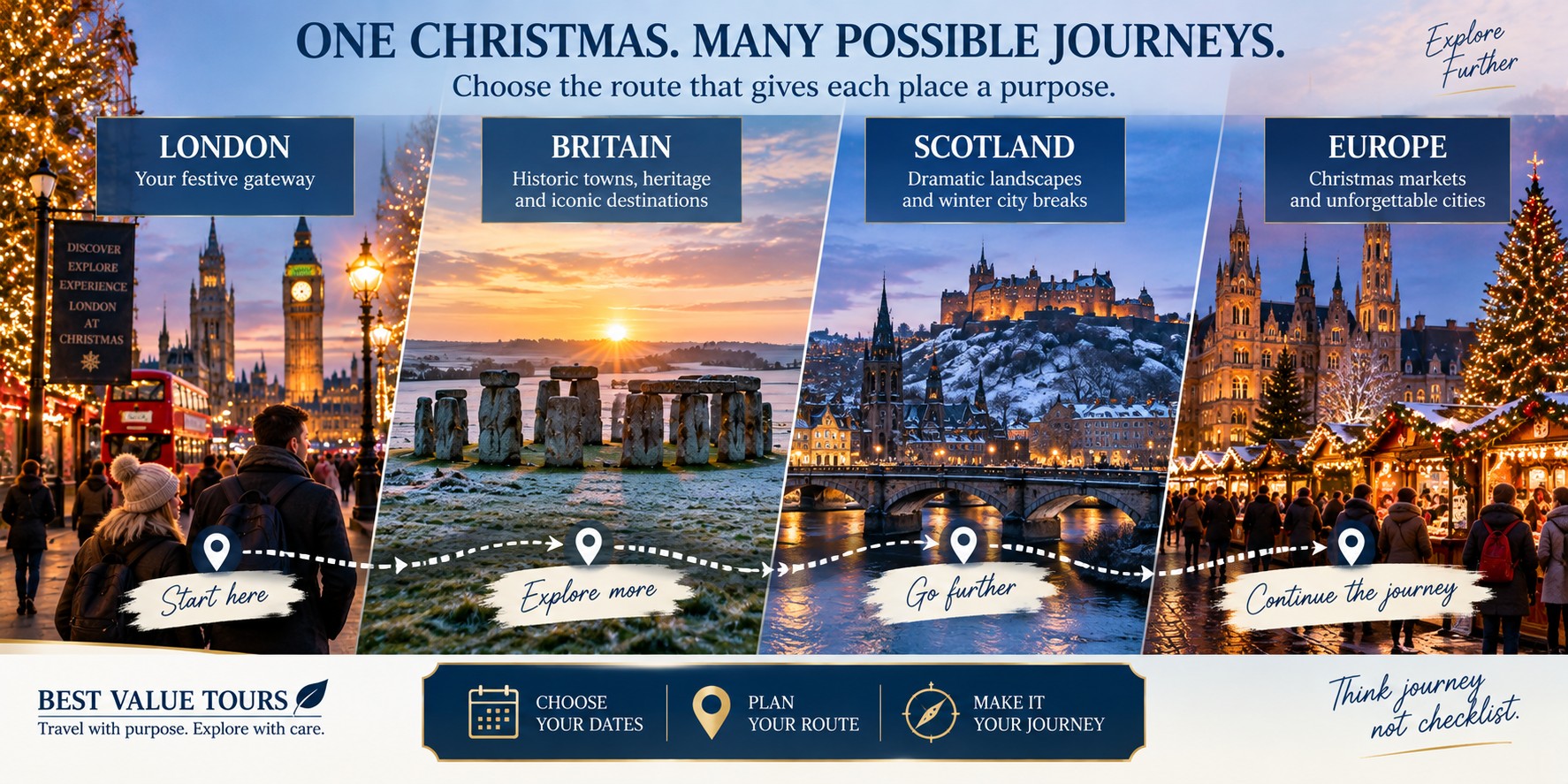
London can be the gateway rather than the boundary of your Christmas journey. Build a logical route through Britain, Scotland and continental Europe, giving each destination a clear purpose
📅 Use the BVT Seasonal Events Calendar
Evergreen travel guidance can explain how to plan Christmas well, but it should not attempt to permanently hold information that changes from season to season.
Event dates, seasonal programmes and other time-sensitive opportunities are better checked against a current resource.
Use the BVT Seasonal Events Calendar when you are ready to move from general festive planning to what is actually happening during your travel dates.
This is particularly useful when your itinerary depends on:
- Christmas-market dates;
- illuminations;
- seasonal events;
- special festive openings;
- New Year celebrations;
- or other date-specific experiences.
The principle is straightforward:
Use evergreen guidance to decide what kind of journey you want. Use current information to determine what is available when you travel.
❄️ What Is Christmas Travel Really Like?
Christmas travel can look effortless in photographs: illuminated streets, historic buildings, festive markets and winter landscapes.
The reality is still highly rewarding, but understanding practical winter conditions makes it much easier to plan well.
🌦️ Weather
Winter weather in Britain and northern Europe can be changeable.
Cold temperatures, rain and wind are possible, while snow is much less predictable than festive imagery sometimes suggests. Conditions can also vary considerably between regions.
Scotland and northern Britain may feel very different from London or southern England, and continental destinations have their own winter climates.
Do not build a Christmas itinerary around the expectation of snow unless you are travelling somewhere where winter conditions make it reasonably likely.
Instead, plan for weather flexibility.
A mixture of indoor and outdoor experiences gives you alternatives if conditions change.
🌇 Daylight
Shorter daylight is one of the most important differences between summer and winter sightseeing.
This does not necessarily reduce how much you can experience. It changes how the day should be organised.
Use the available daylight for experiences where visibility and landscape matter most. Historic sites, countryside, scenic journeys and outdoor attractions usually benefit from being positioned earlier in the day.
Then allow evening experiences to take over.
Christmas lights, markets, theatre, dining and illuminated attractions can become more atmospheric after dark.
Visitors who want a fuller understanding of how winter conditions affect sightseeing can continue to Winter Sightseeing in London & Britain.
👥 Crowd Concentration
Winter is not automatically quiet.
Some destinations may have fewer general visitors than during peak summer, but Christmas concentrates demand around particular places and dates.
Christmas markets can become busiest during evenings and weekends. Popular illuminations may operate timed entry. Major shopping areas become crowded. New Year’s Eve events can attract very large numbers of people.
This creates a different kind of crowd pattern from summer tourism.
Rather than asking whether December is “busy” or “quiet,” ask:
Where will demand concentrate during the dates I am travelling?
That question is much more useful.
🧥 What Should You Wear?
Layering is usually more useful than relying on one extremely heavy item of clothing.
A practical winter sightseeing wardrobe may include:
- a waterproof outer layer;
- warm intermediate layers;
- comfortable footwear suitable for wet conditions;
- gloves;
- a hat;
- and clothing that can be adjusted when moving between cold outdoor conditions and heated interiors.
Comfort matters because Christmas travel often involves more outdoor time than visitors initially expect.
Markets, lights, walking routes, heritage sites and transport connections can all keep you outside for extended periods.
🚇 Transport, Opening Hours & Festive Closures
Transport and opening arrangements deserve more attention during the Christmas period than they normally would.
The closer your itinerary moves towards Christmas Day, Boxing Day or New Year, the less useful it becomes to assume that ordinary schedules will apply.
🚆 Public Transport
Public transport can operate differently across the festive period.
Services may finish earlier on Christmas Eve, become extremely limited or unavailable on Christmas Day, and operate altered timetables on Boxing Day and New Year’s Day.
The exact arrangements can vary by transport provider, route, destination and year.
That means an itinerary that works perfectly on an ordinary December weekday may not work at all when transferred unchanged to a major festive date.
Always check current transport information before finalising journeys around these days.
🏛️ Attractions
The same principle applies to attractions.
Some museums, heritage properties and visitor attractions close on particular festive dates. Others operate reduced hours. Some introduce special Christmas programmes or require advance booking for seasonal events.
Do not assume that because an attraction normally opens every day it will operate normally throughout Christmas and New Year.
For London visitors in particular, What’s Open in London at Christmas & New Year? provides the specialist planning layer for understanding festive opening patterns.
🍽️ Restaurants & Christmas Meals
Meals can become part of the logistical planning rather than something left until the day.
This is especially true on Christmas Day, when restaurant availability may be much more restricted than visitors expect.
If a traditional Christmas lunch or dinner matters to you, treat it as a priority reservation rather than an incidental part of the itinerary.
The same applies to special dining experiences connected with river cruises, hotels or festive events.
A well-planned meal can become one of the highlights of the day. Failing to plan one can create unnecessary difficulty when many ordinary alternatives are unavailable.
🚌 When Organised Touring Can Simplify the Day
Organised touring is not necessary for every festive journey.
On dates when ordinary visitor infrastructure becomes more restricted, however, its value can increase considerably.
A well-designed tour can combine transport, sightseeing and sometimes meals within one planned itinerary. This can be particularly useful when public transport is reduced, several destinations are being combined, or visitors do not want to spend a significant part of their holiday managing festive logistics.
The distinction is important:
Do not choose a tour simply because it is Christmas. Choose one when it solves a genuine travel problem or provides an experience that would be difficult to organise independently.
For travellers assessing Christmas Day specifically, Christmas Day in London & Britain – Travel, Opening & Visitor Guide provides the more detailed practical planning layer.
🧭 Organised Tour or Independent Travel?
Christmas travel does not automatically require an organised tour.
In many places, independent travel remains straightforward and gives you maximum flexibility. London sightseeing, Christmas markets, neighbourhood exploration and many city attractions can often be arranged independently with little difficulty.
The value of organised touring increases when logistics become more complicated.
This may include:
- travelling on Christmas Day or another date with restricted transport;
- combining several destinations in one day;
- reaching countryside or heritage locations that are less convenient by public transport;
- travelling with a family or multi-generational group;
- or wanting transport, admissions and timing coordinated within one itinerary.
Independent travel may be stronger when flexibility is the priority and transport connections are straightforward.
The right question is therefore not:
“Are tours better than independent travel?”
It is:
“Which parts of this particular Christmas journey become easier or better when organised for us?”
Use organised travel selectively where it adds genuine value.
⏰ What Should You Book Early?
Not every part of a Christmas trip needs to be reserved months in advance.
The experiences most worth prioritising are usually those where capacity is limited, dates are fixed or alternatives would be difficult to arrange.
These can include:
- Christmas Day tours and meals;
- New Year’s Eve events;
- popular illumination experiences;
- selected Christmas-market accommodation;
- festive rail journeys;
- specialist seasonal attractions;
- and multi-day tours operating on limited departure dates.
Where the visitor is ready to move from planning into available festive travel, the wider Christmas and New Year Tours collection provides the appropriate commercial discovery layer.
Do not book everything simply because it is Christmas.
Prioritise the parts of the journey that would be hardest to replace.
🌱 Sustainable Christmas Travel
Christmas travel can involve flights, road journeys, additional consumption and movement between several destinations.
That makes thoughtful itinerary design particularly worthwhile.
Sustainable travel does not require removing the experiences that make the journey special. It means considering how those experiences can be connected more efficiently and how your visit can contribute positively to the places you explore.
The wider BVT guide to Sustainable Travel in the UK provides the deeper responsible-travel framework.
🗺️ Build Efficient Routes
One of the simplest improvements is to avoid unnecessary backtracking.
If you want to visit several regions, arrange them in a logical geographical sequence where possible.
A journey such as:
London → northern Britain → continental Europe
may be more efficient than repeatedly returning to the same base between distant destinations.
Good route design can reduce unnecessary travel while also making the holiday less tiring.
🚶 Explore Locally
Once you arrive somewhere, walking and public transport can often provide a better sense of place than continually moving between attractions by vehicle.
This is particularly true in historic centres, where the streets between major sights can be part of the experience.
Christmas markets, neighbourhood decorations, independent shops and smaller heritage sites are easily missed when the itinerary focuses entirely on headline attractions.
🛏️ Stay Longer
Slower travel can improve both the experience and the efficiency of the journey.
Spending an additional night in a destination may allow you to see it at different times of day, reduce repeated transfers and support local accommodation, restaurants and businesses.
This does not mean every destination deserves a longer stay.
It means considering whether a second night would add more value than another hurried destination.
🤝 Support Local Communities
Christmas travel creates opportunities to support local businesses.
Independent restaurants, cafés, shops, market traders and locally operated experiences can all contribute to the character of a destination.
Buying locally does not need to become a complicated ethical calculation. Simply allowing some of your spending to remain within the communities you visit is a practical place to begin.
🏛️ Respect Heritage
Historic buildings, ancient landscapes and religious sites can have significance far beyond their role as visitor attractions.
Follow access guidance, respect restricted areas and remember that cathedrals and churches may remain active places of worship throughout the festive season.
At ancient sites such as Stonehenge, responsible behaviour helps protect landscapes that have survived for thousands of years.
Travel with purpose. Explore with care.
Plan efficient routes. Stay longer where it adds value. Explore locally. Support communities. Respect heritage.
🧭 Build Your Christmas Journey: Where Should You Go Next?
By this point, you should have a clearer idea of your dates, preferred destinations, travel style and festive priorities.
The next step is not to read everything.
It is to follow the pathway that matches the journey you are actually planning.
🎡 If London Is Your Base
Start with London if you want the broadest combination of major sightseeing, festive atmosphere, transport connections and day-trip possibilities.
The wider London Travel Guide can help you understand the capital as both a destination and a gateway to the rest of Britain and Europe.
If your trip is specifically focused on the festive season, move instead into the dedicated Christmas in London guide.
London can then become the starting point rather than the boundary of the journey. Day trips, Stonehenge, historic cities, Scotland and continental Europe can all be considered according to the time available.
🏴 If Scotland Is Your Priority
Choose Scotland if your Christmas journey is built around Edinburgh, dramatic winter landscapes, Highland scenery or New Year celebrations.
The Scotland Travel Guide provides the broader planning foundation for understanding how Edinburgh, the Highlands, islands and other parts of the country can fit together.
For a specifically festive journey, continue instead to Christmas in Scotland.
🪨 If Stonehenge Matters Most
If Stonehenge is one of the principal reasons for visiting Britain, treat it as part of the wider journey rather than simply adding it to whichever day appears empty.
Consider where you are staying, what else you want to see in southern England and whether you want a standard visit or a more specialist experience.
The Stonehenge Tours from London & UK: Complete Guide provides the broader authority layer for comparing the main ways to visit.
For the seasonal considerations specifically, use Stonehenge at Christmas.
🎪 If Christmas Markets Are the Main Attraction
If Christmas markets are central to the trip, allow them to influence both destination choice and timing.
Market operating dates vary, and a route designed specifically around festive markets may look very different from a conventional sightseeing itinerary.
Continue to Christmas Markets in Britain & Europe for the dedicated market-planning layer.
🎅 If You Are Travelling on Christmas Day
Christmas Day needs its own plan.
Do not build the day around assumptions taken from an ordinary London or Britain itinerary. Transport, opening arrangements, meals and sightseeing possibilities all require specific consideration.
Use Christmas Day Tours in Britain for the dedicated authority guidance.
🎁 If You Are Travelling on Christmas Eve or Boxing Day
Treat these as distinct travel days rather than extensions of Christmas Day.
For Christmas Eve, continue to Christmas Eve Tours & Experiences.
For the following day, use Boxing Day Tours from London.
🎆 If New Year Is the Focus
If your journey extends beyond Christmas into New Year, decide whether the celebration itself is a major part of the trip or simply one night within a longer itinerary.
For a broader British New Year journey, continue to New Year’s Eve in Britain.
If you want to continue sightseeing after the celebrations, New Year’s Day Tours provides the dedicated next step.
👨👩👧👦 If You Are Travelling as a Family
Families should prioritise variety, manageable pacing and experiences that work for the people actually travelling.
Use Christmas Family Experiences when you want the journey to balance traditional sightseeing with seasonal and themed experiences.
🧳 If You Have Several Days
If your holiday gives you enough time to move beyond a single base, consider whether a connected multi-day journey would be more rewarding than a sequence of unrelated day trips.
The dedicated Festive Multi-Day Tours guide can help you consider the wider touring possibilities.
🇪🇺 If You Want to Continue into Europe
Britain can be the first stage of a wider European Christmas journey.
Rather than adding continental destinations simply because they are reachable, choose the next destination because it adds something genuinely different to the holiday.
Use Touring Europe from Britain to plan that onward transition.
❓ Christmas Travel FAQs
Is Britain a good place to visit at Christmas?
Yes. Britain combines major cities, historic towns, countryside, heritage attractions, festive events and easy connections between many different types of destination.
The important consideration is timing. Travel conditions and opening arrangements can differ significantly between an ordinary December sightseeing day and Christmas Day itself.
Plan around the exact dates you will be travelling rather than treating the whole festive period as operationally identical.
🎄 Where should I spend Christmas in Britain?
That depends on the experience you want.
London offers the widest range of sightseeing and festive experiences and is the easiest major gateway for many international visitors.
Historic cities can provide architecture, cathedrals and a more intimate seasonal atmosphere. Countryside destinations offer a slower pace. Scotland adds Edinburgh, Highland landscapes and distinctive New Year traditions.
For a first visit, London often works particularly well as the starting point because it can be combined with other parts of Britain without requiring the entire holiday to be spent in the capital.
🎅 Can I go sightseeing on Christmas Day?
Yes, but Christmas Day needs more planning than an ordinary sightseeing day.
Public transport can be extremely restricted, many attractions close and independent travel may become more difficult.
Specialist sightseeing arrangements can still make it possible to explore. If sightseeing on 25 December is important to you, plan the day specifically rather than assuming your normal itinerary will continue unchanged.
The dedicated Christmas Day Tours in Britain guide explains the available planning approach in greater depth.
🚇 Does public transport operate at Christmas?
It depends on the date and location.
Services may be reduced around the festive period and can be extremely limited or unavailable on Christmas Day. Boxing Day, New Year’s Eve and New Year’s Day can also operate differently from normal weekdays.
Always check current information for the exact date, route and transport provider involved.
🪨 Can I visit Stonehenge at Christmas?
Stonehenge can form part of a festive journey, but opening and access arrangements should be checked for your exact travel date.
Winter daylight and weather should also be considered when deciding where the visit fits into the itinerary.
For the dedicated seasonal planning layer, use Stonehenge at Christmas.
For changing Inner Circle access opportunities, the Stonehenge Inner Circle Access Calendar 2026–2027 provides the appropriate current-information resource.
🎪 When do Christmas markets open?
There is no single opening period covering every Christmas market.
Dates vary by destination and event. Some markets begin in November, some continue close to Christmas, and others may finish before 25 December.
If a particular market is central to your journey, verify its current operating dates before booking transport or accommodation around it.
The BVT Seasonal Events Calendar provides the appropriate current-information pathway for checking seasonal opportunities alongside your travel dates.
🏴 Is Scotland worth visiting at Christmas?
Yes, particularly if you want to combine historic cities with winter landscapes or continue through to New Year.
Edinburgh provides a strong city base, while the Highlands offer a very different experience from London and southern Britain. Weather, daylight and transport conditions become increasingly important as you travel north, so allow enough time rather than trying to compress Scotland into an already crowded itinerary.
The dedicated Christmas in Scotland guide provides the deeper festive planning layer.
🇬🇧🇪🇺 Can I combine Britain and Europe in one Christmas trip?
Yes.
For travellers with enough time, combining Britain and continental Europe can create an excellent festive journey.
The key is to avoid treating every destination as a separate short break. Build a logical route instead.
London can act as the gateway to Britain, followed by another British region or a direct continuation into Paris, Belgium or elsewhere in Europe.
The broader Touring Europe from Britain guide can help you plan that transition.
👨👩👧👦 Is Christmas travel suitable for families?
Yes, but family itineraries usually benefit from more variety and less intensity.
Balance major sightseeing with seasonal experiences, allow extra time for meals and transport, and avoid filling every day with similar attractions.
Children may remember an illuminated garden, Christmas market or themed attraction just as strongly as a famous monument.
The dedicated Christmas Family Experiences guide provides further planning ideas for family-focused festive travel.
⏰ How far ahead should I book Christmas travel?
There is no single booking window for every part of a festive journey.
Prioritise experiences with fixed dates, limited capacity or few realistic alternatives.
Christmas Day sightseeing, New Year’s Eve events, popular illuminations, selected rail journeys and limited-departure tours may deserve earlier attention than flexible sightseeing that can be arranged later.
Before committing to date-sensitive plans, use the BVT Seasonal Events Calendar to check current seasonal opportunities.
🎄 Make Christmas a Journey, Not Just a Date
The strongest Christmas trips are not necessarily the ones with the most markets, attractions or destinations.
They are the ones where the different parts of the journey work together.
Start with:
WHEN → WHERE → WHAT
Know the dates you are travelling.
Choose the places that genuinely suit those dates.
Then select the experiences that matter most to the people travelling with you.
A well-designed festive journey might mean spending several days in London before exploring southern England. It might mean continuing north into Scotland for winter landscapes and Hogmanay. It might mean crossing into continental Europe for Paris, Bruges, Brussels or a wider Christmas-market journey.
Or it might mean staying in one place and experiencing it properly.
There is no single correct Christmas itinerary.
The strongest journey is the one that fits:
- your interests;
- the people travelling with you;
- the amount of time available;
- and the practical realities of your exact festive dates.
Use specialist guides when you need deeper destination knowledge. Use current calendars when dates and availability matter. Use organised travel when it solves a genuine logistical problem or gives you access to an experience that would otherwise be difficult to arrange.
And leave enough space in the itinerary to enjoy Christmas rather than simply travelling through it.
🎁 Your Next Step
Once you know the shape of your journey, move from inspiration into current planning.
Check the Seasonal Events Calendar for changing festive dates and opportunities.
When you are ready to explore bookable festive travel, continue to Christmas and New Year Tours.
This keeps the final decision simple:
Understand the journey first. Check what is happening when you travel. Then choose the experience that fits.