


Scotland Travel Guide: Discover the Highlands, Islands, Cities and Legendary Landscapes
3rd August 2026
🏴 Scotland Travel Guide: Discover the Highlands, Islands, Cities and Legendary Landscapes
Discover Scotland’s remarkable cities, dramatic Highlands, beautiful islands and legendary landscapes through one complete travel guide designed to help you plan the journey that suits you best
One Scotland journey begins beneath the towers of Edinburgh Castle, where medieval closes descend towards the historic heart of the capital. Another follows a road through Glen Coe as cloud moves across steep mountain ridges. Farther west, ferries cross towards Hebridean beaches, while in Orkney and Lewis, prehistoric monuments stand within landscapes shaped thousands of years before Scotland became a nation.
This Scotland travel guide is designed to help you decide which of those journeys belongs in your plans.
Scotland is not one uniform destination. It is a collection of historic cities, Highland regions, islands, coastlines, castles, cultural traditions and seasonal experiences, each requiring different amounts of time and different styles of travel. A festival-led visit to Edinburgh bears little resemblance to a road journey through Assynt, while an archaeology-focused trip to Orkney demands very different planning from a first introduction to Glen Coe and Loch Ness.
That variety is one of Scotland’s greatest strengths, but it can also make the country surprisingly difficult to plan.
First-time visitors often try to combine Edinburgh, Glasgow, Skye, Loch Ness, Orkney and several Highland regions within one short holiday. The result can become a journey dominated by check-in times, ferry schedules and long transfers rather than the places themselves. A more rewarding itinerary begins by choosing one principal region, one complementary experience and enough time to appreciate both properly.
Perhaps your Scotland is the historic country of royal castles, ancient cities and clan landscapes. It may be the natural Scotland of mountains, forests, lochs and islands. Festivals, Highland Games or Hogmanay may determine your dates, while whisky, rail journeys, wildlife, prehistoric monuments or famous screen locations may shape the route.
The first chapter of our BVT Scotland journey followed Merlin through the Borders, Edinburgh, Skye, Scotland’s standing stones and the Highlands. That legendary pathway was only the beginning. The wider Scotland Cluster now opens into cities, islands, seasons, regional journeys, cultural events and practical travel choices.
Throughout this guide, you will discover which Scottish cities make the strongest starting points, how the Highland regions differ, which islands suit different travellers and when Scotland is at its best for your priorities. You will also learn how long to allow, how to travel between regions and how to explore responsibly.
The best Scotland holiday does not begin by asking how much of the country can be included.
It begins by deciding which version of Scotland matters most to you.
🧭 Welcome to the BVT Scotland Travel Guide
Scotland is far more than a single destination. It is a collection of remarkable landscapes, historic cities, ancient monuments, island communities and living traditions, each offering a very different travel experience. This guide has been designed as the starting point for exploring the entire BVT Scotland Cluster.
🗺️ Four Ways to Discover Scotland
- 🏙️ Cities & Culture — historic capitals, museums, architecture and festivals.
- 🏔️ Highlands & Scenic Landscapes — mountains, lochs, glens, forests and dramatic road journeys.
- 🏝️ Islands & Coastlines — Skye, Orkney, the Hebrides and Scotland’s remarkable shores.
- 🏰 History, Archaeology & Legends — castles, prehistoric monuments, clan heritage and Scotland’s legendary landscapes.
✅ Three Decisions Shape Every Great Scotland Journey
- When to visit — every season offers different scenery, events and travel opportunities.
- How long to stay — realistic itineraries create richer experiences than trying to see everything.
- How to travel — self-drive, rail, organised tours and ferries each unlock Scotland in different ways.
Begin by choosing the Scotland that interests you most. The strongest itineraries grow from one clear priority, then expand naturally into the regions, experiences and stories that complement it.
🧭 How to Use This Scotland Travel Guide
This guide is a gateway to the wider country rather than an encyclopaedia of every destination.
It organises Scotland into four principal travel experiences: cities and culture, Highlands and scenic landscapes, islands and coastlines, and history, ancient places and legendary traditions.
You will also make three practical decisions that shape almost every successful Scotland itinerary: when to visit, how long to stay and how to travel.
Season matters because Scotland changes dramatically throughout the year. Summer offers long daylight hours and a busy programme of festivals, Highland Games and island travel, while autumn brings quieter roads, changing woodland and atmospheric photography. Winter suits festive city breaks and carefully planned scenic journeys, whereas spring often provides a valuable balance between active landscapes and moderate visitor levels.
Time matters just as much. A short break can introduce one city and a carefully selected excursion, but the Highlands, islands and more remote regions reward longer stays. Transport then determines how those places can be connected, whether by rail, self-drive, ferry, organised tour or a combination of several methods.
This guide introduces the main choices before directing you towards the deeper regional and thematic content that will follow across the BVT Scotland Cluster.
🗺️ How to Use the BVT Scotland Cluster
The BVT Scotland Cluster is designed as a connected travel-planning system. Begin with the national hub, identify the part of Scotland or type of experience that matters most to you, then move into the regional, seasonal and practical guides that help turn that interest into a realistic journey.
🏴 National Hub
Start with the complete Scotland overview to understand the country’s principal regions, travel styles and planning choices.
🏙️ Cities
Choose the strongest urban gateway for your interests, whether that means Edinburgh, Glasgow, Inverness or another historic city.
🏔️ Highlands
Explore Scotland’s mountain regions, lochs, glens, national parks and scenic journeys according to your time and preferred pace.
🏝️ Islands
Compare Skye, Orkney, the Outer Hebrides, Shetland and other island regions before committing to ferries, flights and longer stays.
🏰 History and Legends
Continue into Scotland’s castles, prehistoric monuments, clan history, Jacobite landscapes and legendary traditions.
📅 Events and Seasons
Match your route with festivals, Highland Games, seasonal landscapes and the best time of year for your priorities.
🎒 Planning
Decide how long to stay, how to travel, what to book early and how to build a realistic itinerary around Scotland’s geography.
🚌 Tours
Compare day tours, multi-day journeys and wider Britain and Ireland options once you understand the experience you want.
National Hub → Cities → Highlands → Islands → History and Legends → Events and Seasons → Planning → Tours
🗺️ Which Scotland Experience Is Right for You?
Every traveller imagines Scotland differently.
Some picture Edinburgh’s castle and medieval streets. Others dream of mist moving across Highland mountains, ferries approaching remote islands or standing stones rising from Atlantic moorland. For many visitors, the defining experience may be a festival, a scenic rail journey, a whisky region or a road trip through landscapes associated with clans, Jacobites and legend.
There is no single correct Scotland holiday.
The strongest route usually combines one principal interest with one complementary experience. Edinburgh pairs naturally with a short Highland journey. Skye can complement Glen Coe and Loch Ness. Orkney suits travellers whose priority is archaeology, while the Outer Hebrides reward those seeking beaches, Gaelic culture and a slower island pace.
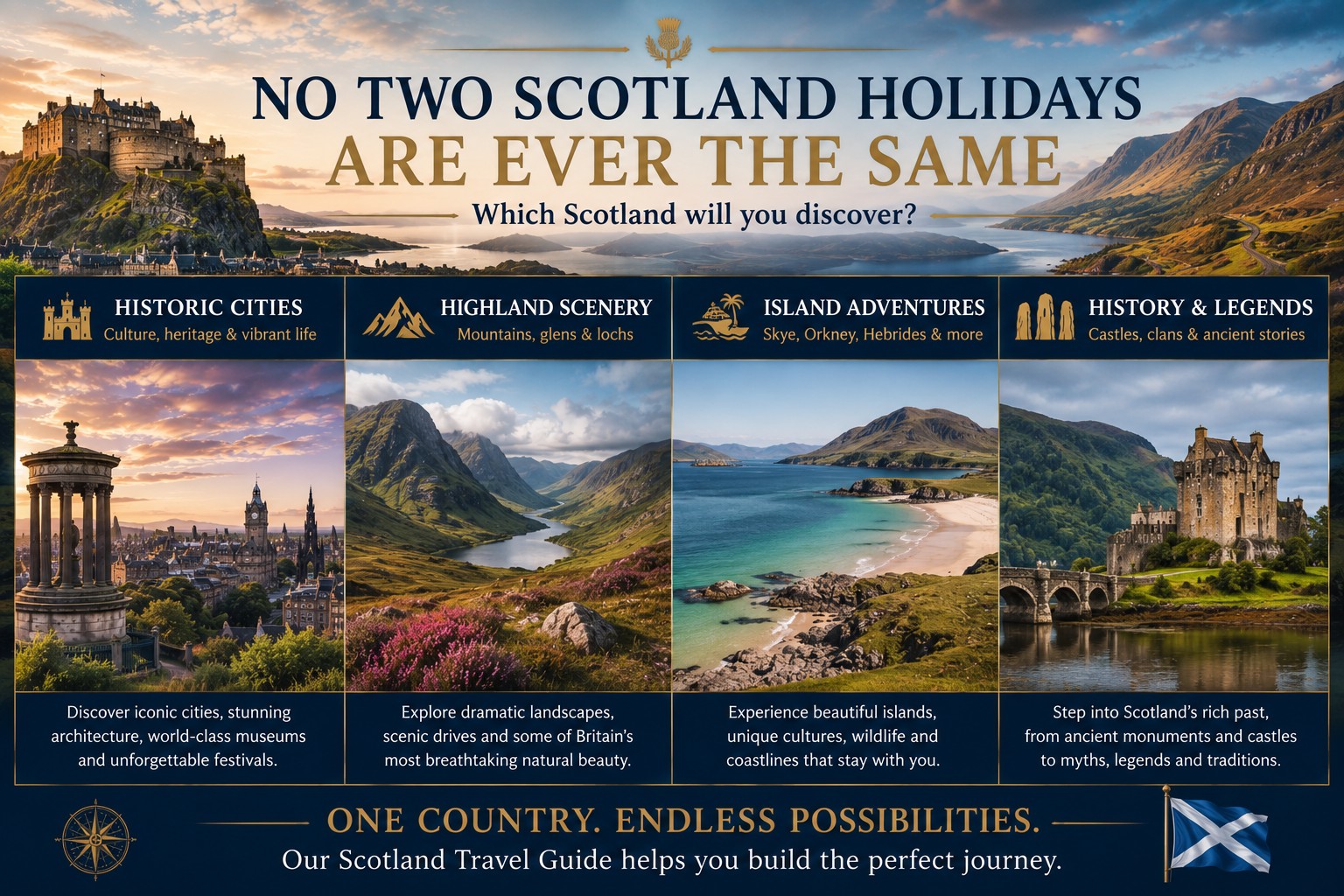
Scotland offers something for every traveller, from vibrant historic cities and breathtaking Highland scenery to spectacular islands and centuries of history, castles and legendary landscapes
📊 Choose Your Scotland Journey
🧭 Choose the Best Scotland Journey for You
Begin with the experience that matters most to you. Once that priority is clear, it becomes much easier to choose the right starting point, avoid an overloaded itinerary and continue into the most useful part of the BVT Scotland Cluster.
| Your Main Priority | Best Starting Point | Why It Suits You | Best Next Guide |
|---|---|---|---|
| 🏛️ First Visit | Edinburgh | The strongest all-round introduction to Scottish history, culture, architecture and onward transport. | Edinburgh and the Highlands |
| 🏔️ Dramatic Scenery | Glen Coe or Skye | Powerful mountain landscapes, atmospheric glens, coastal scenery and memorable viewpoints. | Highlands and Islands |
| 🏝️ Island Adventure | Skye, Orkney or the Outer Hebrides | Distinct island landscapes, local culture, archaeology, wildlife and a slower pace of travel. | Scottish Islands Guides |
| 🪨 Ancient History | Orkney, Calanais or Clava Cairns | Scotland’s most significant prehistoric monuments, ancient settlements and archaeological landscapes. | Ancient Scotland |
| 🧙 Legends and Folklore | Arthur’s Seat, Drumelzier and Loch Ness | Merlin traditions, literary history, folklore and atmospheric landscapes shaped by storytelling. | Merlin and Legendary Scotland |
| 🎉 Festivals and Events | Edinburgh or Regional Scotland | Highland Games, major festivals, Hogmanay, cultural celebrations and seasonal experiences. | Scotland Events Calendar |
| 🚗 Scenic Touring | Highlands and Islands | Multi-day routes, changing landscapes, memorable road journeys and carefully paced exploration. | Scotland Tours |
| 🌿 Sustainable Travel | Rail-linked cities and longer regional stays | Fewer transfers, slower journeys, stronger local connections and more meaningful regional experiences. | Sustainable Scotland |
On smaller screens, swipe sideways to view the complete comparison.
Many Scotland holidays combine two interests, but one should remain dominant. Choose your principal priority first, then add only the experiences that connect naturally with it.
Many journeys combine two priorities, but one should remain dominant. Choosing that focus early prevents the itinerary from becoming an exhausting attempt to include every famous destination.
🧭 Choose Your Scotland Journey
The best Scotland itinerary begins with one dominant priority. Use this quick decision path to identify the type of journey that should shape your route, then add one complementary experience without overloading your plans.
🏴 Is This Your First Visit?
Begin with Edinburgh, then add one carefully selected Highland journey for the strongest all-round introduction to Scotland.
🏰 Is History Your Main Priority?
Focus on Edinburgh, Stirling, Scotland’s great castles and the country’s ancient monuments before expanding into regional journeys.
🏔️ Is Dramatic Scenery Most Important?
Choose Glen Coe, Loch Ness, the Cairngorms or Skye, depending on your available time and preferred balance of accessibility and remoteness.
🏝️ Are the Islands Your Main Ambition?
Choose Skye for a first island journey, Orkney for archaeology, the Outer Hebrides for beaches and Gaelic culture, or Shetland for wildlife and remote coastal landscapes.
📅 Will Events Determine Your Dates?
Build your itinerary around festivals, Highland Games, Hogmanay or seasonal celebrations, then choose nearby regions that fit naturally around those fixed dates.
🧙 Are Legends and Folklore the Main Attraction?
Begin with the Merlin mini-cluster, then continue into ancient Scotland, legendary Highland landscapes and places where history and storytelling meet.
📖 Choose Your Best Starting Guide
First visit → Cities and Highlands
History → Castles and Ancient Scotland
Scenery → Highlands and Islands
Islands → Scottish Islands Guides
Events → Scotland Events Calendar
Legends → Merlin and Legendary Scotland
🏙️ Scotland’s Historic Cities: Choosing the Right Starting Point
For many visitors, Scotland’s cities provide the ideal introduction before continuing into the country’s mountains, islands and coastal landscapes.
Each city has its own personality and strengths. Rather than trying to visit them all within a single holiday, it is usually better to choose the one that best matches your interests before building outward into the surrounding regions.
🏰 Edinburgh: Scotland’s Historic Capital
Edinburgh remains the natural starting point for many first-time visitors.
Its medieval Old Town, elegant Georgian New Town and world-famous castle create one of Europe’s most distinctive historic cityscapes, while museums, galleries, restaurants and year-round cultural events provide far more than a simple sightseeing destination. The capital also serves as an excellent transport hub, making it easy to combine a city break with journeys into the Highlands, St Andrews, Loch Lomond or the Scottish Borders.
Visitors interested in history, architecture, literature, festivals and royal heritage often find Edinburgh provides the perfect foundation for a wider Scottish itinerary.
🎵 Glasgow: Scotland’s Creative City
Where Edinburgh reflects centuries of royal and political history, Glasgow offers a different perspective on modern Scotland.
Known for its music scene, Victorian architecture, outstanding museums and welcoming atmosphere, Glasgow provides excellent access to the west coast, Loch Lomond and the southern Highlands. The city rewards travellers who enjoy art, live performance, contemporary culture and vibrant neighbourhoods alongside traditional Scottish hospitality.
For visitors planning to explore western Scotland, Glasgow frequently makes an ideal touring base.
🏔️ Inverness: Gateway to the Highlands
Inverness marks the transition between Scotland’s cities and its great Highland landscapes.
Situated near Loch Ness and the Great Glen, it provides convenient access to the Cairngorms, the Black Isle, Speyside, the North Coast 500 and numerous historic sites across northern Scotland. Rather than functioning as a destination filled with major attractions, Inverness succeeds as an exceptionally practical base from which to explore some of Scotland’s most celebrated scenery.
Travellers whose priority is the Highlands often find that beginning here allows them to spend more time in the landscapes themselves.
🏛️ Other Historic City Gateways
Several other Scottish cities also deserve consideration depending on your interests.
Stirling combines royal history with one of Scotland’s most significant castles and the story of Bannockburn. Dundee offers an attractive waterfront, a growing cultural scene and easy access to the east coast, while Aberdeen opens the door to the north-east’s dramatic coastline, castle country and whisky regions.
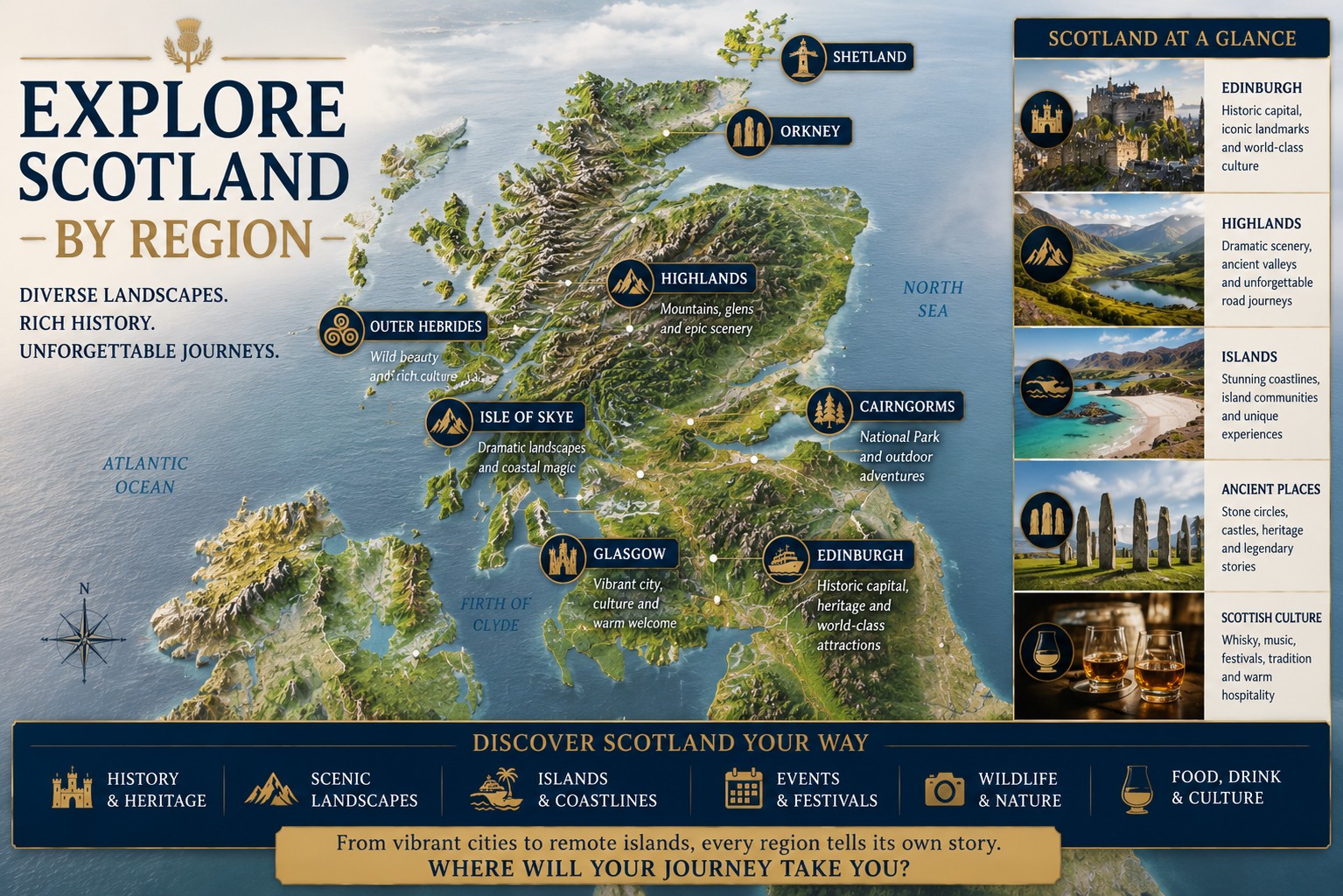
Discover Scotland region by region, from vibrant cities and dramatic Highland landscapes to island adventures, ancient heritage and unforgettable cultural experiences across the country
📊 Choosing the Right Scottish City
🏙️ Choose the Right Scottish City Gateway
Scotland’s cities offer very different starting points. Choose the gateway that best matches your interests and connects most naturally with the region you want to explore next.
| City | Best For | Natural Regional Connections | Suggested Stay |
|---|---|---|---|
| 🏰 Edinburgh | First visits, royal history, architecture, festivals and cultural city breaks | Scottish Borders, Stirling, East Coast, St Andrews and organised Highland journeys | 2–4 days |
| 🎵 Glasgow | Music, museums, architecture, food and contemporary Scottish culture | Loch Lomond, Argyll, western Scotland, Glen Coe and the southern Highlands | 2–3 days |
| 🏔️ Inverness | Highland exploration, scenic touring and northern Scotland | Loch Ness, Great Glen, Cairngorms, Black Isle, Speyside and North Coast 500 | 2–4 days |
| ⚔️ Stirling | Royal heritage, military history and compact historic sightseeing | Loch Lomond, the Trossachs, central Scotland and the southern Highlands | 1–2 days |
| 🎨 Dundee | Design, museums, maritime heritage and relaxed east-coast touring | Angus, Fife, Perthshire, St Andrews and the eastern Cairngorms | 1–2 days |
| 🏛️ Aberdeen | Castles, coastal scenery, whisky regions and north-east Scotland | Royal Deeside, Speyside, Moray Coast and north-east castle country | 2–3 days |
On smaller screens, swipe sideways to view the complete city comparison.
Quick Gateway Guide
- Choose Edinburgh for the strongest first-time introduction.
- Choose Glasgow for culture and western Scotland.
- Choose Inverness when the Highlands are your main priority.
- Choose Stirling for concentrated royal and military history.
- Choose Dundee for design, museums and east-coast connections.
- Choose Aberdeen for castles, whisky and the north-east coast.
The best city gateway is not necessarily the most famous. Choose the city that connects most naturally with the region and experiences you want to prioritise.
🏙️ Scottish City Gateways Compared
Scotland’s cities are more than places to begin and end a journey. Each offers a different atmosphere, suits a different type of traveller and opens naturally into particular regions of the country. Choosing the right gateway can make the rest of your itinerary considerably easier.
| City | Atmosphere | Ideal Visitor | Best Experiences | Regional Connections | Suggested Stay |
|---|---|---|---|---|---|
| 🏰 Edinburgh | Historic, elegant and atmospheric | First-time visitors, culture lovers and festival travellers | Castle, Old Town, royal heritage, museums and major events | Borders, East Coast, Stirling and Highland tours | 2–4 days |
| 🎵 Glasgow | Creative, energetic and welcoming | Music, art, food and contemporary-culture travellers | Museums, live music, Victorian architecture and neighbourhood culture | Loch Lomond, Argyll, western Highlands and Clyde coast | 2–3 days |
| 🏔️ Inverness | Compact, practical and Highland-focused | Travellers prioritising scenery, road trips and northern Scotland | Loch Ness, riverside walks, castles and Highland excursions | Great Glen, Cairngorms, Black Isle, Speyside and North Coast 500 | 2–4 days |
| ⚔️ Stirling | Historic, compact and strategically placed | Visitors interested in royal, military and national history | Stirling Castle, Bannockburn and historic viewpoints | Trossachs, Loch Lomond, central Scotland and southern Highlands | 1–2 days |
| 🎨 Dundee | Modern, waterfront-focused and cultural | Design, museums and quieter city-break travellers | Waterfront, design attractions, maritime heritage and galleries | Fife, Angus, Perthshire and eastern Cairngorms | 1–2 days |
| 🏛️ Aberdeen | Grand, coastal and distinctive | Castle, coastline, whisky and north-east explorers | Granite architecture, museums, coastal scenery and regional heritage | Speyside, Deeside, Moray Coast and north-east castle country | 2–3 days |
Quick Gateway Guide
- Choose Edinburgh for the strongest first-time introduction.
- Choose Glasgow for culture and western Scotland.
- Choose Inverness when the Highlands are your main priority.
- Choose Stirling for concentrated royal and military history.
- Choose Dundee for design, waterfront culture and east-coast connections.
- Choose Aberdeen for castles, whisky regions and the north-east coast.
Select the city that naturally opens into the region you most want to explore. The right gateway reduces unnecessary travel and gives the rest of your Scotland itinerary a clearer direction.
Beyond these cities, Scotland begins to change dramatically. Roads become quieter, distances feel greater and the landscapes open into mountains, glens, forests and lochs that have shaped the country’s identity for centuries.
That is where many visitors discover the Scotland they have imagined all along.
🏔️ Explore the Scottish Highlands: One Region, Many Different Journeys
To many visitors, the Highlands represent the very image of Scotland.
Mountain passes, ancient glens, mirror-like lochs, pine forests and winding roads combine to create landscapes that feel dramatically different from the country’s cities. Yet one of the biggest surprises for first-time travellers is discovering that the Highlands are not a single destination.
Each region offers its own scenery, atmosphere and pace of travel.
Choosing the right Highland area can transform an itinerary from an exhausting road trip into an unforgettable journey.
🌄 Glen Coe: Scotland’s Most Dramatic Mountain Landscape
Few places capture the scale and grandeur of the Highlands quite like Glen Coe.
The steep mountains rising above the glen, together with waterfalls, winding roads and constantly changing weather, create one of Scotland’s most recognisable landscapes. The area’s powerful history, including the 1692 Glencoe Massacre, adds another layer of significance to a place already shaped by remarkable natural beauty.
Glen Coe works especially well for first-time visitors wanting dramatic scenery without travelling to Scotland’s most remote regions. It also combines naturally with Loch Lomond, Fort William, Ben Nevis and the Isle of Skye.
🌊 The Great Glen and Loch Ness
Stretching from Fort William to Inverness, the Great Glen forms one of Scotland’s great natural corridors.
Its chain of lochs, forests and mountains creates a journey that feels far larger than the famous waters of Loch Ness alone. While Nessie understandably attracts worldwide attention, the surrounding landscape rewards visitors whether they believe in legendary creatures or not.
Travellers can explore scenic viewpoints, sections of the Caledonian Canal, Urquhart Castle and peaceful woodland walks while enjoying one of Scotland’s most beautiful long-distance routes.
🏞️ The Cairngorms National Park
The Cairngorms provide a different Highland experience.
Instead of steep western glens, visitors discover expansive mountain plateaus, ancient Caledonian pine forests, rivers, wildlife habitats and attractive Highland towns. The park supports nationally important habitats, including populations of red squirrels, red deer and rare bird species, although wildlife sightings are never guaranteed.
Outdoor activities such as walking, cycling, wildlife watching and winter sports all play an important role here, making the Cairngorms ideal for travellers seeking both scenery and active exploration.
⛰️ Ben Nevis and Fort William
Standing at 1,345 metres, Ben Nevis is the United Kingdom’s highest mountain and dominates the skyline above Fort William.
Not every visitor intends to climb its summit, but the surrounding area offers excellent walking, scenic drives, mountain viewpoints and access to the Great Glen. Fort William itself serves as a practical touring base for western Highland journeys, particularly when combined with Glen Coe, the Jacobite railway corridor and the Road to the Isles.
🏔️ Choose Your Highland Region
The Highlands are not one destination. Each region offers a different balance of scenery, accessibility, activity and travel time. Choose the area that best matches your confidence, available days and preferred style of exploration.
| Region | Scenery | Planning Difficulty | Accessibility | Ideal Trip Length | Best Traveller |
|---|---|---|---|---|---|
| 🌄 Glen Coe | Steep mountains, waterfalls and dramatic glen scenery | Low to moderate | Excellent by road and organised tour | 1–2 days | First-time visitors, photographers and scenic tourers |
| 🌊 Great Glen | Lochs, forests, mountain corridors and waterside scenery | Low to moderate | Very good between Fort William and Inverness | 1–3 days | First-time Highland travellers, families and history lovers |
| 🏞️ Cairngorms | Mountain plateaus, ancient forests, rivers and wildlife habitats | Moderate | Good road and rail access to several bases | 2–4 days | Walkers, wildlife enthusiasts and active travellers |
| ⛰️ Ben Nevis and Fort William | High mountains, glens and western Highland viewpoints | Moderate; high if summit walking | Good by road and rail | 2–3 days | Walkers, rail enthusiasts and western-route travellers |
| 🪨 North-West Highlands | Remote mountains, open moorland, sea lochs and ancient geology | High | Best by self-drive or specialist tour | 3–5 days | Experienced road trippers, photographers and slower travellers |
| 🌿 Loch Lomond and the Trossachs | Loch shores, wooded hills, villages and accessible Highland scenery | Low | Excellent from Glasgow and Stirling | 1–2 days | Families, short-break visitors and first-time Highland explorers |
Quick Decision Guide
- Choose Glen Coe for maximum drama with straightforward access.
- Choose the Great Glen for Loch Ness, historic stops and a logical Highland corridor.
- Choose the Cairngorms for walking, forests and wildlife.
- Choose Ben Nevis and Fort William for mountain experiences and western touring.
- Choose the North-West Highlands for remoteness, photography and slow road travel.
- Choose Loch Lomond and the Trossachs for an accessible first introduction.
The most rewarding Highland itinerary usually focuses on one principal region, then adds only the landscapes that connect naturally with it.
Rather than attempting to include every Highland region within one short holiday, most visitors enjoy a far richer experience by choosing one area, allowing time to explore properly and discovering the places that lie between the famous landmarks.
🏔️ Scotland’s Remote North-West Highlands
For travellers seeking quieter roads and some of Scotland’s most distinctive scenery, the north-west Highlands offer an entirely different experience.
Regions such as Torridon and Assynt are not simply extensions of Glen Coe or Loch Ness. Their landscapes are defined by isolated mountains rising dramatically from lochs, open moorland and long stretches of coastline where villages are separated by considerable distances. Torridon’s immense sandstone peaks create some of the country’s most dramatic mountain scenery, while Assynt is renowned for distinctive mountains such as Suilven and Stac Pollaidh, whose unique profiles rise above a landscape of freshwater lochs and ancient rock.
These regions reward travellers who enjoy photography, walking, geology and slower-paced exploration.
They also require realistic planning.
Accommodation can fill quickly during the busiest months, fuel stations become less frequent and journey times are often considerably longer than maps suggest. Building flexibility into each day allows time for scenic stops and changing weather without turning every drive into a race against the clock.
🌿 Loch Lomond and the Trossachs
Located within easy reach of both Glasgow and Stirling, Loch Lomond and the Trossachs National Park provides one of Scotland’s most accessible introductions to Highland scenery.
Loch Lomond has the largest surface area of any freshwater body in Great Britain, while the surrounding hills, forests and villages create an attractive balance between natural beauty and visitor facilities. Walking trails, boat trips and scenic viewpoints make the region suitable for families, first-time visitors and travellers beginning a longer Highland journey.
Many itineraries naturally combine Loch Lomond with Glen Coe, creating a gradual transition from Scotland’s Lowlands into the dramatic western Highlands.
🏝️ Discover Scotland’s Islands
No visit to Scotland’s islands feels exactly like another.
Some islands are linked by bridges, others require ferries or flights, and each possesses its own history, traditions and landscapes. Rather than treating “the islands” as one destination, it is far more useful to think of them as individual regions with very different personalities.
Some reward short scenic visits, while others deserve several days of exploration.
🏝️ Scottish Islands Compared
Scotland’s islands offer remarkably different experiences. Some are famous for dramatic mountain scenery, others for prehistoric archaeology, extraordinary beaches or abundant wildlife. Choosing the island that best matches your interests will usually create a more rewarding trip than trying to visit several during one holiday.
| Island Group | Scenery | Archaeology | Beaches | Wildlife | Accessibility | Ideal Stay |
|---|---|---|---|---|---|---|
| 🏔️ Isle of Skye | ★★★★★ | ★★★☆☆ | ★★★☆☆ | ★★★★☆ | Bridge access plus ferry options | 3–5 days |
| 🏖️ Outer Hebrides | ★★★★★ | ★★★★☆ | ★★★★★ | ★★★★★ | Ferry or flight required | 4–7 days |
| 🪨 Orkney | ★★★★☆ | ★★★★★ | ★★★★☆ | ★★★★☆ | Regular ferry and flights | 3–4 days |
| 🌊 Shetland | ★★★★★ | ★★★★☆ | ★★★☆☆ | ★★★★★ | Long ferry or domestic flight | 4–6 days |
Quick Island Guide
- Choose Skye for your first Scottish island and spectacular mountain scenery.
- Choose the Outer Hebrides for world-class beaches, Gaelic culture and peaceful coastal landscapes.
- Choose Orkney if prehistoric archaeology and ancient history are your main interests.
- Choose Shetland for exceptional wildlife, dramatic coastlines and Scotland’s most remote island experience.
The best island holidays focus on one island group rather than trying to combine several. Allow enough time to experience the landscapes, communities and slower pace that make Scotland’s islands so distinctive.
🌊 The Isle of Skye
The Isle of Skye is Scotland’s most visited island for good reason.
Its dramatic mountain ridges, sea cliffs, waterfalls and picturesque harbours create an extraordinary variety of scenery within a relatively compact area. Locations such as the Quiraing, the Old Man of Storr, the Fairy Pools and Neist Point each reveal a different side of the island, while Portree provides an attractive base for exploring much of Skye.
Although some visitors include Skye as part of a shorter Highland circuit, allowing two or three nights creates a far more relaxed experience. It also leaves time to explore quieter corners beyond the island’s best-known viewpoints.
🏖️ The Outer Hebrides
The Outer Hebrides present a completely different island experience.
Stretching along Scotland’s Atlantic edge, these islands combine remarkable white-sand beaches, Gaelic culture, archaeological treasures and peaceful coastal communities. Lewis and Harris are particularly popular, offering everything from the Calanais Standing Stones to spectacular beaches such as Luskentyre and Seilebost.
Travellers who appreciate slower journeys, local heritage and expansive coastal scenery often find the Outer Hebrides among Scotland’s most rewarding destinations. Ferry crossings and accommodation should be planned well in advance, particularly during summer.
🪨 Orkney
For visitors fascinated by ancient history, Orkney stands apart.
The islands contain one of Europe’s richest concentrations of prehistoric archaeology, including the Heart of Neolithic Orkney UNESCO World Heritage Site, Skara Brae, the Ring of Brodgar and the Standing Stones of Stenness. Together they create an exceptional opportunity to explore landscapes where people lived, gathered and built ceremonial monuments more than five thousand years ago.
Beyond archaeology, Orkney also offers dramatic coastlines, abundant birdlife, Viking heritage and welcoming island communities.
🌬️ Shetland
Farther north still, Shetland offers a distinctive blend of Scandinavian heritage, rugged coastlines and remarkable wildlife.
Sea cliffs, seabird colonies, archaeological sites and traditional fishing communities combine to create an island group unlike anywhere else in Britain. Shetland rewards travellers willing to devote sufficient time to explore rather than treating the islands as a brief addition to a wider Scottish itinerary.
📊 Choosing the Right Scottish Island
🏝️ Choose the Right Scottish Island
Scotland’s major island regions offer very different journeys. Compare their strongest experiences, access requirements and realistic stay lengths before deciding which island best matches your priorities.
| Island Region | Best For | Access | Suggested Stay |
|---|---|---|---|
| 🏔️ Isle of Skye | First island journeys, mountain scenery, iconic viewpoints, walking and a natural extension to the western Highlands | Bridge access from the mainland, with additional ferry connections | 2–3 nights |
| 🏖️ Outer Hebrides | White-sand beaches, Gaelic culture, archaeological landscapes, island communities and slower coastal travel | Ferry or domestic flight, followed by additional inter-island travel where required | 3–5 nights |
| 🪨 Orkney | Prehistoric archaeology, Viking heritage, dramatic coastlines, historic sites and rewarding wildlife experiences | Ferry from northern Scotland or domestic flight | 3–4 nights |
| 🌊 Shetland | Wildlife, seabird colonies, rugged coastlines, Norse heritage and Scotland’s most remote island adventure | Overnight ferry or domestic flight, with local transport needed for wider exploration | 4–5 nights |
On smaller screens, swipe sideways to view the complete island comparison.
Quick Island Guide
- Choose Skye for the easiest first island journey and dramatic scenery.
- Choose the Outer Hebrides for beaches, Gaelic culture and slower travel.
- Choose Orkney when archaeology and ancient history are your priorities.
- Choose Shetland for wildlife, rugged coastlines and a more remote adventure.
Scotland’s islands reward depth rather than speed. Choose one island region, secure the essential transport and accommodation early, and allow enough time for weather, ferry schedules and unplanned discoveries.
Whichever island you choose, successful planning depends on realistic travel times, advance ferry reservations where required and allowing enough flexibility for changing weather conditions. Island journeys are rarely about seeing as much as possible—they are about experiencing each destination properly.
🧭 Choose Your Scottish Island
Every Scottish island offers something different. Rather than asking which island is “best”, start by deciding what kind of experience you want most, then let that choice guide your itinerary.
🏝️ First Scottish Island?
↓
🏔️ Spectacular Scenery
Choose dramatic mountains, sea cliffs and iconic viewpoints.
↓
🏛️ Ancient History
Choose prehistoric monuments, Viking heritage and archaeological treasures.
↓
🦅 Wildlife & Nature
Choose seabirds, seals, whales, dolphins and quieter natural landscapes.
↓
🌊 Remote Adventure
Choose fewer crowds, longer journeys and a stronger sense of wilderness.
↓
🏆 Your Best Starting Island
| 🏔️ Spectacular scenery | Isle of Skye |
| 🏛️ Ancient history & archaeology | Orkney |
| 🏖️ Beaches & wildlife | Outer Hebrides |
| 🌊 Ultimate remote adventure | Shetland |
Choose one island group, allow enough time to explore it properly and let the slower pace become part of the experience. Scotland’s islands reward depth far more than speed.
🏰 Castles, Ancient Scotland and Legendary Landscapes
Historic fortresses, prehistoric monuments and enduring legends connect every region of Scotland, adding remarkable depth to journeys that begin with scenery alone.
Scotland’s castles tell the story of kings, queens, powerful clans, religious change and centuries of conflict, while its prehistoric monuments reveal a human story stretching back thousands of years before written history.
Alongside them sit legendary landscapes that continue to inspire stories of Merlin, Arthur, saints, warriors and folklore. Together they create one of Europe’s richest combinations of history, archaeology and myth.
🏰 Scotland’s Great Castles
Every Scottish castle has its own character.
Edinburgh Castle dominates the capital from volcanic rock and remains closely associated with Scotland’s royal history. Stirling Castle occupies another commanding position, standing at the crossroads between the Highlands and Lowlands and playing a pivotal role during the Wars of Independence.
Farther north, Urquhart Castle overlooks Loch Ness, combining dramatic scenery with medieval history, while Eilean Donan Castle, beautifully restored during the twentieth century, has become one of Scotland’s most photographed landmarks thanks to its striking setting where three sea lochs meet.
Rather than trying to visit every famous castle, most travellers benefit from choosing those that naturally complement their wider route.
🪨 Ancient Scotland
Long before medieval castles appeared across the landscape, Scotland’s earliest communities were constructing ceremonial stone circles, chambered cairns and sophisticated settlements.
Orkney contains the remarkable Heart of Neolithic Orkney UNESCO World Heritage Site, while the Calanais Standing Stones on Lewis continue to fascinate visitors with their scale and dramatic Atlantic setting. On the mainland, Clava Cairns near Inverness and the prehistoric monuments of Kilmartin Glen reveal further chapters of Scotland’s distant past.
These ancient places should be appreciated for their genuine archaeological significance rather than through later myths that are sometimes attached to them.
🧙 Legends and the Merlin Journey
Scotland’s landscapes have inspired legends for centuries.
Some traditions connect Merlin with Drumelzier in the Borders, Arthur’s Seat in Edinburgh, the Isle of Skye and the mysterious landscapes surrounding Loch Ness and the Highlands. These stories belong to Scotland’s rich cultural heritage, even though they should not be confused with established historical evidence.
The completed BVT Merlin mini-cluster explores these legendary locations in far greater depth, allowing this national guide to introduce them while encouraging readers to continue their journey through Scotland’s remarkable blend of myth, landscape and history.
⚔️ Jacobites, Clans and Scotland on Screen
Many visitors also arrive inspired by Scotland’s later history.
Culloden Battlefield, Highland clan traditions and the Jacobite period continue to shape Scotland’s cultural identity, while film and television productions have introduced millions to locations featured in Outlander, Harry Potter, James Bond and numerous other productions.
For many travellers, Scotland becomes even more fascinating because history, legend and modern storytelling often exist side by side within the very same landscape.

From dramatic Highland landscapes and historic castles to island adventures, ancient monuments and world-famous traditions, Scotland offers unforgettable experiences for every type of traveller
🏰 Continue Exploring Legendary Scotland
The landscapes of Scotland are shaped by more than mountains, castles and coastlines. They are also places of enduring legend, where stories of Merlin, ancient kingdoms, standing stones and mysterious landscapes continue to inspire travellers today. Continue your journey through one of Scotland’s most fascinating collections of myths, history and remarkable places.
🪦 Merlin’s Grave
Explore the traditions surrounding Drumelzier in the Scottish Borders.
⛰️ Arthur’s Seat
Discover Edinburgh’s legendary volcanic hill and its Merlin connections.
🏔️ Legendary Highlands
Explore the Highlands through myth, folklore and remarkable scenery.
🗺️ Merlin-Inspired Scotland Itinerary
Bring the entire legendary journey together with a practical multi-day itinerary following Scotland’s most iconic Merlin landscapes.
Scotland’s legendary landscapes become even more rewarding when explored together. Follow the Merlin mini-cluster to discover how mythology, archaeology and spectacular scenery combine to tell one of Britain’s greatest stories.
📅 When Is the Best Time to Visit Scotland?
There is no universally perfect season to visit Scotland.
The best time depends entirely on the type of journey you want to experience. Long summer evenings suit island adventures and scenic road trips, autumn transforms forests and glens with rich colour, spring brings fresh landscapes and quieter roads, while winter offers festive cities, dramatic mountain scenery and unique seasonal traditions.
Understanding how each season shapes the country will help you choose the right itinerary rather than simply the most popular travel dates.
🌸 Spring (March to May)
Spring is one of Scotland’s most rewarding seasons for relaxed touring.
Gardens begin to bloom, wildlife becomes increasingly active and visitor numbers are generally lower than during the height of summer. Snow often remains visible on the highest mountains while lower glens fill with fresh greenery, creating striking contrasts for photographers and walkers alike.
For travellers who prefer quieter attractions and more flexible itineraries, spring offers an excellent balance between scenery and accessibility.
☀️ Summer (June to August)
Summer delivers Scotland’s longest daylight hours, making it possible to enjoy full days of sightseeing, walking and scenic driving.
This is also the season of many major festivals, Highland Games and outdoor events, with Edinburgh’s internationally renowned festival season attracting visitors from around the world. The Highlands and islands are at their busiest, however, so accommodation, ferries and popular attractions should be booked well in advance.
Visitors travelling during summer benefit from planning fewer regions rather than trying to fit too much into one holiday.
🍂 Autumn (September to November)
Autumn brings a quieter rhythm to many parts of Scotland.
Woodlands display spectacular seasonal colour, temperatures often remain comfortable for walking and photography, and many scenic routes become noticeably less crowded after the busiest summer period. It is an especially appealing season for travellers interested in landscapes, wildlife and relaxed touring.
Whisky enthusiasts also enjoy autumn journeys, with distilleries welcoming visitors throughout the year against a particularly atmospheric seasonal backdrop.
❄️ Winter (December to February)
Winter reveals a completely different Scotland.
Edinburgh’s festive celebrations, Hogmanay, Christmas markets and snow-covered Highland scenery create memorable experiences for visitors willing to embrace shorter daylight hours and changing weather. Roads and ferry services can occasionally be affected by winter conditions, so flexible planning remains important, particularly when travelling through remote Highland and island regions.
📊 Scotland by Season
🌦️ When Should You Visit Scotland?
Every season reveals a different side of Scotland. Rather than asking which season is “best”, choose the time of year that best matches the experience you want to enjoy.
| Season | Best For | Things to Consider | Ideal For |
|---|---|---|---|
| 🌸 Spring | Wildlife, gardens, waterfalls, castles and quieter sightseeing | Highly changeable weather, particularly in the Highlands | Nature lovers and first-time visitors seeking fewer crowds |
| ☀️ Summer | Festivals, Highland Games, islands, long daylight and road trips | Peak visitor numbers, higher prices and early accommodation booking | Visitors wanting maximum choice and outdoor exploration |
| 🍂 Autumn | Autumn colours, photography, scenic touring and quieter roads | Shorter daylight hours and cooler evenings | Photographers and scenic road-trip enthusiasts |
| ❄️ Winter | Historic cities, festive events, snow-covered landscapes and cosy escapes | Short daylight, weather disruption and some seasonal closures | Christmas markets, Hogmanay and dramatic winter scenery |
On smaller screens, swipe sideways to view the complete seasonal comparison.
Quick Seasonal Guide
- 🌸 Spring — quieter travel and emerging landscapes.
- ☀️ Summer — maximum daylight, festivals and island adventures.
- 🍂 Autumn — Scotland’s finest colours and scenic driving.
- ❄️ Winter — festive cities, Hogmanay and dramatic Highland scenery.
There is no single best time to visit Scotland. The ideal season is the one that best matches the landscapes, activities and pace of travel you hope to experience.
🎉 Plan Around the BVT Scotland Events Calendar
Choosing where to travel is only half the planning process.
Knowing when to visit can make an equally significant difference.
Scotland hosts an exceptional variety of festivals, Highland Games, cultural celebrations, sporting events and seasonal experiences throughout the year. Checking the BVT Scotland Events Calendar before confirming your itinerary can help you align your journey with events that match your interests while also highlighting periods when accommodation should be booked particularly early.
Whether you are hoping to experience Edinburgh’s festival season, Highland Games, Hogmanay, agricultural shows, food festivals or regional celebrations, the calendar provides a practical starting point for planning your travel dates.
📅 Plan Your Scotland Journey Around the Right Dates
Scotland’s festivals, Highland Games, cultural celebrations and seasonal events can transform a memorable holiday into an exceptional one. They can also increase demand for accommodation, ferries, transport and popular attractions.
Explore the Best Value Tours Scotland Events Calendar before confirming your itinerary to discover what is happening during your visit, identify events that match your interests and plan ahead for particularly busy periods.
Choose where you want to travel, then use Scotland’s events and seasons to help decide when your journey should begin.
🚗 How to Travel Around Scotland
One of the greatest pleasures of exploring Scotland is that there is no single correct way to do it.
Some visitors enjoy the freedom of a self-drive holiday, stopping whenever a mountain view, quiet beach or historic village captures their attention. Others prefer travelling by rail between Scotland’s principal cities before joining organised excursions into the Highlands. Many choose guided tours that remove the stress of navigation while allowing them to appreciate the scenery from the comfort of the journey itself.
The right approach depends on your available time, confidence behind the wheel, preferred pace and the regions you hope to explore.
🚘 Self-Drive Holidays
Driving offers the greatest flexibility and remains the preferred choice for many visitors exploring the Highlands and islands.
A car allows spontaneous stops at viewpoints, waterfalls, castles and small villages that larger transport networks cannot always reach conveniently. It also provides the freedom to discover quieter regions such as Torridon, Assynt or parts of the Outer Hebrides at your own pace.
However, Scotland’s roads deserve realistic expectations. Highland routes are often winding, weather conditions can change quickly and journey times are frequently longer than sat-nav estimates suggest. Single-track roads with passing places require patience, courtesy and careful driving, particularly during busy summer months.
Successful self-drive itineraries build generous time into each day rather than treating driving as simply moving between attractions.
🚆 Rail Travel
Scotland’s rail network provides a comfortable way to connect several major cities and selected Highland destinations.
Edinburgh, Glasgow, Stirling, Dundee, Aberdeen and Inverness are all linked by regular rail services, while some scenic routes have become attractions in their own right. Travelling by train allows visitors to relax and enjoy changing landscapes without concentrating on unfamiliar roads.
Rail works particularly well when combined with organised day tours, local buses or short periods of car hire, creating flexible itineraries that reduce unnecessary driving while still reaching many of Scotland’s highlights.
⛴️ Ferries and Island Connections
Island travel introduces another layer of planning.
Many of Scotland’s islands rely on ferry services, while others are served by domestic flights or bridge connections. Ferry timetables, weather conditions and seasonal demand all influence travel plans, making advance reservations particularly important during the busiest months.
Allowing flexibility around ferry crossings helps avoid unnecessary stress and provides valuable contingency if conditions change.
🚌 Day Tours and Multi-Day Tours
Guided touring remains one of the easiest ways to experience Scotland, particularly for first-time visitors.
Day tours work well for travellers staying in Edinburgh or Glasgow who wish to explore places such as Loch Lomond, Glen Coe or Loch Ness before returning to the city the same evening.
🚘 Choose How to Travel Around Scotland
Scotland can be explored independently, by public transport or with expert guidance. The right option depends on how much flexibility you want, whether remote locations are important and how much responsibility you wish to take for navigation and daily planning.
| Travel Style | Flexibility | Cost Profile | Remote Access | Comfort | Best Suited For |
|---|---|---|---|---|---|
| 🚗 Self-Drive | Very high | Variable once hire, insurance, fuel, parking and possible one-way fees are included | Excellent, including many rural and remote areas | High freedom, but all driving and navigation remain your responsibility | Confident drivers, couples, families and independent road trippers |
| 🚆 Rail Travel | Moderate | Often good value when booked early, particularly for city-to-city journeys | Limited without buses, local tours or short periods of car hire | Relaxed and comfortable, with no driving responsibility | Solo travellers, non-drivers and visitors focusing on cities and rail-linked bases |
| 🚌 Day Tours | Moderate to low | Predictable, with transport and itinerary normally included | Good for established routes from Edinburgh, Glasgow and other major bases | High convenience with no hotel changes or navigation | Short-break visitors and travellers wanting one Highland experience from a city base |
| 🏔️ Multi-Day Tours | Moderate | Predictable overall cost, although accommodation arrangements vary | Very good across established Highland and island touring routes | High convenience, with route planning and navigation handled | First-time visitors, solo travellers and those wanting deeper exploration without driving |
| ✨ Private Touring | Very high | Premium | Excellent, subject to road and local access conditions | Highest comfort, personal attention and itinerary adaptability | Couples, families and small groups prioritising flexibility, expertise and a slower pace |
Quick Travel Style Guide
- Choose self-drive for maximum independence and remote access.
- Choose rail for relaxed travel between cities and selected Highland bases.
- Choose a day tour for a convenient Scotland experience without changing accommodation.
- Choose a multi-day tour for deeper Highland or island exploration without managing the route yourself.
- Choose private touring for maximum comfort, flexibility and personalised guidance.
The best transport choice is the one that gives you access to the Scotland you want to experience without creating more driving, transfers or planning responsibility than you will enjoy.
🚌 Explore Scotland Tours
Choose the touring style that best matches your available time. Scotland day tours offer a convenient introduction from a city base, while multi-day journeys provide more time to explore the Highlands, islands, lochs and historic landscapes at a comfortable pace.
🚍 Scotland Day Tours
Ideal for visitors staying in Edinburgh, Glasgow or another major base who want to experience Highland scenery, historic destinations or famous landscapes without changing accommodation.
🏔️ Scotland Multi-Day Tours
Best for travellers who want to journey deeper into Scotland, spend longer among Highland landscapes and explore islands, castles, lochs and smaller communities without managing every part of the route themselves.
Choose a day tour for one memorable Scotland experience from a fixed base, or a multi-day journey when you want the route itself to become part of the adventure.
✨ Private and Luxury Touring
Travellers seeking a more personalised experience may prefer private or luxury touring.
Luxury travel in Scotland is defined less by extravagance than by quality, flexibility and time. Rather than rushing between destinations, many premium itineraries focus on spending longer in exceptional locations. Boutique Highland lodges, elegant country houses, carefully selected castle hotels and stylish coastal accommodation all provide opportunities to experience Scotland at a slower pace.
Private driver-guides, specialist historians, wildlife experts and local guides can also add considerable depth to a journey, transforming familiar landmarks into memorable experiences through local knowledge and personal interpretation.
Often, the greatest luxury is simply allowing an extra day beside a Highland loch or on a Hebridean island instead of trying to add another destination to the itinerary.
⏳ How Many Days Do You Need in Scotland?
The answer depends less on how much Scotland has to offer than on how deeply you wish to experience it.
Although Scotland appears relatively compact on a map, travelling through mountain roads, island ferry routes and remote Highland regions takes considerably longer than many first-time visitors expect. Choosing a realistic itinerary almost always produces a more rewarding holiday than attempting to include every famous destination.
📊 Scotland by Trip Length
⏳ How Many Days Do You Need in Scotland?
The secret to an enjoyable Scotland itinerary is realistic pacing. Rather than trying to see everything, choose a route that matches the time available and allows space to enjoy each destination properly.
| Time Available | What You Can Comfortably Experience | Ideal Traveller |
|---|---|---|
| 🗓️ 2–3 Days | Explore Edinburgh or Glasgow with one carefully chosen scenic day trip, such as Loch Lomond, Glen Coe or the Borders. | First-time visitors, city breaks and short UK holidays. |
| 🚗 4–5 Days | Combine one city with a rewarding Highland journey, or include part of the Isle of Skye without rushing every day. | Visitors wanting Scotland’s classic highlights. |
| 🏔️ 7 Days | Experience one city, the Highlands and one major island or region while allowing time for scenic stops and flexibility. | Travellers seeking a balanced Scotland holiday. |
| 🧭 10–14 Days | Discover multiple regions, selected islands, historic cities and remote landscapes at a comfortable pace with genuine flexibility. | Explorers wanting a deeper journey across Scotland. |
On smaller screens, swipe sideways to compare every itinerary option.
🧭 Planning Tip
- 2–3 days — focus on one city and one unforgettable excursion.
- 4–5 days — ideal for Scotland’s classic Highland experience.
- 7 days — enough time to combine cities, Highlands and an island.
- 10–14 days — perfect for slower travel and regional exploration.
The most memorable Scotland holidays are rarely those that visit the greatest number of places. They are the ones that allow enough time to experience each destination properly.
A two or three-day visit works best when centred on one city combined with a single memorable excursion. Edinburgh together with a Highlands day tour provides an excellent introduction without feeling rushed.
With four or five days available, visitors can comfortably combine Edinburgh with Glen Coe, Loch Ness or a carefully planned Isle of Skye route. A full week opens considerably more possibilities, allowing travellers to experience both a Scottish city and the Highlands while still leaving time to appreciate one major island or coastal region properly.
Ten to fourteen days offers genuine freedom. Rather than constantly changing accommodation, visitors can spend meaningful time within several regions, explore lesser-known landscapes and enjoy the slower pace that often creates the most memorable Scottish holidays.
The aim is not to see everything.
It is to experience each chosen region well enough that it feels like more than a stop between photographs.
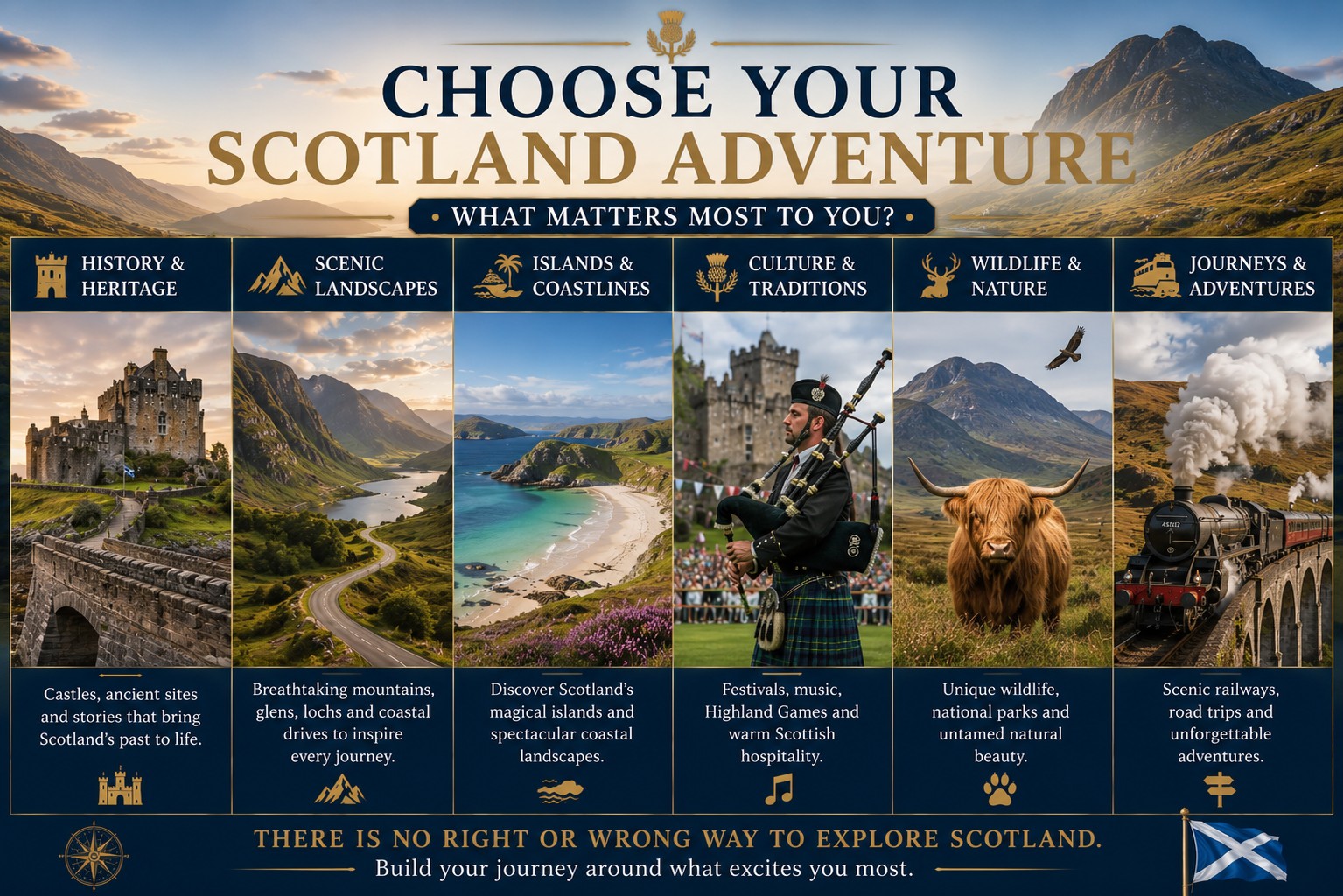
Every Scottish holiday is unique. Whether you’re inspired by castles, mountains, islands, wildlife, culture or scenic journeys, Scotland offers an unforgettable adventure tailored to your interests
⏳ How Long Should You Spend in Scotland?
Scotland rewards realistic pacing. The right trip length depends not only on how many places you want to visit, but also on whether your plans include remote Highland roads, island ferries, walking, events or time to explore each destination beyond its most famous viewpoint.
🏙️ 2–3 Days
Focus on Edinburgh or Glasgow and add one carefully selected day excursion. This is enough for a strong introduction, but not for a full Highland or island circuit.
🏔️ 4–5 Days
Combine one city with part of the Highlands, or build a focused route through Glen Coe, Loch Ness and the Isle of Skye without trying to include every region.
🗺️ 7 Days
Enjoy one city, a meaningful Highland journey and one major region or island at a comfortable pace, with enough flexibility for scenic stops and changing weather.
🏝️ 10–14 Days
Explore several regions, include a carefully selected island journey and spend longer in fewer bases. This creates space for slower travel, local discoveries and itinerary changes.
⭐ Best Experience by Trip Length
2–3 days: city break and one day tour
4–5 days: city and focused Highland route
7 days: city, Highlands and one island or major region
10–14 days: multi-region journey with slower exploration
More days should create more depth, not simply more destinations. Scotland is usually most rewarding when additional time is used to slow the itinerary rather than lengthen the daily driving.
💷 Budget, Luxury and Sustainable Scotland
One of Scotland’s greatest strengths is its ability to reward almost every style of traveller.
Whether you are planning an affordable long weekend, a carefully curated luxury holiday or a slower, environmentally conscious journey, Scotland offers experiences that can be adapted to different budgets without losing the sense of discovery that makes travelling here so rewarding.
Whether your ideal journey focuses on value, comfort or sustainability, thoughtful planning allows you to experience far more of what makes Scotland special.
💷 Scotland on a Budget
Exploring Scotland does not have to involve an unlimited budget.
Many of the country’s greatest attractions are its landscapes, coastlines, forests and historic towns, all of which can be enjoyed without expensive admission fees. Choosing one or two regions rather than attempting to cross the entire country also reduces transport costs while creating a far more relaxed holiday.
Travelling during spring or autumn may provide better value outside major festivals and peak holiday periods, while staying several nights in one location instead of changing accommodation every day often reduces both travel costs and unnecessary driving.
Combining free natural attractions with a small number of carefully selected paid experiences frequently delivers the best balance between value and memorable travel.
✨ Luxury Scotland Travel
Luxury travel is less about seeing more places and more about experiencing Scotland more deeply.
Many premium itineraries focus on outstanding accommodation, exceptional local food, private guiding and spending additional time in carefully chosen regions rather than constantly moving between destinations.
A luxury Highland journey may include a boutique country house overlooking a loch, a private wildlife excursion, an exclusive whisky tasting or a guided walk with a local historian. These experiences create a richer understanding of Scotland while maintaining a relaxed pace throughout the journey.
🌱 Sustainable Scotland Travel
Travelling responsibly benefits both visitors and the communities that welcome them.
Choosing longer stays in fewer locations reduces unnecessary transport while allowing more meaningful engagement with local businesses. Supporting independent accommodation, cafés, visitor attractions and guides helps ensure that tourism contributes directly to local economies.
Where practical, combining rail travel with organised tours, respecting walking routes, using designated parking areas and leaving natural environments exactly as they were found all contribute to more sustainable travel.
Scotland’s mountains, peatlands, coastlines and wildlife are among its greatest treasures.
Protecting them is part of enjoying them.
📊 Choosing Your Travel Style
🌱 Choosing Your Scotland Travel Style
There is no single right way to explore Scotland. The best journey depends on what matters most to you—whether that’s maximising value, enjoying greater comfort or travelling in a way that supports local communities and protects Scotland’s remarkable landscapes.
| Travel Style | Best Approach | Main Advantages | Ideal For |
|---|---|---|---|
| 💷 Budget | Base yourself in fewer locations, travel more slowly and focus on experiences that offer the greatest value. | Excellent value, relaxed pacing, lower transport costs and more time to explore each destination. | First-time visitors, families and travellers seeking the best overall value. |
| ✨ Luxury | Choose premium accommodation, personalised experiences and slower itineraries with greater flexibility. | Outstanding comfort, personal service, flexible schedules and deeper regional experiences. | Couples, special occasions and visitors wanting a more relaxed journey. |
| 🌿 Sustainable | Stay longer in regional areas, support local businesses and reduce unnecessary travel between destinations. | Lower environmental impact, stronger local connections and richer, more authentic travel experiences. | Travellers who value local communities, nature and slower, more meaningful exploration. |
On smaller screens, swipe sideways to compare each travel style.
🧭 Quick Travel Style Guide
- 💷 Budget — maximise experiences while keeping costs under control.
- ✨ Luxury — prioritise comfort, flexibility and memorable experiences.
- 🌿 Sustainable — travel more slowly, support local communities and reduce your environmental impact.
The most rewarding Scotland journeys often combine all three approaches—travelling thoughtfully, spending where it adds genuine value and allowing enough time to experience each destination properly.
🌱 Choose Your Scotland Travel Style
Budget, luxury and sustainable travel are not simply price categories. Each represents a different set of priorities. Begin by deciding what you most want from the journey, then shape the itinerary around that goal.
💷 Choose Budget Travel for Better Value
Focus on longer stays in fewer locations, free landscapes, carefully selected paid experiences and travel outside the busiest periods where possible.
Best goal: make every pound contribute to meaningful time in Scotland rather than unnecessary transfers.
✨ Choose Luxury Travel for Time and Flexibility
Prioritise exceptional accommodation, private guidance, memorable local experiences and slower itineraries that can adapt to weather and personal interests.
Best goal: experience fewer places more deeply, comfortably and personally.
🌿 Choose Sustainable Travel for Deeper Local Connections
Reduce unnecessary transfers, use rail or shared transport where practical, stay longer in regional bases and support locally owned accommodation, cafés, guides and attractions.
Best goal: create a rewarding journey that supports communities and protects the landscapes being explored.
🧭 Quick Decision Guide
| Your priority is stretching the budget | Choose Budget |
| Your priority is comfort and personalisation | Choose Luxury |
| Your priority is slower, lower-impact travel | Choose Sustainable |
These styles can overlap. A slower itinerary with fewer hotel changes may be more affordable, more luxurious and more sustainable at the same time.
🌱 Travel Through Scotland Responsibly
Scotland’s remarkable landscapes deserve thoughtful care from everyone who visits.
Simple choices make a significant difference. Stay on established paths to protect fragile habitats, respect working farmland and livestock, dispose of litter responsibly and avoid disturbing wildlife. In the Highlands, use passing places correctly and never block narrow roads relied upon by local communities and emergency services.
Island travel also benefits from careful planning. Booking ferries and accommodation in advance, supporting locally owned businesses and allowing enough time to experience each destination rather than simply passing through all contribute to more sustainable tourism.
Responsible travel is not about seeing less.
It is about leaving Scotland exactly as future visitors hope to discover it.
Travel with purpose. Explore with care.
🌱 Travel Through Scotland Responsibly
Scotland’s mountains, islands, coastlines, historic places and rural communities are central to what makes the country so rewarding to explore. A few thoughtful choices can help protect those landscapes while ensuring tourism supports the people who live and work within them.
🌿 Responsible Scotland Travel in Practice
- Stay longer in fewer places to reduce unnecessary transfers and experience each region more deeply.
- Support local communities through independently owned accommodation, cafés, guides, shops and visitor attractions.
- Protect natural landscapes by remaining on established paths, using designated parking and leaving no litter.
- Respect wildlife by keeping a suitable distance and avoiding disturbance to habitats, nesting areas and marine life.
- Travel considerately on single-track roads by using passing places correctly and never blocking access needed by residents or emergency services.
- Use rail, shared transport or organised tours where they provide a practical alternative to unnecessary driving.
- Plan island journeys carefully by booking ferries and accommodation early and allowing enough time to contribute meaningfully to local economies.
Responsible travel is not about reducing the quality of your journey. Slower routes, longer stays and stronger local connections often create the most memorable Scotland experiences.
Travel with purpose. Explore with care.
🎒 Practical Scotland Planning Tips
Careful planning allows you to spend less time solving problems and more time enjoying Scotland itself.
Although the country is relatively compact, distances often feel longer because roads follow mountains, lochs and coastlines rather than straight lines. A journey that appears short on a map can become a leisurely half-day of scenic stops, photography and unexpected discoveries.
Building flexibility into your itinerary almost always leads to a more enjoyable holiday.
🎒 Pack for Four Seasons
Scotland’s weather is famously changeable, and experiencing sunshine, wind and showers within the same day is perfectly normal.
Comfortable waterproof footwear, layered clothing and a lightweight waterproof jacket are useful throughout the year. Even during summer, evenings can become cool in the Highlands and on the islands, while mountain conditions are often very different from those in nearby towns.
⛴️ Plan Ahead for Remote Areas
If your itinerary includes island ferries, remote Highland accommodation or popular scenic routes, advance planning is highly recommended.
Accommodation on Skye, Orkney and the Outer Hebrides can become limited during busy periods, while ferry capacity may also be reduced by seasonal demand or changing weather conditions. Booking key elements of your journey well in advance provides far greater flexibility later.
When travelling through rural Scotland, fuel stations, cafés and food shops may be widely spaced, so it is sensible to avoid leaving essential stops until the last moment.
👨👩👧👦 Families and Accessible Travel
Families usually enjoy Scotland most when driving distances remain realistic and there is enough time to explore each destination rather than constantly moving between accommodation.
Travellers with accessibility requirements should remember that access varies considerably between historic castles, ancient monuments, island ferries, mountain viewpoints and remote landscapes. Checking individual attraction information before travelling helps avoid disappointment and allows realistic route planning.
📱 Stay Flexible
Downloading offline maps before entering remote regions is worthwhile, as mobile coverage can become limited in parts of the Highlands and islands.
Most importantly, allow room for the unexpected.
Some of Scotland’s finest memories come from places that were never included on the original itinerary—a quiet beach discovered after a ferry crossing, a mountain view revealed as cloud suddenly clears or a welcoming village café found during an unplanned stop.
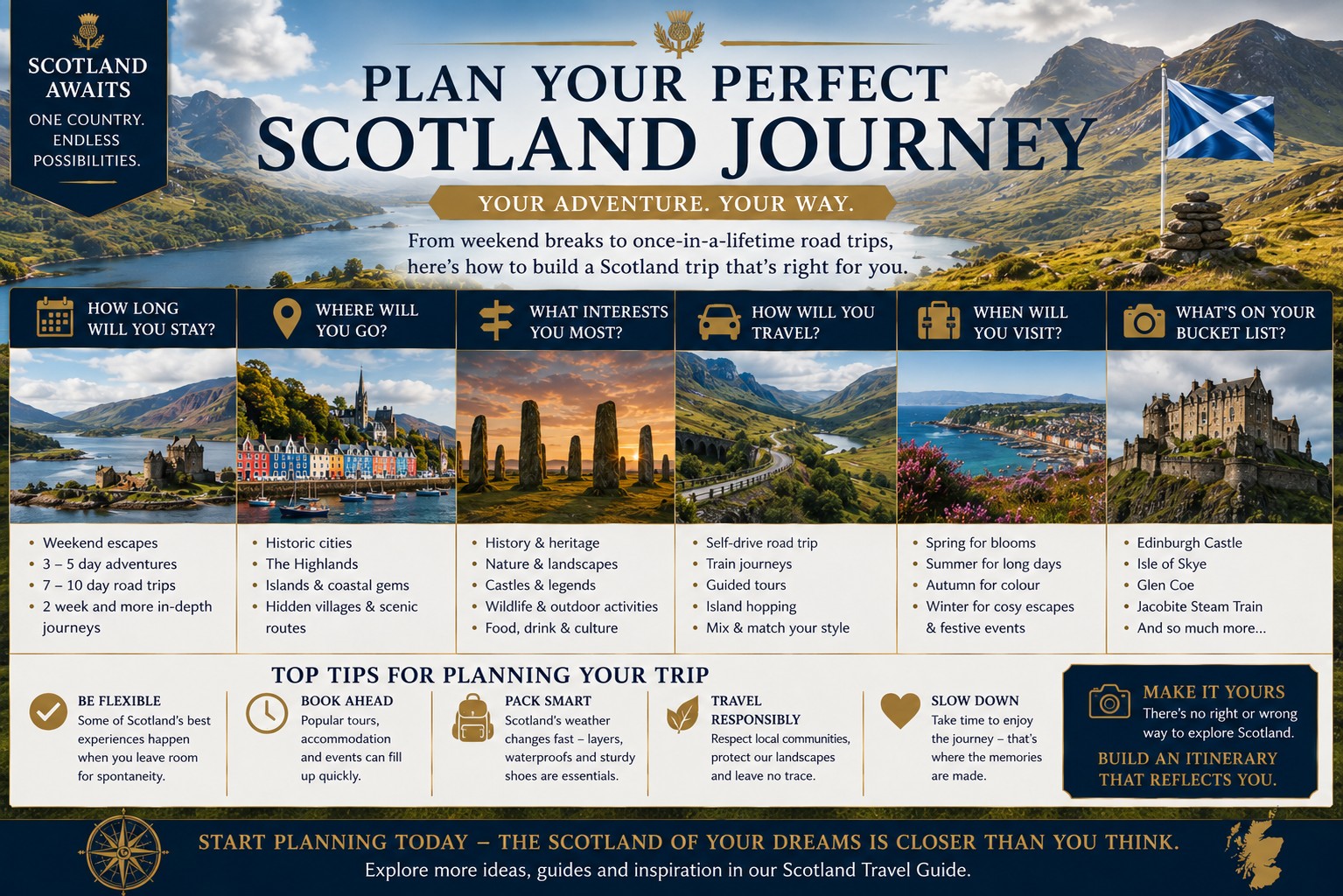
Whether you’re planning a weekend escape or an unforgettable Highland adventure, Scotland offers countless ways to build a journey around your interests, travel style and the time you have available
🎒 Practical Scotland Planning Checklist
Scotland rewards visitors who prepare for changing conditions without removing every element of spontaneity. Use this checklist to secure the essential parts of your journey while preserving enough flexibility for weather, scenic stops and unexpected discoveries.
| ✅ | Pack versatile layers Bring clothing that can be added or removed as temperatures change between cities, coastlines, glens and exposed viewpoints. |
| ✅ | Carry reliable waterproofs A lightweight waterproof jacket remains useful throughout the year, even when the day begins with a favourable forecast. |
| ✅ | Book essential ferries early Reserve important island crossings in advance, particularly when travelling with a vehicle during summer or around major holidays. |
| ✅ | Secure key accommodation Book early for Skye, Orkney, the Outer Hebrides and remote Highland regions where supply may be limited. |
| ✅ | Download offline maps Save routes, accommodation details and important addresses before entering areas where mobile coverage may become unreliable. |
| ✅ | Keep the itinerary flexible Leave space for weather changes, slower roads, ferry disruption, photography and places discovered unexpectedly along the route. |
| ✅ | Plan fuel and food stops Avoid waiting until the last moment in remote Highland and island areas, where filling stations, cafés and shops may be widely spaced. |
| ✅ | Wear suitable walking footwear Choose comfortable, supportive and preferably waterproof footwear for uneven paths, wet ground, historic sites and scenic viewpoints. |
Book the elements that could disrupt the journey if missed, prepare for changing conditions and leave the rest of the itinerary flexible enough for Scotland to surprise you.
❓ Frequently Asked Questions
❓ What is the best place to visit in Scotland for a first trip?
Edinburgh is usually the ideal starting point thanks to its remarkable history, excellent transport links and easy access to the Highlands. Combining the capital with one carefully planned Highland journey provides an excellent first introduction to Scotland.
❓ How many days should I spend in Scotland?
Four to seven days allows most first-time visitors to experience one city together with a meaningful Highland itinerary. Ten to fourteen days provides far greater flexibility for exploring several regions at a comfortable pace.
❓ Can I explore Scotland without hiring a car?
Yes. Scotland’s rail network connects many major cities, while organised day tours and multi-day tours provide convenient access to Highland destinations that are less practical to reach independently.
🚌 Explore Scotland Tours
Choose the touring style that best matches your available time. Scotland day tours offer a convenient introduction from a city base, while multi-day journeys provide more time to explore the Highlands, islands, lochs and historic landscapes at a comfortable pace.
🚍 Scotland Day Tours
Ideal for visitors staying in Edinburgh, Glasgow or another major base who want to experience Highland scenery, historic destinations or famous landscapes without changing accommodation.
🏔️ Scotland Multi-Day Tours
Best for travellers who want to journey deeper into Scotland, spend longer among Highland landscapes and explore islands, castles, lochs and smaller communities without managing every part of the route themselves.
Choose a day tour for one memorable Scotland experience from a fixed base, or a multi-day journey when you want the route itself to become part of the adventure.
❓ Should I choose the Highlands or the islands?
If this is your first visit, the Highlands usually provide the easiest introduction to Scotland’s scenery and are simpler to include within a shorter itinerary. The islands offer equally rewarding experiences but generally benefit from additional time and more detailed planning.
❓ Which Scottish island is easiest for a first visit?
The Isle of Skye is often the most accessible first island because it can be reached by bridge and combines naturally with Glen Coe, Fort William and Loch Ness. Travellers seeking archaeology, quieter landscapes or distinctive island culture may prefer Orkney or the Outer Hebrides.
❓ Do I need to book island ferries in advance?
Yes, particularly during late spring, summer and around major holidays. Advance reservations are strongly recommended for both vehicles and passengers where appropriate, especially if your itinerary depends on specific sailing times.
❓ Should I choose a day tour or a multi-day tour?
Day tours are ideal if you are staying in Edinburgh or Glasgow and want an introduction to the Highlands without changing accommodation. Multi-day tours allow considerably more time to experience Highland landscapes, islands and smaller communities at a more comfortable pace.
❓ Is Scotland suitable for family holidays?
Absolutely. Scotland offers historic cities, castles, wildlife, beaches, scenic railways, outdoor activities and family-friendly attractions throughout the country. Planning realistic driving distances and allowing time for unplanned stops generally creates the most enjoyable family experience.
❓ How can I travel more sustainably in Scotland?
Stay longer in fewer places, support local businesses, respect wildlife and historic sites, remain on established paths and use public transport or organised tours where practical. Responsible travel helps protect Scotland’s remarkable landscapes while supporting the communities that make them special.
🧭 Begin Your Scotland Journey
Scotland offers far more than a collection of famous landmarks.
It is a country where historic cities, mountain landscapes, remote islands, ancient monuments, vibrant festivals and centuries of tradition combine to create journeys that feel deeply personal. No two visitors experience Scotland in exactly the same way because every itinerary reflects different interests, different seasons and different ambitions.
Some travellers will begin among Edinburgh’s medieval streets before continuing into the Highlands. Others will head directly towards Skye, Orkney or the Outer Hebrides. Many will discover that Scotland’s greatest memories come not from ticking famous attractions off a list, but from slowing down long enough to appreciate the landscapes and communities that lie between them.
The completed Merlin mini-cluster introduced Scotland through mythology and legendary places. This guide marks the beginning of the wider BVT Scotland Cluster, opening the door to every corner of the country while helping you decide where your own Scottish journey should begin.
Whether your ideal holiday centres on castles, mountains, islands, archaeology, festivals, whisky, wildlife, scenic touring or sustainable travel, Scotland offers experiences that remain with you long after you return home.
Choose the Scotland that matters most to you.
Give it the time it deserves.
Then allow the journey itself to become part of the adventure.
🧭 Continue Exploring Island Scotland
Your island journey can continue in several directions.
Once you have decided which island experience appeals most, use these guides to answer the next questions: where else should you explore, how much time should you allow, how do the Highlands connect with the islands, and when should you travel?
🏔️ Plan the Highlands Before Heading to the Islands
Explore the mountains, lochs, castles and scenic mainland routes that form the natural gateway to many Scottish island journeys.
⏳ Give the Highlands and Islands More Time
See how a multi-day journey creates room for overnight stays, coherent routes and deeper exploration of Scotland’s Highlands and islands.
🚆 Decide How to Travel Through Scotland
Compare rail, escorted touring, small-group journeys and self-drive travel when planning how your island adventure fits into a wider Scotland holiday.
🏴 Discover Where Else to Explore
Step back to the complete Scotland journey and compare the Highlands, islands, cities and legendary landscapes before choosing what belongs in your itinerary.
📅 Choose When to Make Your Island Journey
Discover festivals, Highland Games, seasonal events and travel inspiration that could influence both the character and timing of your Scotland journey.
🧭 Build the Journey in the Right Order
Choose your island → understand the mainland connection → allow enough time → choose how to travel → select the right dates.
🏝️ BVT Island Planning Principle: The strongest island itinerary is rarely the one containing the most islands. Build outward from the experience you want, follow Scotland’s geography and give each part of the journey enough time to be enjoyed properly.