


Isle of Skye Travel Guide: Mountains, Fairy Pools, Castles and Coastal Landscapes
31st August 2026
🏔️ Isle of Skye Travel Guide: Mountains, Fairy Pools, Castles and Coastal Landscapes
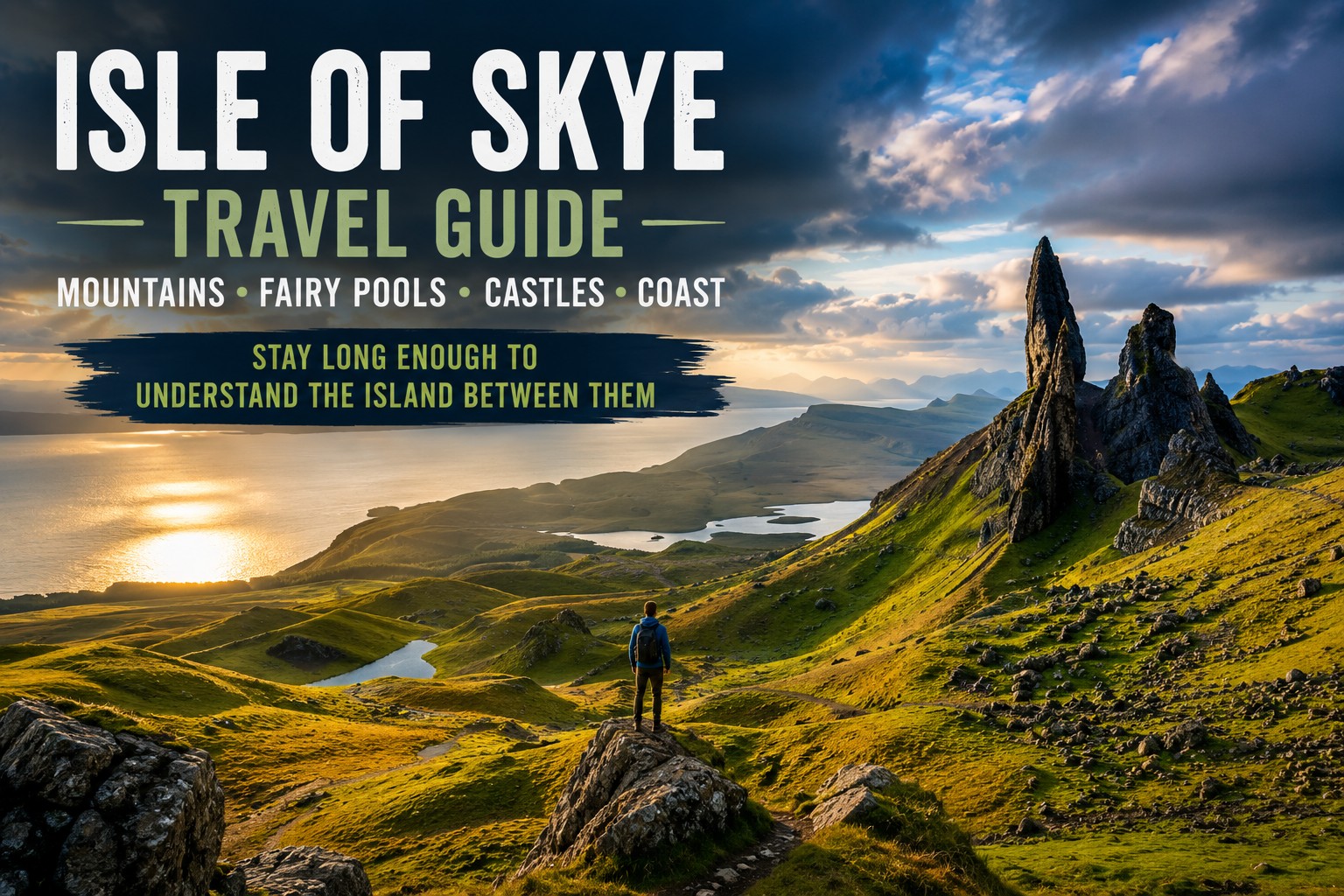
Discover the Isle of Skye beyond its famous viewpoints, from the dramatic landscapes of Trotternish and the Cuillin to waterfalls, castles and Atlantic coastline
Few places in Scotland concentrate so much drama into one island as the Isle of Skye. Jagged mountains rise above dark glens, waterfalls descend through rocky landscapes, castles overlook sea lochs, and coastal roads reveal cliffs, headlands and changing views towards the Atlantic. Add colourful Portree, centuries of clan history and landscapes woven through Gaelic culture and folklore, and it is easy to understand why Skye has become one of Scotland’s most celebrated destinations.
Yet Skye can also be misunderstood by first-time visitors. On a map, many famous locations appear surprisingly close together. In reality, narrow roads, changing weather, walking time and the temptation to stop whenever another remarkable view appears can turn a modest distance into a substantial part of the day.
That is why the best Skye itinerary is rarely the one containing the greatest number of attractions.
This Isle of Skye travel guide will help you understand how the island fits together, which landscapes deserve priority, how many days to allow, where to base yourself and whether driving, touring or using public transport best suits your journey. We will explore the Cuillin mountains, Fairy Pools, Old Man of Storr, Quiraing, Dunvegan Castle, Portree and Skye’s remarkable coastline, while also looking beyond the famous photographs to the communities, history and practical realities behind the scenery.
Come for Skye’s famous landscapes. Stay long enough to understand the island between them.
🗺️ Where Is the Isle of Skye and What Makes It Special?
The Isle of Skye lies off Scotland’s west coast and forms part of the Inner Hebrides. It is connected to the mainland by the Skye Bridge, while ferry services provide alternative approaches to the island. Portree, on Skye’s east coast, is its principal settlement and a natural orientation point for many first-time visitors.
What makes Skye particularly compelling is not one attraction but the concentration of remarkably different landscapes. The rugged Cuillin dominate the island’s mountain identity. Trotternish in the north-east contains some of Scotland’s most recognisable geological scenery. The west brings castles, exposed headlands and Atlantic horizons, while the greener Sleat Peninsula creates a gentler southern contrast.
There is no single central sightseeing zone from which everything radiates conveniently. Skye is an island of peninsulas, mountain barriers, coastal roads and distinct geographical areas. Understanding those differences before deciding what to see is one of the keys to planning the island well.
🧭 Understanding Skye by Area
| Area Landscape Character Signature Experiences | ||
|---|---|---|
| Trotternish | Dramatic geological landscapes | Old Man of Storr, Quiraing, Kilt Rock |
| Central Skye | Island hub and mountain approaches | Portree, Sligachan, Cuillin views |
| Minginish and Glenbrittle | Mountains, waterfalls and open glens | Fairy Pools, Cuillin scenery |
| West Skye | Clan history and Atlantic landscapes | Dunvegan Castle, Neist Point |
| Sleat and South Skye | Greener landscapes and island history | Armadale, coastal scenery |
| South-west Skye | Remote coastal perspectives | Elgol and views towards the Cuillin |
⛰️ The Cuillin: Mountains That Define the Isle of Skye
The Cuillin are more than a spectacular backdrop to a Skye journey. They give the island much of its physical character, rising above glens, roads and sea lochs and changing dramatically with the weather. On clear days, their ridges can stand sharply against the sky; hours later, cloud may sweep across the summits until only fragments of mountain remain visible.
For first-time visitors, the important point is that you do not need to be a mountaineer to experience them. Some of Skye’s most memorable Cuillin views are found from lower-level locations around Sligachan, Glenbrittle and Elgol. Entering the higher mountains is an entirely different proposition and should be approached according to experience, equipment, route conditions and current mountain weather.
🖤 The Black Cuillin
The Black Cuillin form Skye’s famously rugged mountain heart. Their dark, serrated ridges contain many of the island’s highest and most serious mountains, creating scenery that feels markedly different from the softer Highland landscapes visitors may encounter elsewhere in Scotland.
For experienced hillwalkers, scramblers and mountaineers, the range contains demanding objectives. For most visitors, however, its greatest value is visual. Watching the Black Cuillin emerge beyond a glen, seeing their ridges reflected in changing water or looking back towards them across the sea can be every bit as memorable as standing high on the mountains themselves.
🔴 The Red Cuillin
The Red Cuillin provide a striking contrast. Their different geology has produced generally rounder, softer-looking forms than the jagged Black Cuillin, although they remain substantial mountains and should not be mistaken for universally easy walking country.
That contrast helps explain why Skye can change character so quickly. This is not one uniform mountain landscape: different geology, elevation, weather and perspective create remarkably varied experiences within the same island.
Visitors can enjoy extraordinary mountain scenery without entering serious high-level terrain. If you intend to undertake demanding routes, treat them as mountain days in their own right. Check current mountain weather and route conditions, carry appropriate equipment and choose objectives that match your experience. Professional guidance can be valuable where a route exceeds your skills or confidence.
💧 Fairy Pools: Famous, Beautiful and Frequently Misunderstood
At the foot of the Black Cuillin near Glenbrittle, the Fairy Pools have become one of the best-known places on the Isle of Skye. A succession of pools, cascades and waterfalls along the River Brittle creates an impressive foreground to the surrounding mountain landscape.
Their fame can also create unrealistic expectations. Carefully framed photographs sometimes suggest isolated pools reached almost effortlessly from the road. A real visit involves walking through exposed Highland terrain, and conditions may be wet, windy or muddy. During popular periods, you are also unlikely to have the landscape entirely to yourself.
None of that makes the Fairy Pools less worthwhile. It simply changes how they are best understood.
The experience is not only about reaching a particular pool. It is the combination of the walk, moving water, open glen and the Cuillin rising beyond that gives the landscape its character. Treating the Fairy Pools as a single photograph to collect misses much of what makes them memorable.
Build walking and stopping time into the day rather than treating the pools as a quick roadside attraction.
Wear footwear appropriate for outdoor terrain that may become wet, muddy or slippery.
Conditions beneath the Cuillin can change, so dress for the landscape rather than the photograph you hope to take.
Low cloud, rain and wind can substantially change both the walk and the surrounding mountain views.
The Fairy Pools are one of Skye’s best-known attractions, particularly during popular travel periods.
Use appropriate parking and follow current local access guidance. Never obstruct roads, access points or surrounding land.
If mountain weather deteriorates or the visit takes longer than expected, adjust the itinerary instead of racing towards the next stop.
🧚 Fairy Pools, Folklore and Legendary Skye
The name naturally contributes to Skye’s reputation as an island of fairies, legends and supernatural stories. Skye has a rich tradition of Gaelic folklore, but folklore, documented history and later storytelling should never be treated as interchangeable.
Visitors fascinated by this other dimension of the island can explore Skye’s legendary landscapes in greater depth separately. Here, the important point is simpler: dramatic landscapes have inspired stories for generations, and the Fairy Pools sit naturally within an island where scenery, tradition and imagination have long existed side by side.
🗿 Trotternish: Old Man of Storr, Quiraing and Northern Skye
If the Cuillin provide Skye’s mountain heart, the Trotternish Peninsula gives the island some of its most immediately recognisable scenery. Stretching north from Portree, this extraordinary landscape has been shaped by immense geological processes, leaving behind cliffs, pinnacles, ridges and landslips that can appear almost sculpted.
For travellers, Trotternish also demonstrates why Skye is best explored geographically. The Old Man of Storr, Quiraing, Kilt Rock and Mealt Falls are not isolated attractions that merely happen to share an island. They belong to the same remarkable northern landscape, and experiencing them as part of one coherent journey creates a far better understanding of Skye.
🪨 Old Man of Storr
Rising above Skye’s east coast, the Old Man of Storr is an enormous rock pinnacle within the wider Storr landslip. Its distinctive profile is visible from considerable distance and has become one of the defining images of the island.
There is an important difference between seeing the Storr from the surrounding landscape and walking towards its famous rock formations. The latter requires time, suitable footwear and a realistic assessment of weather and ability. As height is gained, increasingly expansive views can open towards the Sound of Raasay while the pinnacles themselves become more imposing.
Weather can transform the experience completely. Clear conditions may reveal enormous perspectives; low cloud and mist can conceal them remarkably quickly. Building flexibility into the day is therefore more useful than forcing a tightly timed itinerary regardless of conditions.
🌄 The Quiraing
Farther north, the Quiraing forms another spectacular part of the Trotternish landslip. Cliffs, plateaux, pinnacles and folds create a landscape unlike the smoother mountain and glen scenery many visitors encounter elsewhere in Scotland.
You do not necessarily need to complete a substantial walk to appreciate its scale. Accessible viewpoints can reveal the extraordinary shape of the landscape, while walking allows suitably prepared visitors to experience the terrain much more intimately.
Again, the distinction matters: seeing a landscape and walking through it are two different experiences, and both can be worthwhile.
🌊 Kilt Rock and Mealt Falls
Kilt Rock and Mealt Falls provide a natural coastal chapter within a Trotternish journey. Here, dramatic cliffs meet the sea while the waterfall drops from the coastal edge, bringing together rock, water and the exposed eastern shoreline of Skye.
The stop itself does not need to dominate the day. Much of its value comes from its position within the wider route north, where scenery continually shifts between cliffs, open land, sea views and extraordinary geological formations.
🏰 Skye’s Castles, Clans and Island History
Skye’s dramatic geology can make it tempting to think of the island primarily as wilderness. Yet these landscapes have been lived in, worked and contested for generations. Clan history, Gaelic culture, crofting communities and settlement are fundamental parts of Skye’s identity.
Including some of that human story creates a richer visit and provides a valuable change of pace between the island’s major natural landscapes.
🏰 Dunvegan Castle and Clan MacLeod
On Skye’s west coast, Dunvegan Castle is the ancestral home of the Chiefs of Clan MacLeod and is recognised as Scotland’s oldest continuously inhabited castle. Its setting beside Loch Dunvegan also means history and landscape remain closely connected rather than existing as separate visitor experiences.
A visit adds valuable context to a journey otherwise dominated by mountains and viewpoints. It introduces generations of human history and helps explain why Skye’s cultural identity is every bit as significant as its scenery.
🛡️ Armadale, Clan Donald and the Museum of the Isles
In southern Skye, Armadale offers another perspective on the island’s past through its connections with Clan Donald. The historic castle is now largely ruinous, while the wider visitor experience includes gardens and the Museum of the Isles, which explores the history of Clan Donald and the Highlands and Islands.
The greener landscapes of the Sleat Peninsula also provide a marked visual contrast with the rugged north and the Cuillin.
Together, places such as Dunvegan and Armadale reinforce an important principle for exploring Skye:
This is not an empty landscape created for visitors. It is a living island whose scenery, communities, culture and history belong to the same story.
🎨 Portree: More Than the Colourful Harbour
Portree is Skye’s principal settlement and, for many visitors, the practical centre of the island. Its harbour, backed by colourful waterfront buildings and surrounding hills, provides one of Skye’s most familiar townscapes, but Portree is considerably more useful to travellers than its photographs alone suggest.
The town offers accommodation, places to eat, shops and essential services, while its location makes it particularly convenient for exploring Trotternish to the north. For visitors spending several days on Skye, it can therefore work well as a single base from which different parts of the island can be reached.
Portree is also part of a living island culture in which Gaelic language, traditions and community remain important. Spending some time around the harbour and town rather than simply stopping for the familiar photograph helps reveal another side of Skye beyond its natural landmarks.
That convenience does not automatically make Portree the best base for everyone. A traveller concentrating on Dunvegan and western Skye may prefer to stay farther west, while somebody exploring Sleat or arriving through southern Skye may find a base there more practical.
Choose Portree because its character and location suit your journey—not simply because it is Skye’s best-known settlement.
🌊 Neist Point, Elgol and Skye’s Coastal Landscapes
Mountains dominate many images of Skye, but the island’s relationship with the sea is just as important. Long peninsulas reach into Atlantic waters, cliffs form abrupt edges to the land, and some of the finest mountain views are actually experienced from the coast.
Neist Point, on the western edge of Skye, captures that sense of exposure particularly well. Its cliffs and lighthouse landscape face towards the open sea, creating an experience quite different from the enclosed glens beneath the Cuillin. The journey there also reinforces a recurring Skye lesson: apparently modest distances can require patience on smaller roads.
Elgol, in southern Skye, provides a different kind of coastal experience. One of its great attractions is the perspective across the water towards the Cuillin. Mountains that feel immense and immediate elsewhere on the island become part of a wider composition of sea, islands and sky.
Other coastal landscapes, including Talisker Bay and stretches of northern Skye, can provide quieter contrasts to the headline viewpoints. They do not all need to be added to one itinerary. Their value lies partly in giving travellers alternatives according to location, weather and available time.
Sometimes Skye’s greatest experience is not the landmark you reach, but the landscape revealed from it.
⏳ How Many Days Do You Really Need on the Isle of Skye?
There is no single correct length of stay, but duration has an unusually large effect on the quality of a Skye visit. Trying to compress the island into too little time often means spending much of the day travelling between famous names rather than experiencing the places themselves.
🚗 One Day: A Glimpse of Skye
One day can provide a memorable introduction, particularly when Skye forms part of a wider Highlands journey. The key is selectivity. Choose one geographical area or a carefully planned group of compatible highlights rather than attempting to cross the island repeatedly.
🌄 Two Days: A Strong Introduction
Two days allow a more balanced approach. One day might concentrate on Trotternish, while another explores the Fairy Pools, Cuillin landscapes or western Skye. There is still a need to prioritise, but the itinerary begins to feel like an island visit rather than a sightseeing sprint.
🏔️ Three Days: The Sweet Spot for Many First-Time Visitors
For many travellers, around three days provides an excellent first experience. It creates enough time for contrasting landscapes, some history and coastal scenery while allowing meaningful stops rather than constant movement.
Three days also introduce something particularly valuable on Skye: resilience. If cloud obscures a mountain landscape or poor weather disrupts one plan, there is a greater chance to adjust the itinerary rather than losing a major experience entirely.
🌦️ Four Days or More: Discover Slower Skye
With four days or longer, the character of the journey changes again. There is greater freedom for walking, photography, quieter locations, longer historical visits and changing plans around the weather. You can also spend more time within individual areas instead of continually moving on to the next famous place.

Explore the Isle of Skye geographically rather than as a checklist, from Trotternish and the Cuillin to West Skye, Portree and the island’s southern coast
| Time on Skye What It Realistically Offers Best Suited To | ||
|---|---|---|
| 1 day | Carefully selected highlights | Tight Highlands itineraries |
| 2 days | Strong introduction to contrasting areas | Short Skye stays |
| 3 days | Balanced first-time experience with greater flexibility | Many first-time visitors |
| 4+ days | Slower exploration and deeper engagement | Walkers, photographers and unhurried journeys |
Measure it by how much time you will actually have to experience them.
STRONG CHOICE FOR MANY FIRST-TIME VISITORS
•
2 Days = Strong Introduction
•
3 Days = Balanced First Visit
•
4+ Days = Slower Exploration
🚘 Getting Around Skye: Car, Tour or Public Transport?
How you travel around Skye can shape the experience almost as much as the places you choose to visit. Attractions are dispersed across several peninsulas, some roads are narrow or single-track, and walking time at places such as the Old Man of Storr and Fairy Pools needs to be considered alongside the journey between them.
The right transport choice therefore depends on more than whether you can reach Skye. It depends on how independently you want to explore, how comfortable you are driving on Highland roads and how much flexibility you want once you are on the island.
🚗 Driving Around the Isle of Skye
A car provides the greatest flexibility. You can adjust plans around weather, spend longer at a viewpoint than expected and reach areas that are difficult to combine efficiently using public transport.
However, Skye should not be approached like a conventional high-speed road trip. Many routes use single-track roads with passing places. Drivers unfamiliar with them should allow faster traffic to pass safely, use passing places correctly and never treat them as convenient parking spaces. Popular attractions can also experience considerable parking pressure, making designated parking and considerate driving particularly important.
Most importantly, do not construct an itinerary solely from map mileage. A route that appears short can take considerably longer once slower roads, traffic, photographs, walks, weather and spontaneous stops are included.
On Skye, mileage is a poor predictor of how long your day will take.
🚐 Exploring Skye on an Organised Tour
An organised tour can be particularly attractive for visitors who would rather concentrate on the scenery than drive unfamiliar Highland roads. It also removes much of the route planning and can make Skye easier to incorporate into a wider multi-day journey through the Scottish Highlands.
The trade-off is flexibility. A structured itinerary determines how much time is available at individual locations, so travellers wanting extended walks, long photography sessions or highly independent exploration may prefer to drive themselves.
For many first-time visitors, however, touring can provide a practical balance between experiencing significant landscapes and avoiding the demands of driving.
🚌 Can You Visit Skye Without a Car?
Yes, but it requires considerably more planning. There is no railway on the Isle of Skye, so rail travellers must connect through mainland gateways and complete the journey by bus, coach, car or ferry. Ferry services, including the mainland connection between Mallaig and Armadale, can also form part of a car-free journey.
Once on Skye, buses connect settlements and some visitor areas, but the network does not function as a hop-on sightseeing circuit between every famous landscape. Timetables, seasonal services and ferry arrangements can change, so always check current transport information before travelling rather than relying on an old itinerary.
A car-free visit can work particularly well when travellers choose accommodation strategically, concentrate on fewer areas and accept a slower pace.
🌦️ When Is the Best Time to Visit the Isle of Skye?
There is no universally perfect month for Skye. The island changes substantially with the seasons, and the best time depends on whether your priority is long daylight, quieter roads, walking, photography or greater freedom to explore.
Spring brings increasing daylight and landscapes returning to colour, while visitor numbers can be lower than at the height of summer. Summer provides the longest days and the greatest amount of usable exploring time, but it is also when famous locations, roads and accommodation can experience the greatest pressure.
Autumn can bring rich colours, lower-angle light and an atmospheric character, although daylight becomes progressively shorter. Winter reveals a quieter and often dramatic Skye, but limited daylight, more challenging weather and potentially reduced visitor services place greater constraints on an itinerary.
Daylight can matter just as much as temperature. A winter day simply provides fewer usable hours for driving, walking and sightseeing than a long summer day, so seasonal itineraries should not be planned identically.
Whatever the time of year, prepare for change. Sunshine, rain, wind and low cloud can alter a day’s plans, particularly around mountain landscapes.
Midges are another practical consideration during the warmer months, especially in mild, damp and relatively still conditions. Their presence varies considerably with weather and location, but carrying repellent and suitable clothing can make outdoor stops much more comfortable.
🛏️ Where Should You Stay on the Isle of Skye?
Choosing where to stay on Skye is less about finding one universally “best” location and more about matching your base to the journey you intend to make. Because the island is larger and slower to travel around than many first-time visitors expect, accommodation location can have a significant effect on how much of each day is spent exploring rather than repeatedly driving the same roads.
Portree is the obvious choice for many visitors. It has a strong concentration of accommodation, places to eat and useful services, and its location is particularly practical for exploring Trotternish. For a first visit covering several parts of Skye, that convenience can outweigh the attraction of staying somewhere more remote.
Travellers concentrating on Dunvegan, Neist Point and western Skye may prefer a western base, while staying farther north can make sense when Trotternish is the main priority. Sleat and southern Skye offer another alternative, particularly for travellers arriving from the mainland or through Armadale and those who prefer a quieter setting.
During the busiest travel periods, booking accommodation ahead is sensible. Wherever you stay, consider the geography of your planned days before committing to a base.
The best base on Skye is the one that reduces unnecessary driving for the journey you actually want to make.
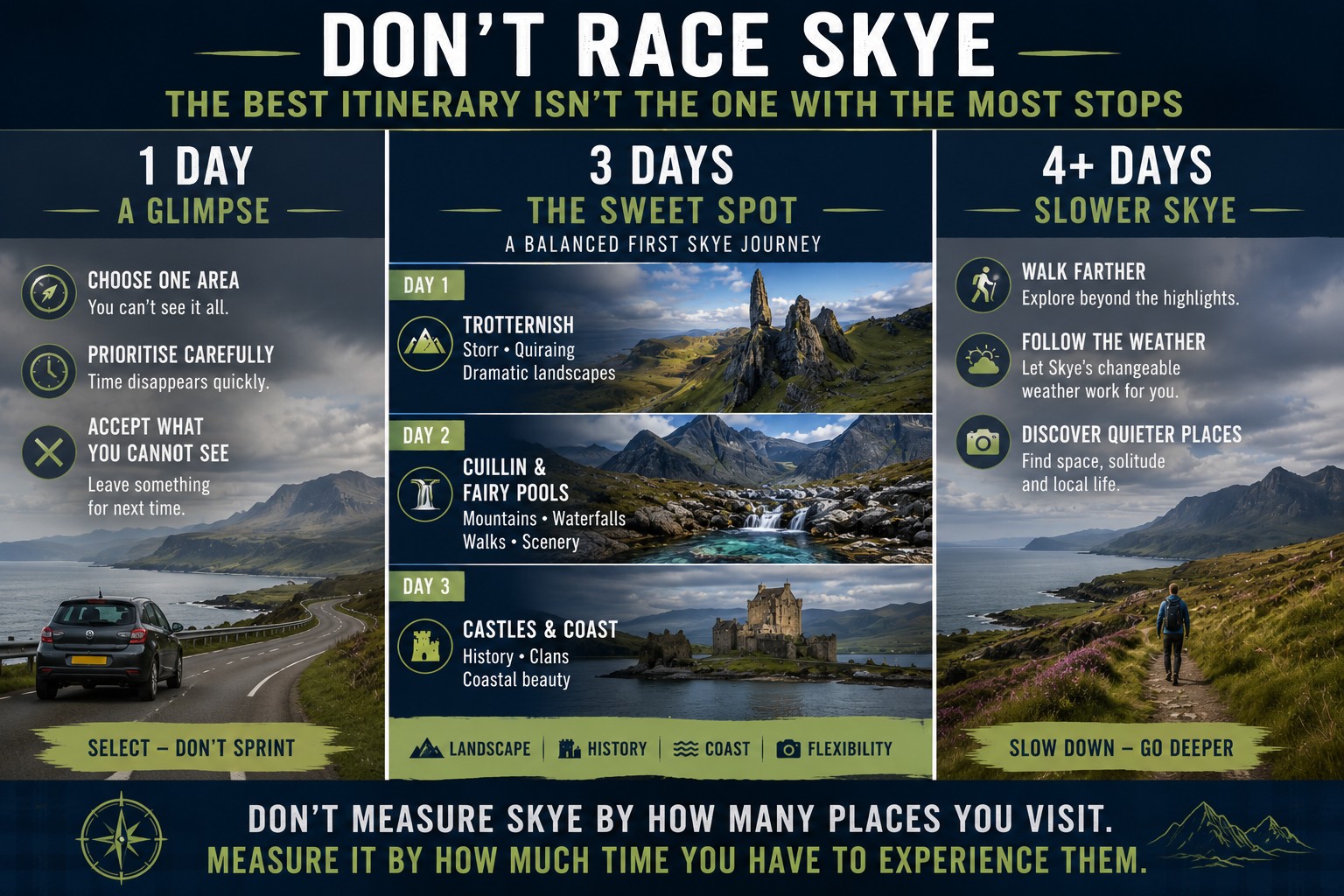
Slow down and experience Skye properly: choose a focused one-day introduction, a balanced three-day first visit or four-plus days for deeper exploration
🗺️ How to Include Skye in a Wider Scotland Journey
Skye is compelling enough to justify a dedicated stay, but its geographical position also makes it a natural part of a wider journey through Scotland. The key is to combine destinations that create a logical progression rather than treating the island as a distant attraction that must somehow be squeezed into an already crowded itinerary.
⛰️ Skye and the Scottish Highlands
For many first-time visitors, this is the strongest combination. Travelling through the Highlands towards Skye allows the landscape to develop naturally, with mountains, glens, lochs and historic places becoming part of the journey rather than simply scenery viewed through a window on the way to the island.
Depending on your route and available time, Skye can sit within a broader Highlands itinerary incorporating places such as Glencoe, Fort William, Loch Ness or the north-west Highlands. The important principle is not to include all of them automatically. Choose a route that matches the number of days you genuinely have.
🏙️ Edinburgh, the Highlands and Skye
Combining Edinburgh with the Highlands and Skye creates one of Scotland’s strongest travel contrasts. A journey can begin among the capital’s historic streets, architecture and cultural attractions before moving through increasingly mountainous country and eventually reaching Skye’s island landscapes.
For international visitors making a first substantial journey through Scotland, this combination can provide urban history, Highland scenery and island exploration without becoming a collection of unrelated destinations.
🌊 Skye and Scotland’s Other Islands
Skye can also form part of a wider island journey, but this requires more time than maps sometimes suggest. Ferries, road connections and weather introduce additional logistical considerations, while each island deserves enough time for its own identity to emerge.
If Skye is your first Scottish island, experiencing it properly is often more rewarding than immediately adding Orkney, the Outer Hebrides and several other islands simply because they appear on the same wish list.
🚆 London, Edinburgh, the Highlands and Skye
Visitors beginning in London can treat Skye as a later landscape chapter of a much larger Britain journey. Travelling north to Edinburgh before continuing through the Highlands creates a far more coherent progression than attempting to regard Skye as an excursion from London.
The greater the distance involved, the more important multi-day planning becomes.
STRONG FIRST-TIME JOURNEY
📅 Check Scotland’s Events Calendar Before You Travel
A journey to Skye does not have to exist in isolation from the events taking place elsewhere in Scotland. Highland Games, festivals, traditional gatherings and seasonal celebrations can add another dimension to a wider itinerary, particularly when your route also includes Edinburgh or the Scottish Highlands.
Skye itself also has a living cultural calendar, with community events, music, festivals and seasonal gatherings adding another layer to island life. Depending on your dates, an event may become a memorable part of the journey rather than something you need to travel elsewhere to experience.
Checking event dates before finalising accommodation and transport can therefore be particularly useful. A Highland gathering may provide an unexpected cultural highlight, while a major festival elsewhere in Scotland can affect accommodation availability, transport demand and the overall shape of your itinerary.
The key is to let events enhance a well-planned route rather than distort it. Travelling a considerable distance simply to add another event to an already crowded Skye itinerary may reduce rather than improve the experience.
🌱 Explore the Isle of Skye Responsibly
Skye’s popularity brings substantial benefits to island businesses and communities, but concentrated visitor numbers also place pressure on roads, parking areas, paths and sensitive landscapes. Responsible travel here is therefore not an abstract principle. Small decisions made throughout a visit can directly affect the island.
On single-track roads, passing places must remain available for vehicles to pass; they are not parking spaces or convenient places to abandon a car for a photograph. At popular natural attractions, use designated parking where available and never stop somewhere that obstructs residents, other road users or emergency access.The landscapes themselves deserve equal care. Follow local access guidance and use established paths where practical, particularly in heavily visited or vulnerable areas. Avoid widening eroded paths simply to escape mud or obtain a different photograph, respect gates and livestock, and remember that apparently open countryside may also be working crofting land.
Responsible travel has a human dimension too. Skye is home to permanent communities whose roads, shops and services continue to function while visitors explore the island. Respect private property, keep noise and waste under control and avoid treating villages, homes or working land as though they exist solely as visitor attractions.
Where possible, allowing more time can itself support a more thoughtful way of travelling. A slower stay reduces the pressure to race repeatedly across the island while creating more opportunities to use local accommodation, cafés, shops, guides and other businesses.
Most importantly, never allow the desire for a photograph or a completed itinerary to override safety. Poor visibility, difficult walking conditions, unsuitable parking or deteriorating weather are legitimate reasons to change a plan.
Responsible travel on Skye is partly environmental and partly social: protecting landscapes matters, but so does respecting the people who live and work within them.
Travel with purpose. Explore with care.
❓ Isle of Skye Travel Guide FAQs
📍 Where Is the Isle of Skye?
The Isle of Skye lies off the west coast of mainland Scotland and forms part of the Inner Hebrides. It is connected to the mainland by the Skye Bridge, while ferry services provide alternative approaches. Portree is the island’s principal settlement.
⏳ How Many Days Do You Need on the Isle of Skye?
For many first-time visitors, around three days provides an excellent balance. It allows time for Trotternish, the Cuillin and Fairy Pools, coastal or historic experiences and some flexibility around weather. One day offers only a glimpse, while four days or more supports a considerably slower and deeper journey.
🚗 Do You Need a Car on the Isle of Skye?
No. A car provides the greatest flexibility for reaching dispersed landscapes and adapting plans around weather, but organised tours offer a practical alternative. Visiting without a car is also possible with careful accommodation choices, current timetable planning and realistic expectations about how much of the island can be covered.
💧 Are the Fairy Pools Worth Visiting?
For many visitors, yes—particularly when the Fairy Pools are appreciated as part of the wider Glenbrittle and Cuillin landscape. Their popularity means you should not expect guaranteed solitude, but the combination of waterfalls, pools, open glen and mountain scenery can still make the visit one of Skye’s memorable natural experiences.
🗿 Is the Old Man of Storr Difficult to Visit?
The Old Man of Storr can be seen from the surrounding landscape, but walking towards its famous rock formations requires considerably more effort than stopping at a roadside viewpoint. The route climbs over uneven ground that can become wet, muddy or slippery, so suitable footwear, sufficient time and a realistic assessment of fitness and conditions are important.
You do not need to reach the highest point available to appreciate the landscape. Choose how far to walk according to the weather and your ability rather than feeling that every visitor must complete exactly the same experience.
⛰️ Can Beginners Walk in the Cuillin?
Beginners can enjoy lower-level walks and viewpoints around the Cuillin, but the high mountains are a very different proposition. Some routes involve complex navigation, steep or exposed terrain and, in places, scrambling or technical mountaineering skills.
Never assume that a route is suitable simply because photographs make it appear accessible. If your plans extend beyond straightforward lower-level walking, check current mountain weather and route conditions, understand the demands of the route and consider professional guidance when an objective exceeds your experience or confidence.
🌦️ What Is the Best Time of Year to Visit Skye?
Late spring through early autumn provides longer daylight for exploring, but every season involves advantages and compromises. Summer offers exceptionally long days but usually greater visitor pressure, while spring and autumn can provide quieter experiences. Winter can be dramatic and peaceful, but shorter daylight and more challenging weather place greater constraints on sightseeing.
The best time therefore depends on your priorities rather than one supposedly perfect month.
🦟 Are Midges a Problem on the Isle of Skye?
Midges can be troublesome during the warmer months, particularly in mild, damp and relatively still conditions. Their presence varies considerably with weather and location, so they are better treated as a practical consideration than a reason to avoid Skye.
Carrying effective insect repellent and clothing that covers exposed skin can make outdoor stops much more comfortable when conditions favour them.
🛏️ Is Portree the Best Place to Stay on Skye?
Portree is one of the most practical bases because it offers accommodation, restaurants and useful services and is conveniently positioned for Trotternish. It is not automatically the best choice for every itinerary.
If most of your priorities lie in western, northern or southern Skye, staying closer to those areas may reduce unnecessary driving and create a more relaxed journey.
🚐 Can You Visit the Isle of Skye on a Day Trip?
You can, but a day trip should be regarded as an introduction rather than a comprehensive Skye experience. It works best when the itinerary concentrates on selected highlights within a logical geographical route instead of attempting to cover the entire island.
If your wider Scotland itinerary permits it, staying for two or three days provides substantially more opportunity to experience Skye rather than simply travel through it.
🏰 What Are the Must-See Places on Skye for a First Visit?
The Old Man of Storr, Quiraing, Fairy Pools and Cuillin landscapes are among the strongest first-time priorities, while Portree, Dunvegan Castle and selected coastal locations can add cultural and geographical variety.
You do not need to see all of them. A stronger itinerary combines a manageable number of contrasting experiences—perhaps a mountain or geological landscape, a coastal or historic location and enough time between them to enjoy the journey itself.
🗺️ Can You Combine Skye with the Scottish Highlands?
Absolutely. Skye and the Highlands form one of Scotland’s most natural journey combinations. Travelling through the Highlands before or after visiting the island allows mountains, glens, lochs and historic landscapes to become part of the overall experience rather than merely the route used to reach Skye.
For travellers with sufficient time, this is usually more rewarding than treating the island as an isolated excursion.
🌄 Make Skye Part of Your Scotland Story
Skye earns its reputation through extraordinary landscapes, but its most memorable journeys are rarely defined by a single famous photograph. The Cuillin may dominate the horizon one morning before disappearing into cloud. Water tumbles through Glenbrittle beneath the mountains. Trotternish reveals pinnacles and landslips unlike anywhere else on the island, while Dunvegan, Portree, Sleat and the Atlantic coast introduce history, community and a different sense of place.
The roads between those highlights matter too.
Allowing enough time means being able to stop when the light changes, alter a route when the weather closes in, walk rather than merely photograph and discover parts of Skye that were never intended to become boxes on an itinerary.
A first visit does not need to include everything. It needs enough space for the island to become more than the sum of its famous sights.
Come for Skye’s famous landscapes. Stay long enough to understand the island between them.
📚 Continue Exploring Scotland
Skye sits at the meeting point of several larger Scotland stories. Continue into the Highlands, compare Scotland’s other islands, return to the wider national journey or explore the folklore and legendary traditions associated with Skye’s landscapes.
Scottish Islands Travel Guide: Skye, Orkney, Hebrides and Remote Coastal Adventures →
Scottish Highlands Travel Guide: Mountains, Lochs, Castles and Scenic Journeys →
Scotland Travel Guide: Discover the Highlands, Islands, Cities and Legendary Landscapes →