


Inverness and the Scottish Highlands: Gateway to Northern Scotland
6th September 2026
🏔️ Inverness and the Scottish Highlands: Gateway to Northern Scotland

Discover Inverness as a Highland city, touring base and gateway to Loch Ness, historic landscapes, the Moray Firth and northern Scotland
Inverness occupies an unusual position in the Scottish Highlands. For some travellers, it is the city where the train arrives before the “real” Highland adventure begins. For others, it is somewhere convenient to stay before heading towards Loch Ness, Culloden or the mountains farther west. Treat Inverness only as a transport stop, however, and you miss much of what makes it valuable.
Scotland’s northernmost city sits where several very different landscapes and journeys begin to converge. The River Ness flows through its compact centre towards the Moray Firth, while the Great Glen reaches south-west towards Loch Ness and eventually Fort William. Historic landscapes lie almost immediately beyond the city, and routes north and west lead deeper into some of Scotland’s most compelling scenery.
That geography gives Inverness three distinct roles. It is a small Highland city worth exploring in its own right, one of the most practical bases for discovering the surrounding region, and a gateway from which a longer journey through northern Scotland can begin.
Stay for Inverness. Explore because of Inverness.
This Inverness and Scottish Highlands guide will help you decide what deserves your time in the city, which nearby experiences best match your interests, whether Inverness or Loch Ness makes the stronger base, how many days to allow and when it makes more sense to stop returning to Inverness and continue deeper into northern Scotland.
Use it as a base — explore Loch Ness, Culloden, Clava Cairns and the Moray Firth.
Use it as a gateway — continue into the northern Highlands, Great Glen, west coast or Isle of Skye.
Two nights is a strong starting point for many first-time visitors. Consider three or more when Inverness will function as a genuine touring base rather than simply one stage of the journey.
The natural south-western journey from Inverness combines famous Highland water, history and scenery, with the option to continue through the Great Glen rather than automatically returning to the city.
Experience two dramatically different periods of Scotland’s past: the eighteenth-century Jacobite story at Culloden and a prehistoric landscape around 4,000 years old at Clava Cairns.
Look beyond the classic inland Highland itinerary for coastline, communities and wildlife — including the possibility, never the guarantee, of seeing bottlenose dolphins.
Not necessarily. Inverness itself is walkable, and selected surrounding journeys can be made using public transport or organised excursions. Independent transport becomes more useful as your itinerary moves farther into rural northern Scotland.
Scottish Highlands Travel Guide.
🗺️ Where Is Inverness and Why Does Its Location Matter?
Inverness lies in northern Scotland at the head of the Moray Firth and close to the north-eastern end of the Great Glen, the remarkable geological corridor extending across the Highlands towards Fort William. Its location helps explain why the city has long held such strategic and regional importance — and why it works so well for travellers today.
Head south-west and the landscape leads towards Loch Ness and through the Great Glen. Travel east and you enter countryside associated with Culloden and some of the area’s most significant historic and prehistoric sites. Turn towards the Moray Firth and Black Isle and the character changes again, with coastline, communities and wildlife replacing inland lochs and glens. Continue farther north or west and Inverness becomes a staging point for much longer Highland journeys.
Inverness matters because several very different Scottish landscapes become accessible from one comparatively compact base.
| Direction from Inverness Key Experiences Journey Character | ||
|---|---|---|
| South-west | Loch Ness and the Great Glen | Lochs, castles and Highland scenery |
| East | Culloden and Clava Cairns | Scottish history and prehistoric landscapes |
| North-east / coast | Moray Firth and Black Isle | Coast, communities and wildlife |
| West | Wider Highlands and routes towards Skye | Mountain and scenic touring |
| North | Northern Highlands | Longer exploratory journeys |
BVT Planning Principle: The question is not only what to see in Inverness, but what staying in Inverness allows you to reach.
That distinction is central to planning the city properly. Before deciding which direction to travel next, however, give Inverness itself some attention. Its greatest strength may be the Highlands around it, but the city should be experienced as part of the journey rather than merely the place where you sleep between excursions.
Loch Ness
and continue through the Great Glen if your journey is moving deeper into the Highlands.
Scottish Highlands
and, with sufficient time, continue towards the
Isle of Skye.
This is where Inverness increasingly becomes a gateway rather than a base you need to return to each evening.
History & prehistory? East to Culloden & Clava Cairns.
Coast & wildlife? North-east to the Moray Firth & Black Isle.
Mountains & islands? West through the Highlands towards Skye.
Going deeper into northern Scotland? Continue north.
🏙️ Inverness Itself: Don’t Leave Without Seeing the City
Inverness is sometimes overshadowed by the landscapes surrounding it. That is understandable when Loch Ness, the Great Glen and the wider Highlands are so close, but it can lead visitors to make the mistake of arriving late, sleeping in the city and departing early without actually experiencing it.
The city does not compete with Edinburgh on the basis of monumental sightseeing. Its appeal is more intimate. The centre is compact, the River Ness gives Inverness a strong sense of place, and it is possible to move quickly from busy streets to quieter riverside surroundings. For travellers spending several days exploring the Highlands, that manageable scale can be a considerable advantage.
🌊 Walk the River Ness and Ness Islands
The River Ness provides one of the best introductions to Inverness. Flowing north from Loch Ness towards the Moray Firth, it passes through the heart of the city and creates a natural walking route that requires no transport and very little planning.
A riverside walk reveals a calmer side of Inverness, with views across the water and easy access to the Ness Islands farther upstream. These wooded islands, linked by footbridges, provide an attractive contrast to the city centre and demonstrate how closely Inverness remains connected to its natural surroundings.
You do not need to turn the walk into a major excursion. Its value lies in slowing down and experiencing Inverness as a place rather than simply moving between attractions.
🏰 Experience Inverness Castle
The castle site overlooking the River Ness has long been one of Inverness’s defining landmarks, but it now plays a much more important role in the visitor experience.
The Inverness Castle Experience, opened in 2026, has transformed the site into a major year-round attraction focused on the stories, culture, landscapes and people of the Highlands. The experience extends across the castle complex and gives visitors a much stronger reason to treat Inverness as a destination in its own right rather than merely a departure point for surrounding excursions.
That makes the castle especially relevant to a first visit. It does not simply add another attraction to the itinerary; it helps provide cultural context for the wider Highland journey that follows.
Because opening arrangements, admission details and individual experiences can change, check current visitor information before travelling.
🛍️ Explore the Victorian Market and City Centre
The Victorian Market adds another dimension to central Inverness. Its covered setting brings together independent traders, food and local businesses, making it an easy addition to a city-centre walk.
Spending time in the centre also has a practical benefit. Inverness is a working regional city rather than an attraction created solely for visitors, and its cafés, shops, restaurants and everyday activity help distinguish it from the smaller Highland communities you may encounter later in the journey.
⛪ Inverness Cathedral and the Riverside
On the western bank of the River Ness, Inverness Cathedral contributes another distinctive landmark to the riverside landscape. It can be incorporated naturally into a walk rather than treated as an isolated sightseeing objective.
Together, the cathedral, river, Ness Islands, castle and city centre create an Inverness experience that can be enjoyed without a car and without an overfilled itinerary.
BVT Expert Insight: Do not measure Inverness against Scotland’s larger cities by counting major attractions. Its strength lies in the combination of a walkable Highland city, meaningful cultural context and the speed with which urban streets give way to historic sites and Highland landscapes.
One of the most important of those places lies only a short journey from the city, where the story shifts from modern Highland life to one of the defining events in Scottish history.
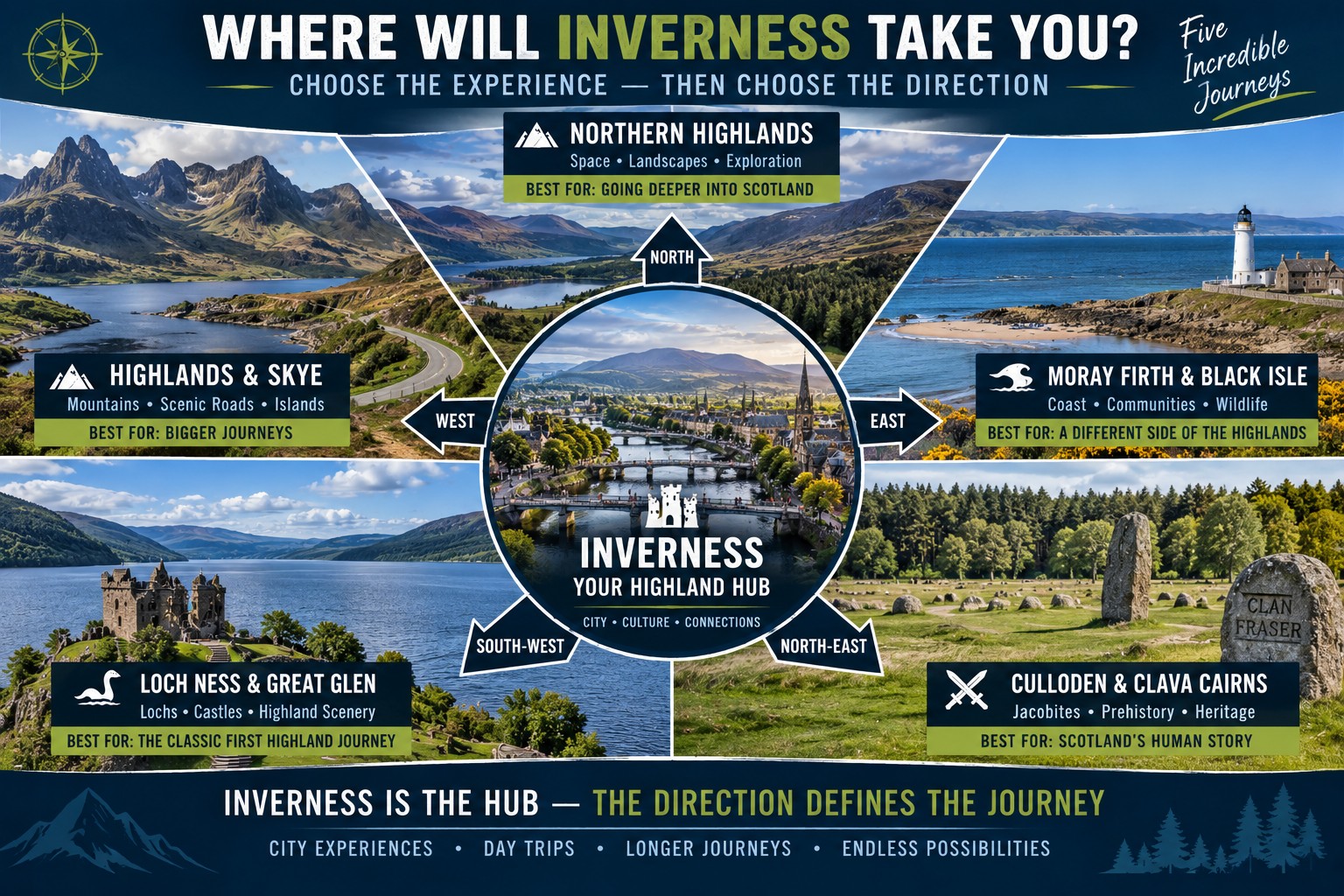
Use Inverness as your Highland hub and choose the journey that suits you, from Loch Ness and Culloden to the Moray Firth, Skye and the landscapes farther north
The riverside gives Inverness much of its character and provides an easy way to experience the city at a slower pace.
Explore the central area and understand Inverness as a Highland city rather than simply the transport point shown on your itinerary.
Time in Inverness helps explain the relationship between the city, surrounding communities and the landscapes you are about to explore.
A few unhurried hours in the city can make the wider journey feel connected rather than like a collection of separate Highland day trips.
⚔️ Culloden Battlefield: The History Beyond the City
Culloden is not simply another sightseeing stop near Inverness. The battlefield marks the location of the final confrontation of the Jacobite rising of 1745, fought on 16 April 1746, and its consequences became deeply significant to the subsequent history of the Highlands.
Visiting the battlefield adds historical context to a journey that might otherwise be dominated by scenery. It also deserves to be approached on its own terms: as a place associated with conflict, loss and profound political and cultural change.
The battlefield and visitor interpretation work best together. Travellers who want to understand the Jacobite story should allow enough time to absorb both the landscape and the historical context rather than treating Culloden as a quick photograph stop.
BVT Expert Insight: Understanding what happened at Culloden changes how many visitors interpret the Highlands around Inverness. The landscape becomes not simply scenic, but historical — shaped by events whose consequences reached far beyond the battlefield itself.
Give yourself time to establish the historical context before treating the battlefield as another sightseeing stop. Understanding the people, events and consequences changes how you experience the ground itself.
After exploring the interpretation, walk the battlefield at an unhurried pace. The open landscape is an important part of understanding the scale and character of what happened here.
Avoid squeezing Culloden between too many other stops. A slower visit provides space for reflection and makes the experience far more valuable than simply arriving, taking photographs and moving on.
Culloden is most powerful when the history and the landscape are experienced together.
🪨 Clava Cairns: Step Thousands of Years Further Back
A visit to Culloden can be combined naturally with another remarkable historical landscape nearby, but the two places should never be confused as belonging to the same period. At Clava Cairns, the story moves back thousands of years beyond the Jacobite era into prehistoric Scotland.
The monuments at Clava are around 4,000 years old. The site includes prehistoric burial cairns, passage graves and standing stones, creating a surviving ceremonial landscape from a world separated from Culloden by several millennia.
That contrast is precisely what makes Clava Cairns so valuable within an Inverness itinerary.
Within a relatively small geographical area, you can move from a battlefield associated with eighteenth-century Scotland to monuments created by communities living here during the Bronze Age. Few experiences demonstrate the extraordinary depth of Scotland’s human story quite so efficiently.
Clava should nevertheless be experienced on its own terms. Its appeal lies partly in the relationship between the monuments and their landscape, so allow yourself time to look rather than treating the cairns as another rapid stop on a sightseeing circuit.
BVT Expert Insight: Culloden and Clava Cairns may be close together geographically, but they represent completely different chapters of Scotland’s past. Visit them together for the extraordinary contrast, not because their histories are directly connected.
Clava Cairns can also provide a natural introduction to Scotland’s much wider prehistoric landscape. Stone circles, cairns and other ancient monuments survive across the country, from the Highlands to the islands, but that broader story deserves exploration beyond a single Inverness visit.
🏰 Fort George and the Moray Firth
The historical journey around Inverness can continue at Fort George, where eighteenth-century military architecture occupies a commanding position beside the Moray Firth.
Constructed in the aftermath of the Jacobite rising, Fort George represents a very different chapter from the battlefield at Culloden. Its enormous defensive scale reflects the government’s determination to strengthen military control in the Highlands following the Jacobite challenge.
Its location is equally important to the visitor experience. Here the landscape opens towards the Moray Firth, shifting the character of an Inverness journey from battlefield and prehistoric countryside towards coast and open water.
That transition demonstrates another advantage of using Inverness as a base: dramatically different historical periods and landscapes can be experienced without repeatedly moving accommodation.
🐉 Loch Ness from Inverness: The Classic Highland Journey
For many first-time visitors, Loch Ness remains the obvious journey from Inverness. The association between the two places is so strong that they can appear almost inseparable when planning a Highland trip, yet they offer distinctly different experiences.
Inverness is the practical urban gateway. Loch Ness begins the transition into the Great Glen and a landscape of long water views, historic sites, smaller communities and Highland scenery.
A visit might include time on the water, Urquhart Castle, Drumnadrochit or, on a longer journey, Fort Augustus and more of the Great Glen. The right combination depends on how much time you have and whether Loch Ness is the principal purpose of the day or one part of a wider Highland route.
The key is not to reduce the experience to reaching the loch, taking a photograph and immediately returning to Inverness.
Seeing Loch Ness and experiencing Loch Ness are not necessarily the same thing.
BVT Planning Principle: If Loch Ness is your only major excursion from Inverness, give it enough time to become a journey rather than merely a stop.
For detailed decisions about cruises, Urquhart Castle, the Loch Ness legend, where to stay and how much time to allow, the loch deserves to be planned as a destination in its own right.
Inverness’s advantage is that Loch Ness is only one direction in which the journey can go. Turn instead towards the Moray Firth and the character of northern Scotland changes again.
🐬 Moray Firth and the Black Isle: Look Beyond Loch Ness
Loch Ness may dominate many first-time itineraries, but travelling in the opposite direction reveals another side of the Inverness region. The Moray Firth and Black Isle replace the enclosed landscapes of lochs and glens with broad coastal views, attractive communities and opportunities to experience Highland wildlife.
Despite its name, the Black Isle is not actually an island. It is a peninsula immediately north of Inverness, bounded by stretches of water and connected naturally to the surrounding mainland. Its farmland, villages and coastline provide a gentler contrast to the mountain landscapes many travellers imagine when they first think of the Scottish Highlands.
That difference is part of its appeal.
Rather than approaching the Black Isle as a checklist of attractions, it can work particularly well as a slower coastal journey. Time spent exploring communities and viewpoints around the peninsula provides an opportunity to experience a more settled side of Highland life while remaining within practical reach of Inverness.
The Moray Firth is also particularly associated with marine wildlife, including bottlenose dolphins. Sightings can never be guaranteed, and that uncertainty should form part of realistic trip planning. The experience is better approached as an opportunity to discover a rich coastal environment in which seeing dolphins may become an exceptional part of the day, rather than as a promised encounter on which the success of the excursion depends.
This contrast between coast and interior reveals one of Inverness’s greatest strengths. From the same base, one day can lead towards the dark waters, castles and glens around Loch Ness, while another opens onto the Moray Firth and Scotland’s north-eastern coast.
BVT Expert Insight: Do not automatically give every available day to Loch Ness and the inland Highlands. If your itinerary allows it, combining one inland journey with one coastal journey creates a much broader impression of northern Scotland.
🚐 Which Day Trip from Inverness Is Right for You?
Once several possibilities are placed on the map, the planning problem changes. Most visitors do not need a longer list of places they could visit. They need to know which experience deserves their limited time.
For a first journey to the Highlands, Loch Ness and the Great Glen provide the most recognisable combination of water, castles and Highland scenery. Travellers primarily interested in Scottish history may gain more from concentrating on Culloden and Clava Cairns. Those who have already experienced Scotland’s famous lochs and glens may find the Moray Firth and Black Isle provide the more rewarding contrast.
The wider Highlands open many further possibilities, but distance matters. A destination that appears achievable on a map can still involve a substantial day on Highland roads, particularly once scenic stops and meaningful time at the destination are included.
This is especially important when considering the Isle of Skye. Travelling between Inverness and Skye can form part of a magnificent wider Scotland journey, and day excursions are possible. However, possible does not automatically mean optimum.
Visitors who genuinely want to explore Skye rather than simply reach it should consider whether an overnight or multi-day journey would provide a better experience.
| Journey Best For Travel Commitment Particularly Suited To | |||
|---|---|---|---|
| Loch Ness & Great Glen | Classic Highland scenery | Moderate | First-time Highland visitors |
| Culloden & Clava Cairns | History and archaeology | Low–moderate | Heritage-focused travellers |
| Moray Firth & Black Isle | Coast and wildlife | Moderate | Nature and slower exploration |
| Wider Highlands | Mountains, glens and scenery | Moderate–high | Landscape-focused travellers |
| Isle of Skye | Major island landscapes | High | Travellers accepting a long day or, preferably, a longer journey |
Choose by experience, not fame.
If this is your first Highland visit and you have only one free day, Loch Ness may be the natural choice. If history matters more, Culloden and Clava Cairns create a more focused journey. If you already know Scotland’s famous inland landscapes, the coast may provide the greater contrast.
There is another option, however: stop thinking of everything beyond Inverness as a day trip.
That is where the city’s role as a true gateway to northern Scotland begins.
🧭 Inverness: Gateway to the Northern Highlands
The most useful way to understand Inverness is not as the northern end of a Scotland itinerary, but as a place where the journey can change direction.
Many first-time visitors arrive with a relatively simple plan: reach Inverness, see Loch Ness and return south. That can make an excellent short Highland break, but it uses only part of the city’s potential. Stay longer or continue travelling, and Inverness becomes the point from which northern Scotland begins to open out.
Routes north lead towards increasingly remote Highland landscapes and communities. Travel west and the scenery becomes progressively more mountainous, with routes eventually connecting towards Scotland’s west coast and the Isle of Skye. Head towards the Moray Firth and the experience becomes coastal, while the Great Glen provides a natural corridor south-west through some of the Highlands’ most recognisable scenery.
Inverness therefore works particularly well as a transition point within a multi-stage Scotland itinerary. Rather than repeatedly returning to Edinburgh or Glasgow between destinations, travellers can use the city to connect Scotland’s major transport network with journeys deeper into the Highlands.
Distance, however, deserves respect.
Northern Scotland is large, Highland roads are not always fast, and trying to turn every distant destination into an Inverness day trip can result in seeing a great deal through a vehicle window while experiencing relatively little on the ground. Scenic routes also invite stops, and those stops are often part of the reason for travelling through the Highlands in the first place.
The better question is often not “Can I get there from Inverness and back in one day?” but “Should this be the next stage of my journey?”
BVT Journey Principle: The real value of Inverness becomes clearest when it stops being the end of your journey and becomes the beginning of the next one.
This is what distinguishes Inverness from a conventional sightseeing base. Within a relatively compact area around the city, travellers can encounter prehistoric monuments, Jacobite history, eighteenth-century military heritage, lochs, coastline and wildlife. Beyond that immediate circle, the landscape opens into the much larger geography of northern Scotland.
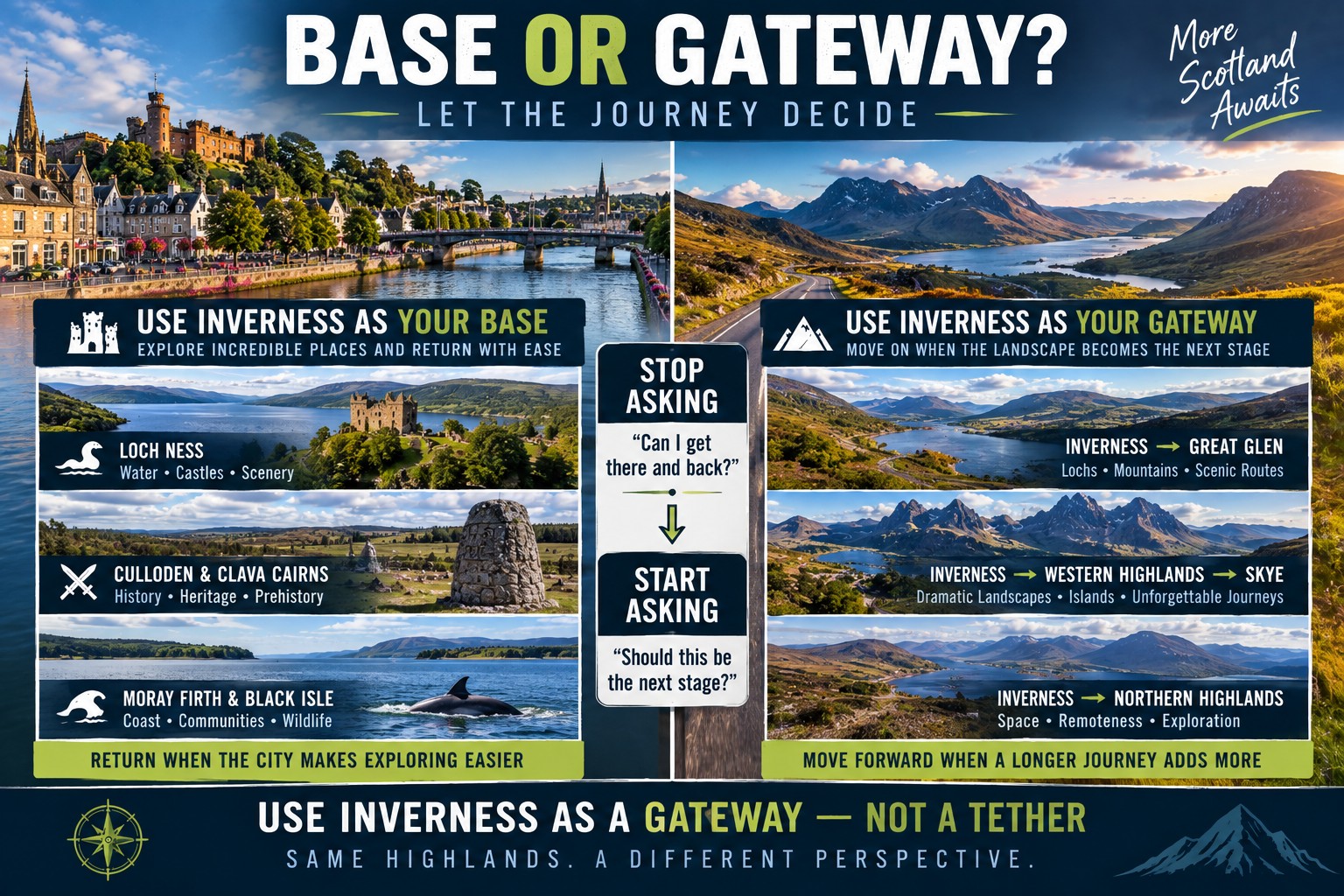
Use Inverness as a convenient Highland base while it improves your journey, then continue through the Great Glen, western Highlands or farther north when moving onwards makes more sense
Consider moving on when the destination is important enough to deserve more time, when returning to Inverness would create unnecessary backtracking, or when your next planned stop naturally lies farther along the same route.
🛏️ Inverness or Loch Ness: Where Should You Stay?
Choosing between Inverness and accommodation closer to Loch Ness is one of the most useful decisions to make before building the rest of a Highland itinerary.
Neither is automatically better.
Inverness generally makes the stronger base when flexibility matters. Staying in the city provides access to restaurants, shops and transport connections while leaving several directions open for the following day. It is particularly practical for travellers arriving by train or air, visitors without a car and anyone planning different excursions rather than concentrating primarily on Loch Ness.
Staying beside or close to Loch Ness offers something different. The emphasis shifts from convenience towards landscape and atmosphere. For travellers whose principal objective is to spend meaningful time around the loch, enjoy quieter surroundings or continue through the Great Glen, moving away from Inverness can make excellent sense.
There is also no requirement to choose one base for an entire Highland visit. A longer itinerary might begin with Inverness, continue to Loch Ness or farther through the Great Glen, and then move onwards rather than repeatedly returning to the city.
| Choose Inverness When…Choose Loch Ness When… | |
|---|---|
| You want strong transport connections | Loch Ness is the principal purpose of your stay |
| You are travelling without a car | You want a more immersive landscape setting |
| You value restaurants and city facilities nearby | You prefer quieter surroundings |
| You plan excursions in several directions | You are concentrating on Loch Ness and the Great Glen |
| You need a flexible Highland base | Your journey naturally continues beyond Inverness |
BVT Expert Insight: Choose your base according to the journey around it, not simply the most famous place name. Inverness offers range, connections and flexibility; Loch Ness offers greater immersion in one of the Highlands’ defining landscapes.
For some travellers the right answer is therefore Inverness. For others it is Loch Ness.
For a longer Highland journey, the strongest answer may be both.
🍽️ More restaurants and city facilities
🚶 Easier for travellers without a car
🚐 Practical for multiple excursions
🧭 Flexible base for exploring in different directions
🌅 More atmospheric Highland surroundings
🌙 Quieter setting away from the city
🐉 More time for loch-focused exploration
🧭 Natural position for continuing through the Great Glen
⏳ How Many Days Should You Spend in Inverness?
How long you need in Inverness depends less on the size of the city than on how you intend to use it. The centre itself is compact, but the moment Loch Ness, Culloden, the Moray Firth or the wider Highlands enter the itinerary, a short city stay can quickly become a much broader journey.
For most first-time visitors, two days provide a strong introduction. Three days or more make increasing sense when Inverness will function as a genuine Highland touring base rather than simply one stop within a longer Scotland itinerary.
⏱️ One Day in Inverness
With one day, resist the temptation to combine too much. Spend part of your available time experiencing Inverness itself, perhaps around the River Ness, castle and city centre, and choose one nearby priority if your arrival time and transport make that realistic.
A carefully planned day can provide a worthwhile introduction, but it should not be mistaken for a complete Highland experience. Trying to add Loch Ness, Culloden, the Black Isle and Inverness itself into the same limited window is more likely to produce rushed transfers than meaningful travel.
🌄 Two Days in Inverness
Two full days provide a much stronger balance for a first visit. One part of the stay can focus on Inverness and a nearby historical experience such as Culloden and Clava Cairns, while the other can be devoted to a larger journey such as Loch Ness and the Great Glen.
Alternatively, travellers who value nature and coastal scenery could choose the Moray Firth and Black Isle. The important point is that two days allow contrasting experiences rather than forcing several different journeys into one hurried circuit.
Remember that sightseeing days and accommodation nights are not necessarily the same thing. Depending on arrival and departure times, enjoying two useful days in the area may require more than two nights.
🏔️ Three Days or More
At three days, Inverness begins to function properly as a touring base. You can experience the city without sacrificing excursion time, combine history with a classic Highland landscape, and still have room for the coast or another surrounding area.
Beyond that, ask whether continuing to use one base remains the best choice. If your ambitions extend far into the northern Highlands or west towards Skye, moving onwards may create a richer journey than repeatedly travelling out from Inverness and returning each evening.
| Time Available Realistic Experience Best For | ||
|---|---|---|
| 1 day | Inverness plus one carefully chosen priority | Tight Scotland itineraries |
| 2 days | City/history plus one major excursion | Most first-time visitors |
| 3 days | Several contrasting experiences | Travellers using Inverness as a Highland base |
| 4+ days | Inverness plus deeper regional exploration | Slower travel or the start of a northern Scotland journey |
BVT Planning Principle: Add days because they unlock experiences you genuinely want, not simply because more attractions can be fitted into the itinerary.
🚆 Getting to Inverness: Train, Car or Air?
Despite its northern location, Inverness is one of the more accessible gateways to the Scottish Highlands. Rail connections make it possible to arrive without driving, road travel provides flexibility for visitors already touring Scotland, and flying to Inverness can be useful when suitable air connections fit the wider itinerary.
The best method is not automatically the fastest one.
Arriving by train can form part of the journey and removes the need to drive immediately on reaching the Highlands. Travelling by car makes greater sense when Inverness is one stage of a wider road itinerary and you already need independent transport. Flying may be practical when available routes substantially reduce the time required to reach northern Scotland.
Avoid building an itinerary around assumed timetables, fares or journey times too far in advance. Transport schedules and services can change, so current arrangements should always be checked before booking.
More importantly, separate getting to Inverness from getting around the Highlands. You may have no need for a car when reaching and exploring the city, yet find independent transport increasingly useful during a later rural stage.
That creates the next important decision: how much mobility do you actually need once Inverness becomes your base?
🚗 Do You Need a Car in Inverness?
You do not need a car simply to visit Inverness. The compact city centre is well suited to exploring on foot, and arriving without a vehicle does not prevent you from experiencing some of the most important places surrounding the city.
The more useful question is how far beyond Inverness you want to travel and how independently you want to do it.
Public transport can work well for selected journeys, while organised day tours remove much of the practical work involved in driving, navigation and parking. This can be particularly useful for first-time visitors who want to experience Loch Ness or a wider Highland route while concentrating on the landscape rather than the logistics of reaching each stop.
Driving independently becomes progressively more valuable when an itinerary moves away from the main transport corridors. A car gives greater control over departure times, stopping places and combinations of smaller destinations, and it can make rural exploration considerably easier.
That freedom, however, should not encourage an unrealistic itinerary. Highland distances can be deceptive, roads may be slower than expected, and the places that make a scenic journey memorable are often the very places where you will want to stop rather than simply drive through.
For some travellers, the optimum solution is therefore a mixture: reach Inverness by rail, explore the city on foot, use an organised excursion for a major Highland journey and drive independently only when the next stage genuinely benefits from it.
| Travel Style Main Advantage Best Suited To | ||
|---|---|---|
| Walking + public transport | No driving required | City stays and selected accessible journeys |
| Organised tour | Simplifies logistics | Major day trips and first-time Highland visitors |
| Driving independently | Maximum flexibility | Rural exploration and multi-stop itineraries |
| Mixed approach | Balances convenience and independence | Multi-day stays with varied plans |
BVT Expert Insight: The farther your itinerary moves from Inverness’s main transport corridors, the more valuable independent mobility becomes. Do not hire a car simply because you are visiting the Highlands; decide first what you actually want to reach.
Taking a concentrated sightseeing day? An organised tour can simplify the journey.
Exploring remote Highland areas independently? A car becomes much more useful.
Doing all three? Combine transport methods instead of hiring a car by default.
🌦️ When Is the Best Time to Visit Inverness?
There is no single best season for Inverness because the character of a Highland journey changes considerably throughout the year. The better choice depends on whether your priority is long touring days, quieter landscapes, seasonal colour, events or winter atmosphere.
The important point is to plan not only for conditions in Inverness itself, but for the journeys you intend to make from it.
🌱 Spring
Spring can be an excellent period for exploring Inverness and the surrounding Highlands as daylight increases and the landscape moves out of winter. Conditions can remain changeable, but increasing daylight gradually makes wider excursions easier to accommodate.
For travellers who value flexibility and want to explore beyond the city without the pressure of the busiest summer period, spring can offer an attractive balance.
☀️ Summer
Summer provides the longest daylight hours and therefore the greatest flexibility for substantial Highland journeys. This is particularly valuable when Inverness is being used as a base for destinations farther into the countryside rather than solely for city sightseeing.
It is also a popular period for travelling in Scotland. Accommodation, major attractions and organised excursions can become busier, so journeys built around specific dates or experiences benefit from earlier planning.
🍂 Autumn
Autumn brings changing colours and a different atmosphere to Highland landscapes. It can be particularly rewarding for scenic travel, but shortening daylight gradually becomes more important when planning longer excursions from Inverness.
A route that feels comfortable during the long days of midsummer may require a more selective approach later in the year.
❄️ Winter
Winter reveals a quieter side of Inverness and the Highlands, but limited daylight and more challenging weather can affect ambitious touring plans. Inverness itself can become an especially useful base at this time because visitors can retain city facilities and transport options while choosing surrounding journeys according to conditions.
This is a season for selective itineraries rather than attempting to reproduce a summer touring schedule in far fewer daylight hours.
Whatever the season, build some flexibility into the journey. Highland weather can change quickly, and an itinerary with breathing room will usually provide a better experience than one dependent on perfect conditions and tightly timed transfers.
Season also influences what may be happening around Inverness and across Scotland. Highland gatherings, cultural events and seasonal celebrations can transform an ordinary travel date into part of the experience — which makes checking the wider events calendar worthwhile before the itinerary is fixed.
🗺️ Build Inverness into Your Scotland Journey
Understanding why Inverness works as a gateway is one thing. The next step is deciding how to use it within an actual Scotland itinerary.
Inverness works particularly well as a connecting stage rather than an isolated destination. Its transport connections and geographical position allow travellers to arrive from Scotland’s major cities, experience the surrounding Highlands and then continue in another direction without automatically retracing the same route.
The strongest itinerary is not necessarily the one that covers the greatest distance. A better journey usually connects places that make geographical and experiential sense together, allowing the landscapes between major destinations to become part of the experience.
🏙️ Edinburgh to Inverness
Travelling from Edinburgh to Inverness creates one of the clearest transitions within a first Scotland itinerary.
Edinburgh provides the architecture, scale and history of the capital. Inverness introduces a smaller city whose identity is closely connected to the surrounding Highland landscape. Rather than treating the journey north simply as a transfer, think of it as the point at which the character of the trip begins to change.
From Inverness, the itinerary can then expand towards Loch Ness, Culloden, the Moray Firth or farther into northern Scotland.
🐉 Inverness to Loch Ness and the Great Glen
For many visitors, this is the most natural geographical continuation.
Rather than automatically treating Loch Ness as an excursion that must finish back in Inverness, consider whether the wider itinerary would work better by continuing through the Great Glen. That approach becomes particularly attractive when the next stage of the journey lies towards Fort William or Scotland’s western landscapes.
It also reduces unnecessary backtracking and allows Loch Ness to become part of a progressive Highland route rather than a destination visited in isolation.
🏝️ Inverness to the Highlands and Isle of Skye
Skye is tempting to approach as a long day trip, but travellers with sufficient time can create a much richer journey by making it the next stage of their itinerary.
Travelling west allows the Highland landscapes between Inverness and Skye to become part of the experience rather than simply distance that must be covered before turning around.
This is an important distinction. If Skye is one of the principal reasons you are travelling to Scotland, giving the island its own time will usually reveal far more than attempting to compress the outward journey, sightseeing and return to Inverness into a single day.
🚆 London to Edinburgh, Inverness and the Highlands
For travellers beginning in London, Inverness can also form part of a much larger journey through Britain.
Breaking the route through Edinburgh before continuing north creates a logical progression: London introduces the journey, Edinburgh provides a major Scottish city experience, and Inverness then opens access to the Highlands.
From there, Loch Ness, the Great Glen, northern Scotland or a westward journey can become the next stage.
The principle remains the same regardless of starting point: build the itinerary around meaningful stages rather than collecting distant destinations.
Loch Ness
rather than treating the city as the end of the route.
Loch Ness,
continue through the Great Glen and let Fort William become the next stage of the itinerary.
Isle of Skye
a genuine stage of the journey. If Skye is a major reason for visiting Scotland, allowing additional time will usually create the stronger experience.
Your next destination lies naturally along the same route? Consider moving on.
Travelling to Skye or deeper into the Highlands? Give the destination enough time to become a proper stage of the journey.
Starting in London? Think of Scotland as a connected journey rather than one isolated excursion.
📅 What’s Happening During Your Highland Journey?
Dates can change the character of a Highland visit. Highland Games, music, cultural gatherings and seasonal celebrations may provide opportunities to experience Scottish traditions alongside the landscapes and historical places that originally brought you north.
Events can also affect practical planning. Popular dates may increase demand for accommodation and transport, while an event taking place close to your route could be worth incorporating deliberately rather than discovering only after the journey has been booked.
Before fixing your itinerary, check what is happening during your stay and decide whether an event deserves a place within it.
Events work best when they enrich the journey rather than distort it. If attending one requires crossing large parts of Scotland solely to fit it into an already busy itinerary, something closer to the route you are naturally travelling may provide the stronger experience.
Traditional gatherings
Culture and celebration
Experiences throughout the year
🌱 Explore Inverness and the Highlands Responsibly
Responsible travel in the Highlands is not simply about choosing one particular form of transport. It is about building a journey that respects the landscapes, communities, wildlife and historic places that make northern Scotland worth visiting in the first place.
Inverness can make that easier. Because the city functions as both a transport hub and a touring base, visitors do not necessarily need to change accommodation every night or drive independently for every excursion. Arriving by rail where practical, walking around the city and using public transport or shared excursions for suitable journeys can all form part of a lower-impact itinerary.
Where driving provides the most practical access, thoughtful route planning matters. Combining nearby experiences, avoiding unnecessary backtracking and allowing realistic time for slower Highland roads can produce both a more enjoyable journey and a more efficient one.
There is also a wider benefit to travelling more slowly. A tightly packed itinerary can encourage visitors to cross large distances simply to reach famous names, while a more selective approach creates time to experience the communities and landscapes between them. Inverness is particularly useful in this respect because several very different experiences can be reached from one base.
Care matters once you arrive, too. Park only where permitted, follow local access guidance, avoid damaging fragile ground and treat archaeological and historic sites with respect. Places such as Clava Cairns have survived for thousands of years; their continued preservation depends partly on visitors experiencing them responsibly.
Wildlife deserves the same consideration. Around the Moray Firth and elsewhere in the Highlands, maintain an appropriate distance and never allow the pursuit of a photograph or sighting to disturb the animals you have travelled to see.
Spending locally can also strengthen the connection between tourism and the communities supporting the destination. Independent cafés, shops, accommodation providers, guides and other Highland businesses can all form part of the visitor experience.
Sometimes the most responsible decision is also the one that improves the holiday: stay longer, travel a little less and experience each place more fully.
Discover practical ways to reduce the impact of your journey while supporting the landscapes and communities you have come to experience.
Travel with purpose. Explore with care.
❓ Inverness and the Scottish Highlands FAQs
🏙️ Is Inverness Worth Visiting?
Yes. Inverness is worth visiting both for its compact riverside city experience and for its exceptional position as a gateway to the Scottish Highlands. The River Ness, Inverness Castle Experience and city centre give visitors reasons to explore locally, while Loch Ness, Culloden, Clava Cairns, the Moray Firth and wider Highland landscapes expand what can be experienced from the same base.
Give the city itself some time rather than using it only as somewhere to sleep before travelling elsewhere.
⏳ How Many Days Do You Need in Inverness?
Two days provide a strong introduction, allowing time for Inverness itself and at least one major surrounding experience. Three days are better if you want to use the city as a genuine Highland touring base and experience contrasting journeys such as Loch Ness, Culloden or the Moray Firth.
If you plan to travel much farther north or west, consider moving onwards rather than adding increasingly long return day trips.
🐉 How Close Is Inverness to Loch Ness?
Loch Ness begins close to Inverness, making the city one of the principal gateways for visiting it. However, Loch Ness is a long landscape rather than a single attraction, so the time required depends on whether you want a brief introduction, time on the water, Urquhart Castle or a wider Great Glen journey.
The practical question is therefore not simply how quickly you can reach Loch Ness, but how much of the experience you want the day to contain.
🚗 Do You Need a Car in Inverness?
No. Central Inverness can be explored on foot, and some surrounding experiences can be reached using public transport or organised excursions.
A car becomes increasingly useful when you want greater independence, plan multiple rural stops or intend to explore areas away from the main transport corridors. Choose according to the itinerary rather than assuming every Highland visit requires driving.
🚆 Can You Visit Inverness Without Driving?
Yes. Inverness is one of the more practical Highland bases for travellers who do not want to drive. Rail and other transport connections can bring you into the city, while walking, public transport and organised excursions can cover different parts of the visit.
Travellers without a car should simply plan surrounding journeys more deliberately, particularly when considering remote destinations.
⚔️ Can You Visit Culloden and Clava Cairns Together?
Yes. Culloden and Clava Cairns are geographically close enough to work naturally within the same wider outing, but allow enough time to appreciate how radically different the two sites are.
Culloden belongs to the eighteenth-century Jacobite story. Clava Cairns takes visitors back around 4,000 years into prehistoric Scotland. Their value as a combination comes from that extraordinary contrast, not from any direct historical connection between them.
🏝️ Can You Visit Skye from Inverness?
Yes. The Isle of Skye can be reached from Inverness, and the journey west passes through some exceptional Highland scenery. However, this is where realistic itinerary planning becomes particularly important.
A day trip is possible, especially as an organised excursion, but reaching Skye is not the same as experiencing Skye properly. The island contains widely separated landscapes and places of interest, and a return journey to Inverness inevitably limits how much time can be spent exploring them.
If Skye is one of the principal reasons for your Scotland trip, consider making it the next stage of your journey rather than simply another Inverness day trip. If time is limited and you are comfortable with a long touring day, an excursion from Inverness can still provide a worthwhile introduction.
BVT Expert Insight: Skye from Inverness is a good example of why “possible” and “optimum” are not always the same thing in the Highlands.
🐬 Can You See Dolphins from Inverness?
The Moray Firth is well known for its bottlenose dolphins, and the wider Inverness area provides opportunities for wildlife watching. However, dolphins are wild animals and sightings should never be treated as guaranteed.
Approach a coastal journey as an opportunity to experience the Moray Firth and its wildlife environment more broadly. A dolphin sighting can then become a memorable part of the experience rather than the sole measure of whether the day was successful.
🌦️ What Is the Best Time to Visit Inverness?
Spring through autumn provides the greatest flexibility for many first-time visitors, particularly when the itinerary includes substantial outdoor exploration and day trips. Summer offers the longest daylight hours, but it is also a popular period for Highland travel.
Spring can provide increasing daylight with greater flexibility, while autumn brings changing colour and atmosphere. Winter offers a quieter experience but with shorter days and a greater possibility of weather affecting ambitious touring plans.
There is no universally best month. Choose according to the type of Highland journey you want and leave enough flexibility for Scottish conditions.
🛏️ Is Inverness or Loch Ness Better to Stay In?
Choose Inverness if you value transport connections, restaurants, city facilities and the ability to explore in several different directions. It is usually the more versatile base for a first Highland visit.
Choose accommodation around Loch Ness if the loch itself is central to your journey and you value landscape, atmosphere and a more immersive setting over urban convenience.
For a longer trip, the strongest answer may be both: begin in Inverness, experience the city and surrounding area, then move onwards rather than repeatedly returning to the same base.
🌄 Stay for Inverness. Explore Northern Scotland.
Inverness can easily appear to be a supporting character in a Scotland itinerary. Edinburgh has its monumental skyline. Loch Ness has one of the world’s most famous legends. Skye has extraordinary mountain and coastal landscapes. The Highlands themselves can seem too vast to be represented by any one city.
Yet that is precisely why Inverness matters.
Walk beside the River Ness and the city feels manageable and intimate. Explore the castle and the Highlands gain cultural context before you have even left the city. Travel a short distance beyond it and the historical scale changes dramatically: Culloden recalls the upheaval of the eighteenth century, while Clava Cairns reaches back around 4,000 years into prehistoric Scotland.
Turn south-west and Loch Ness opens the journey into the Great Glen. Head towards the Moray Firth and the experience changes from inland lochs and glens to coast and wildlife. Continue north or west and Inverness becomes something else again: not simply somewhere to return to at the end of the day, but a departure point for the next stage of northern Scotland.
The strongest visit therefore does not ask Inverness to compete with the places around it.
It uses their proximity to understand why the city matters.
Inverness is where a Highland visit can become a northern Scotland journey.
Stay long enough to experience the city rather than simply sleep there. Choose surrounding journeys according to your interests instead of trying to collect every famous destination. Use Inverness as a base while that makes geographical and practical sense — and recognise when continuing onwards will create the better experience.
Stay for Inverness. Then follow the lochs, coastlines, roads and Highland landscapes that open beyond it.
📚 Continue Your Scotland Journey
Inverness makes more sense when it is placed within the wider geography of Scotland. Continue with the regional guide that explains the Highlands as a whole, explore Loch Ness in greater depth, follow the natural westward progression towards Skye, or return to the national Scotland guide to shape the wider journey.